






About this worksheet
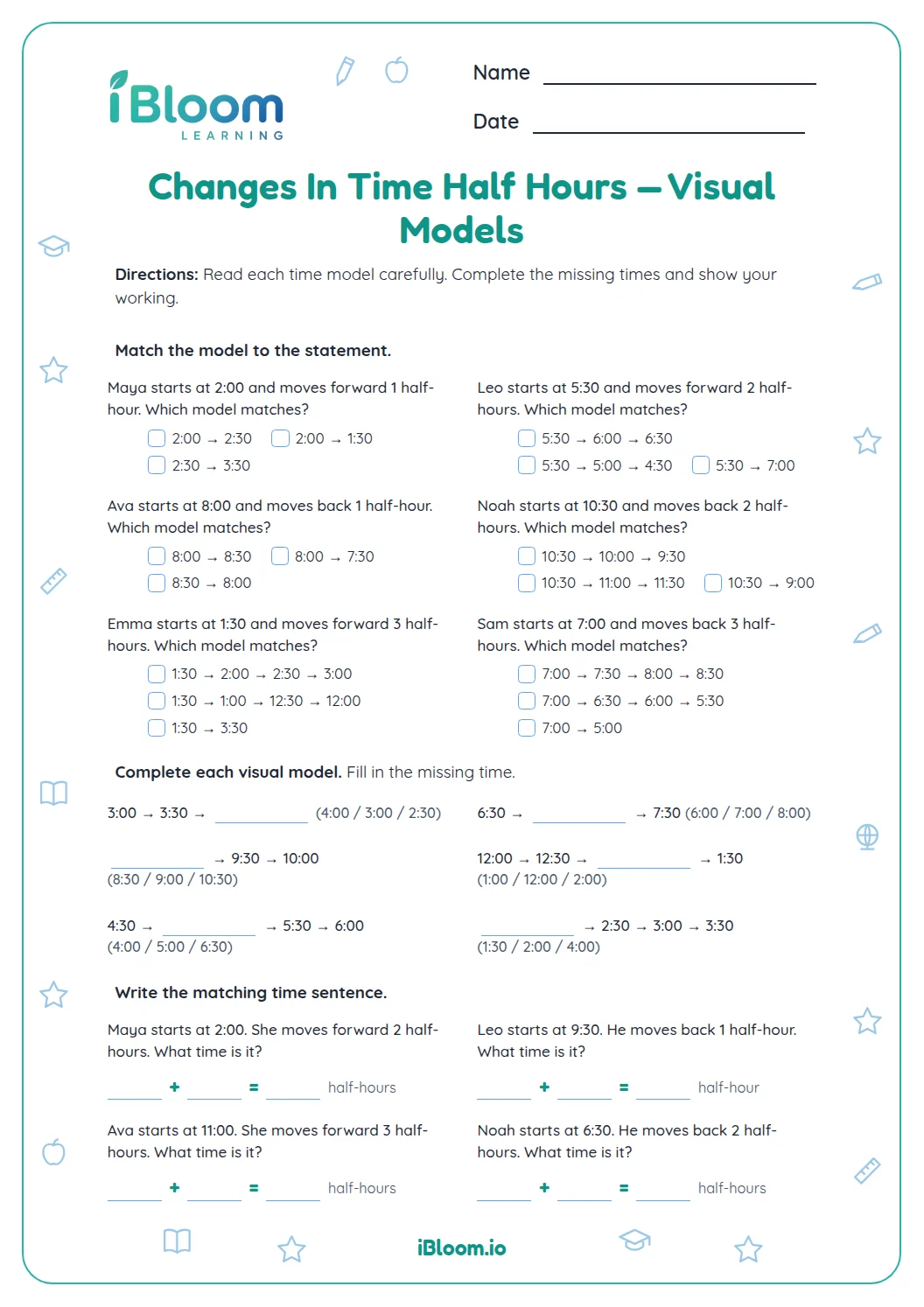
This printable gives Grade 2 students 16 problems about half-hour time changes. Learners identify what a story asks, find an earlier or later time, and count elapsed half-hours in real-world schedules. The questions start by identifying what is unknown, then a separate answer key is included.
What does each story ask you to find?
Part A separates start time, finish time, and elapsed time. Read the question at the end before choosing. The old sheet uses this classification step before students solve time stories.
How do half-hour steps change a clock time?
Parts B and C ask for a missing time or a duration. Move from :00 to :30, then from :30 to the next :00. Reverse the same steps when a story gives the finish time and asks for the start.
- 1Maya begins at 4:00 and works for two half-hours.
- 24:00 → 4:30 → 5:00
- 3She finishes at 5:00.
How can you find a duration?
Count the half-hour jumps between the two clock times. For 2:00 to 3:30, the jumps are 2:00, 2:30, 3:00, 3:30: three half-hours, or 1 hour 30 minutes.
How can you use this worksheet?
- 1Read the question and mark the time you know.
- 2Decide whether to find a time or a length of time.
- 3Count in 30-minute steps on a clock or aloud.
- 4For stories, sketch a quick timeline if it helps.
- 5Check that the answer matches the question: a clock time or a duration.
What errors should you watch for?
The mistake
Writing 30 minutes when the question asks for the ending time.
The fix
Answer with a clock time when it asks “When?” and a duration when it asks “How long?”
The mistake
Moving the hour hand before the minute hand reaches 12.
The fix
At :30, the hour hand sits between two numbers; the next half-hour step reaches the next hour.
The mistake
Counting backward to find a duration.
The fix
For elapsed time, move from the start toward the end. Move backward only to find an earlier start.
What to practice next
Make more practice
Questions parents and teachers ask
What does elapsed time mean?
Elapsed time tells how long something lasts from its start to its finish. This page includes stories with both times given, so students count half-hour jumps between them. Other questions give a starting or ending time and ask for the missing clock time.
How many half-hour jumps are in one hour?
There are two half-hour jumps in one hour: :00 to :30 and :30 to the next :00. The worksheet uses one, two, three, and four jumps so learners can connect each count to the clock time or duration in the story.
Does this page ask students to find start times?
Yes. One story gives a finish time and the number of half-hours, then asks when the activity began. Count backward by 30 minutes for each jump, keeping the hour hand’s movement in mind as the minutes pass :00.
Are clock pictures included?
The prompts give written start and finish times, and several ask students to find an earlier or later time. Learners can sketch a clock or timeline as they solve, then compare their responses with the separate answer key.
Is an answer key included?
Yes. A separate answer key lists the expected choice, clock time, or duration for all 16 questions. Check whether the response answers “when” with a clock time and “how long” with a duration. It also helps locate a missed half-hour step.