






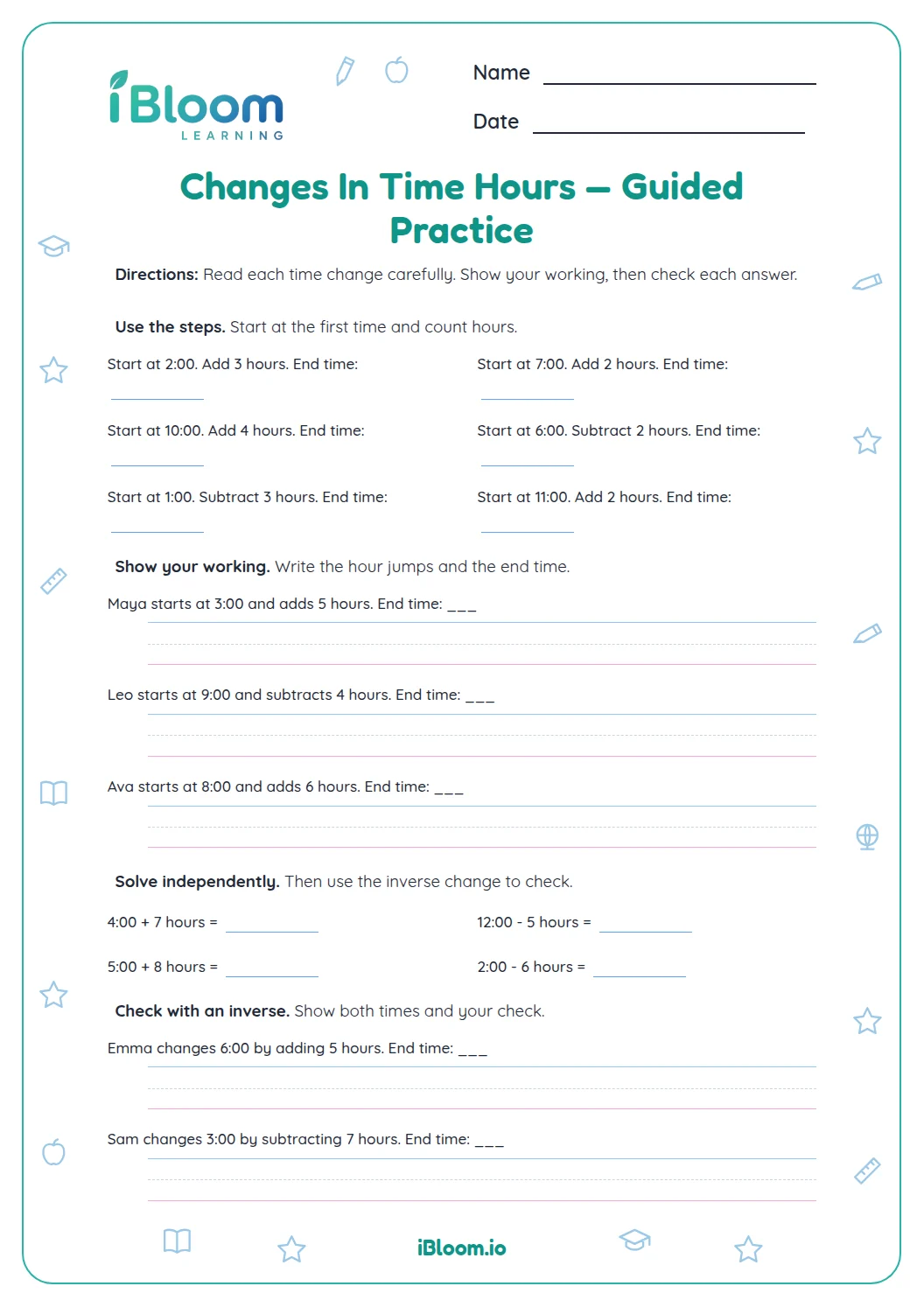
About this worksheet
This Grade 2 printable builds reasoning with time changes in 30-minute steps. Learners find times after or before an event, measure an elapsed interval, and work backward from an ending time. One item asks children to diagnose a half-hour counting mistake, and another compares two intervals. The 15 questions use whole and half hours and include a separate answer key.
How does a half-hour jump change the time?
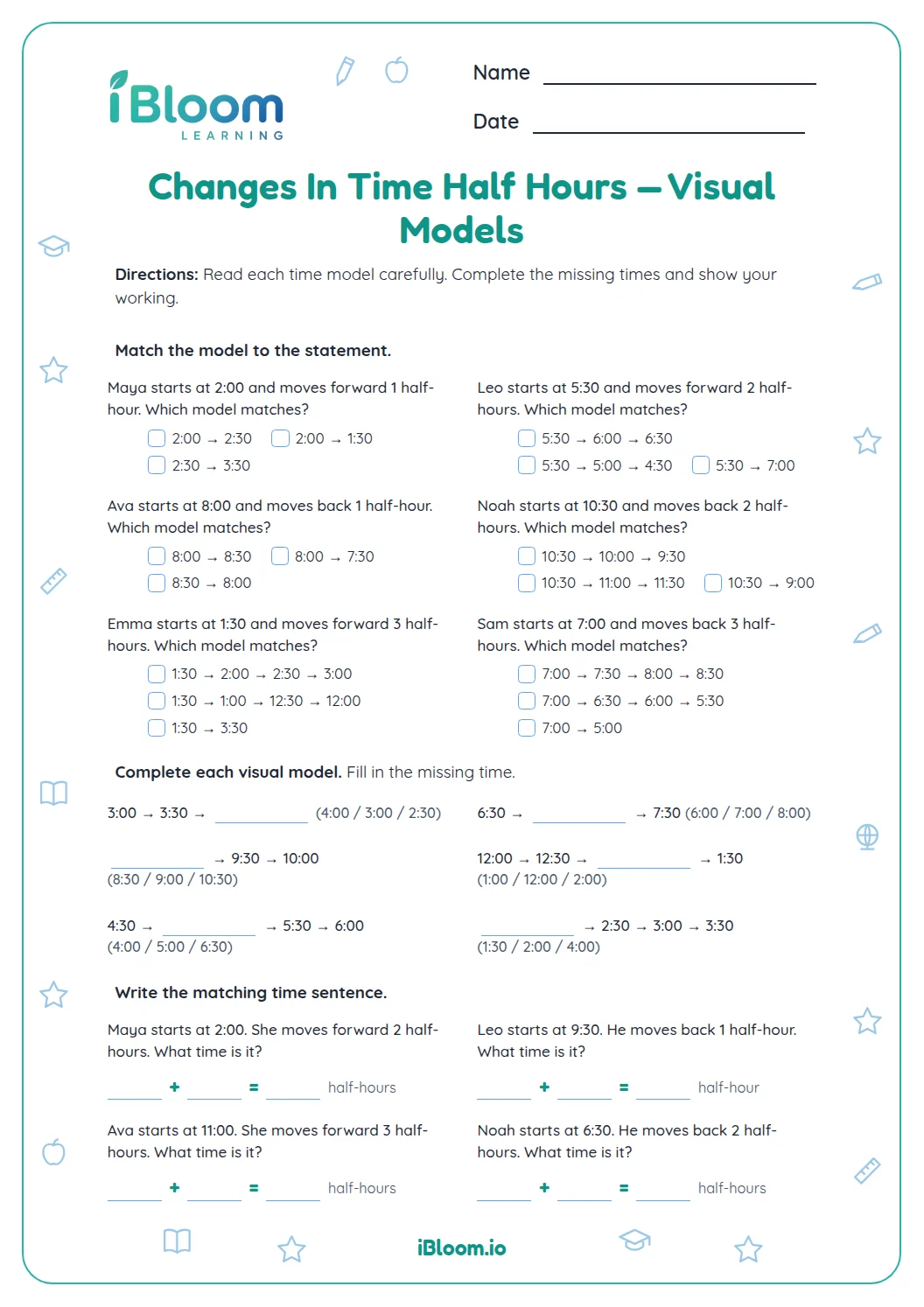
A half-hour is 30 minutes. Moving forward from 2:00 by one half-hour reaches 2:30; moving back from 7:00 by one half-hour reaches 6:30. In question 3, Maya’s answer moves the time forward, even though the problem subtracts 30 minutes.
- 1Start at 7:00.
- 2Subtract 30 minutes, so move back one half-hour.
- 3The time is 6:30.
- 4Maya moved forward to 7:30, so her direction was wrong.
How do you find the time between two events?
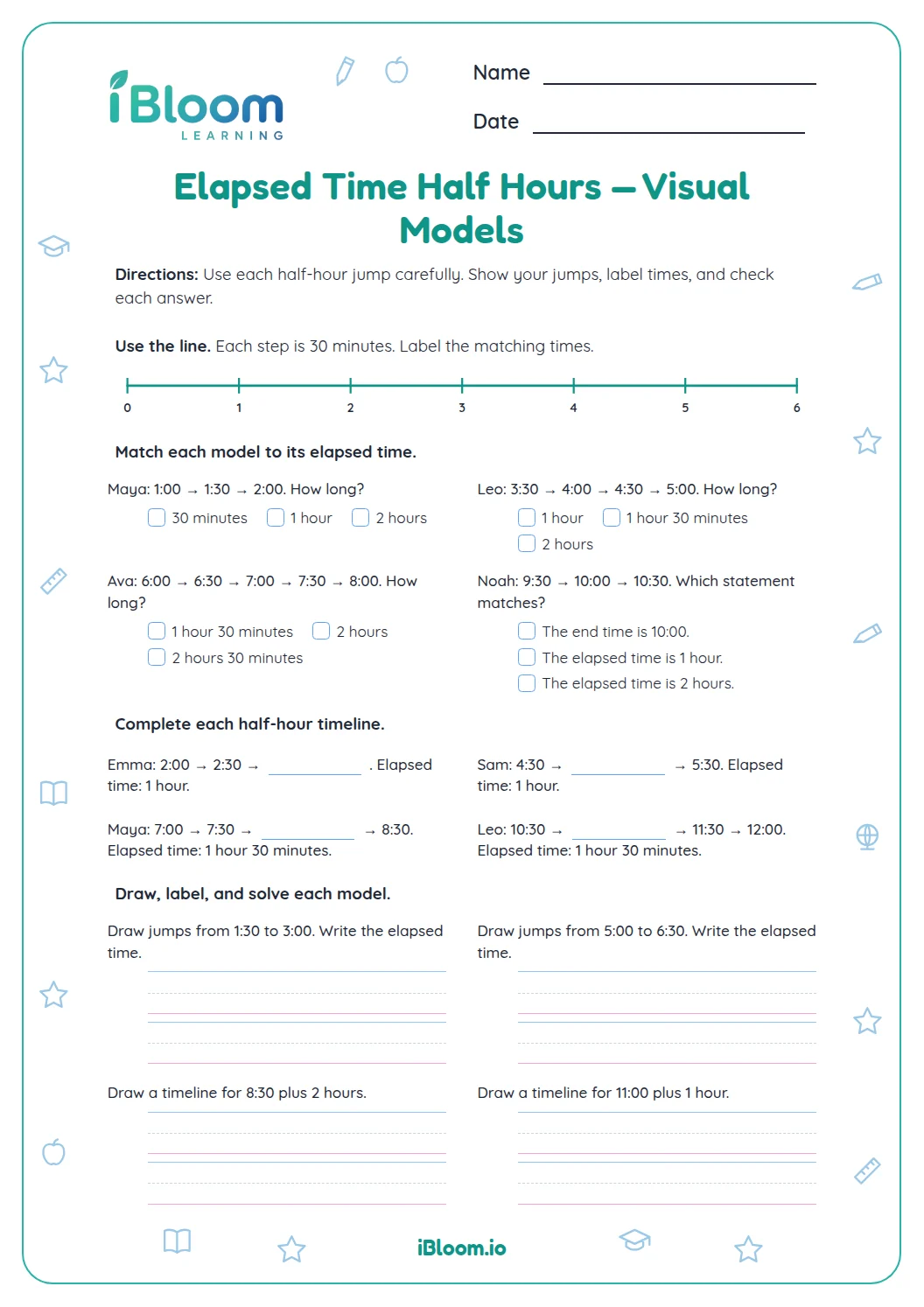
Count equal half-hour jumps from the start to the end. Question 7 goes from 3:00 to 4:30: 3:00 to 3:30, 3:30 to 4:00, and 4:00 to 4:30. Three half-hours make 1 hour 30 minutes.
How can you find a start time by working backward?
Start at the ending time and move back by the stated duration. In question 14, a party ends at 4:00 after 1 hour 30 minutes. Move back three half-hour jumps: 3:30, 3:00, 2:30. It began at 2:30.
How can you compare two time intervals?
The final part includes backward reasoning and a comparison. Count half-hour jumps for each interval, then compare the number of jumps. From 9:00 to 10:30 is three jumps; from 1:30 to 2:30 is two jumps, so the first interval is longer.
A routine for time changes
- 1Mark whether the problem moves forward or backward in time.
- 2Use one jump for each 30 minutes.
- 3For an elapsed-time question, count jumps from start to finish.
- 4For a missing start time, begin at the ending time and move backward.
- 5Compare durations by counting their half-hour jumps.
- 6Use the key to check each time and interval.
Common time slips and quick fixes
The mistake
Moving the hour hand to the next number after only 30 minutes.
The fix
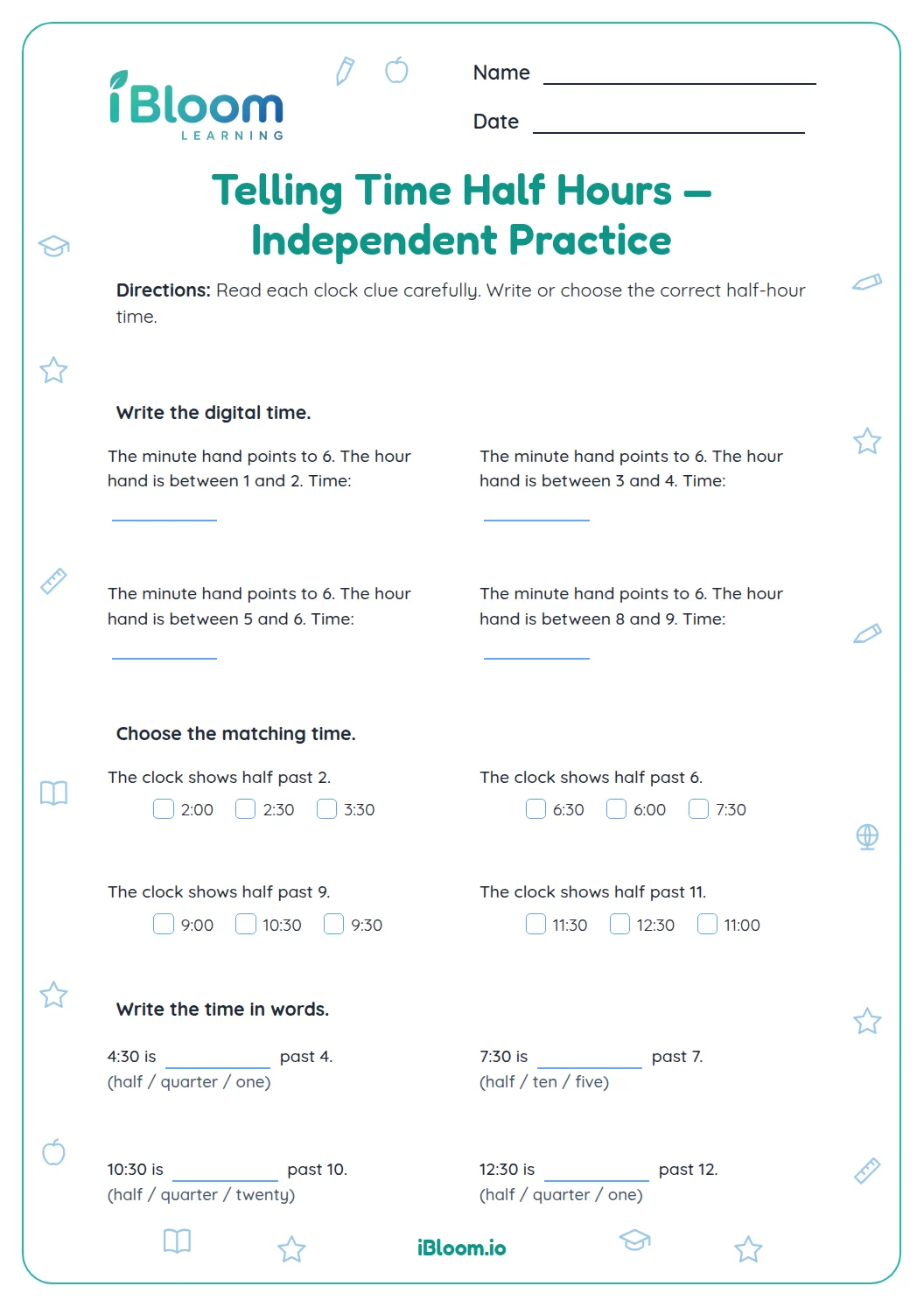
At :30 the hour hand is halfway between hour numbers.
The mistake
Calling 3:00 to 4:30 one hour.
The fix
Count three half-hour jumps: that is 1 hour 30 minutes.
The mistake
Moving forward when asked for a start time before an ending time.
The fix
Begin at the ending time and step backward by each half hour.
What to practice next
Make more practice
Further reading
Questions parents and teachers ask
What does one half-hour jump mean?
One half-hour jump changes the time by 30 minutes. From 2:00, one jump forward reaches 2:30; a second reaches 3:00. When subtracting 30 minutes from 7:00, move back to 6:30. First decide which direction the problem requires, then count one jump.
How do children find elapsed time?
They count equal half-hour jumps from the starting time to the ending time. For example, 3:00 to 4:30 has three jumps: 3:30, 4:00, and 4:30. Three half-hours equal 1 hour 30 minutes. Marking each stop helps keep the interval clear.
Are there questions that work backward?
Yes. Some items give an ending time and a duration, then ask when the event began. Start at the ending time and move backward one half-hour at a time until the duration is used. Question 14 ends at 4:00 after 1 hour 30 minutes, so the start was 2:30.
Does the worksheet include error analysis?
Yes. Question 3 asks learners to explain Maya’s mistake: she moves from 7:00 to 7:30 even though the problem subtracts 30 minutes. The correct move is backward to 6:30. The final part also asks learners to compare two elapsed intervals.
Is a separate key included?
Yes. The answer key lists the time or duration for all 15 questions. When checking an interval, make sure each half-hour jump changes the time by exactly 30 minutes. The key also identifies the correct explanation for the error-analysis item.