






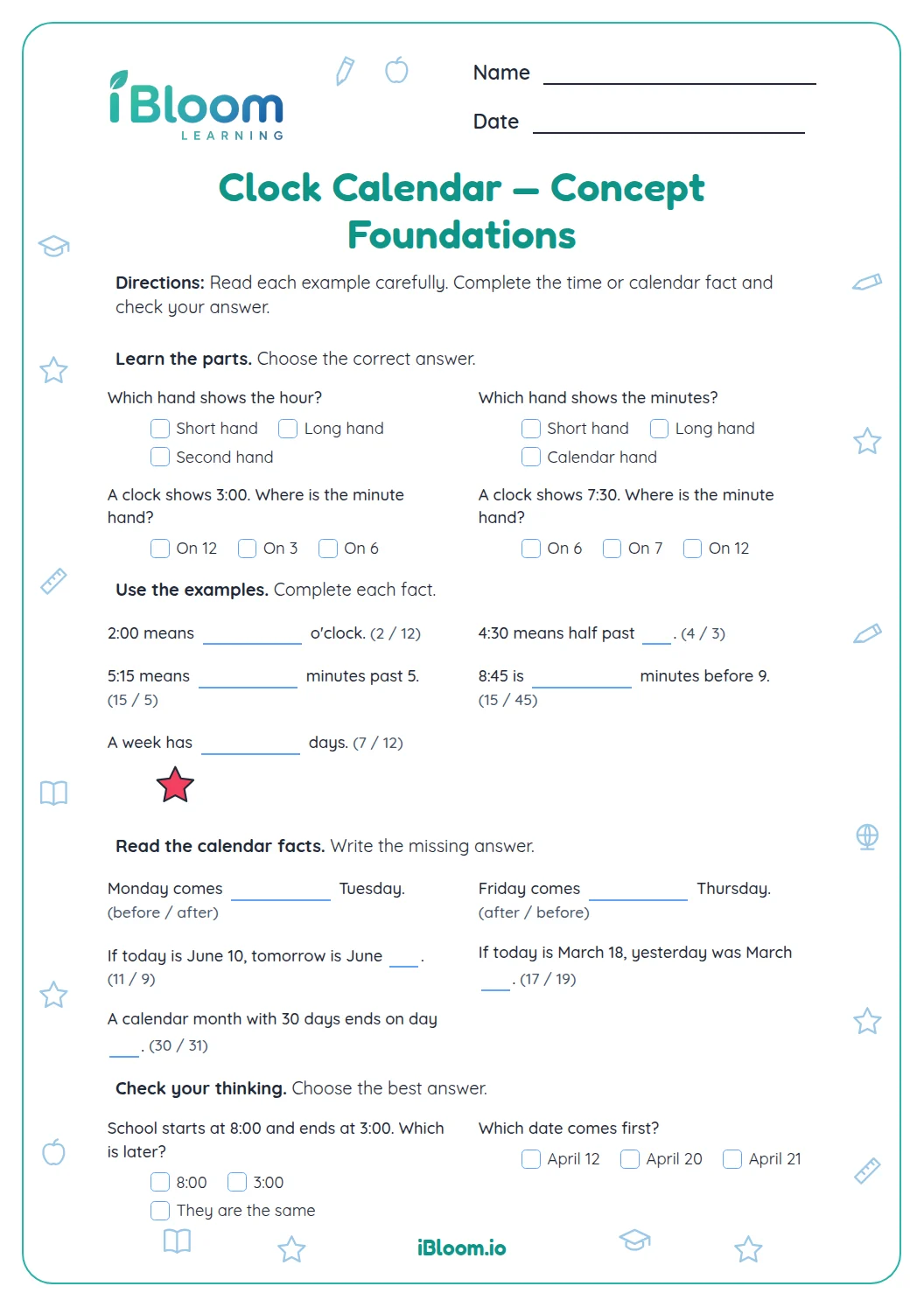

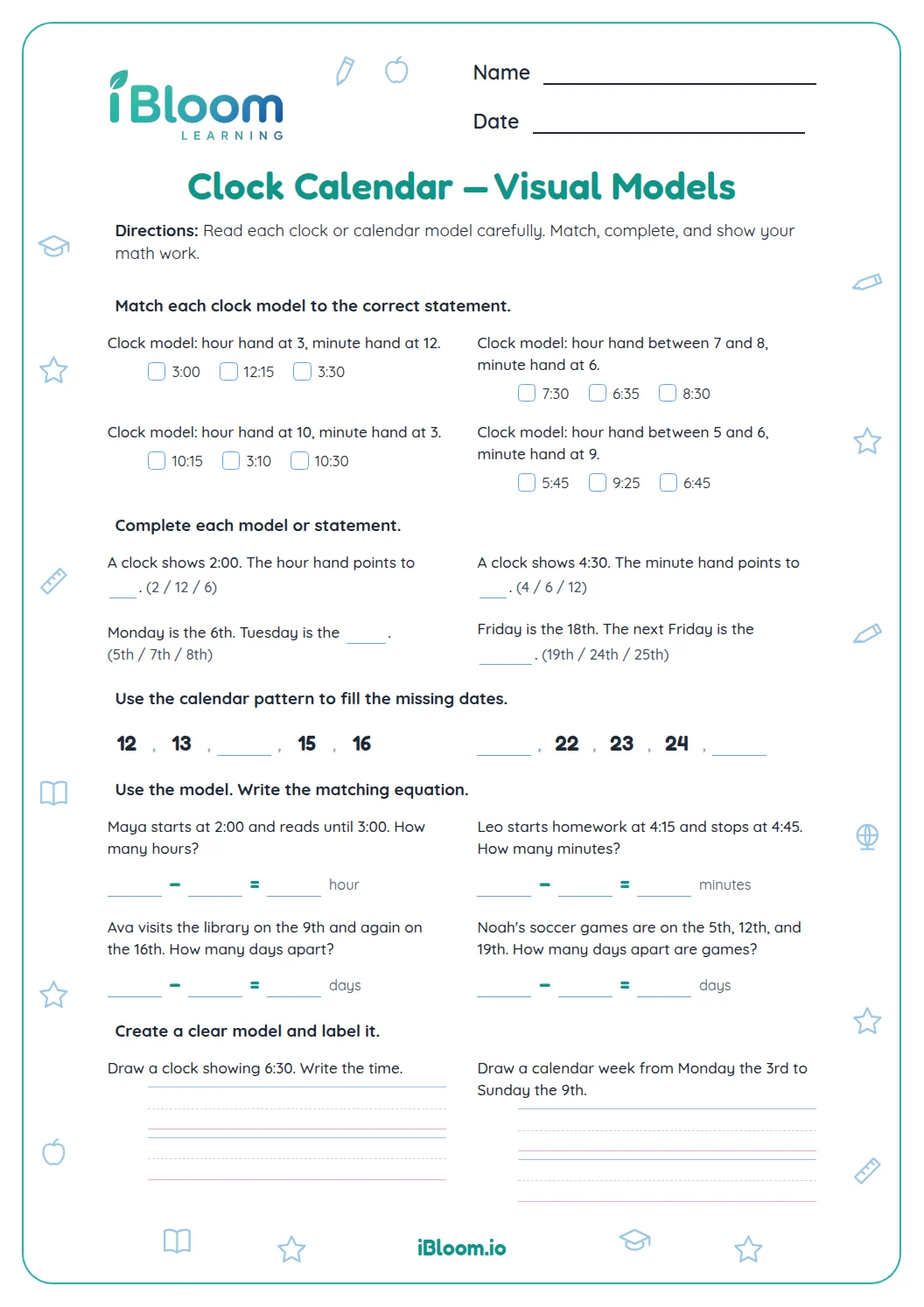
About this worksheet
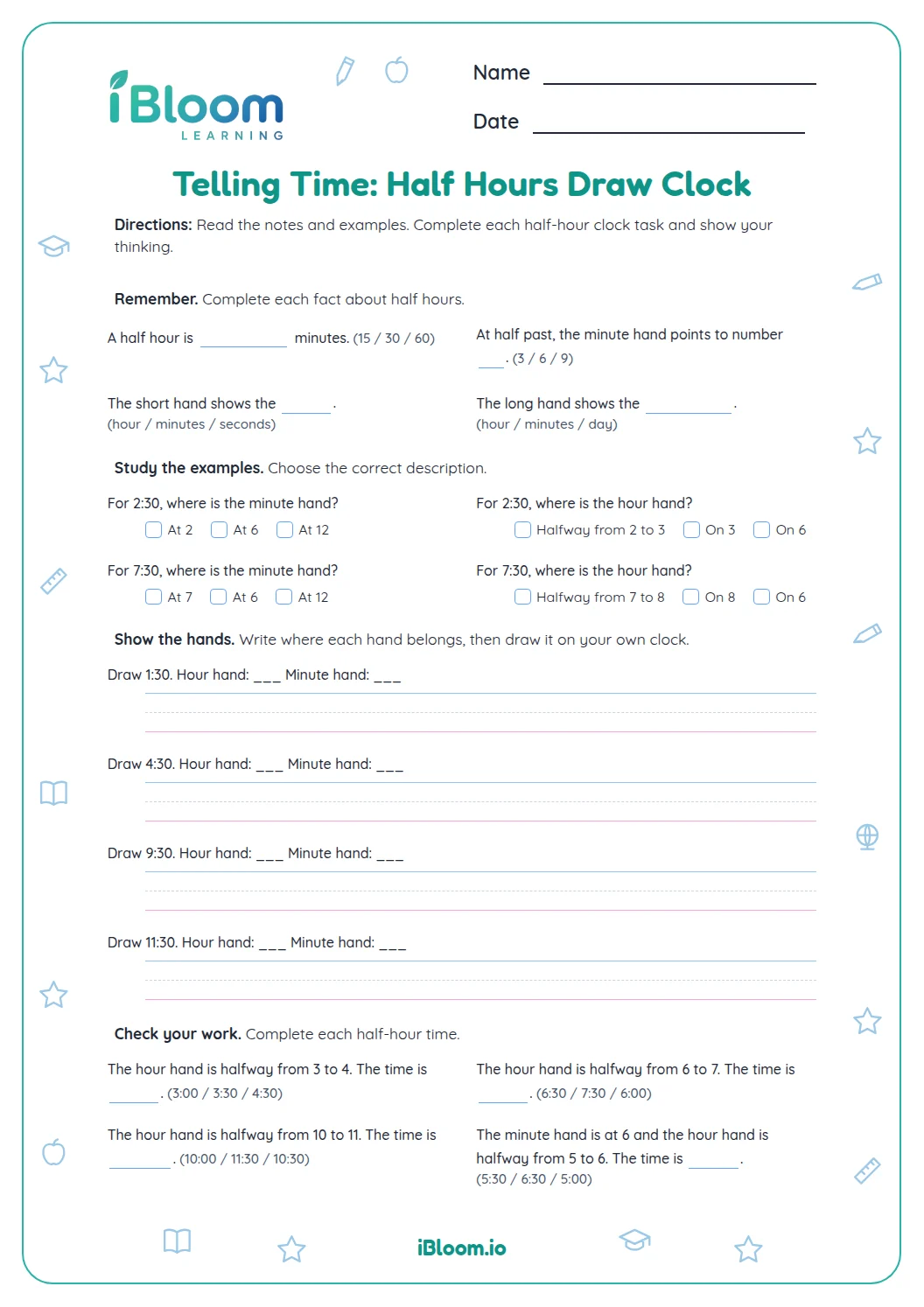
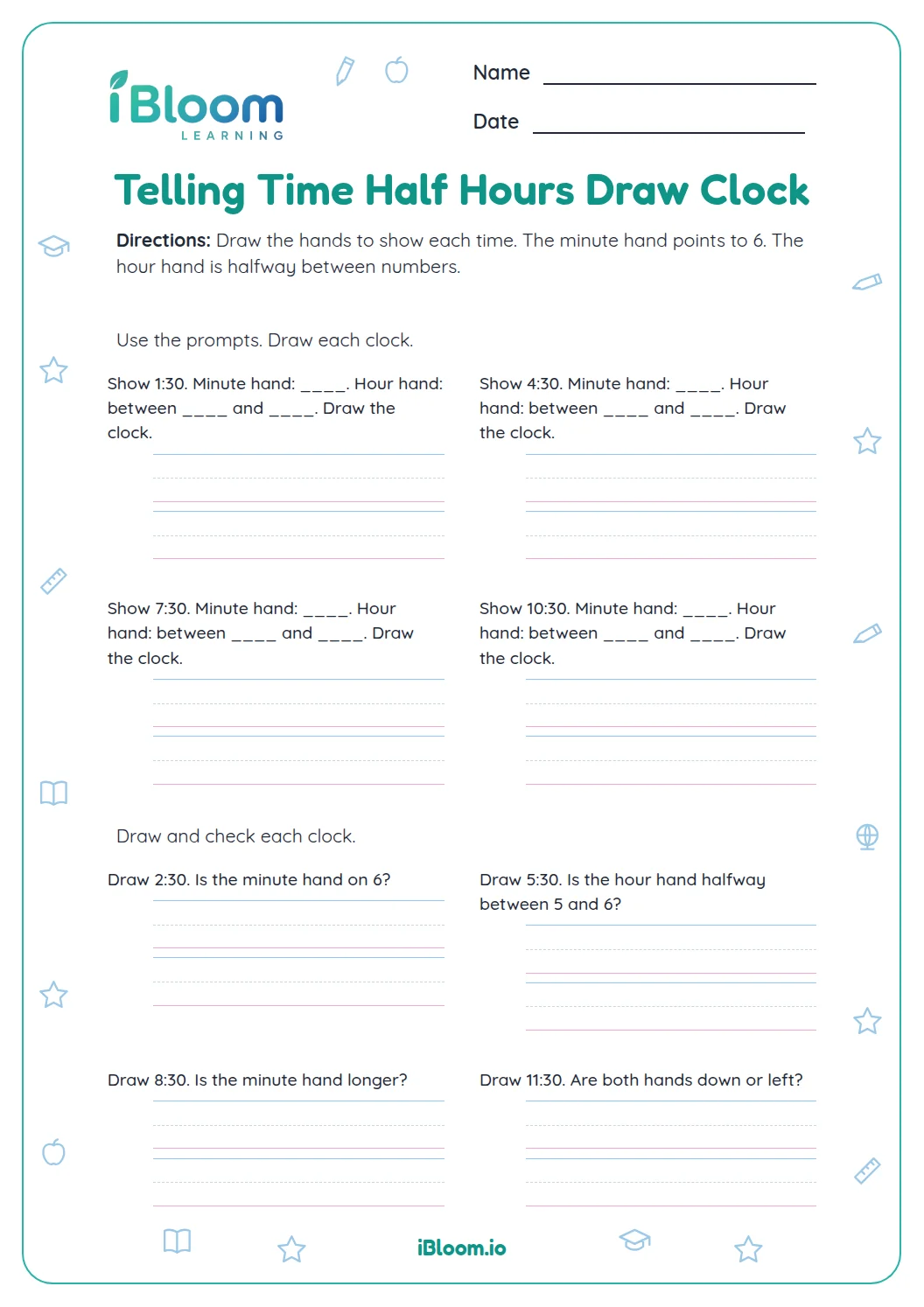
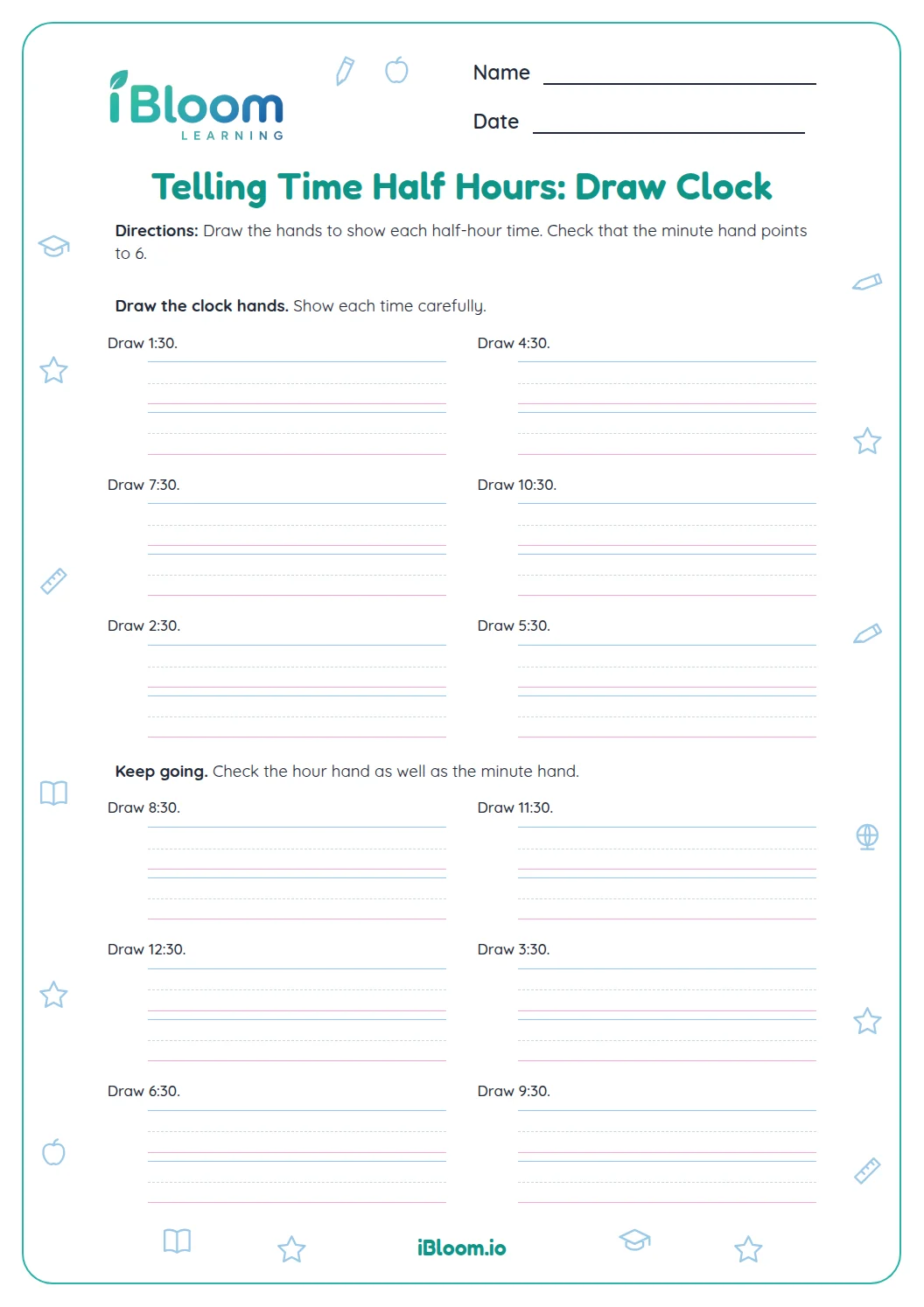
This free printable worksheet is for Grade 2 learners practicing reading and reasoning with half-hour times. It focuses on analog clocks at :30, clock-hand clues and ordering half-hour times. Across two parts, children work through 14 multiple-choice questions: 1 clock read and 13 half-hour clues. The prompts are specific to this skill, and a separate answer key supports quick checking. The page aligns with 2.MD.C.7.
Aligned to CCSS.Math.Content.2.MD.C.7
What does each clock show?
Part A begins with one analog clock to read, then uses written clues about where the hour and minute hands point. The seven questions practice reading half-hour times and describing the hand positions.
- Part A: 7 clock-reading and hand-position items.
- Part B: 7 questions about half-hours and time order.
- A separate answer key lists all 14 choices.
How do half-hour steps change a time?
At a half hour, the minute hand points to 6. The hour hand has moved halfway from the hour it just passed toward the next hour, so at 8:30 it is between 8 and 9.
- 1At 8:30, the minute hand points to 6 and the hour hand sits between 8 and 9.
How can you order half-hour times?
To order half-hour times, compare the hour first and then the minutes. The minute hand at 6 marks :30, so 4:30 falls between 4:00 and 5:00. This makes the sequence clear without changing the clock by elapsed intervals.
How to use this worksheet
- 1Find the minute hand and check whether it points to 6.
- 2Read the hour hand’s position to name the hour.
- 3Write :30 when the minute hand is on 6.
- 4Place each :30 time between the matching whole-hour times.
- 5Reread the ordered times from earliest to latest.
Common mistakes and quick fixes
The mistake
Calling the hour hand’s next number the current hour at :30.
The fix
At 7:30 the hour hand is between 7 and 8, so the hour is still 7.
The mistake
Reading the minute hand on 6 as six minutes.
The fix
On a clock, each number marks five minutes; 6 represents 30 minutes.
The mistake
Reading the hour hand as the next number when it is halfway between two numbers.
The fix
At 7:30, the hand is between 7 and 8, so the hour is still 7.
Common Core alignment
This worksheet practices reading and reasoning with half-hour times through focused Grade 2 activities.
Read and write half-hour times on analog and digital clocks.
On this sheet: Read and write half-hour times on analog and digital clocks.
Show the official wordingHide the official wording
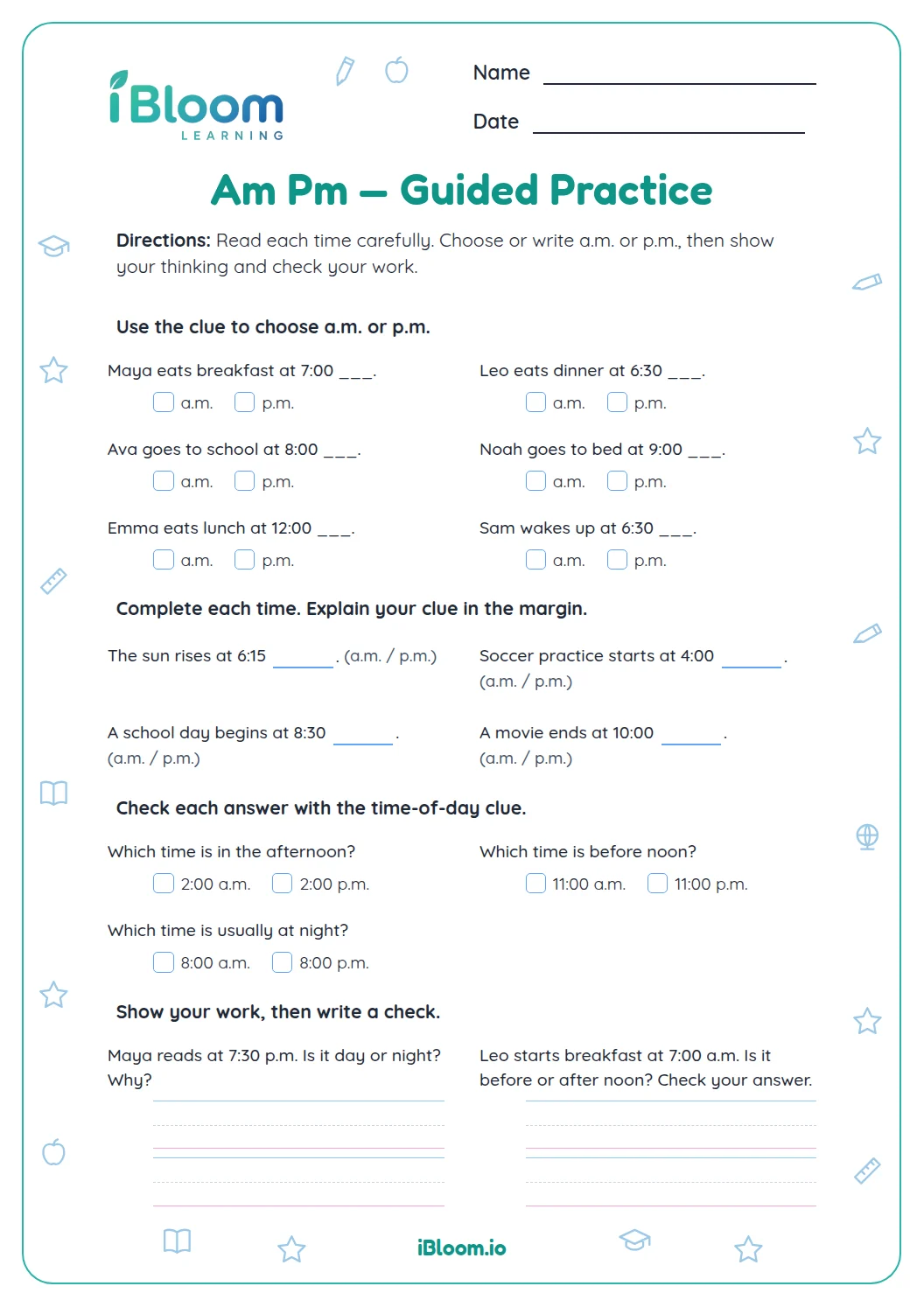
Tell and write time from analog and digital clocks to the nearest five minutes, using a.m. and p.m.
What to practice next
Make more practice
Further reading
Questions parents and teachers ask
What does the minute hand show at half past the hour?
The minute hand points to 6 at 30 minutes past the hour. The hour hand is between the hour just passed and the next hour. For example, at 8:30 it is between 8 and 9. The worksheet uses that relationship in its clock and hand clues.
How many questions are on this worksheet?
There are 14 questions across two parts. Part A starts with one clock drawing and then gives hand-position clues. Part B asks about half past, the minute hand, and putting times in order. Answers use digital time or a hand position.
How do you read the hour hand at 7:30?
At 7:30, the hour hand has moved halfway from 7 toward 8. The hour is still 7, so the time is seven thirty. Looking at whether the hour hand has passed the number helps avoid reading the next hour too soon.
How can a child locate a half-hour time between two hours?
Look for the time with :30 between the two whole-hour marks. For example, 6:30 comes after 6:00 and before 7:00. On an analog clock, the minute hand points to 6, and the hour hand sits between 6 and 7. This gives a child one more clear way to use the page’s target skill.
Can a child write 7:30 instead of half past 7?
Yes. The answer key uses digital time notation such as 7:30. Saying “half past 7” is another way to read the same time, but writing 7:30 matches the short answer format on this practice page. This gives a child one more clear way to use the page’s target skill.
What should we try next?
A next step is reading clocks at five-minute intervals or drawing clock hands for a given time. The related Grade 2 telling-time worksheets extend practice beyond half-hour marks and give children more opportunities to read and record times. The current sheet focuses on half-hour readings and reasoning.