


About this worksheet
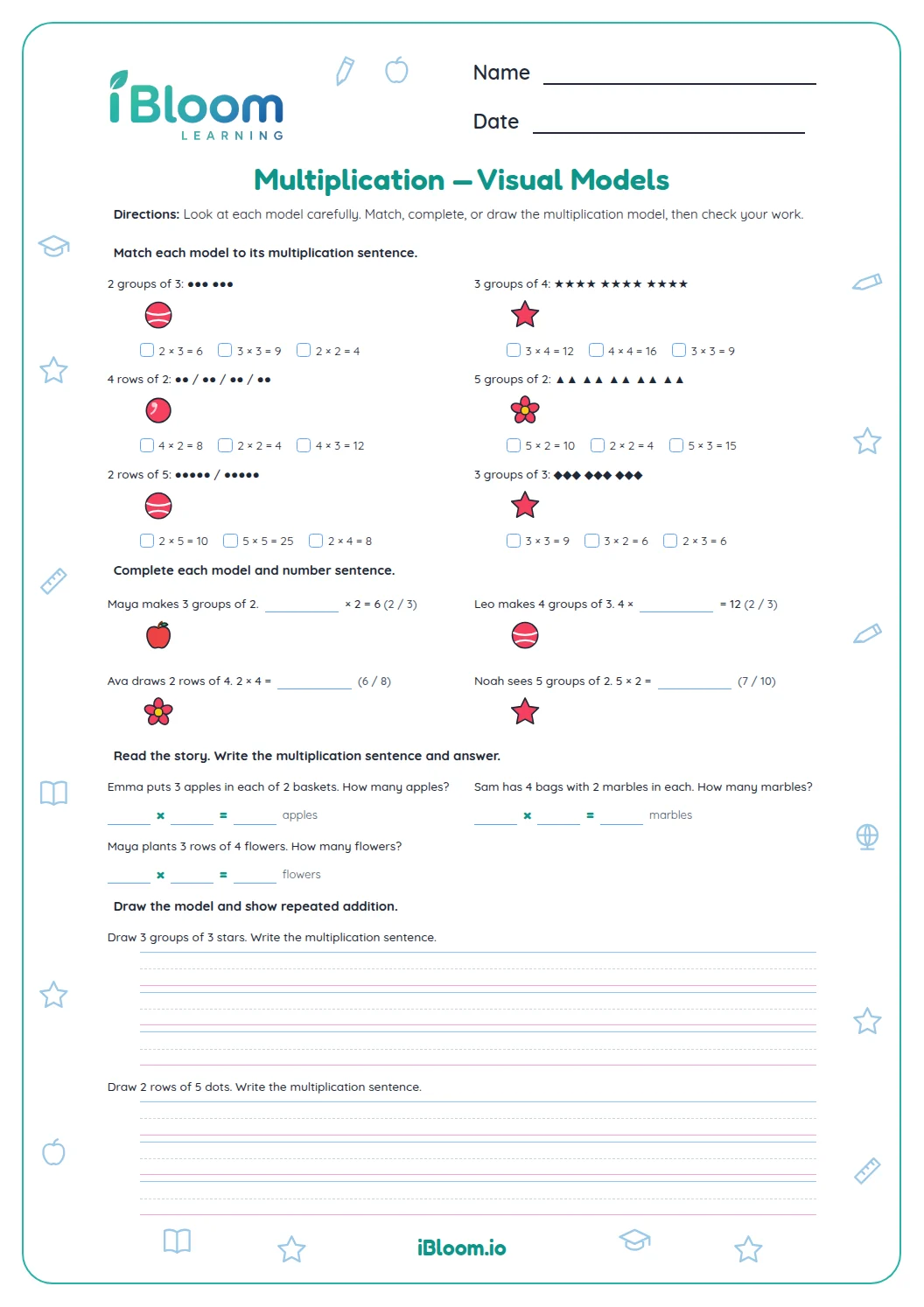
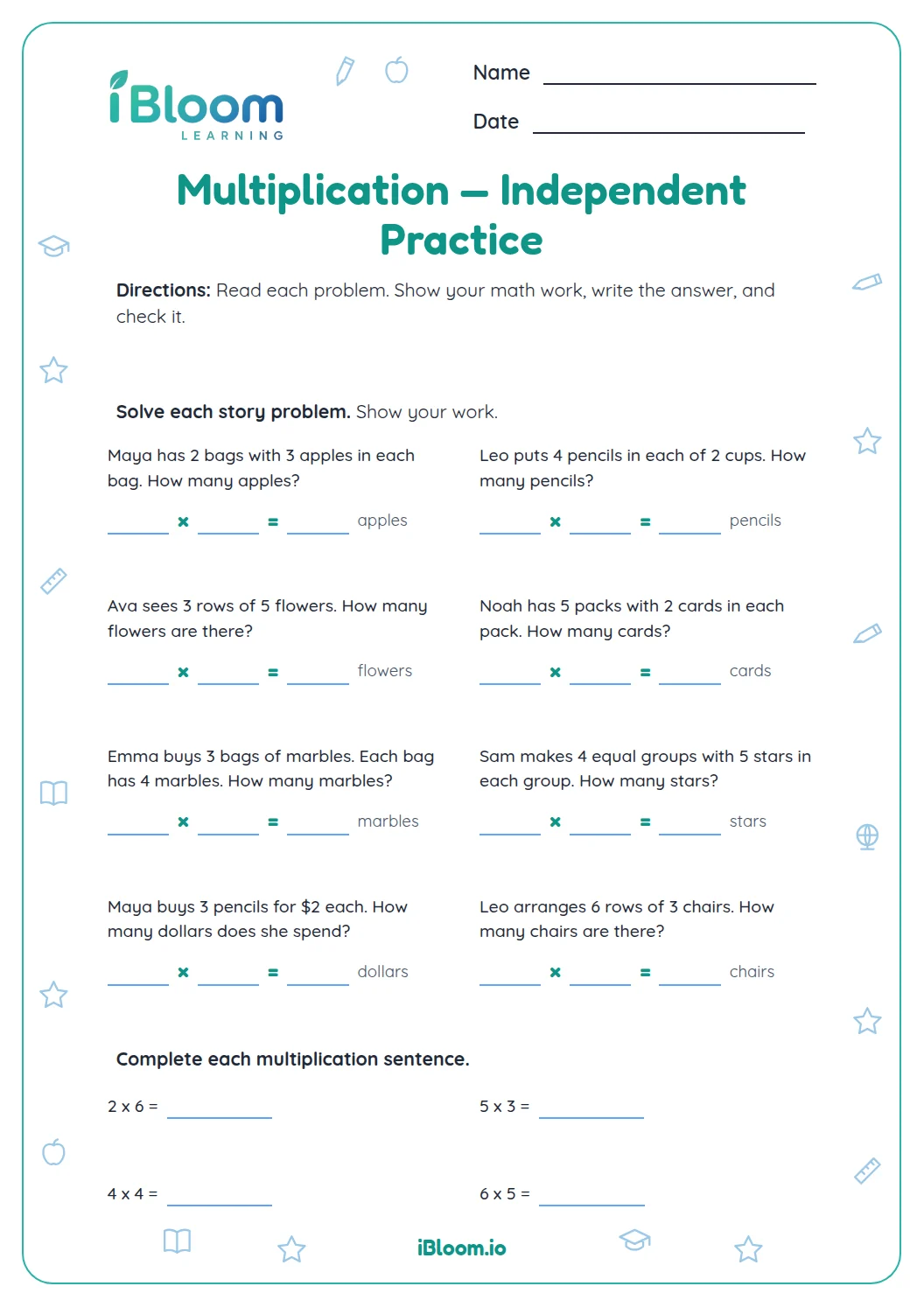
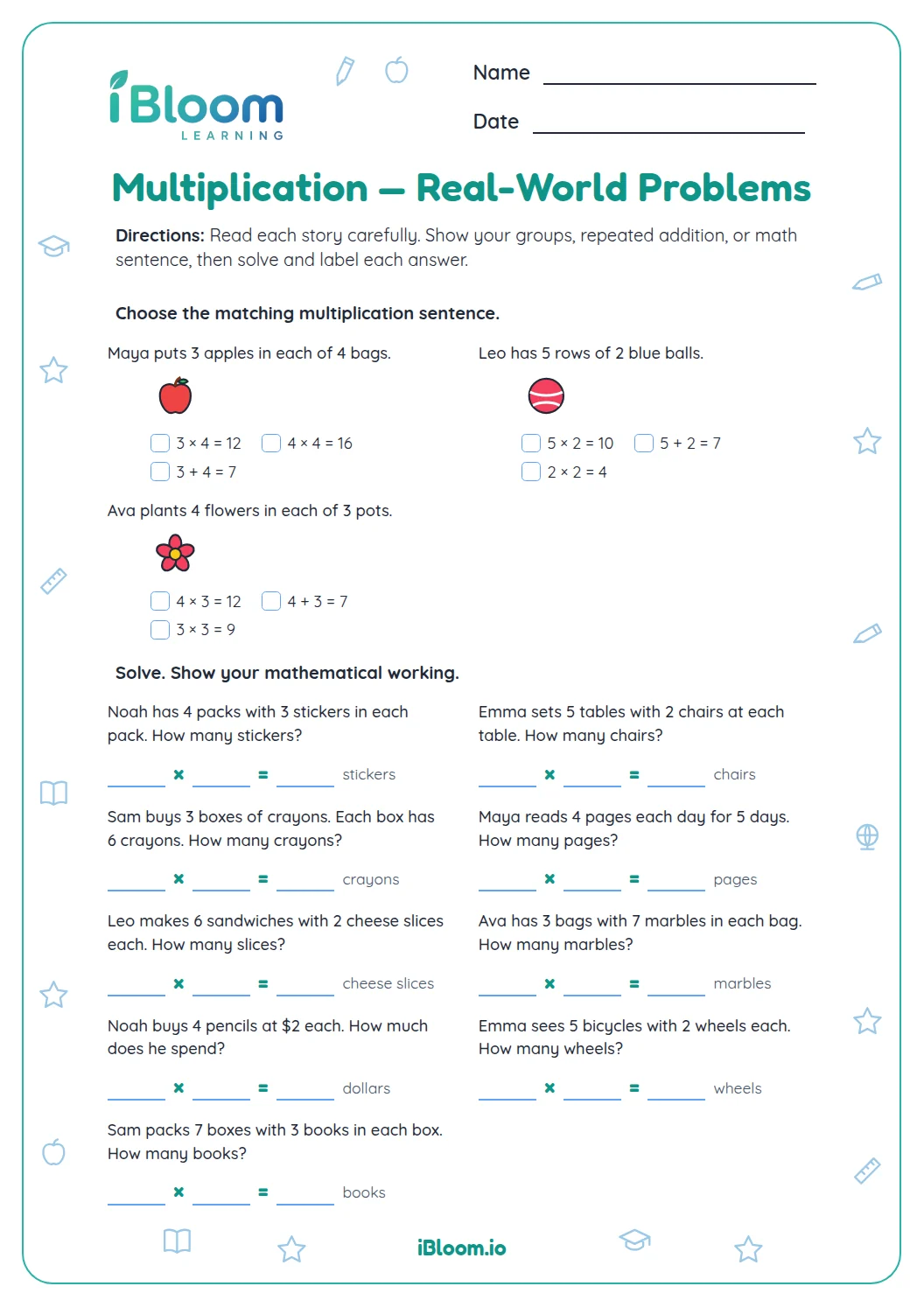
This free printable worksheet introduces Grade 2 multiplication word problems through equal rows and repeated addition. Four picture arrays show the rows described in short stories; the remaining stories ask children to organize equal groups themselves. Children write an addition equation with one equal addend for each group and find the total. All row and group counts and sizes are five or fewer, matching Common Core 2.OA.C.4. The 14 totals range from 6 to 25. The answer key lists each total for checking.
Aligned to 2.OA.C.4
What makes these multiplication stories?
Each story describes equal rows or groups. Knowing how many groups there are and how many objects are in each group lets a child find the total by repeated addition. Three rows of four apples means adding four three times.
The worksheet asks for addition equations so children can explain what the groups mean. You can also say “three groups of four” while pointing to the array.
How do we turn a row story into an equation?
Find the row size first. Write that number once for each row, join the addends with plus signs, and finish the equation with the total. The answer box holds the number of objects in all.
- 13 rows; 4 apples in each row.
- 24 + 4 + 4 = 12
- 3Answer: 12 apples.
- 4The multiplication sentence for the same groups is 3 × 4 = 12.
How can I check more than the final total?
Look at the number of addends and the size of each addend. In question 8, five rows of two hats should produce five 2s: 2 + 2 + 2 + 2 + 2 = 10. Later stories use the same check, including two new picture arrays.
A correct total with unrelated working deserves another look. Ask the child to match each addend to a row. For the text-only stories, small dots in the working area can make that connection visible.
How to use this worksheet
- 1Point to one complete row in the first array and count its apples.
- 2Count the rows, then write one 3 for each row.
- 3Join the addends and write 3 + 3 = 6 in the working space.
- 4Finish Part A, using each array to check the equation.
- 5For Part B, identify rows and row size before adding.
- 6Check each total and match every addend to a row.
Mistakes to check together
The mistake
Adding the number of rows to the row size, such as 3 + 4 = 7.
The fix
Use four as the addend and write it three times.
The mistake
Leaving out one row in the equation.
The fix
Touch each row once as you write its addend.
The mistake
Losing track while adding five equal groups.
The fix
Keep a running total and check the number of addends before recording the final sum.
Common Core alignment
Write repeated-addition equations for arrays with up to five rows and five columns.
On this sheet: Part A supplies arrays; both parts ask for equations with one equal addend per row.
Show the official wordingHide the official wording
Use addition to find the total number of objects arranged in rectangular arrays with up to 5 rows and up to 5 columns; write an equation to express the total as a sum of equal addends.
What to practice next
Make more practice
Further reading
Questions parents and teachers ask
Does my child need memorized multiplication facts?
Your child can solve these 14 problems by repeated addition. The six picture arrays make each equal row visible, and the directions ask for an addition equation. Knowing multiplication facts can help with checking, but the written working should still connect the row count to the equal addends.
What should children write in the working space?
Children should write a complete addition equation with one addend for each row. For three rows of four apples, that is 4 + 4 + 4 = 12. The separate answer box holds the total, 12. Small row sketches can help organize the later stories before writing the equation.
How large are the groups on this sheet?
The stories use two to five rows, with two to five objects in each row. The largest total is 25 cups in question 10; the new problems range from 8 to 20. These sizes let children check by counting, adding equal groups, or drawing a small array in the available working space.
Why is 3 + 4 not correct for three rows of four?
Three counts the rows, while four counts the objects in each row, so adding them mixes two different roles. Point to the three rows and count four apples each time. Writing 4 + 4 + 4 preserves those equal groups and produces the total of 12 apples.
How should I use the answer key?
Use the key to check each total, then inspect the addition equation in the working space. A total alone cannot show whether the child understood the rows. Ask the child to point to or describe one row for every addend and to name the objects being counted.