



About this worksheet
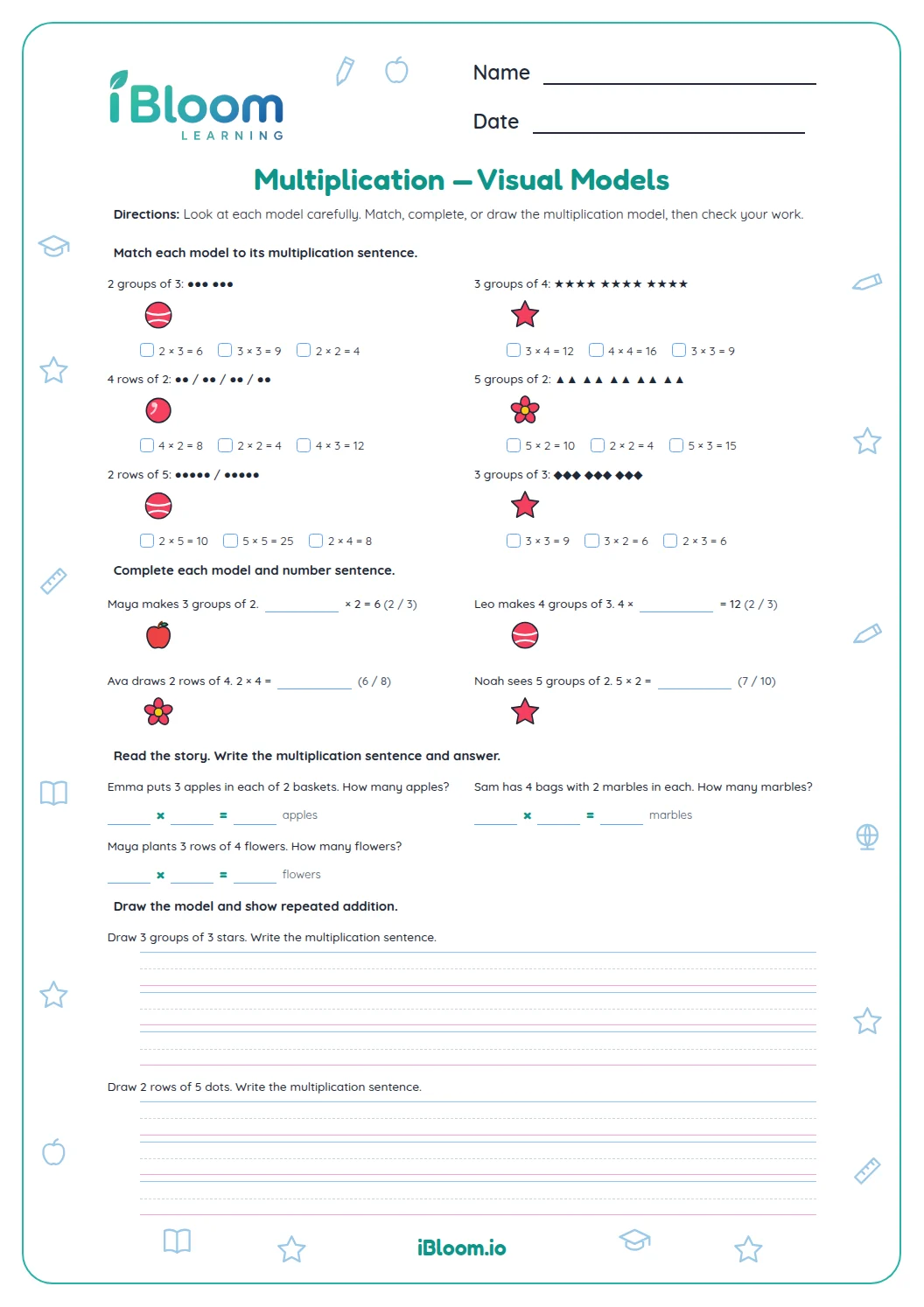
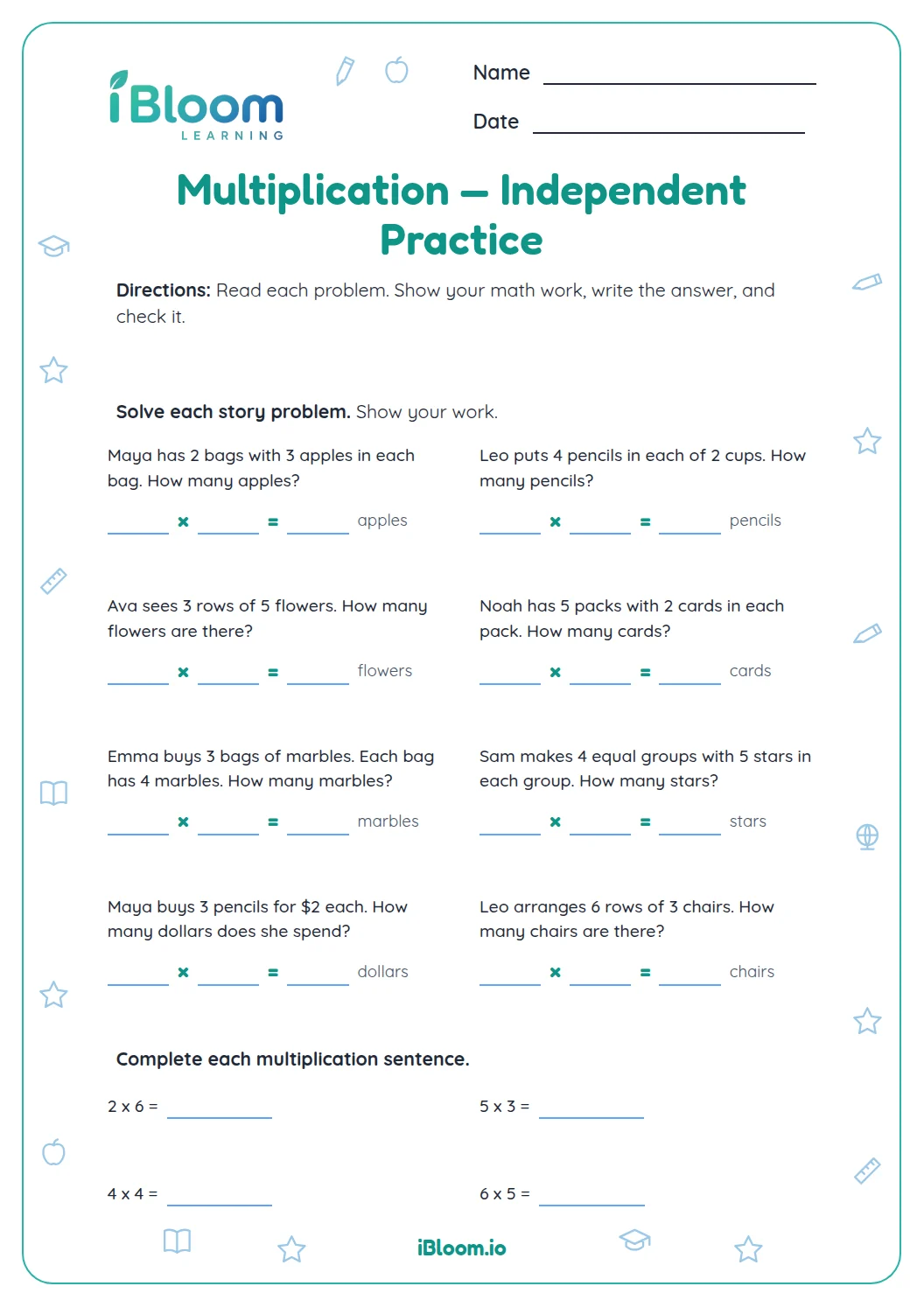
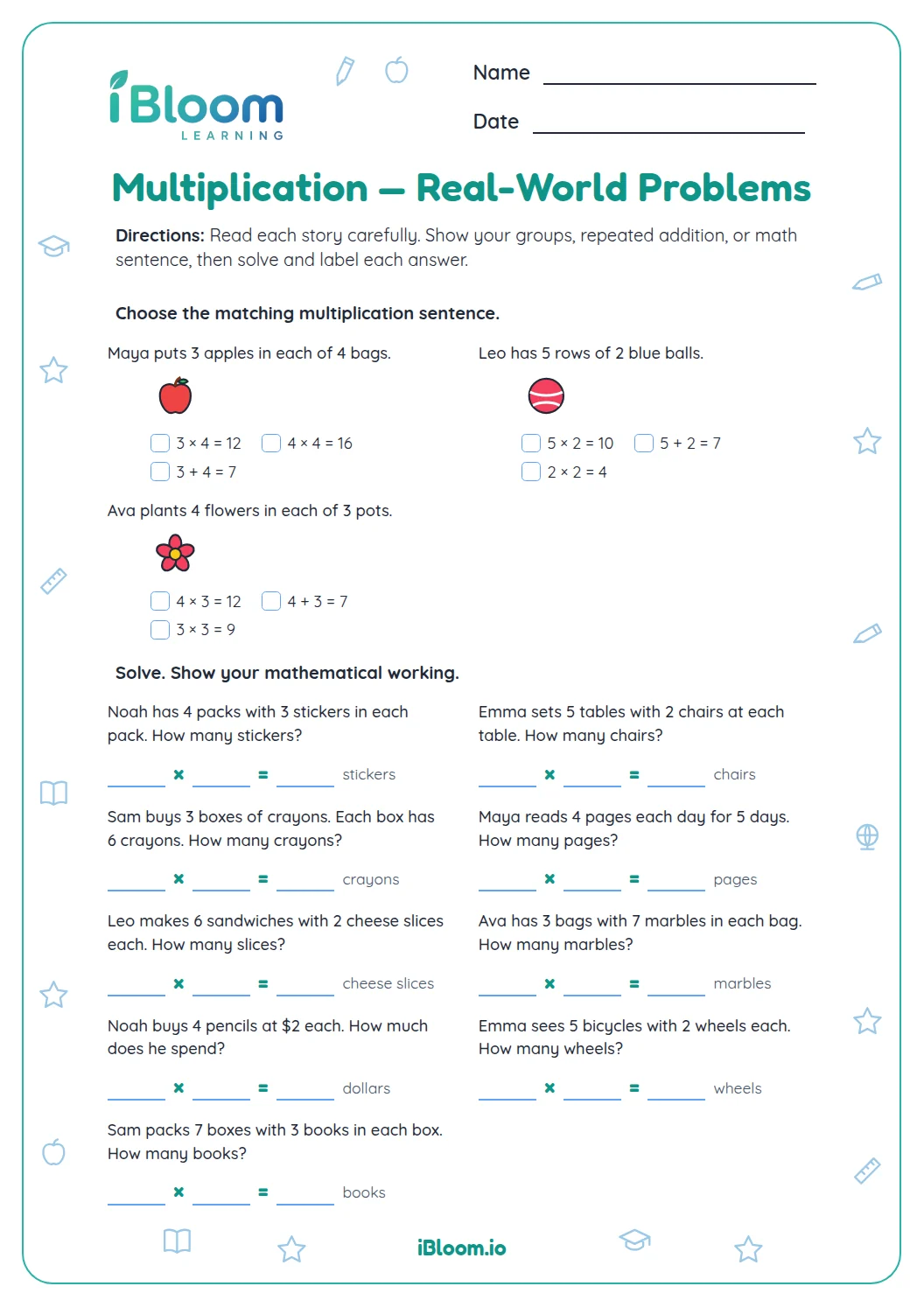
This Grade 2 bridge worksheet uses 14 short equal-group stories with totals no greater than 20. Children connect repeated groups to multiplication and find the total number of objects, with room to write an equation. The separate key gives each product. The equal-group reasoning connects to CCSS 3.OA.A.1.
Aligned to 3.OA.A.1
How can equal groups help find a total?
Identify how many groups there are and how many objects are in each group. Add the equal groups or write a multiplication equation to find the total.
For example, 3 bags with 4 oranges each means 4 + 4 + 4, or 3 × 4, for 12 oranges.
How to use this worksheet
- 1Find the number of groups in the story.
- 2Find the number of objects in each group.
- 3Write an addition or multiplication equation.
- 4Find the total and check that it answers the story.
Common mistakes and quick fixes
The mistake
Using the number in each group as the total.
The fix
Count every equal group, not just one group.
The mistake
Adding the group count and group size.
The fix
Represent equal groups with repeated addition or multiplication.
The mistake
Reversing what the two factors count.
The fix
Label one factor as groups and the other as objects in each group.
Curriculum alignment
This worksheet practices the skill named below.
Interpret products as equal groups.
On this sheet: Students interpret each story as equal groups and find the product, practicing the Grade 3 equal-groups representation.
Show the official wordingHide the official wording
Interpret products of whole numbers, e.g., interpret 5 × 7 as the total number of objects in 5 groups of 7 objects each.
What to practice next
Questions parents and teachers ask
What does “equal groups” mean?
Equal groups have the same number of objects in every group. In a story about 3 bags with 4 oranges each, each bag has 4 oranges. Adding 4 + 4 + 4 or writing 3 × 4 gives the same total: 12 oranges.
How many problems are on this page?
The worksheet has 14 short equal-group word problems in three parts. Each asks for one total, and the totals stay at 20 or below. Children choose the matching answer, then explain the number of groups and objects in each group.
Can children use repeated addition?
Yes. Repeated addition is a useful way to show equal groups, such as 4 + 4 + 4 for 3 groups of 4. Children who know multiplication can also write 3 × 4. Either way, they should explain what each number represents in the story.
How should I check a response?
Ask the learner to point out the groups and the objects in one group, then check the equation against the story. The answer key lists the total. If the equation uses the right numbers but the wrong operation, recount the groups together.
Why is this listed for Grade 2?
The stories use small totals and familiar equal-group situations to build reasoning about multiplication. Children can model the groups with drawings or repeated addition, then connect that representation to a multiplication sentence. The page cites the Grade 3 equal-groups standard it practices.