


About this worksheet
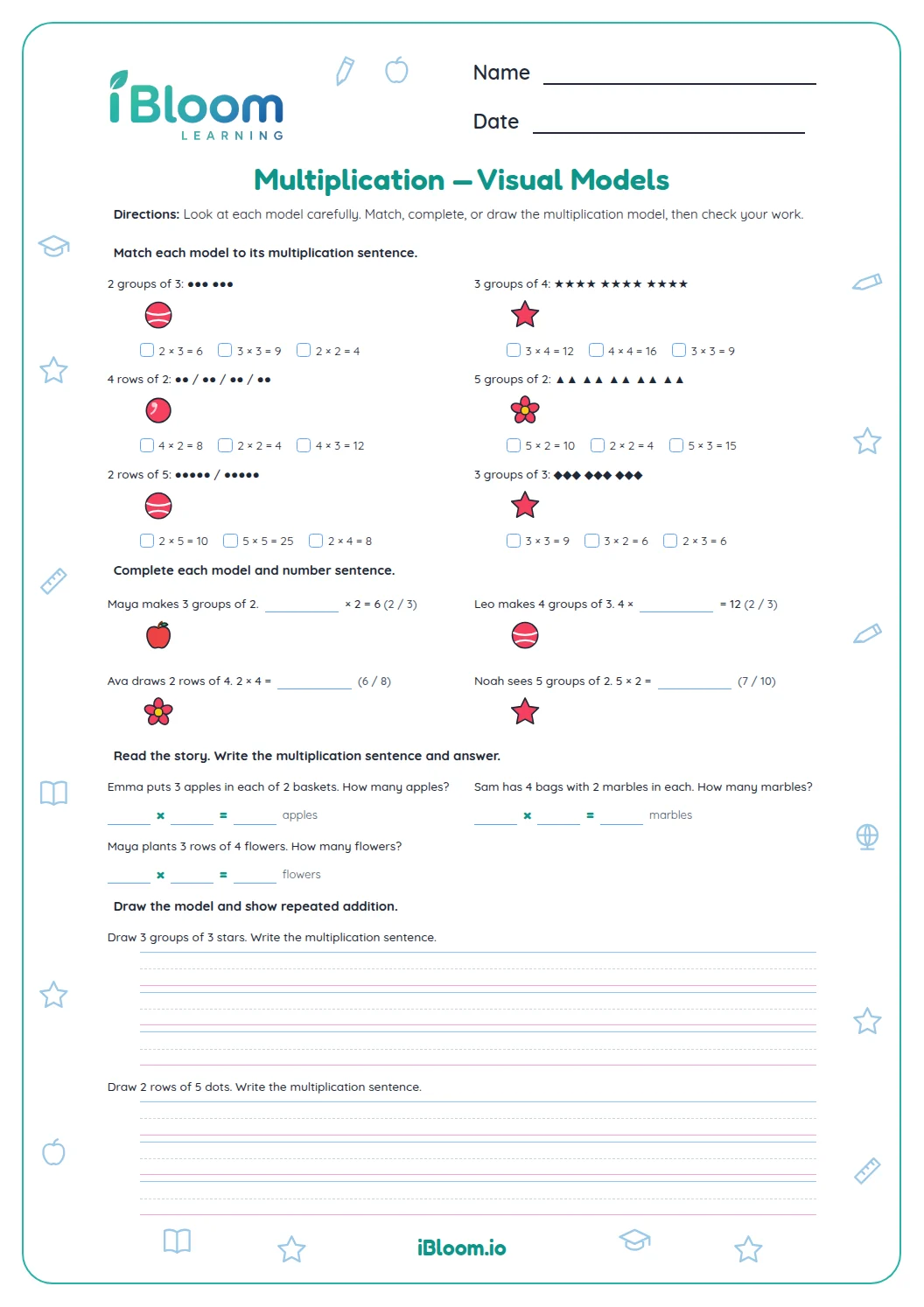
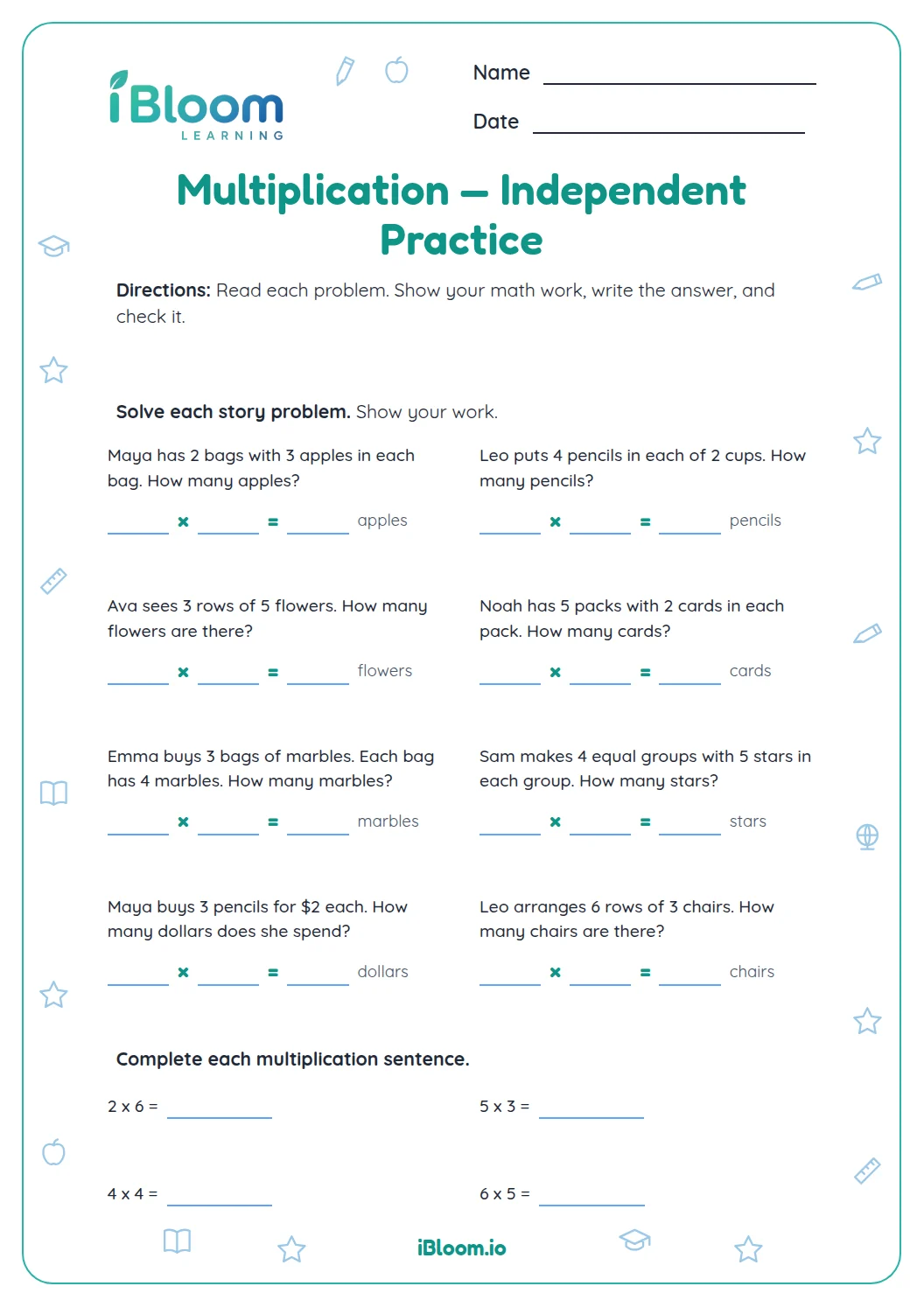
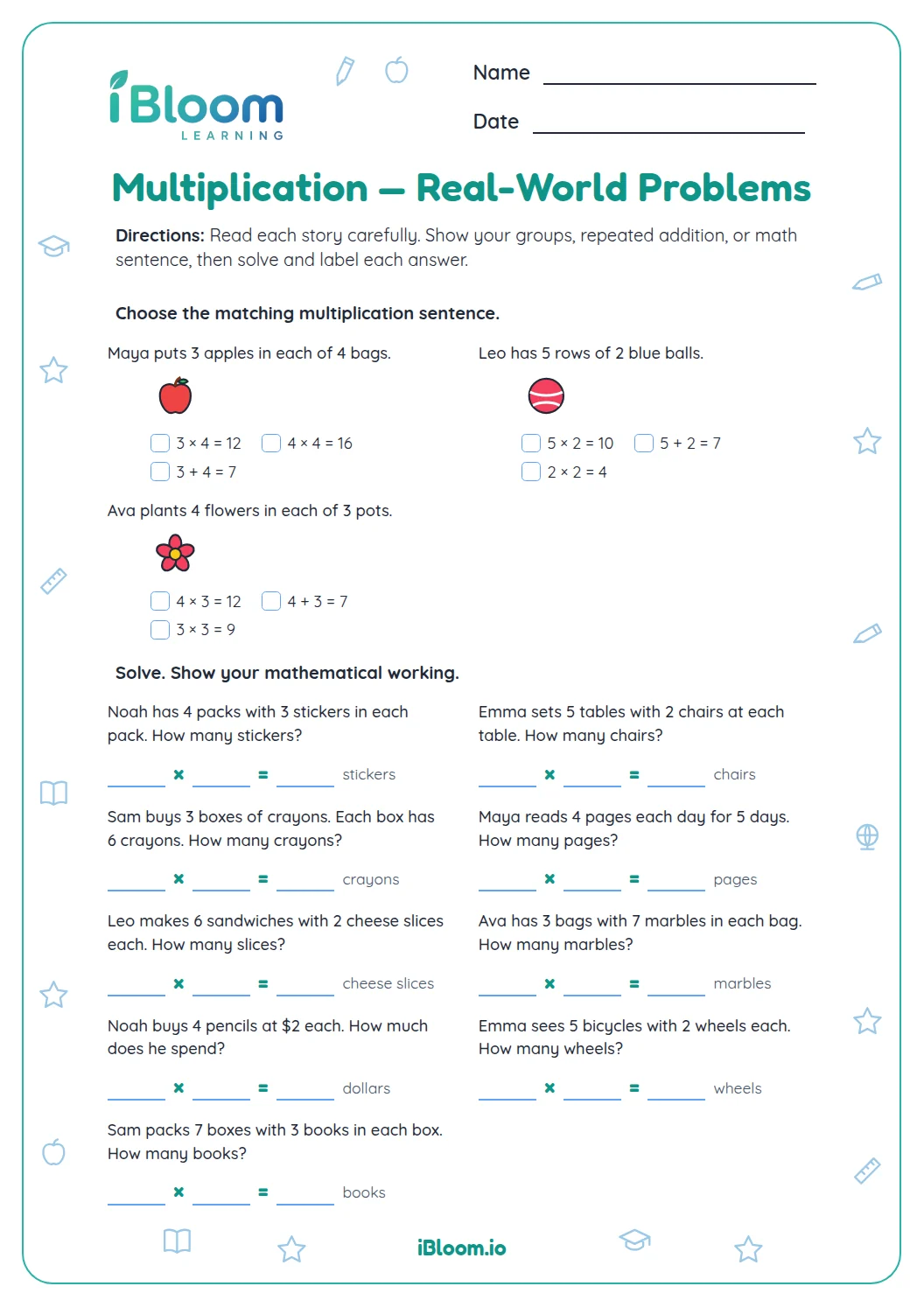
This free printable gives Grade 2 learners practice reading multiplication situations as equal groups. Part A starts with four short equal-group stories; Parts B and C move to familiar stories about trays, teams, books, and seeds. Children find a missing total or group detail, then record the number that answers the story. The problems use small whole-number facts. A separate answer key is included.
Aligned to 3.OA.A.3
What does multiplication mean in a story?
Multiplication describes equal groups. In a story about 4 trays with 3 rolls on each tray, the 4 tells how many groups there are and the 3 tells how many are in each group. The total is 4 × 3.
- 1Four trays hold 3 rolls each.
- 2There are 4 groups of 3.
- 3Equation: 4 × 3 = 12
- 4Answer: 12 rolls
How can an array help find a total?
An array organizes objects into equal rows and columns. In question 2, three rows of four stars make 3 × 4, or 12 stars. A child can sketch that array on scratch paper to check the total before writing the answer.
How do you find the size of one group?
When a story gives a total and an equal group detail, division can find what is missing. In question 11, 18 tulips shared across 3 equal rows means 18 ÷ 3 = 6 in each row. In question 13, 24 tiles in groups of 4 means 24 ÷ 4 = 6 groups. Check that the quotient matches the question.
How to use this worksheet at home or in class
- 1Read the whole story and underline the group count and group size.
- 2In Part A, identify the number of groups and the objects in each group.
- 3In Part B, use the group count and group size to find each total.
- 4In Part C, use division to find the missing group size or number of groups.
- 5Compare each answer with the story to check that it names the requested quantity.
Common mistakes and quick fixes
The mistake
Multiplying the group count by a number that is not the group size.
The fix
Reread the sentence and point to the phrase that tells how many are in each group.
The mistake
Adding the two numbers in an equal-groups story.
The fix
Sketch or count equal groups, then write repeated addition or a multiplication equation.
The mistake
Giving the number of groups when the question asks for objects in each group.
The fix
Circle what the question asks for and use division when the total and group count are known.
Common Core alignment
The problems use the equal-group and array situations described in this standard.
Represent equal-group and array stories with multiplication or division equations.
On this sheet: The array and story problems represent equal groups and ask children to find a total or one group size.
Show the official wordingHide the official wording
Use multiplication and division within 100 to solve word problems in situations involving equal groups, arrays, and measurement quantities, e.g., by using drawings and equations with a symbol for the unknown number to represent the problem.
What to practice next
Make more practice
Further reading
Questions parents and teachers ask
How do the row stories in Part A show equal groups?
Each Part A story describes objects arranged in equal groups; some use rows and one uses baskets. Identify the number of groups and how many objects belong in each group, then find the total. A child can sketch the groups on scratch paper to check the count before writing the answer.
How should a child write the answer?
The worksheet gives a short answer space for the missing total or group size. A child can sketch or say a multiplication or division equation while solving, then write the number of objects or the number in one group that the story asks for.
Why are there division problems on a multiplication worksheet?
Some stories give the total and number of equal groups, then ask how many belong in each group. Division finds that missing group size and is the inverse of multiplication. These questions keep the focus on equal groups and their relationship.
Can I read the stories aloud?
Yes. Reading a story aloud can help a child focus on its quantities and on what the question asks. Invite the child to point out the groups, the number in each group, and the unknown. Then have them check that the answer fits the story.
How long does the worksheet take?
Plan for about 20 minutes. The first four questions describe equal rows, followed by other equal-group stories and missing-group questions. A child can pause to sketch groups or check an answer with repeated addition, then use the key to review the completed page.