





About this worksheet
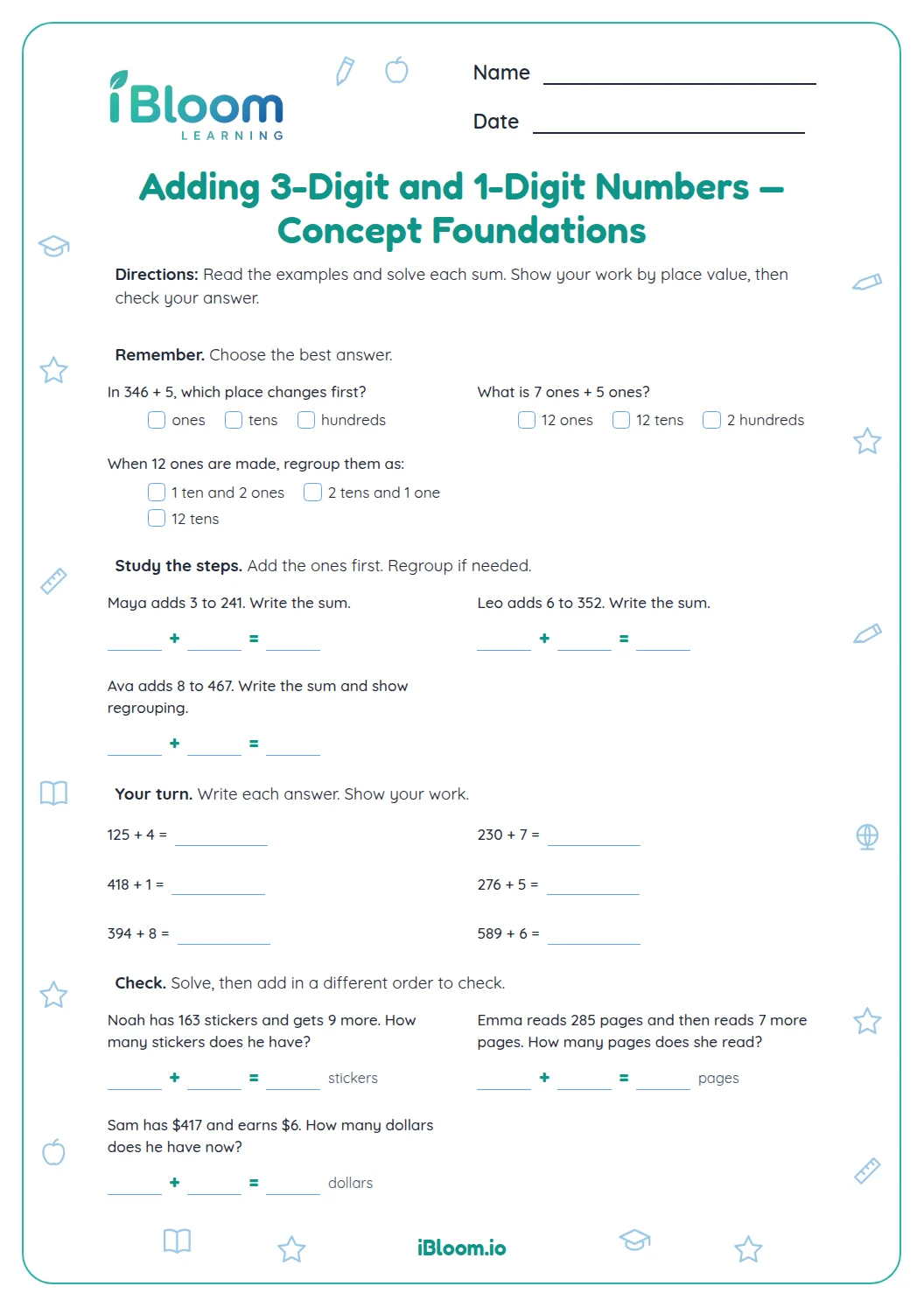
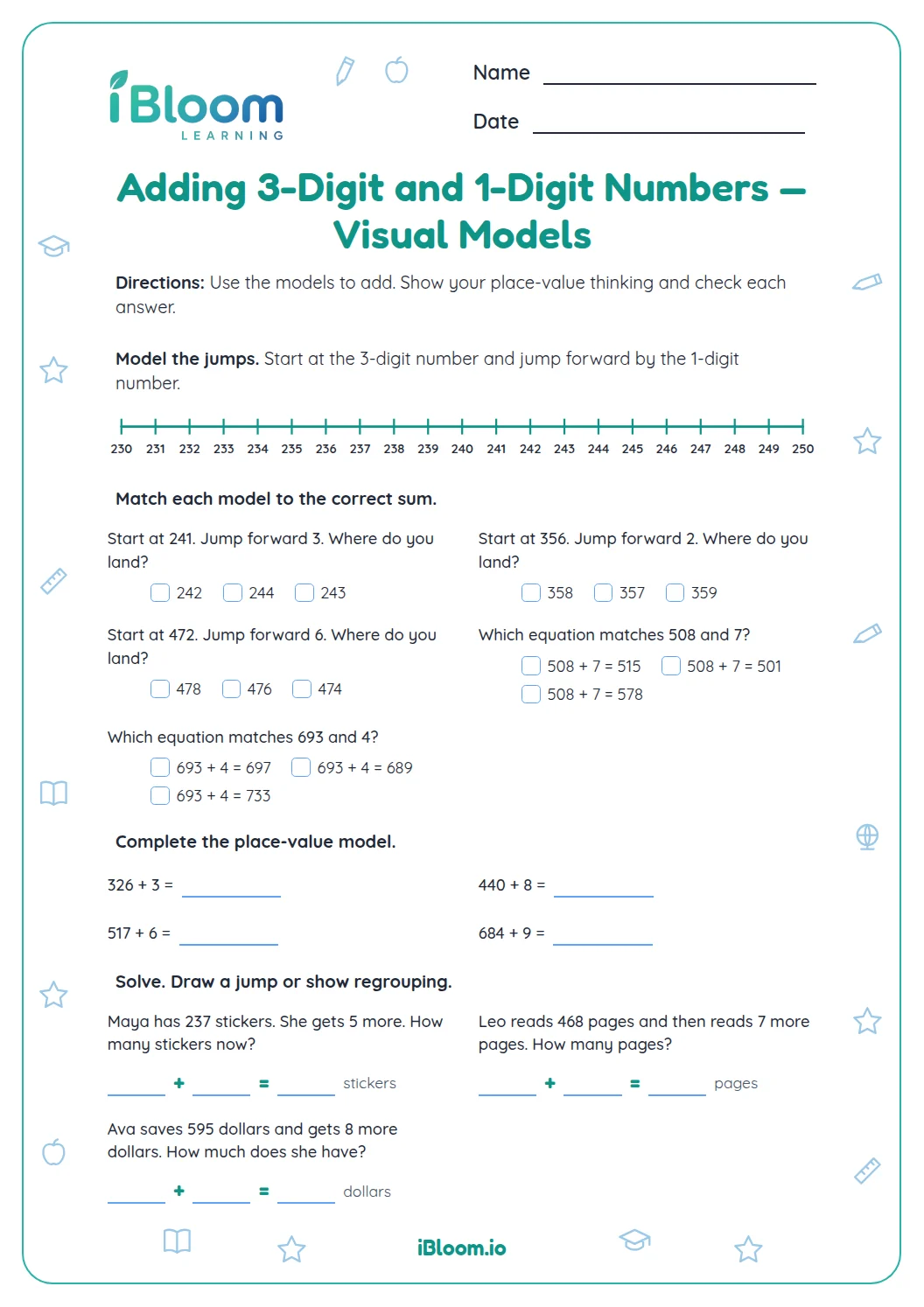
This free Grade 3 worksheet guides students through adding a one-digit number to a three-digit number. The first items warm up the idea of reaching the next ten. Two worked sequences then break an addend apart, add to a friendly ten, and finish the sum. Students apply the same reasoning to short situations and check an incorrect calculation. The page aligns with CCSS 3.NBT.A.2, which connects addition within 1,000 to place value and properties of operations. A separate answer key lists each result.
Aligned to 3.NBT.A.2
What does “make a ten” mean?
When the ones digits are close to the next ten, split the one-digit addend into two parts. Add enough to reach the ten, then add the leftover ones. The opening questions warm up the idea with quick sums.
- 1286 + 7 = 286 + 4 + 3
- 2= 290 + 3 = 293
How do you split the addend?
Part B writes each step explicitly. For 539 + 6, add 1 to reach 540; the remaining 5 gives 545. The same addend is split in a different way for 674 + 9: add 6, then 3.
- Find how many ones reach the next ten.
- Subtract that amount from the addend.
- Add the leftover ones to the new ten.
How can you check an answer?
Part C applies the strategy in two short situations. The final choice asks students to identify a split that reaches the next ten. A quick estimate helps: adding 6 to 578 should make the number a little larger.
How to use this worksheet
- 1Look at the ones digit and find the next ten.
- 2Decide how many ones are needed to reach it.
- 3Split the one-digit addend into that amount and the leftover amount.
- 4Add to the ten, then add the leftover ones.
- 5Check that the answer is greater than the starting number by exactly the addend.
Common mistakes and quick fixes
The mistake
Adding the full addend after reaching the ten.
The fix
Subtract the part already used from the addend; in 286 + 7, after adding 4, only 3 remains.
The mistake
Changing a tens or hundreds digit while adding ones.
The fix
Track each regrouping carefully; 539 + 6 reaches 540 first, then 545.
The mistake
Subtracting because the split shows a number being taken away.
The fix
The split does not change the operation. Both parts are still added to the original number.
Common Core alignment
The guided steps use place value to add within 1,000.
Use place value and properties to add within 1,000.
On this sheet: Students add a one-digit addend to a three-digit number by making the next ten and applying place-value reasoning.
Show the official wordingHide the official wording
Fluently add and subtract within 1000 using strategies and algorithms based on place value, properties of operations, and/or the relationship between addition and subtraction.
What to practice next
Make more practice
Further reading
Questions parents and teachers ask
What is the make-a-ten strategy?
Make a ten means splitting an addend so part of it completes the next multiple of ten. In 286 + 7, use 4 of the 7 ones to make 290, then add the remaining 3. The answer is 293. A final reread can confirm the size of the sum.
How many questions are included?
There are 14 questions across two worksheet pages, plus a separate answer key. Students warm up with sums, work through two step-by-step examples, solve two short situations, and choose a correct make-a-ten split. The key lists both the final total and the helpful intermediate ten.
Does this worksheet include regrouping?
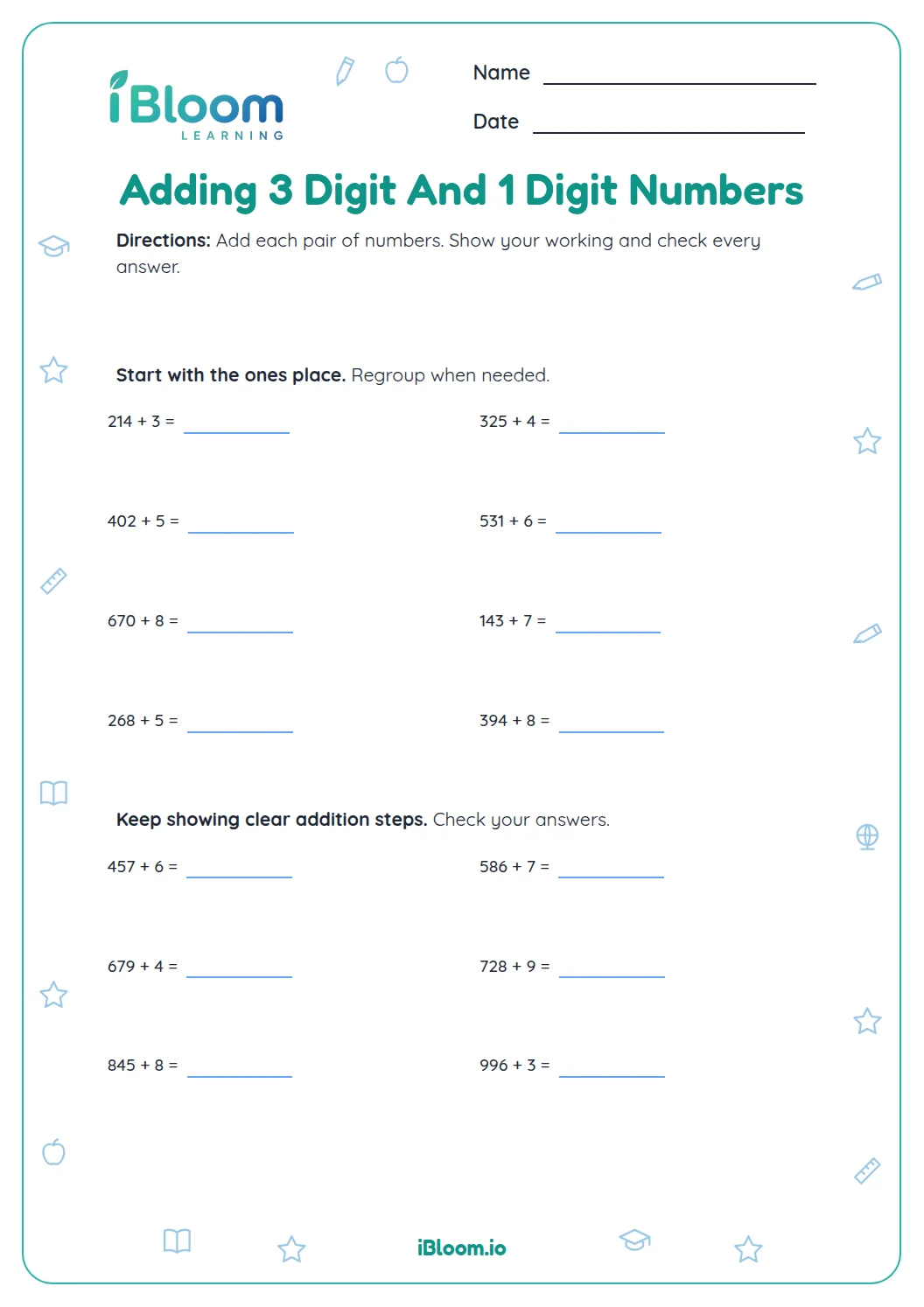
Yes. Students add ones that may make a new ten, such as 539 + 6 or 674 + 9. The written steps make clear how the ones are split before the total is found. The printed key helps adults check each intermediate and final answer.
What is the answer to 674 + 9?
The next ten after 674 is 680, and reaching it takes 6 ones. Split 9 into 6 and 3, then add the remaining 3 to 680. The sum is 683. The work makes regrouping visible instead of hiding the place-value change.
Why does the answer need to be larger?
Adding a positive number increases the starting amount. If a student adds 6 to 578 and gets a smaller number, they may have subtracted or changed a digit by mistake. Comparing the result to the starting number is a quick reasonableness check.
What should students practice after this page?
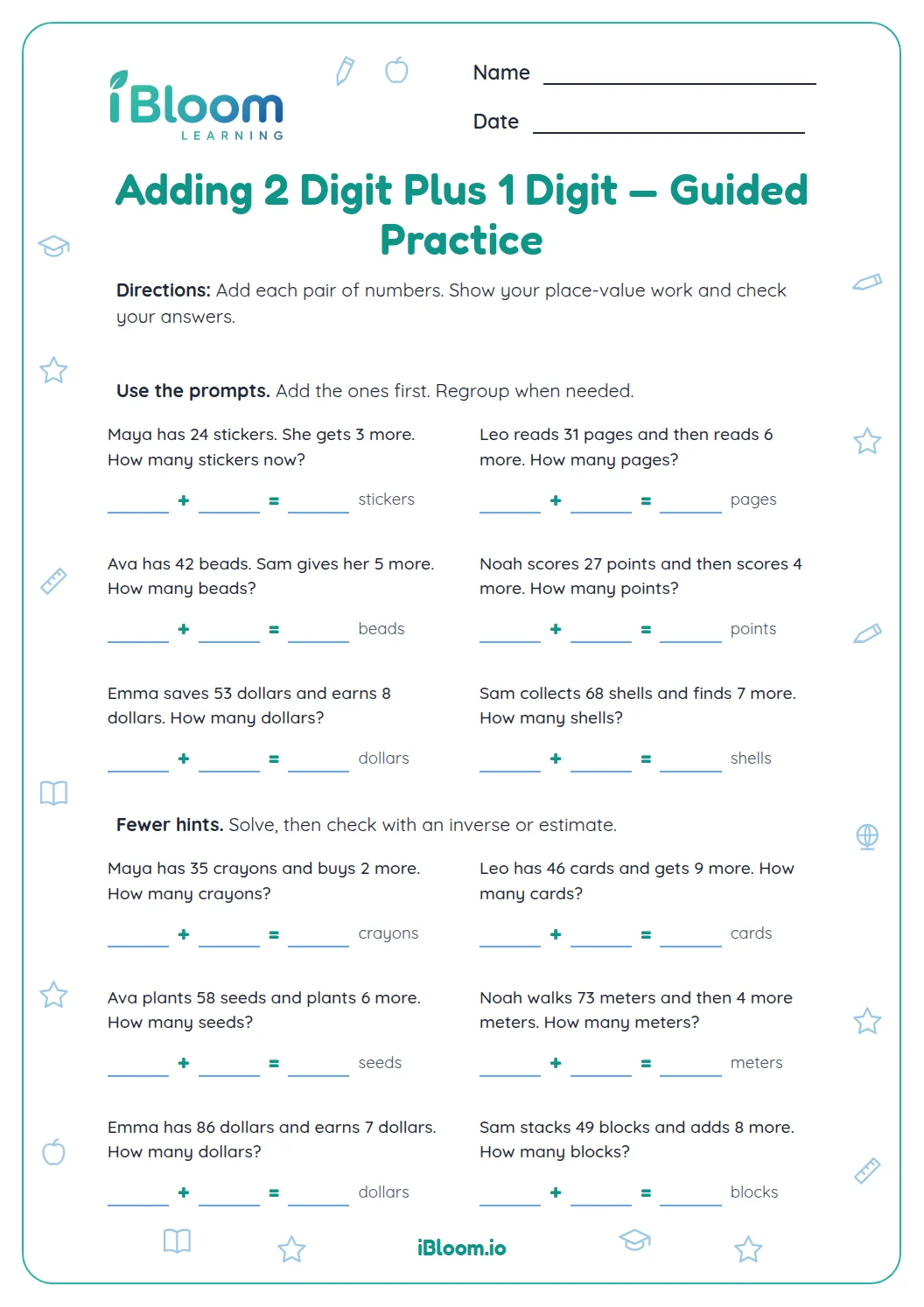
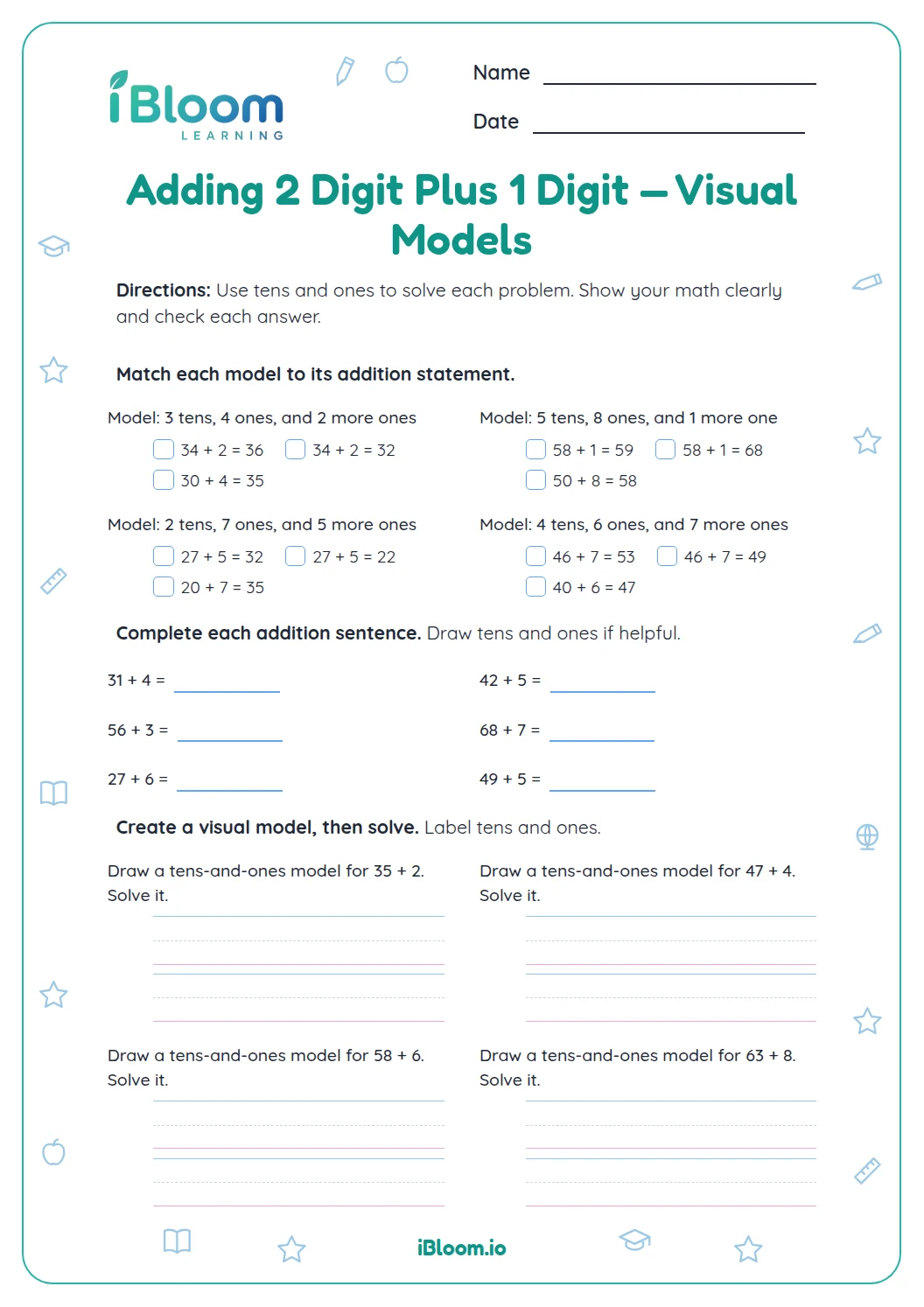
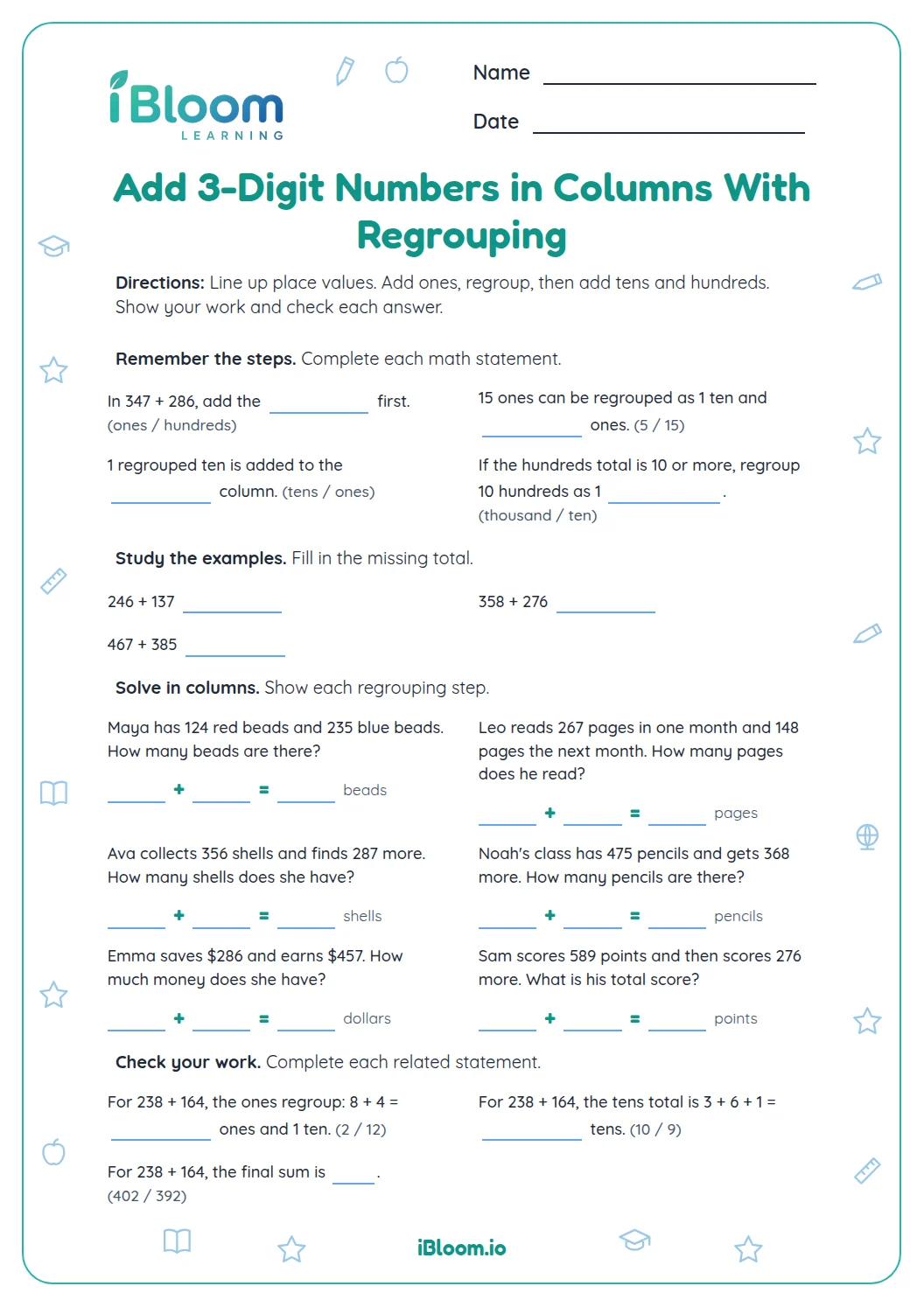
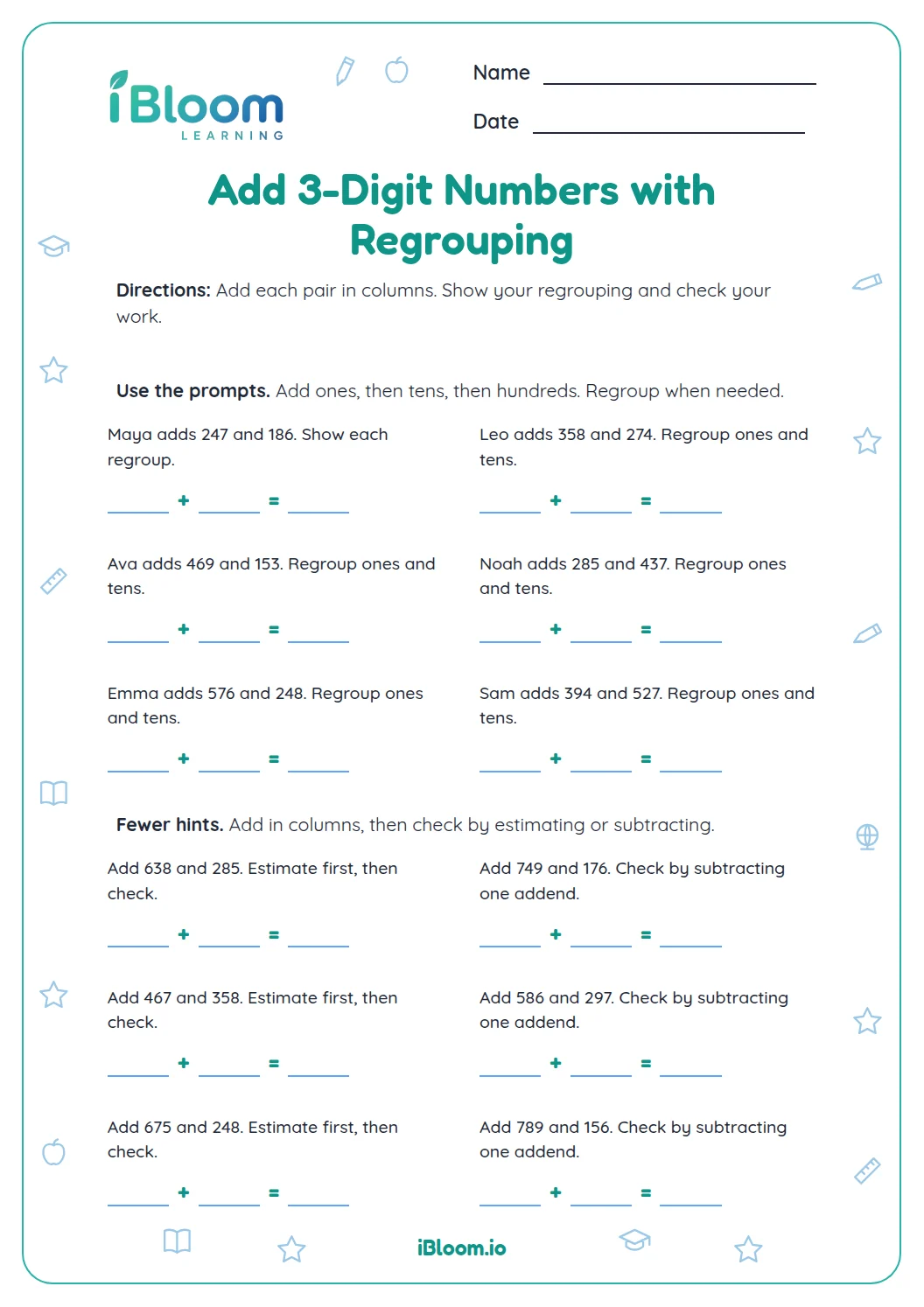
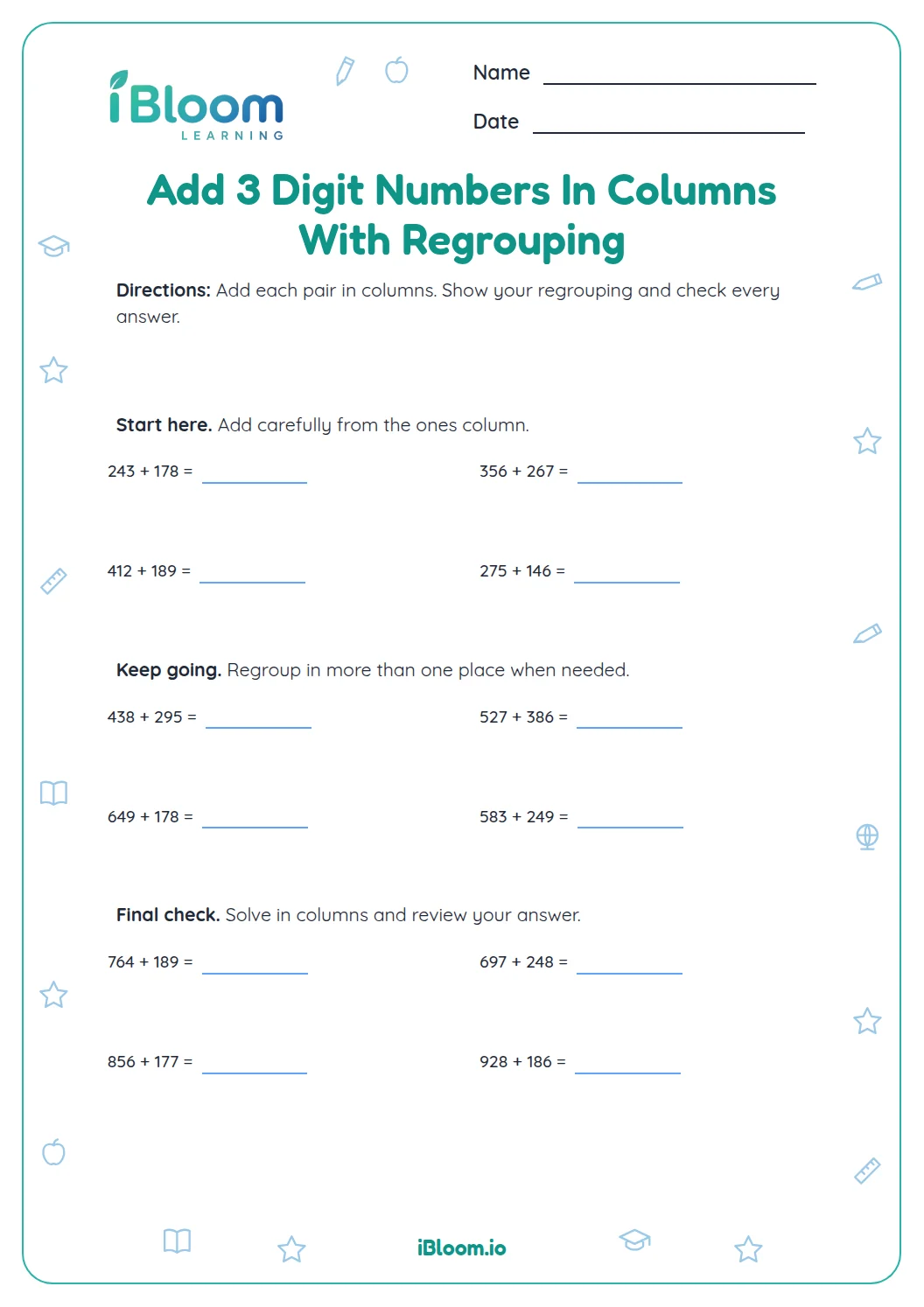
Students can use the same make-a-ten idea with a two-digit number and one-digit addend, then move to adding two three-digit numbers with regrouping. The linked pages build from one addend to more complex sums. Each next page adds another step while keeping place values important.