




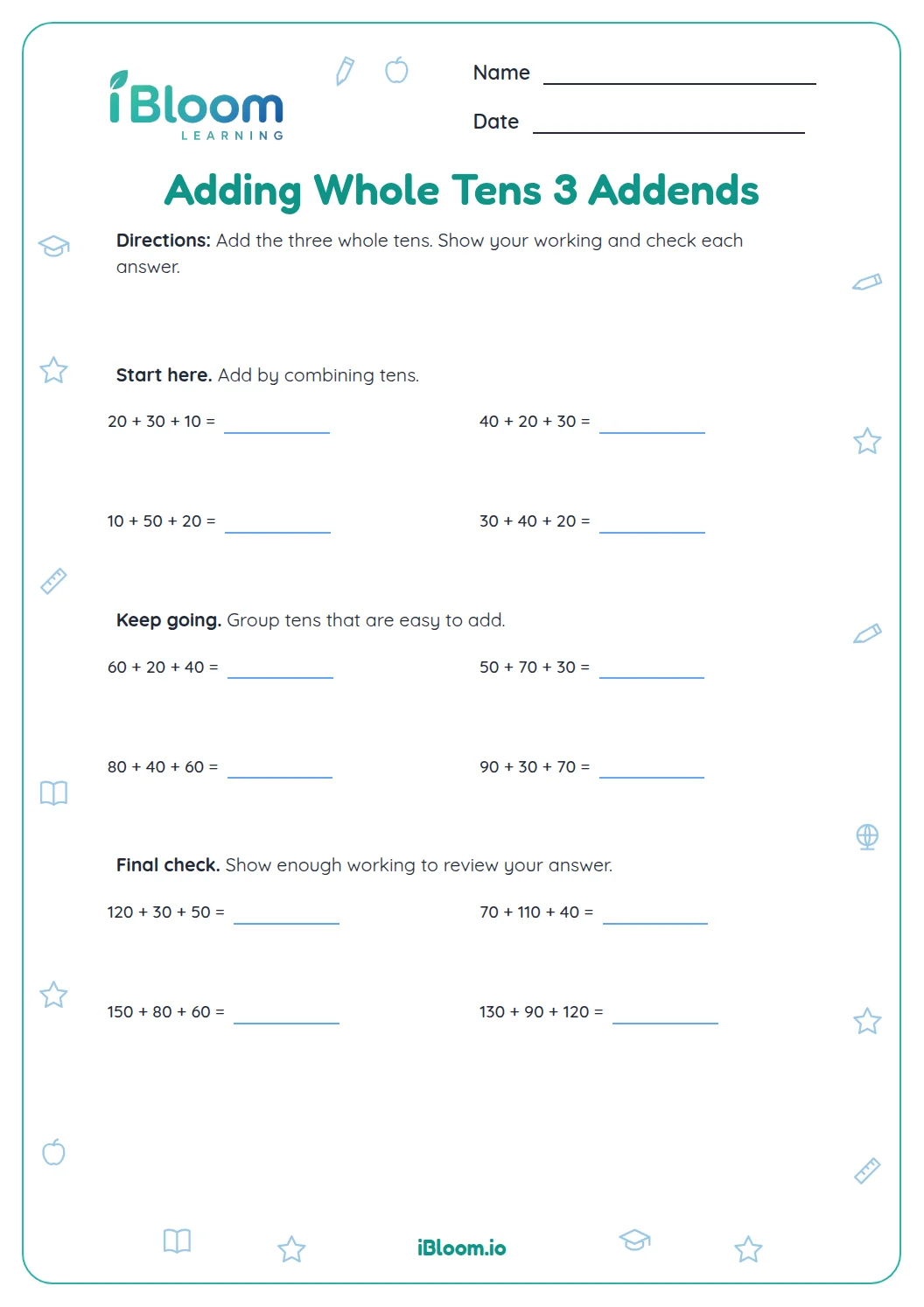
About this worksheet
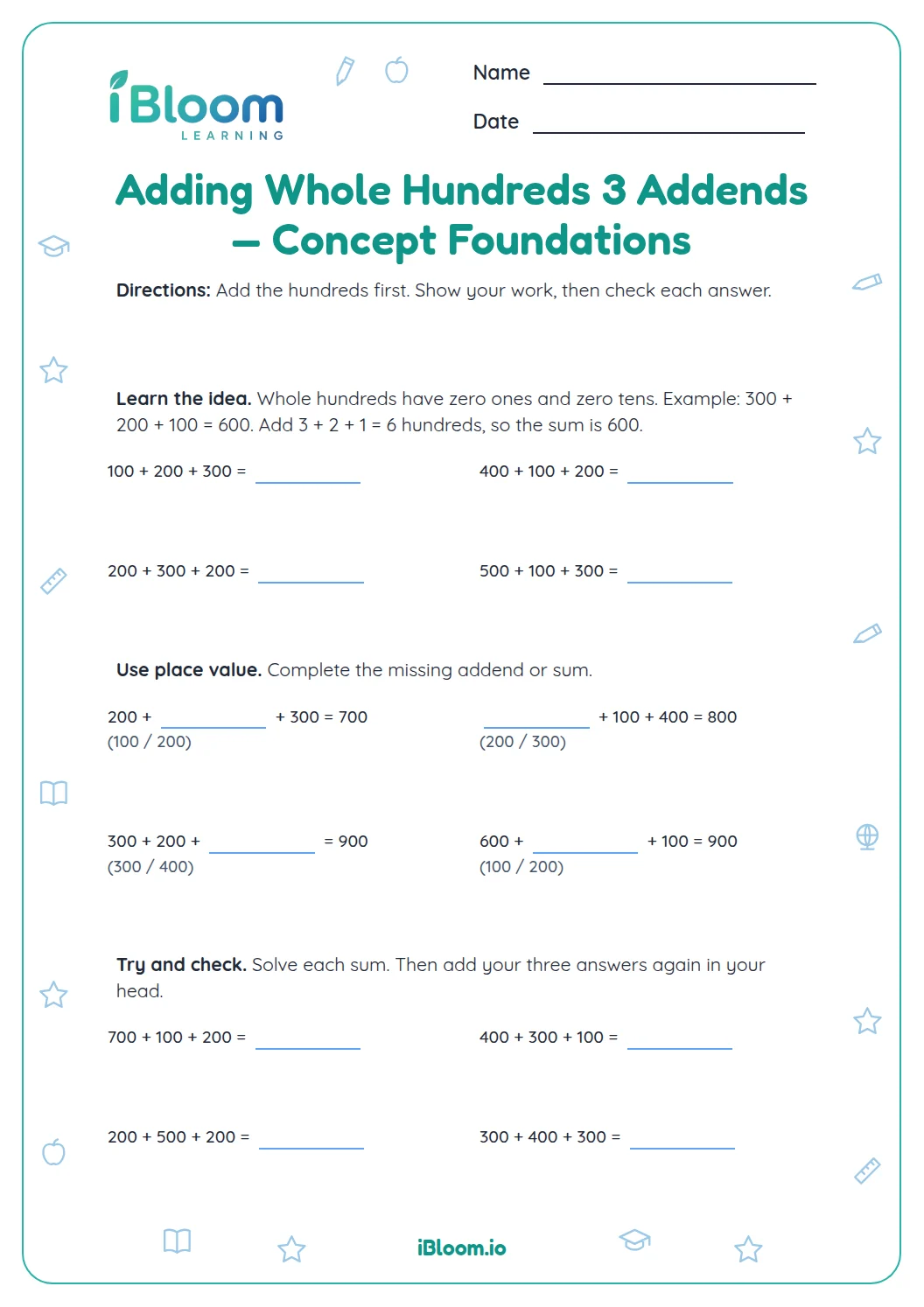
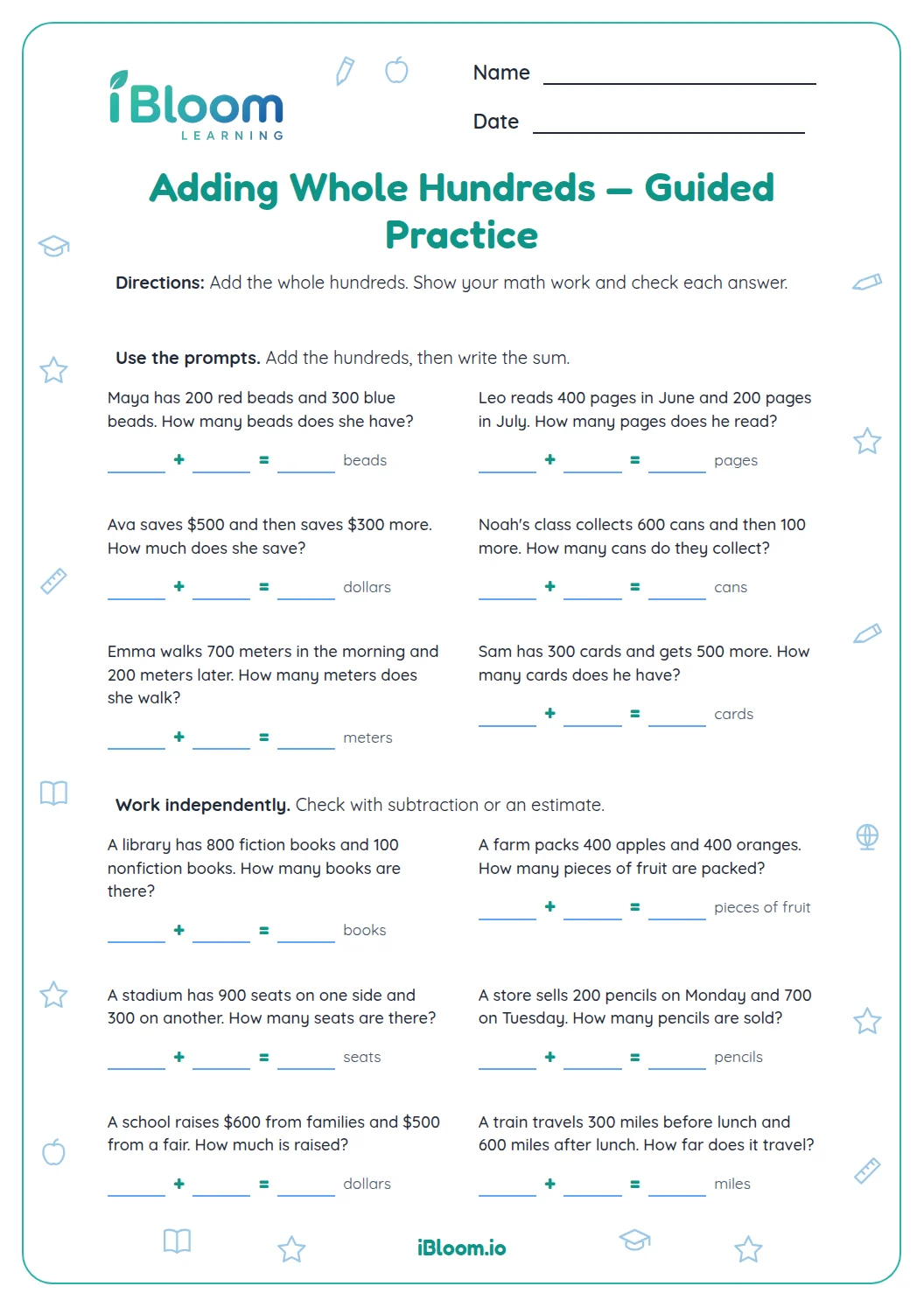
This Grade 3 printable practices adding three whole hundreds through number sentences and real-world contexts. Learners add amounts such as visitor counts, books, and harvested fruit, then label each total. The answer key lists the sums for all 15 questions.
Aligned to 3.NBT.A.2
How do you add three hundreds?
Add two addends first, then add the third. For 300 + 200 + 400, combine 300 + 200 = 500, then 500 + 400 = 900. You can also group 200 + 400 first.
How can an equation organize a story?
In the cans question, the school collected 300, 200, and 400 cans on three days. Write 300 + 200 + 400 = 900, then label the total: 900 cans.
How can you check a total?
Add the hundreds place by place or regroup the addends in a different order. Since changing the order does not change the sum, a second grouping can confirm your result.
How to use this worksheet
- 1Underline the three amounts in the story.
- 2Write them as three addends.
- 3Add two amounts, then add the last amount.
- 4Check by changing the grouping.
- 5Include the unit named in the question.
Common mistakes and quick fixes
The mistake
Leaving out one amount.
The fix
Mark all three numbers before writing the equation.
The mistake
Adding only two addends.
The fix
Count the plus signs: three addends need two plus signs.
The mistake
Writing the number without a unit in a story.
The fix
Reread the question and label cans, visitors, books, or meters.
Common Core alignment
This practice connects the worksheet activity to the following Common Core skill.
Fluently add within 1,000 using place-value strategies.
On this sheet: Each question adds three whole-hundred addends, with totals within 1,000.
Show the official wordingHide the official wording
Fluently add and subtract within 1000 using strategies and algorithms based on place value, properties of operations, and/or the relationship between addition and subtraction.
What to practice next
Make more practice
Further reading
Questions parents and teachers ask
What numbers are added on this sheet?
Each question uses three whole-hundred amounts. Students combine amounts such as 300, 200, and 400, then state a total. The word problems use contexts including cans, books, visitors, fruit, and classroom materials. The five opening equations warm up the same addition used later in the stories.
How can children add three amounts?
Add two amounts first, then add the third. For 300 + 200 + 400, combine 300 and 200 to make 500, then add 400 for 900. Regrouping the addends is another way to check. Grouping two hundreds first can make a friendly total before adding the third.
Should students write an equation for each story?
Yes. The story questions ask for an addition equation with three addends. Writing all three amounts before calculating helps students avoid leaving out a day, group, or category. Each story supplies three amounts; the equation should include all three addends.
Why should the answer include a unit?
A unit connects the sum to what the story counts, such as cans, books, or meters. Reread the question after calculating and add its unit to the numerical total. The answer should name what the total counts, such as books, visitors, or cans.
Is there a separate answer key?
Yes. A separate answer key lists each sum. For story problems, compare both the total and the unit, and check that the equation includes all three amounts from the prompt. The key shows the total and unit so students can check both parts.