



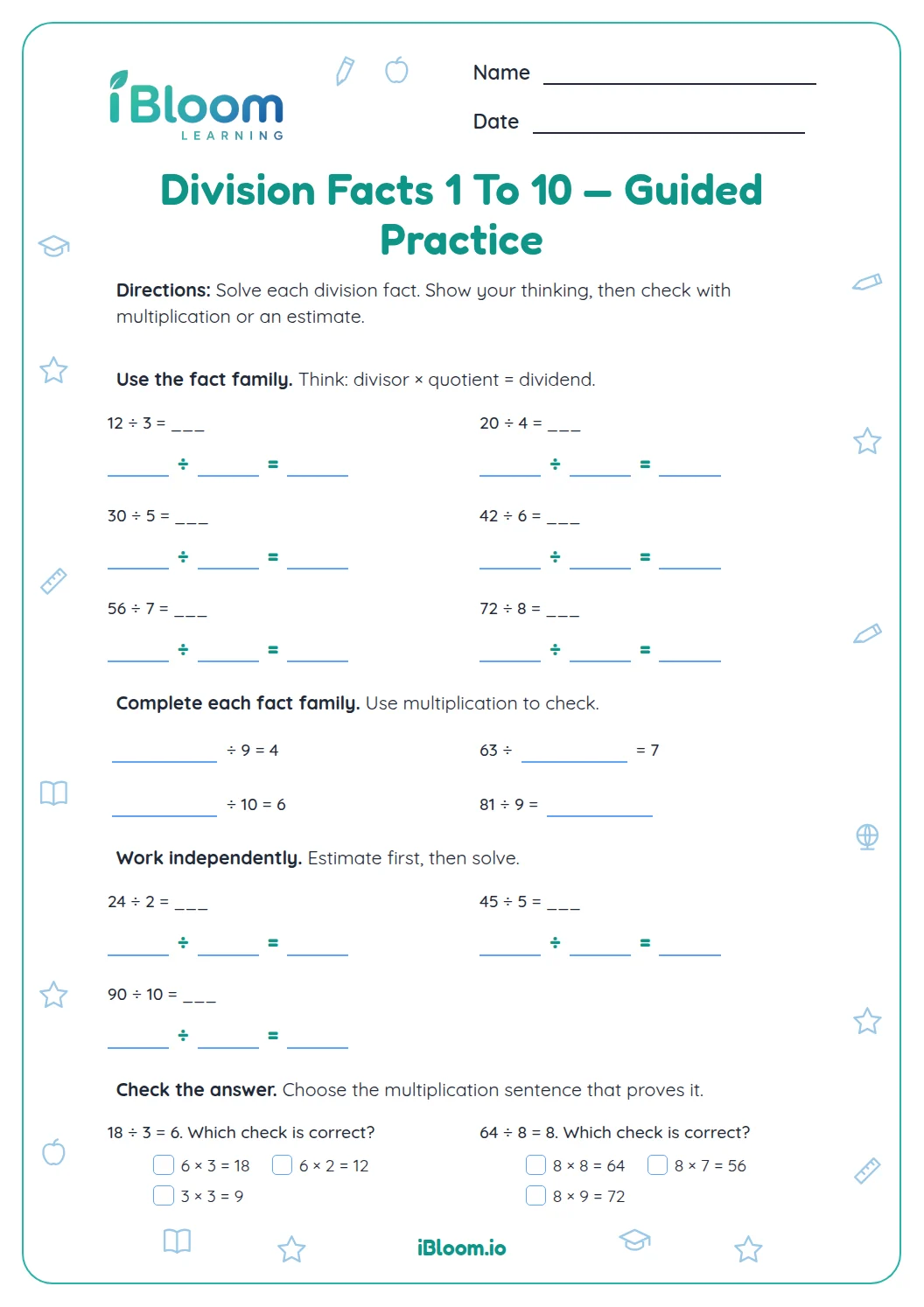

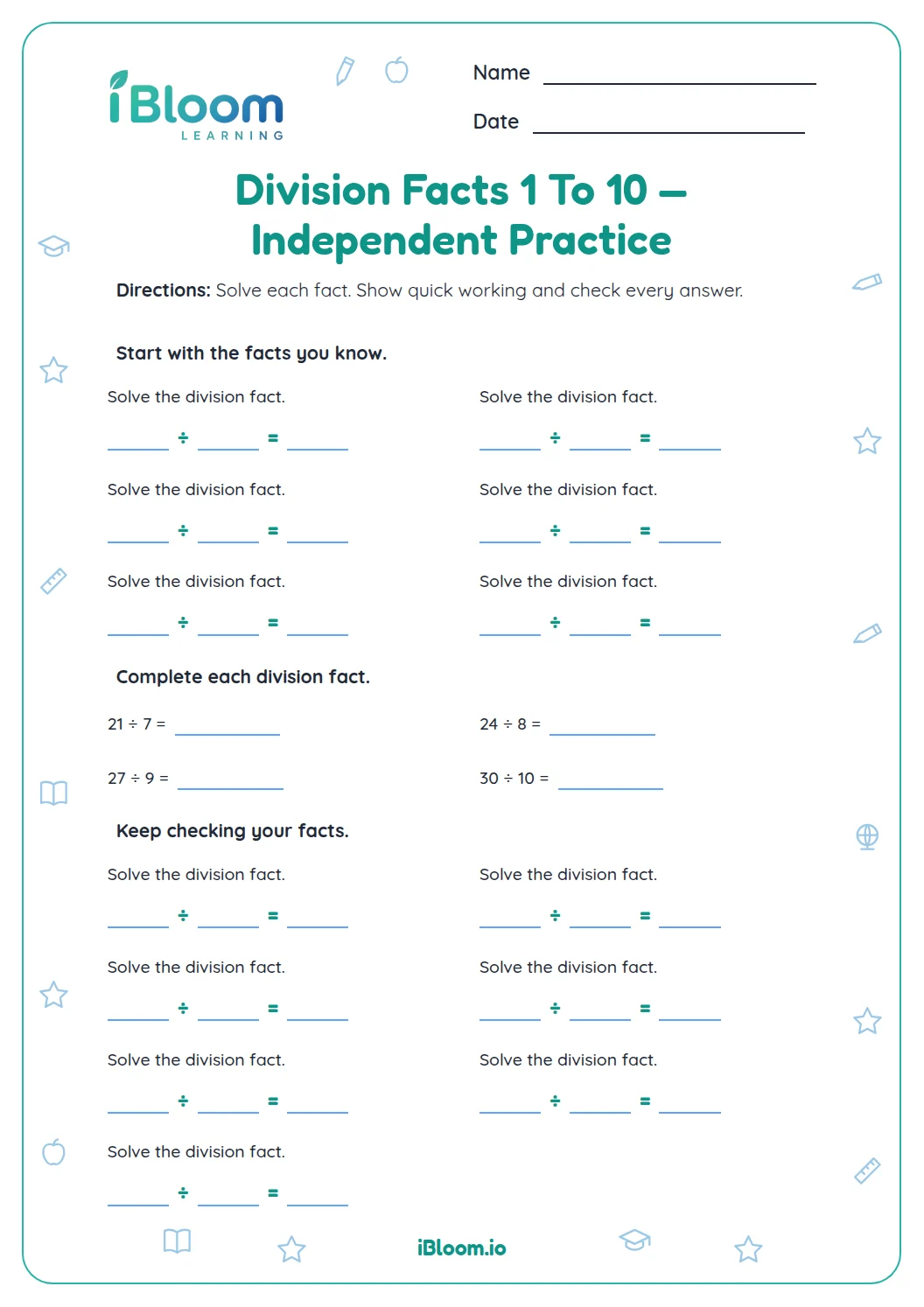
About this worksheet
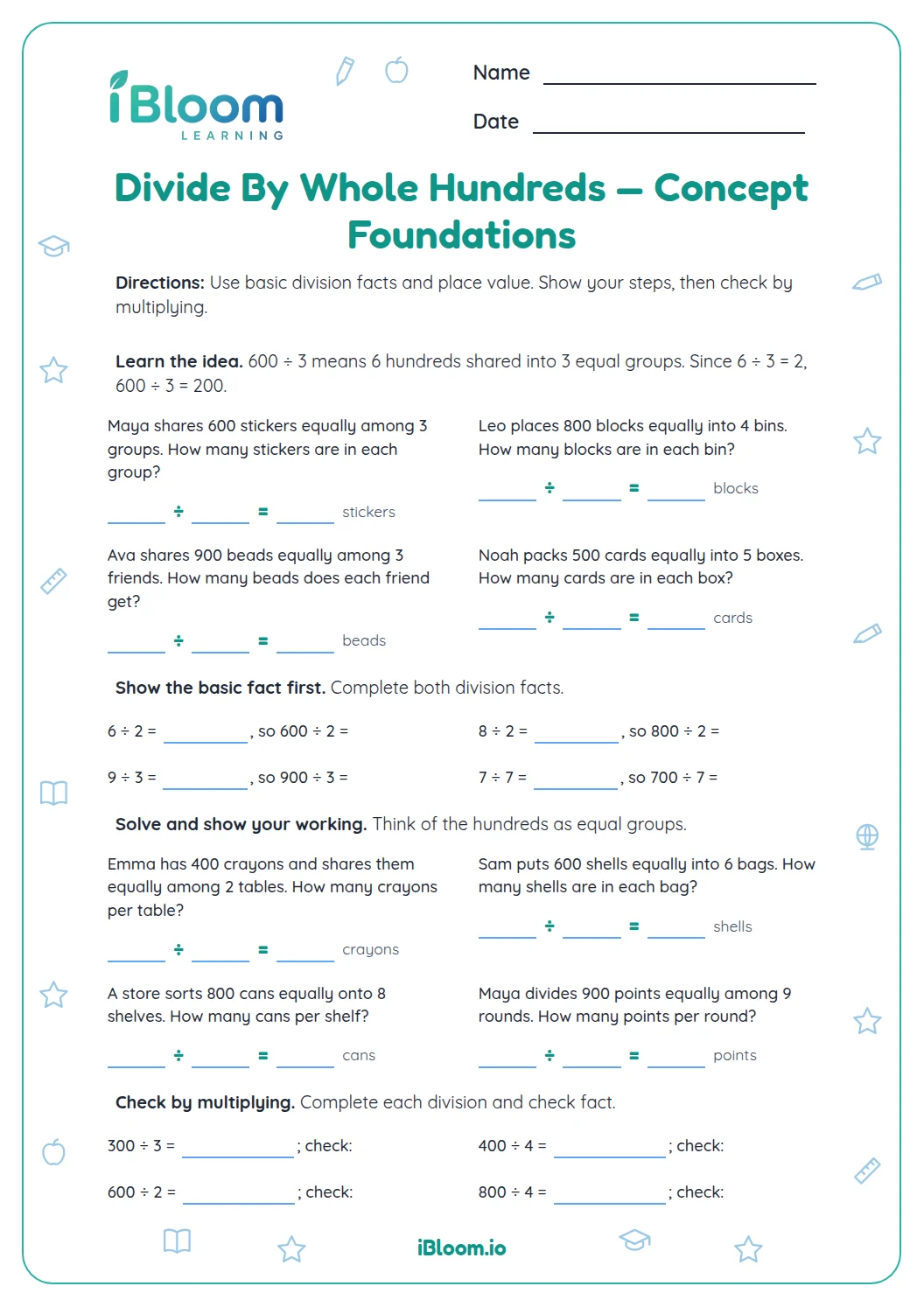
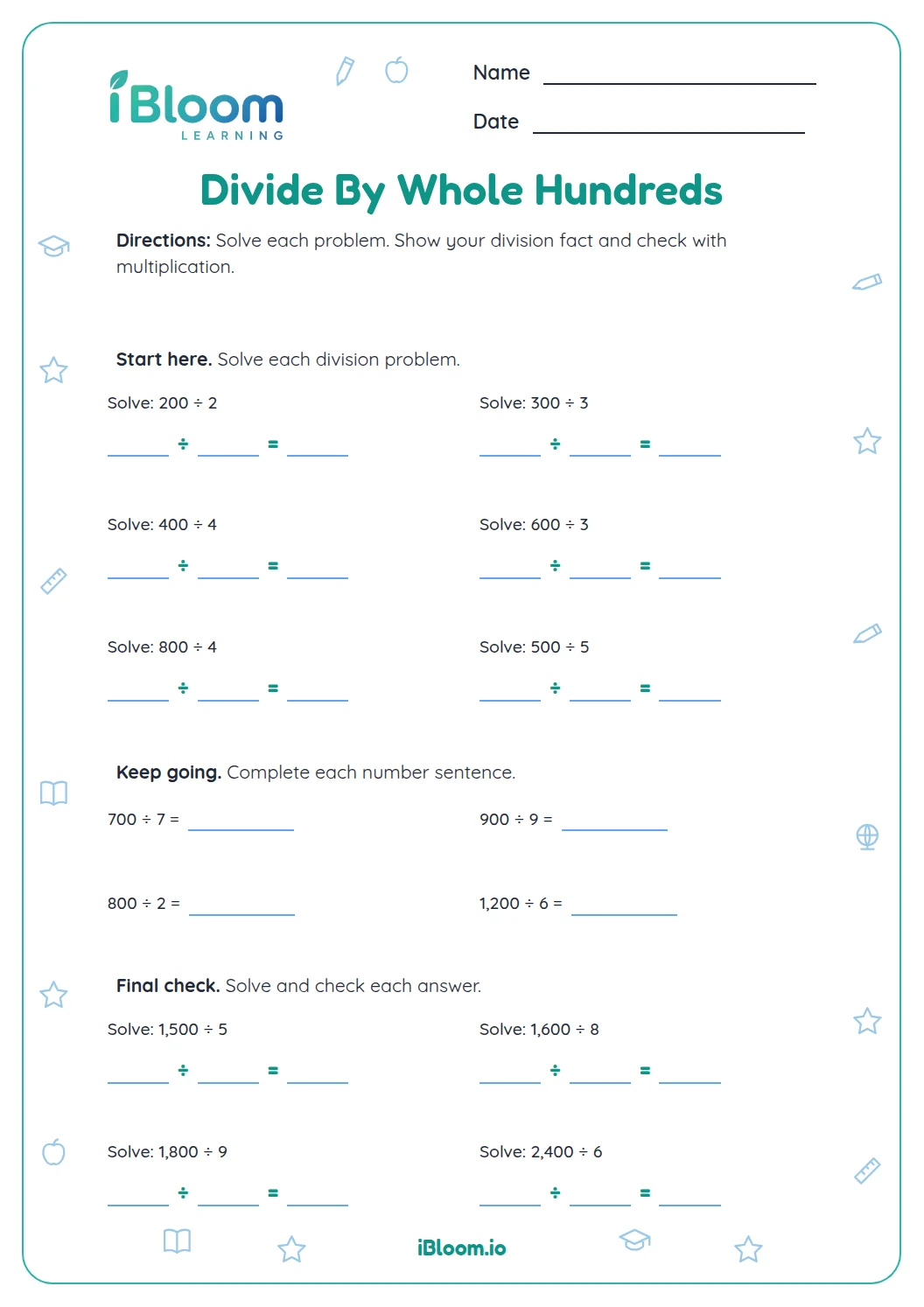
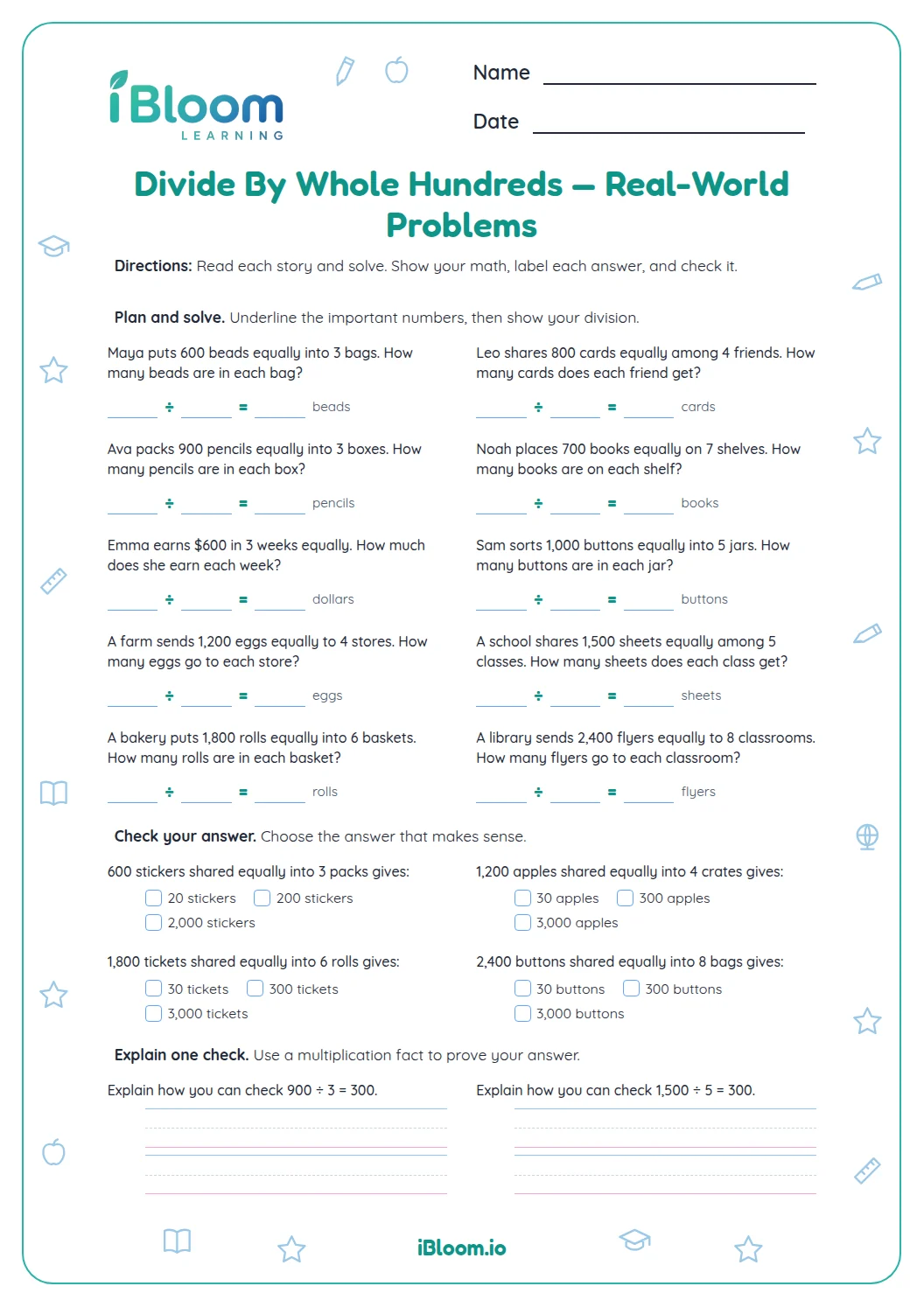
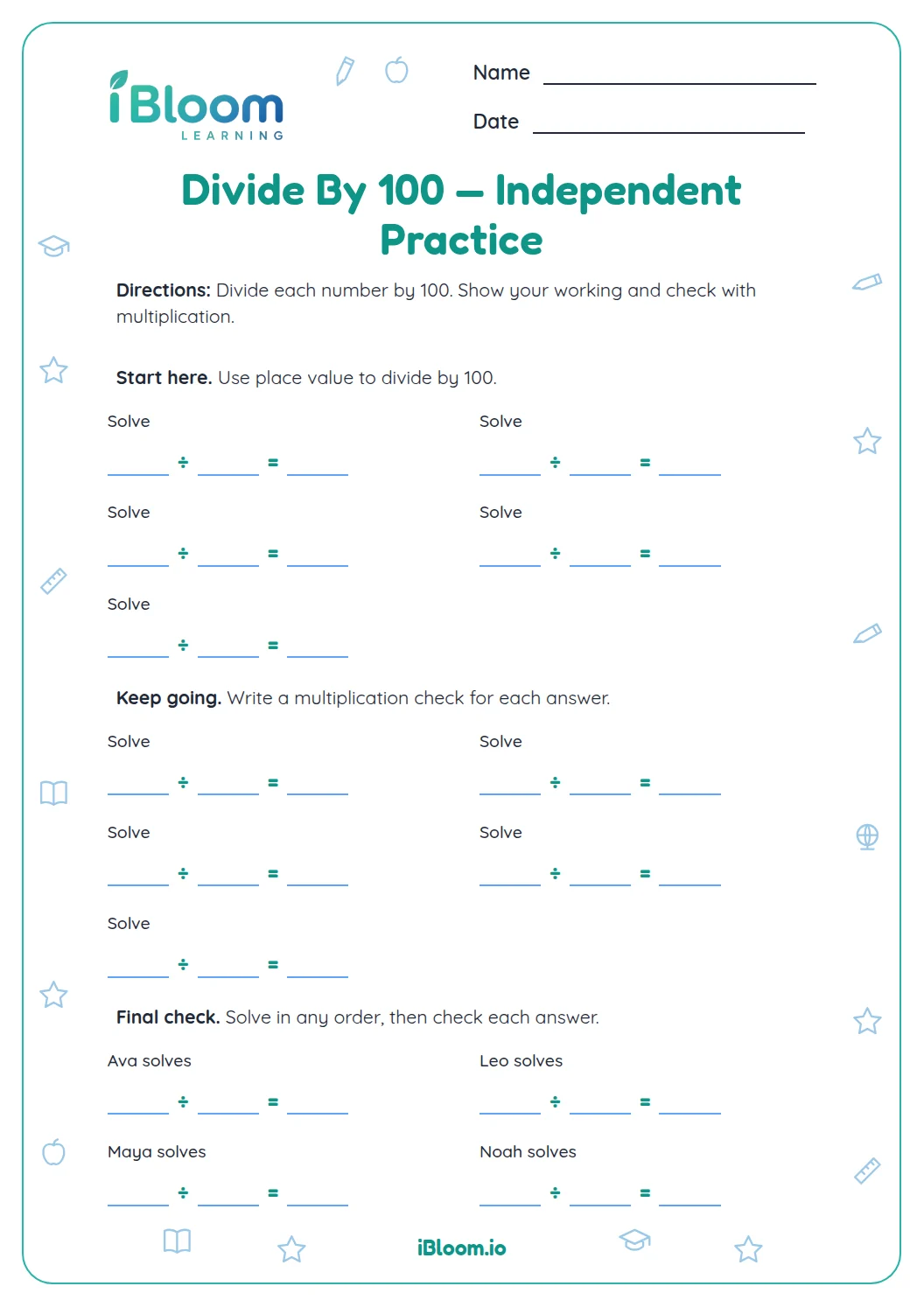
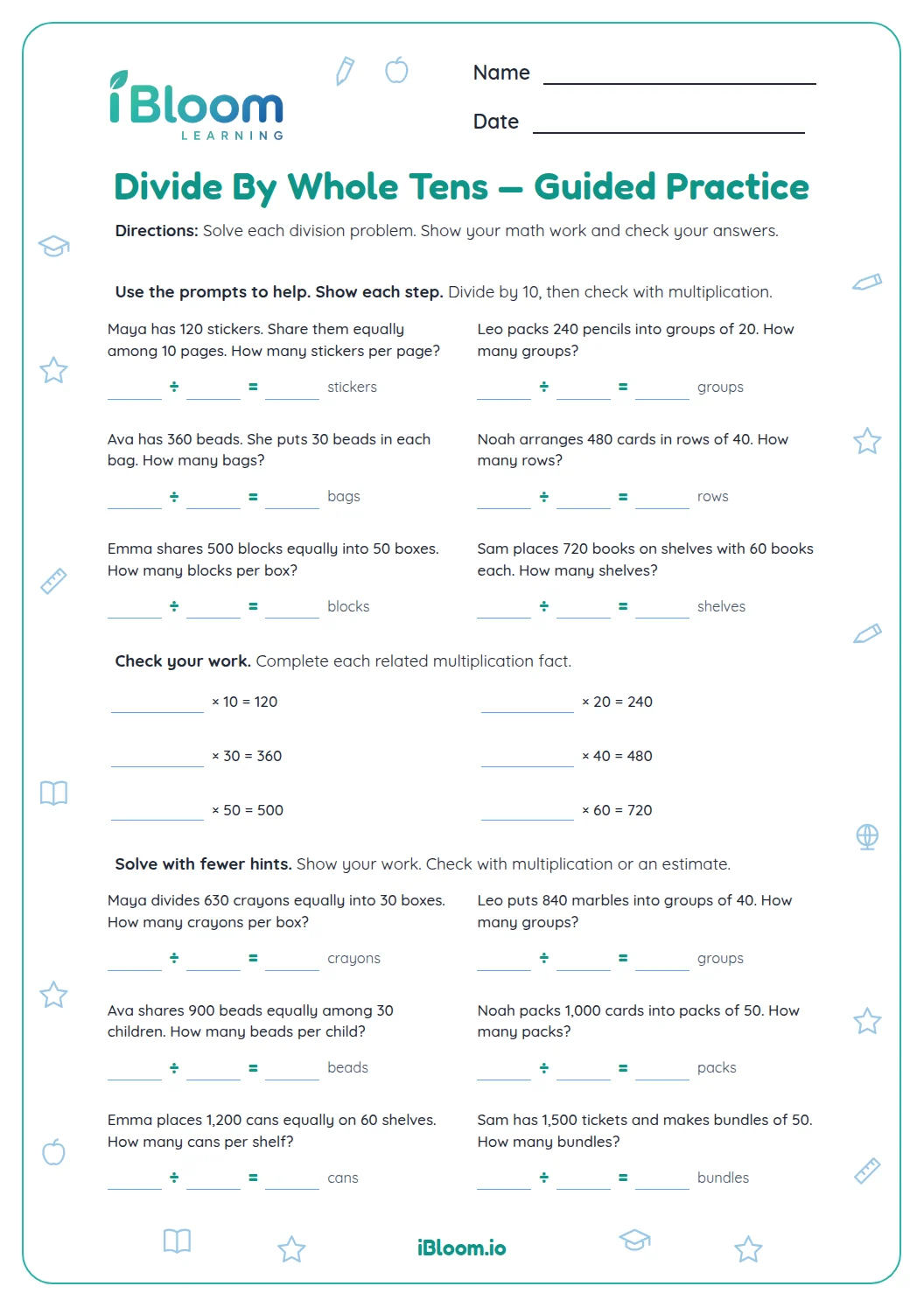
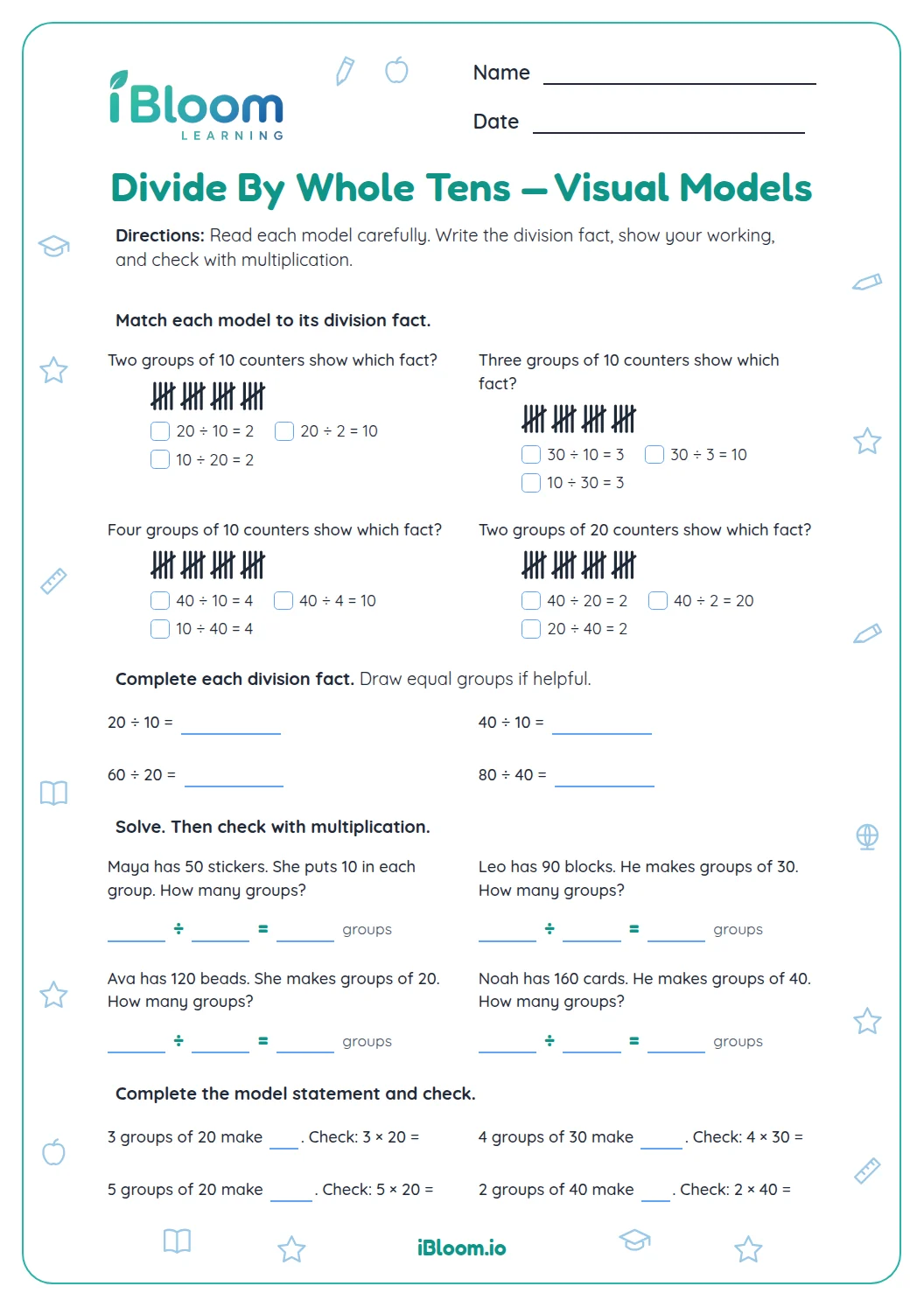
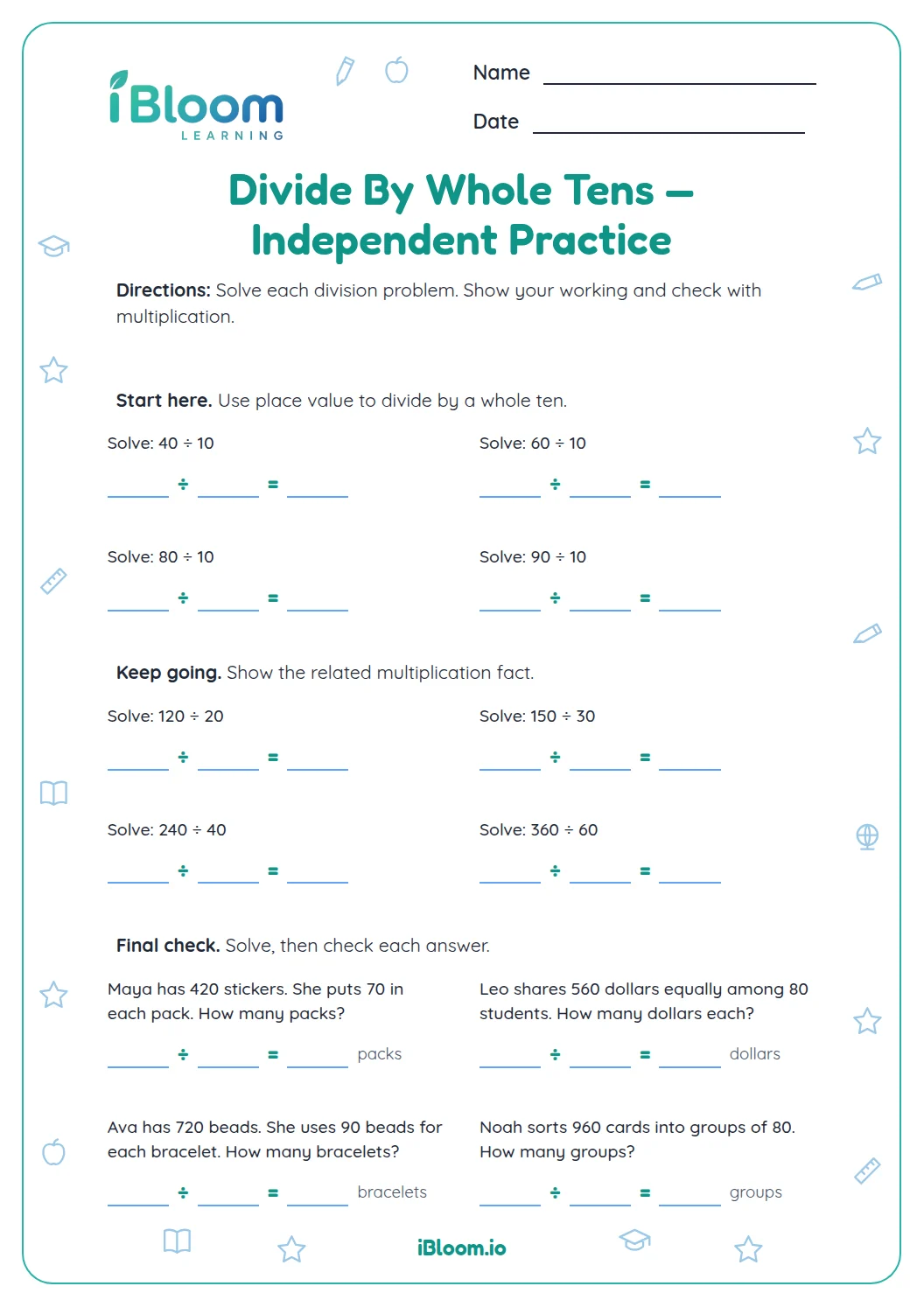
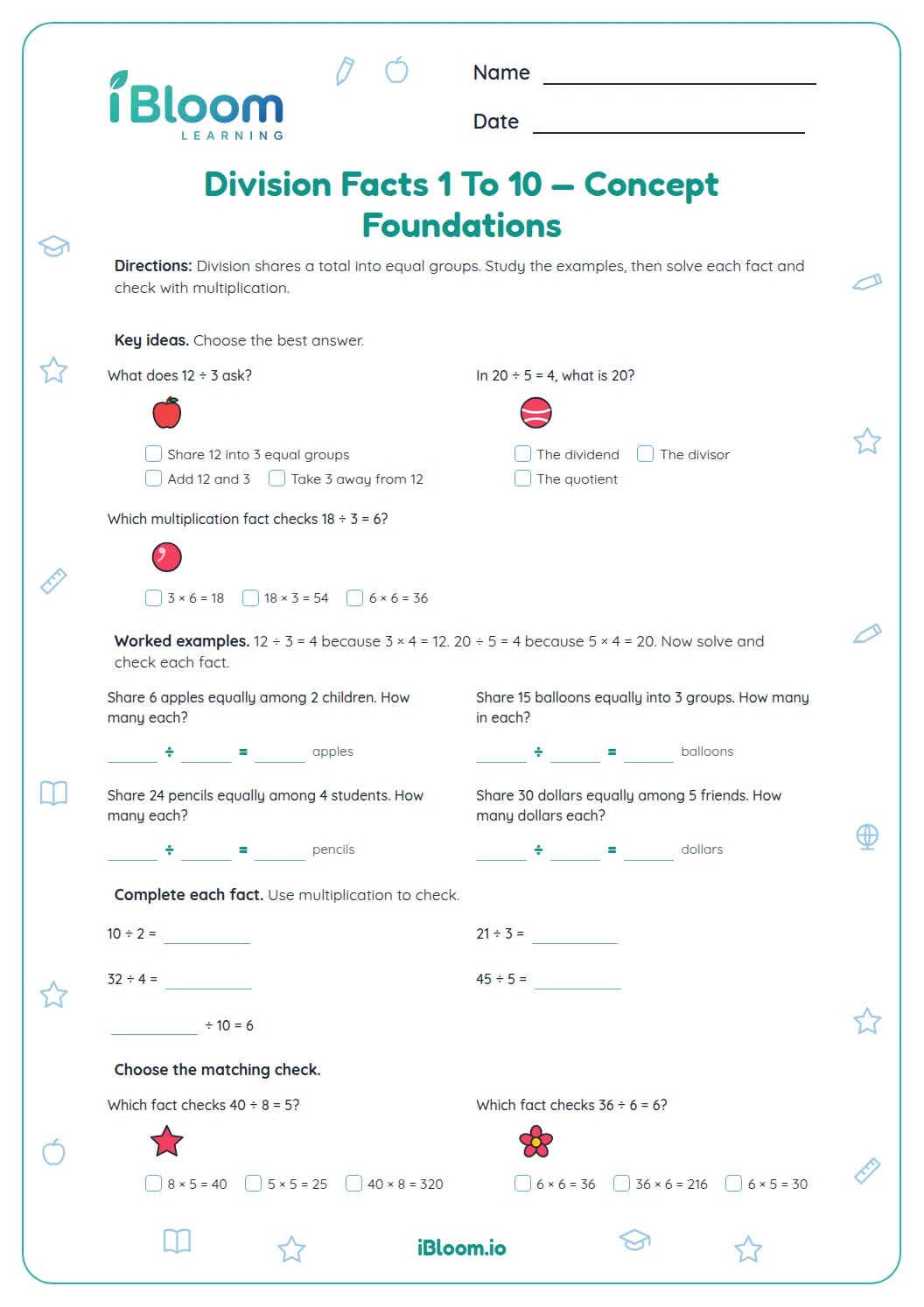
This printable Grade 3 division worksheet asks children to reason about division by sharing whole hundreds into equal groups. Four multiple-choice items inspect common reasoning, eight equations ask for quotients, and four missing-number questions use the related multiplication fact. The answer key gives quotients and checks. For example, 600 ÷ 3 can be checked by asking what number times 3 equals 600.
Aligned to 3.OA.B.6
Where do the zeros go in a quotient?
Think of 600 as 6 hundreds. Sharing 6 hundreds among 3 groups gives 2 hundreds, or 200. In question 5, 600 ÷ 3 = 200; checking 200 × 3 returns 600.
How does multiplication check division?
For a division sentence a ÷ b = c, multiply c × b. If the product equals a, the quotient is correct. This connects every quotient on the page to a missing-factor question.
How do I find a missing number?
Use the equation’s relationship. In 900 ÷ ___ = 300, ask which number times 300 equals 900; the missing divisor is 3.
What does the printable include?
The first part checks reasoning, the second solves whole-hundred quotients, and the final part finds missing numbers. The key gives each answer and the multiplication check idea.
How can I use this page?
- 1Read the dividend and divisor carefully.
- 2Think of the dividend in hundreds when it ends in zeroes.
- 3Find the number of hundreds in each equal group.
- 4Multiply quotient by divisor to check.
Common slips and quick fixes
The mistake
Dropping both zeroes and forgetting they represent hundreds.
The fix
Name the units: 6 hundreds shared into 3 groups is 2 hundreds.
The mistake
Using the divisor as the quotient.
The fix
Ask how many equal groups or how many in each group the division describes.
The mistake
Checking with a different operation.
The fix
Multiply quotient by divisor and compare with the original dividend.
Common Core alignment
The questions connect division with its related multiplication fact.
Check a quotient by finding the factor that multiplies by the divisor to make the dividend.
On this sheet: Each quotient can be checked as an unknown factor in a multiplication equation.
Show the official wordingHide the official wording
Understand division as an unknown-factor problem. For example, find 32 ÷ 8 by finding the number that makes 32 when multiplied by 8.
What to practice next
Make more practice
Further reading
Questions parents and teachers ask
How does place value help with 600 ÷ 3?
Think of 600 as 6 hundreds. Dividing 6 hundreds into 3 equal groups gives 2 hundreds in each group, or 200. Multiplication confirms the result because 200 × 3 = 600. The related fact is 200 groups of 3, which totals 600; naming the hundreds helps preserve both zeroes in the dividend.
How do I check a quotient?
Multiply the quotient by the divisor. For 700 ÷ 7 = 100, check 100 × 7 = 700. If the product matches the dividend, the quotient is correct. Reversing the check gives the matching multiplication statement, which should return exactly to the starting dividend.
Why is 800 ÷ 4 not 2?
The 8 in 800 means 8 hundreds, not 8 ones. Four equal groups of 8 hundreds contain 2 hundreds each, so 800 ÷ 4 = 200. Four groups of 200 make 800, while four groups of 2 make only 8; the quotient must reflect the hundreds.
How do I solve 900 ÷ ___ = 300?
Find the number that makes 300 times the divisor equal 900. Since 300 × 3 = 900, the missing divisor is 3. The page’s final part gives more missing-number items. Think of 300 as the quotient and the missing divisor as the factor; multiplication shows that factor is 3.
What is on the answer key?
The key provides the correct choices, each whole-hundred quotient and all four missing numbers. It helps children check their calculations with related multiplication facts. For missing-number items, the key’s numbers can be checked by writing the multiplication sentence beside the division.