




About this worksheet
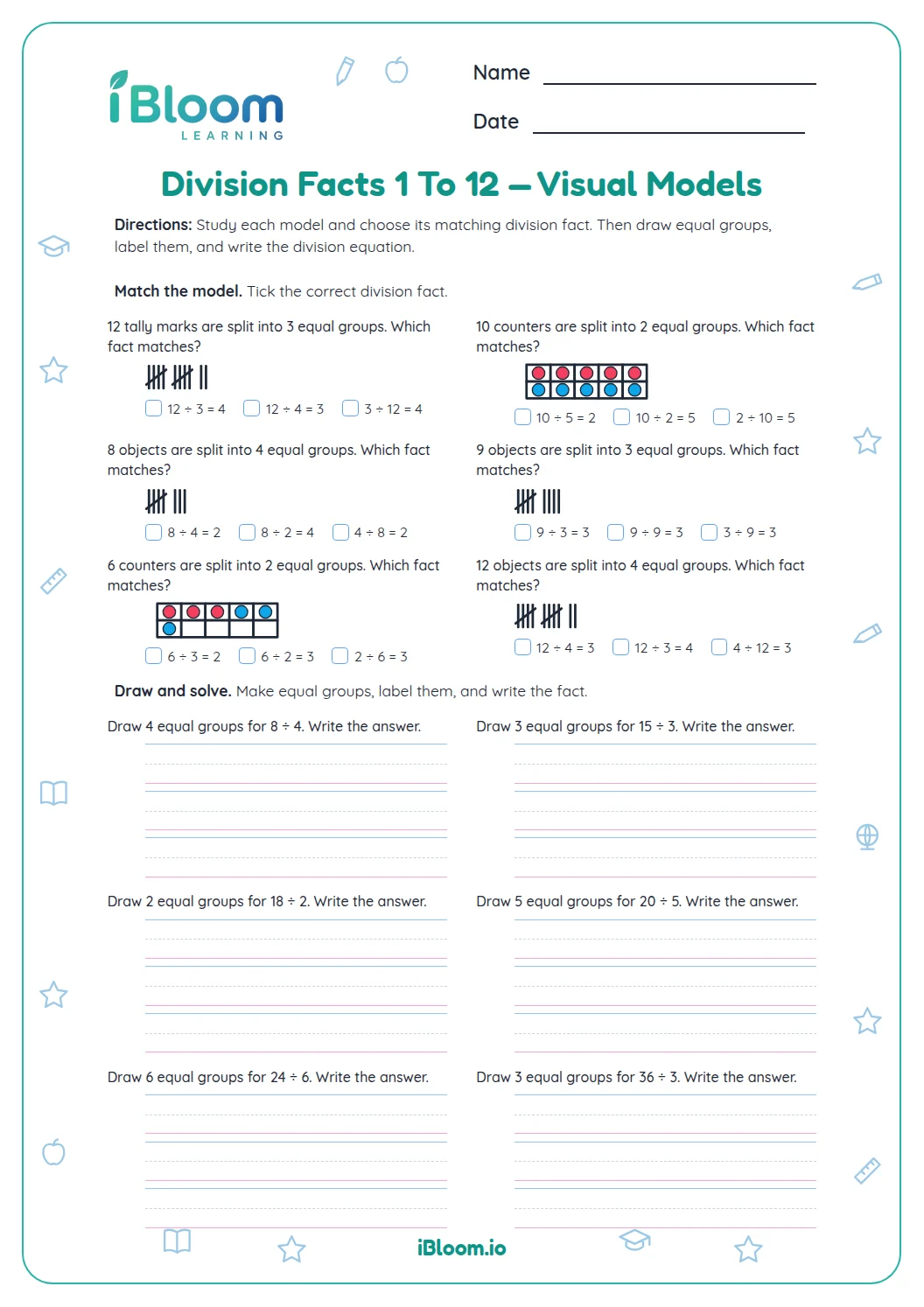
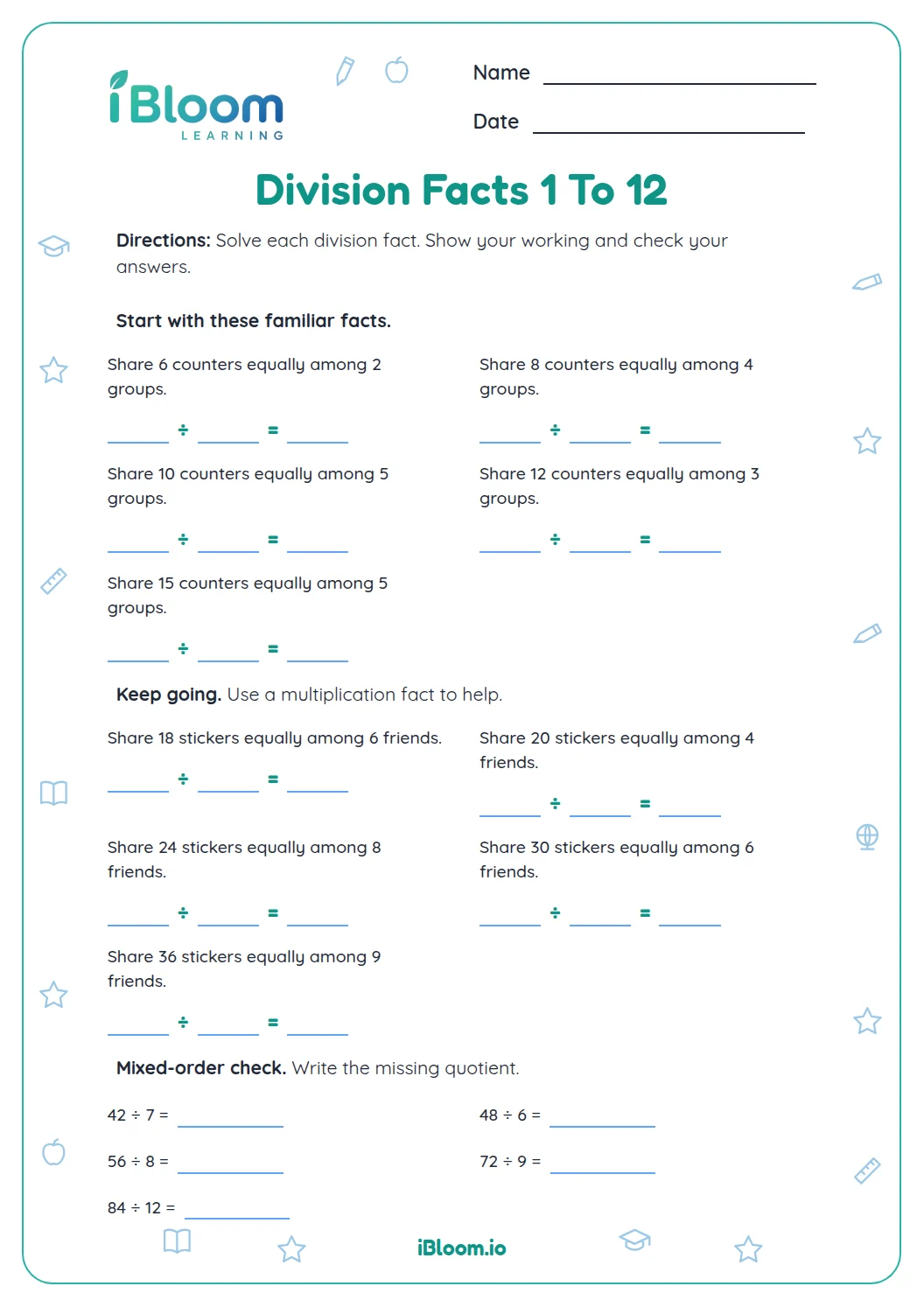
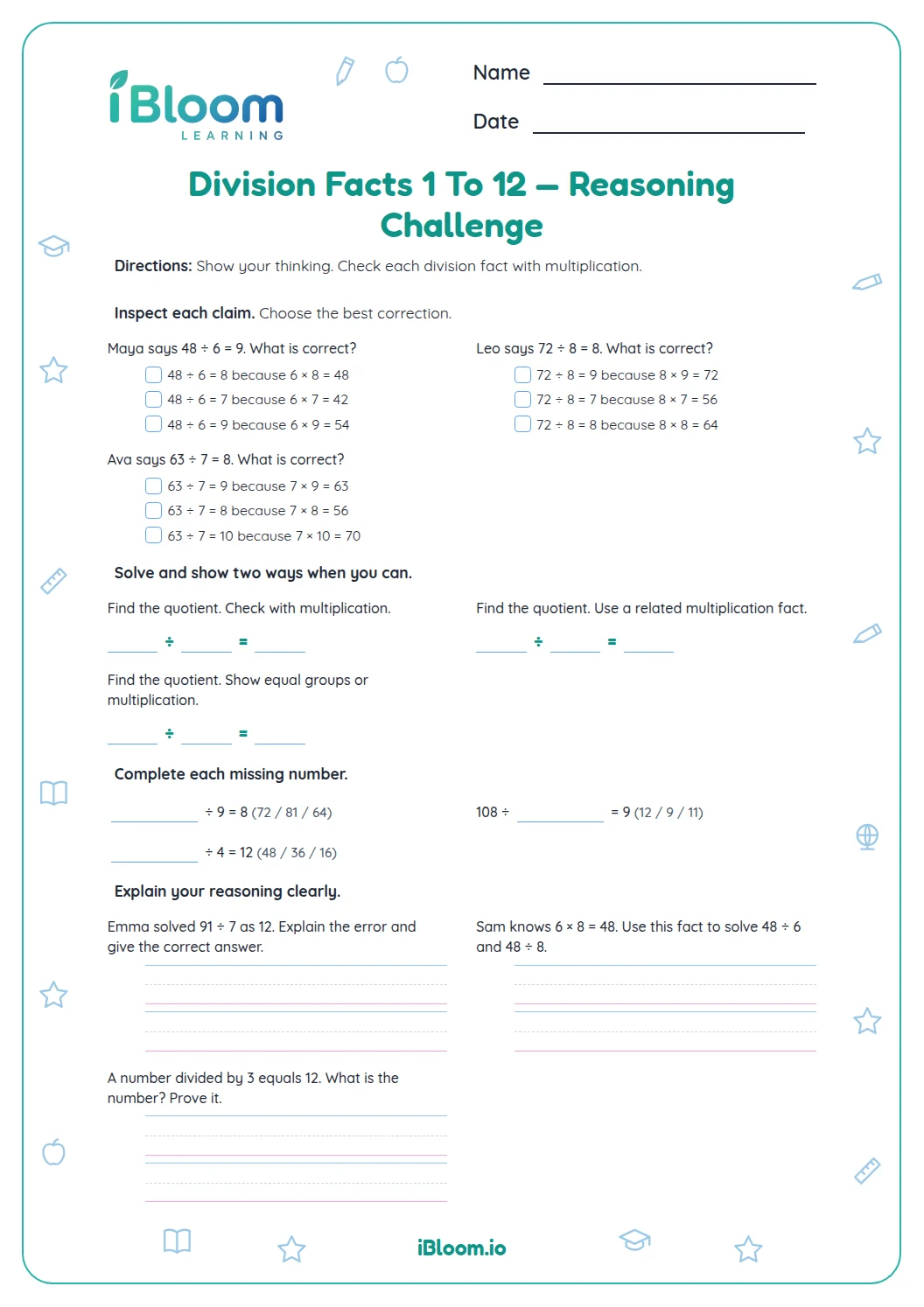
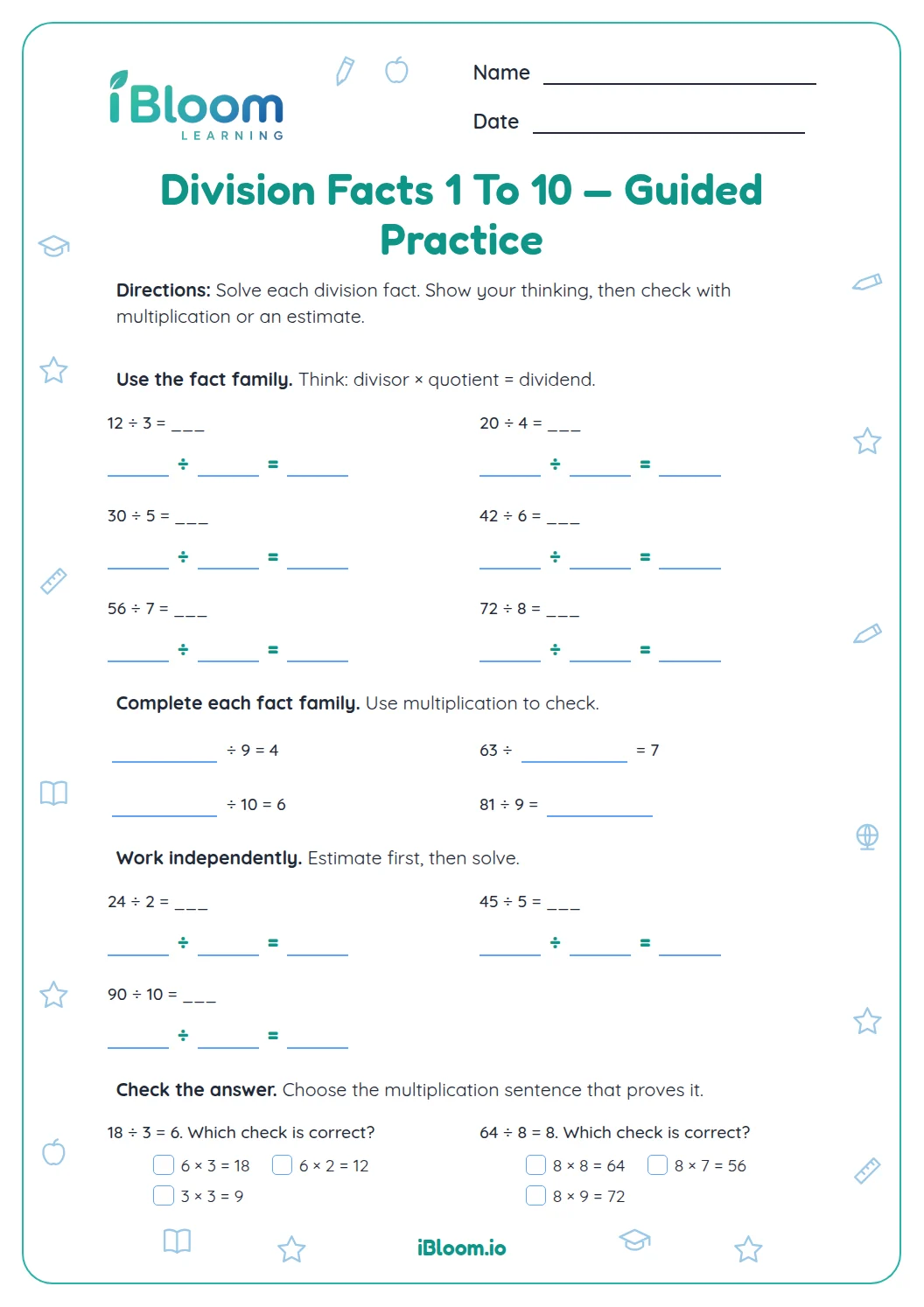
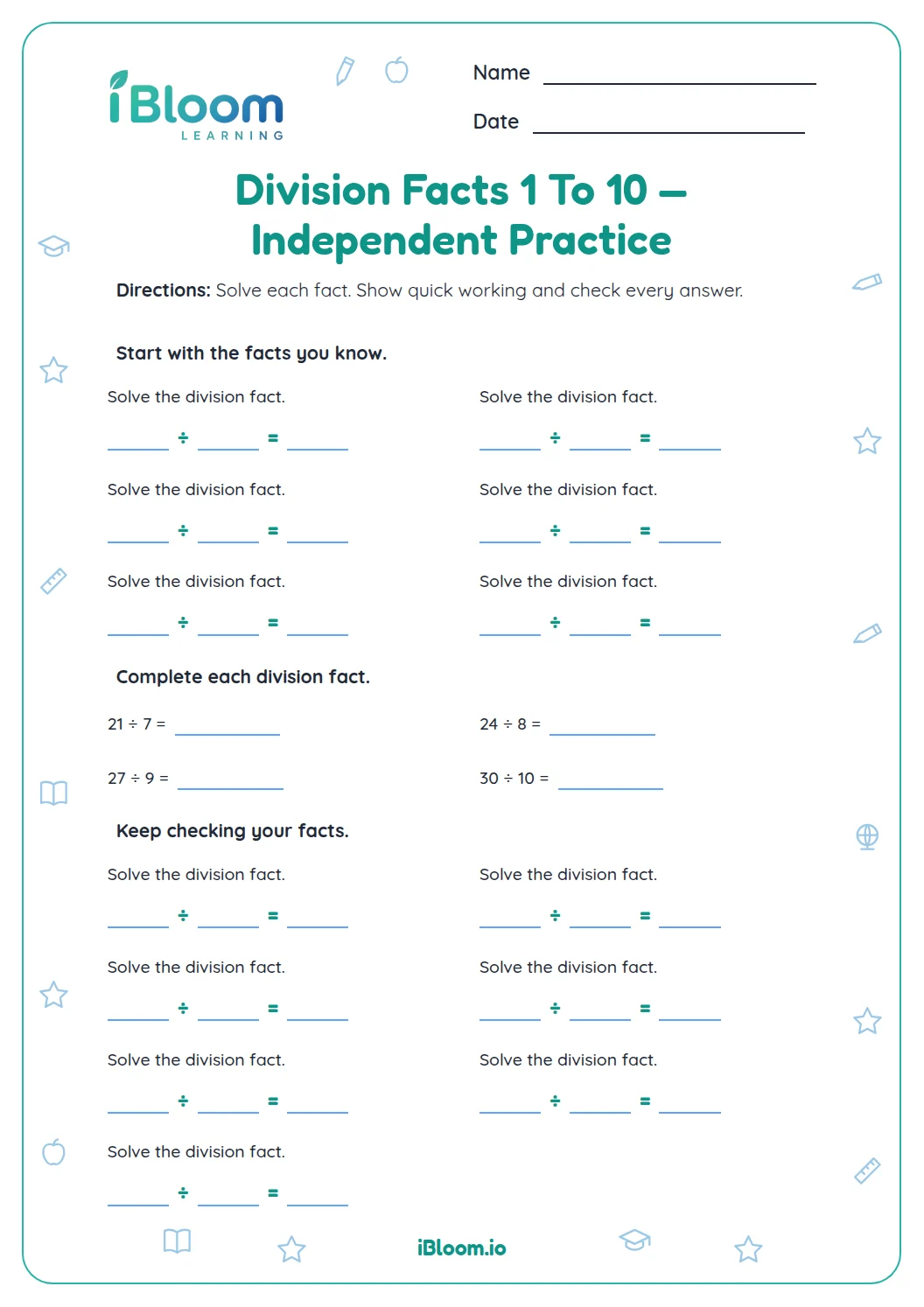
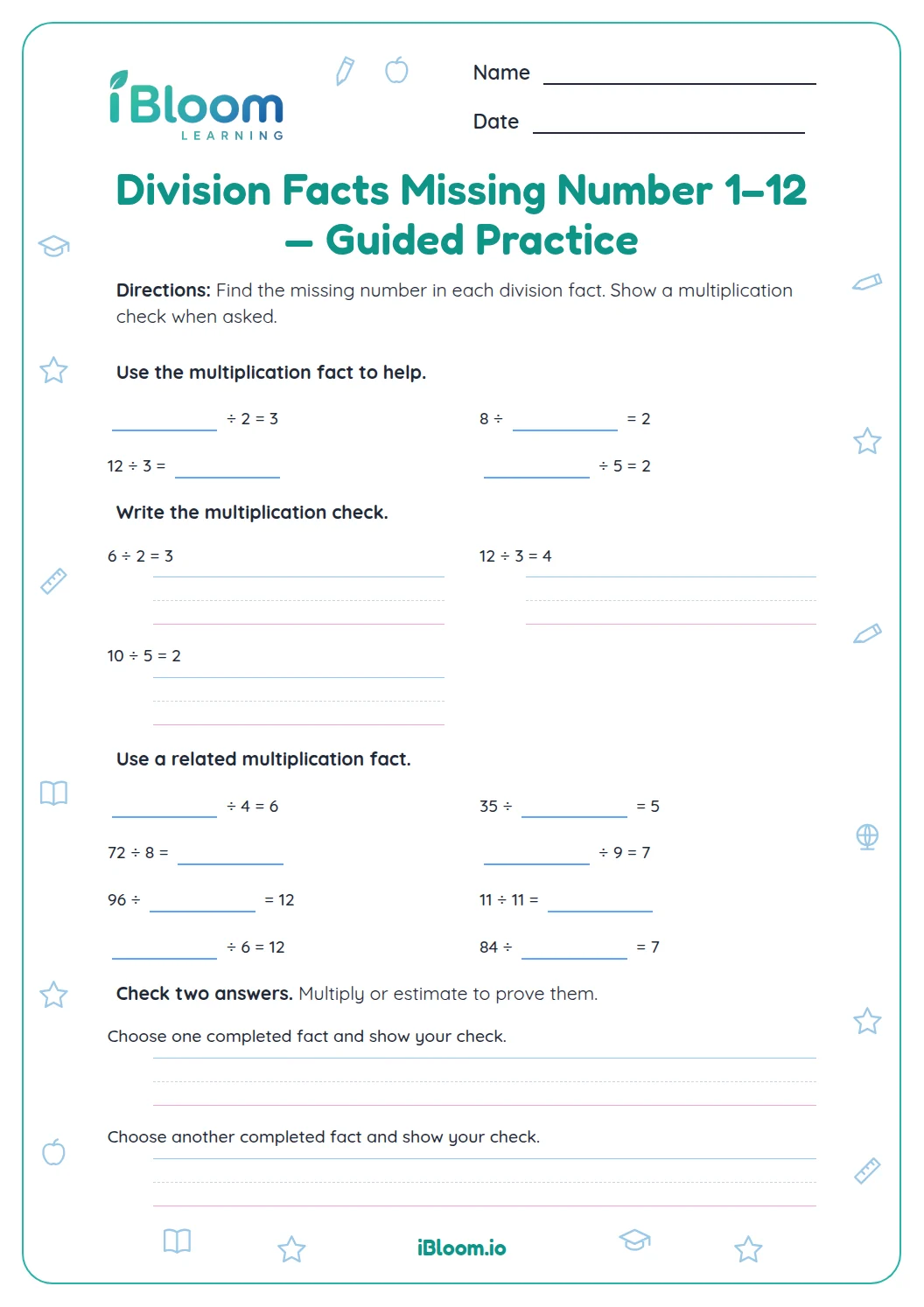
This free Grade 3 division worksheet practices division facts with every divisor from 1 through 12. Children solve 12 equations, work two equal-group stories, and use multiplication to check a fact and describe a missing-factor strategy. An array drawing connects one division fact to equal rows and columns. The answer key gives each quotient and the story units. The practice aligns with Common Core 3.OA.C.7, which calls for fluency with multiplication and division within 100 and using the relationship between the operations.
Aligned to 3.OA.C.7
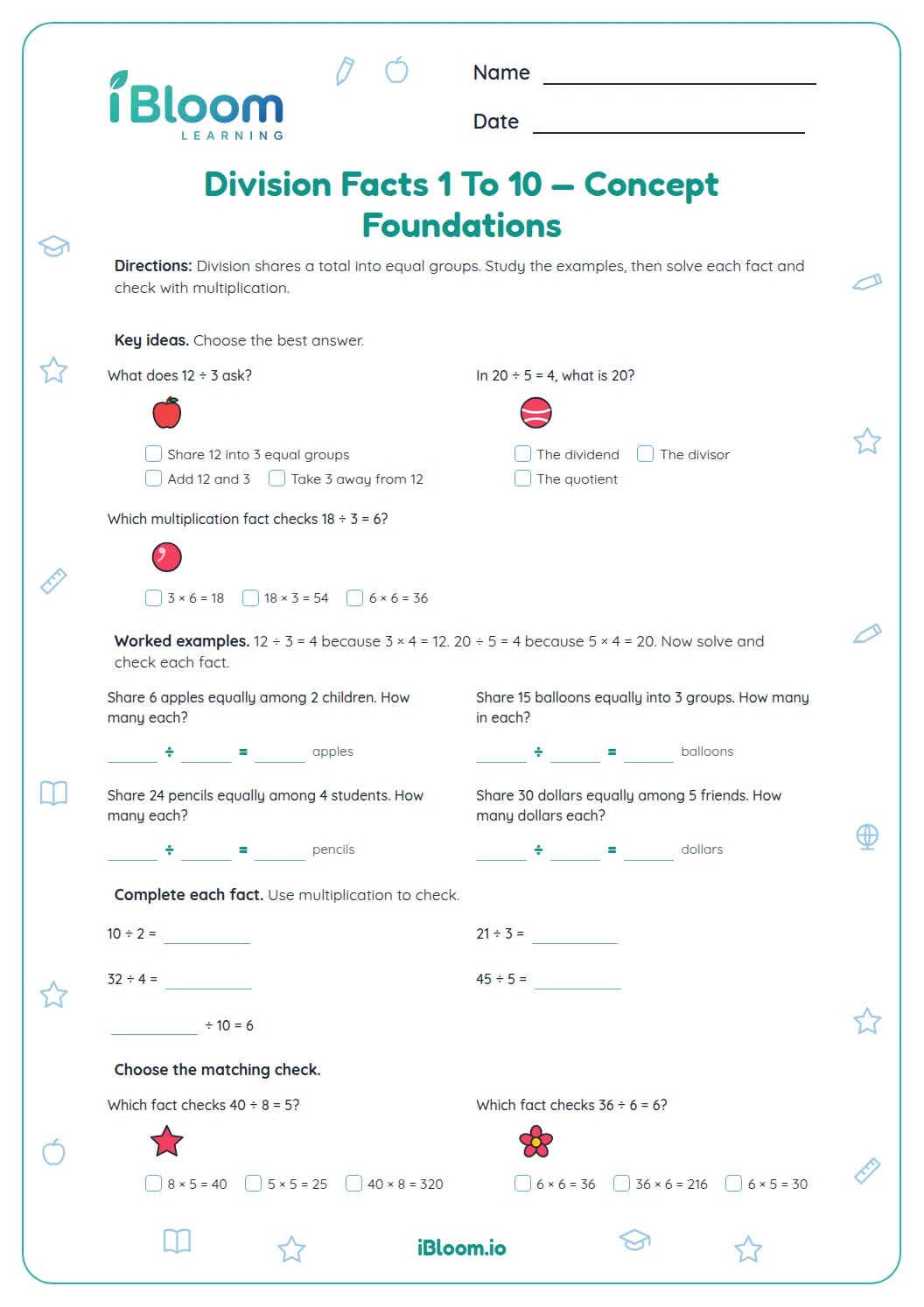
What does a division fact ask?
A quotient can tell how many are in each equal group or how many equal groups can be made. For example, 12 ÷ 3 = 4 means 12 objects arranged in 3 equal groups make 4 in each group.
How does this page practice facts through 12?
The first 12 equations include each divisor from 1 through 12. The array in question 3 shows 12 objects in 3 equal rows.
How do you choose the right division fact in a story?
Find the total and the equal group size, then decide whether the question asks for the size of each group or the number of groups. In question 13, 42 cones shared among 6 teams gives 7 cones per team.
- 142 ÷ 6 = 7
- 2Each team gets 7 cones.
How to use this worksheet
- 1Read the dividend and divisor in each equation.
- 2Use a multiplication fact you know to find the quotient.
- 3For an array, count the equal rows and objects in each row.
- 4In a story, identify the total and the equal groups.
- 5Check a quotient by multiplying it by the divisor.
Common mistakes and quick fixes
The mistake
Using the divisor as the quotient without checking.
The fix
Ask what number multiplied by the divisor equals the total.
The mistake
Mixing up groups and objects per group in a story.
The fix
Underline what is shared and what the question asks you to count.
The mistake
Checking with the same division fact again.
The fix
Use multiplication: divisor × quotient should equal dividend.
Common Core alignment
The equations and equal-group problems connect division facts with multiplication.
Build fluency with multiplication and division within 100 using related facts.
On this sheet: The page practices division facts and uses multiplication to find or verify quotients.
Show the official wordingHide the official wording
Fluently multiply and divide within 100, using strategies such as the relationship between multiplication and division (e.g., knowing that 8 × 5 = 40, one knows 40 ÷ 5 = 8) or properties of operations. By the end of Grade 3, know from memory all products of two one-digit numbers.
What to practice next
Make more practice
Further reading
Questions parents and teachers ask
How can multiplication help with division facts?
Think of the missing factor: 42 ÷ 6 asks what number times 6 makes 42. The missing factor is 7, so the quotient is 7. The worksheet uses related multiplication facts to find and check division answers, building a connection students can reuse across the fact range.
What does an array show in division?
An array arranges objects in equal rows and columns. For 12 ÷ 3, three equal rows of four objects show that each group has four. Counting rows and objects per row connects the drawing to the division equation and helps explain the quotient.
What is a division fact family?
A fact family connects multiplication and division equations made from the same three numbers. If 8 × 6 = 48, then 48 ÷ 8 = 6 and 48 ÷ 6 = 8. Recognizing that connection helps students recall quotients and check their answers efficiently.
What does the answer key include?
The key lists each quotient, missing factor, and unit for the word problems. For array questions, use both the drawing and equation to check that the number of equal groups and objects in each group match the division fact shown.