

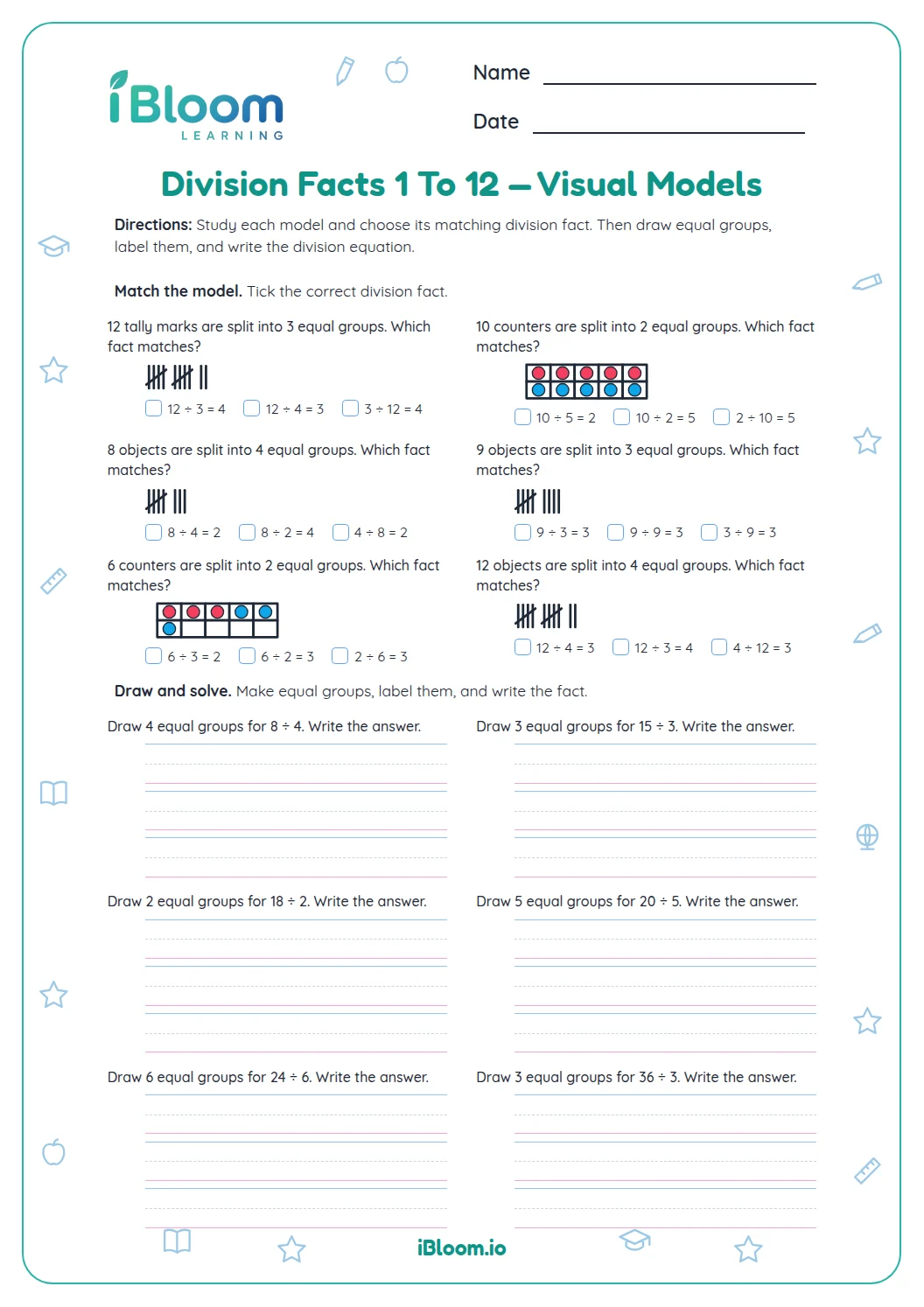
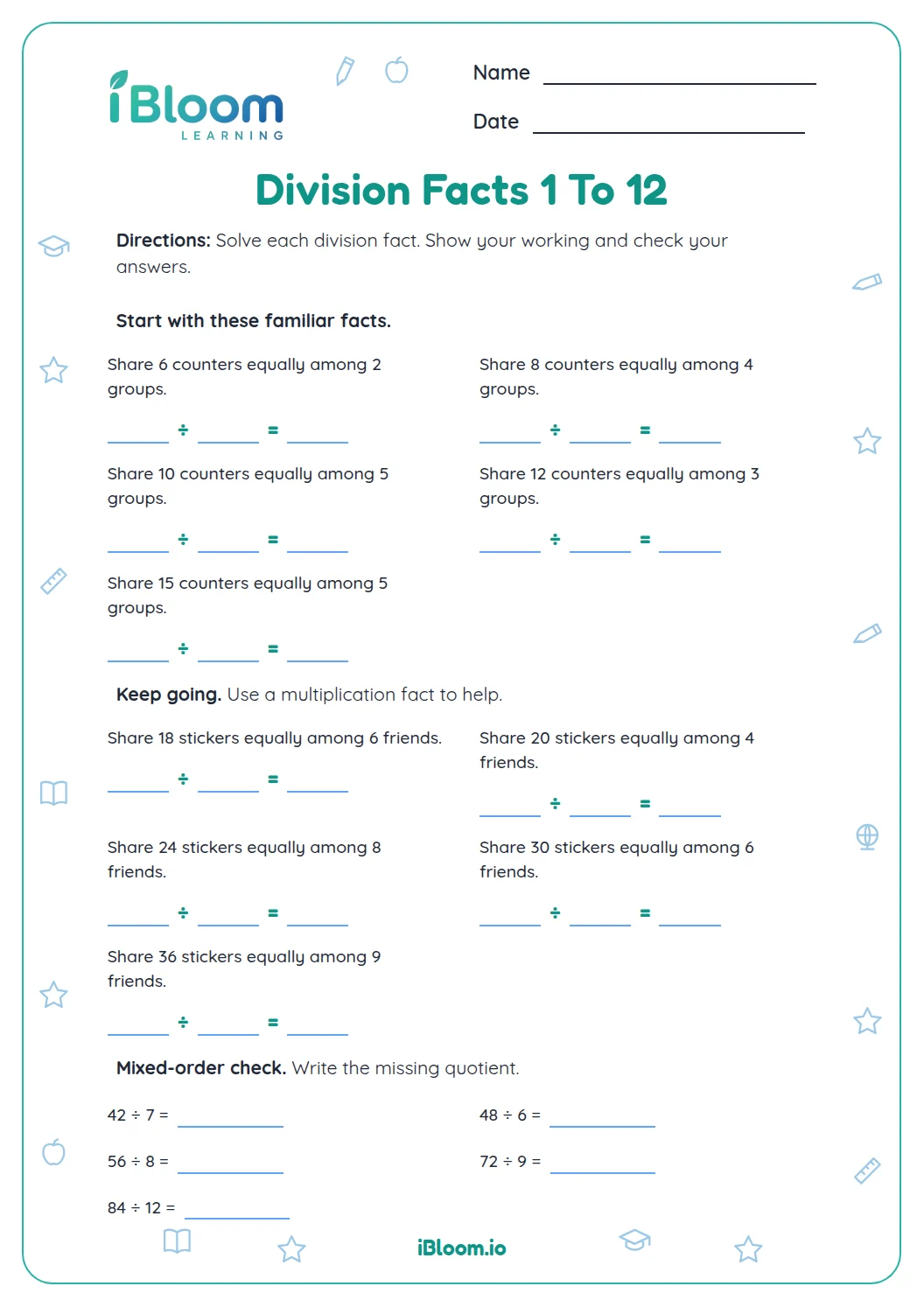
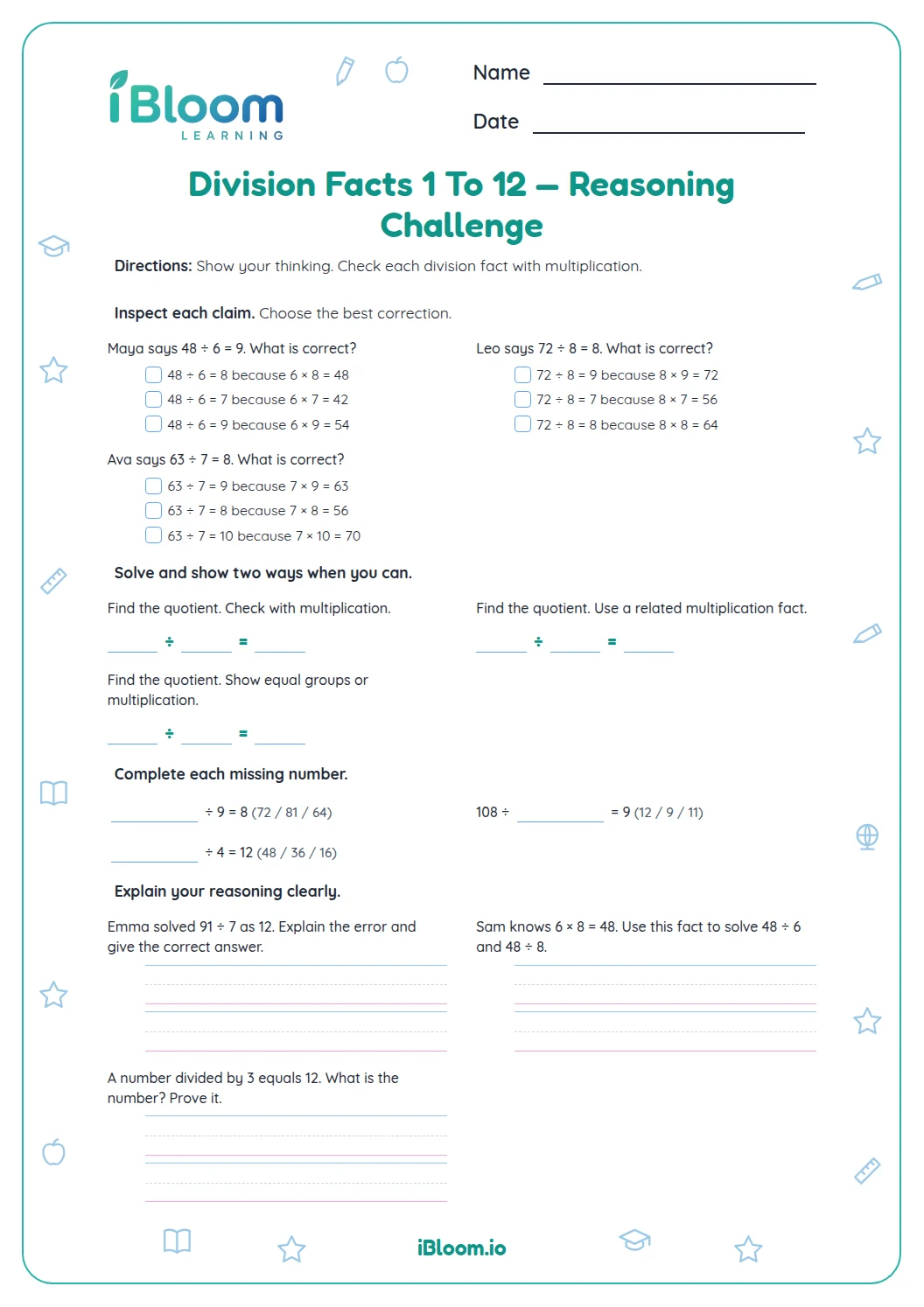
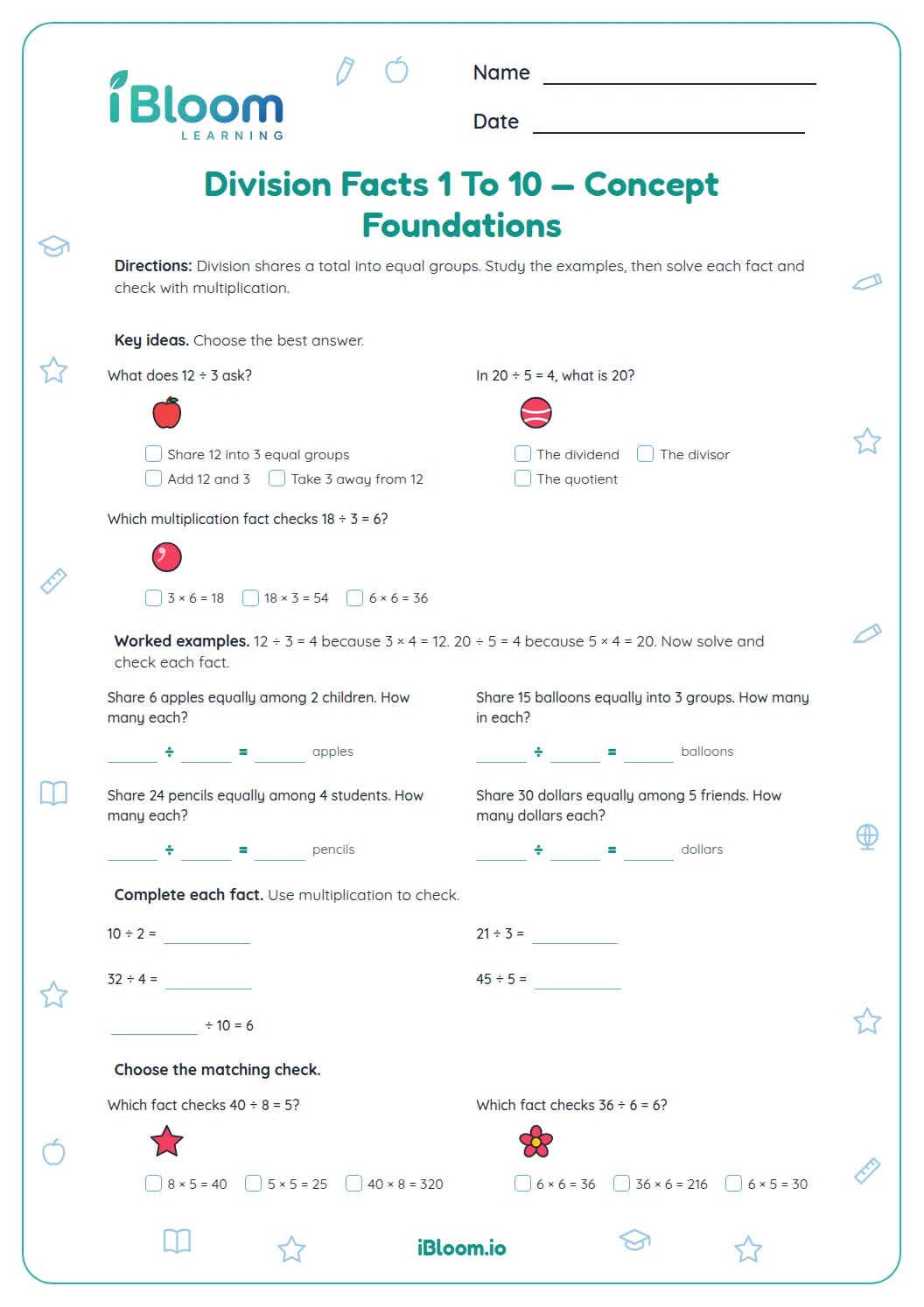



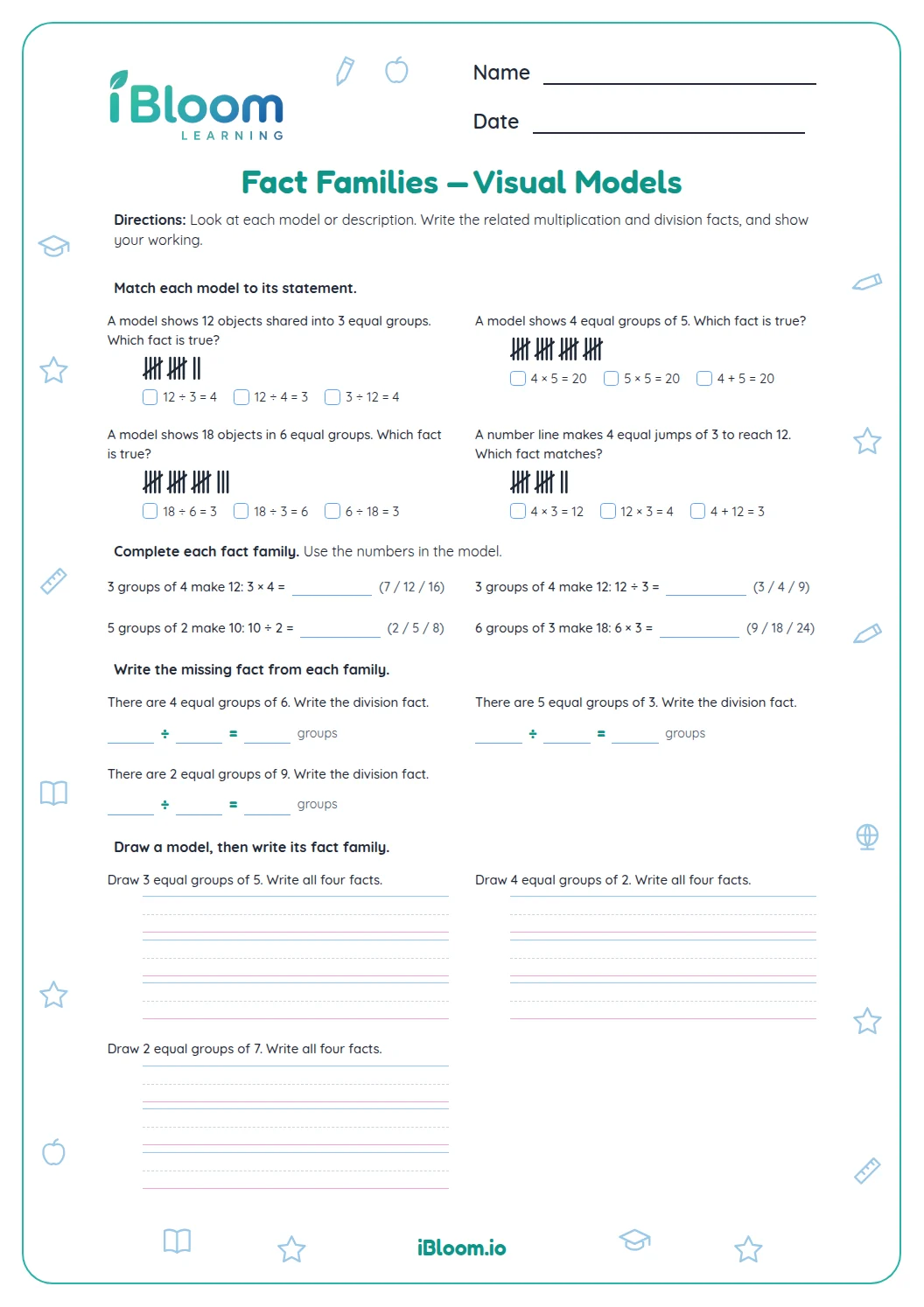
About this worksheet
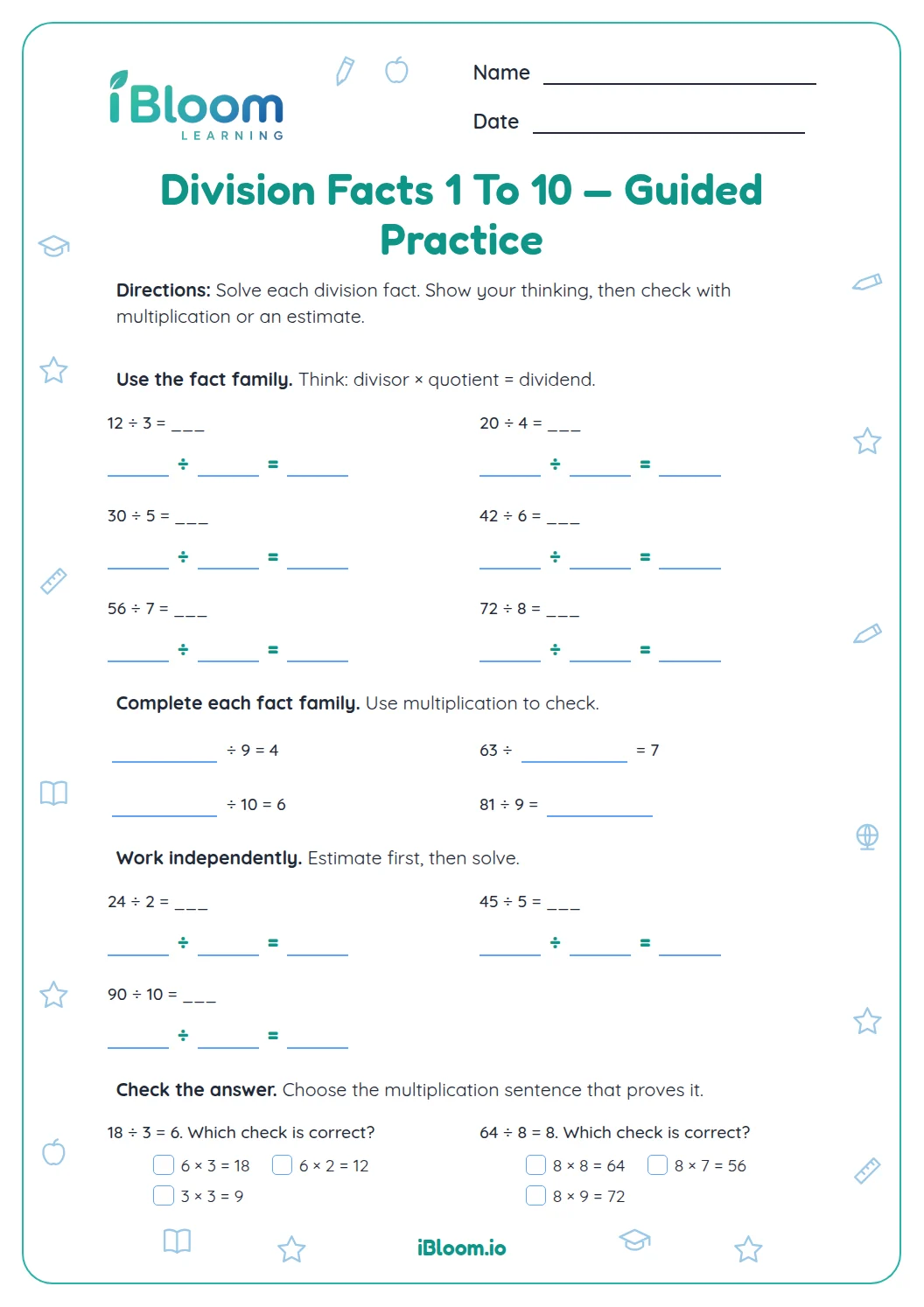
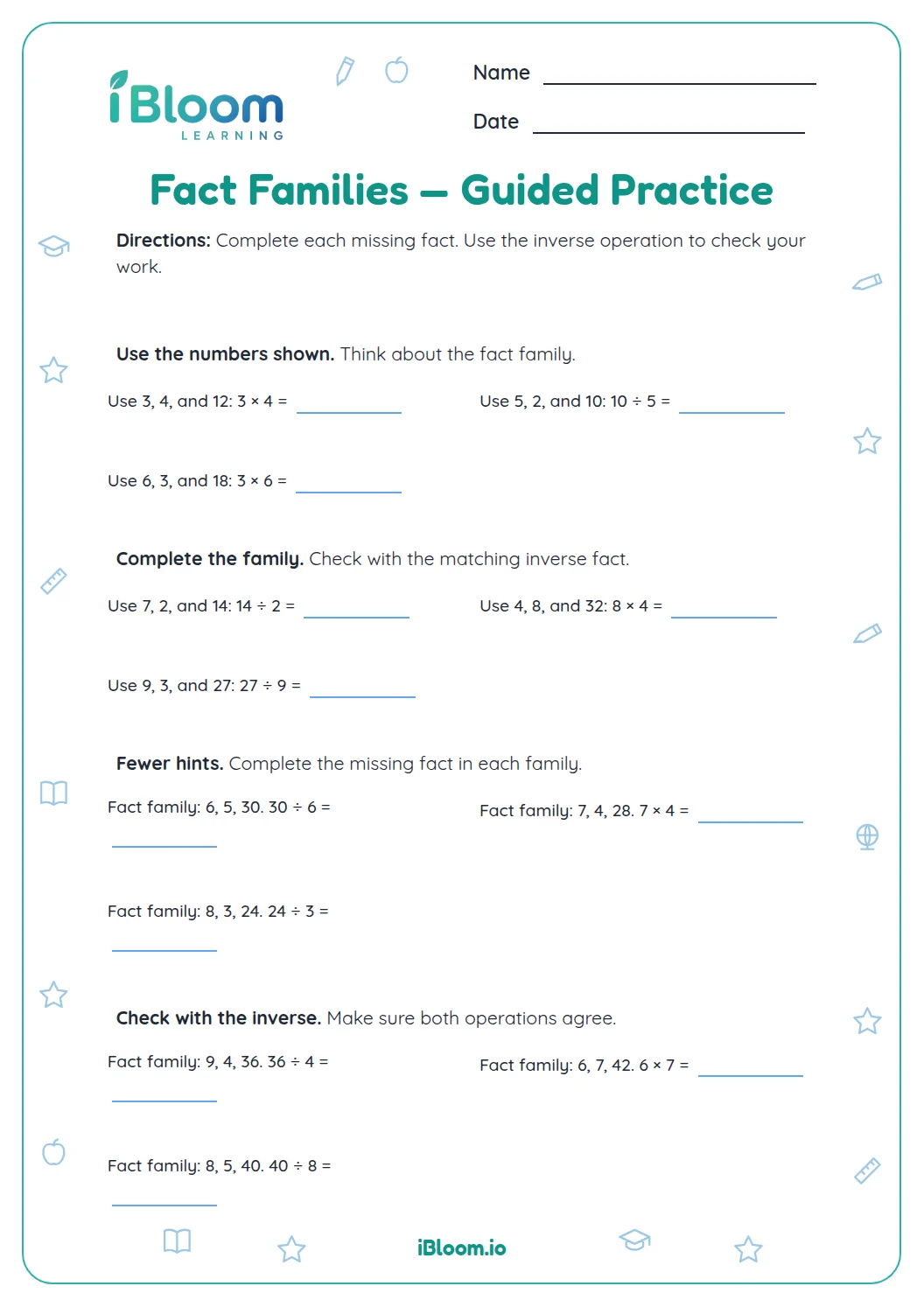
This printable Grade 3 worksheet practices division facts with every divisor from 1 through 12. Children find quotients, use multiplication to find missing factors, solve missing-divisor equations, and apply division to equal-sharing stories. The answer key supports checking the relationship between multiplication and division.
Aligned to 3.OA.C.7
How is division practice organized?
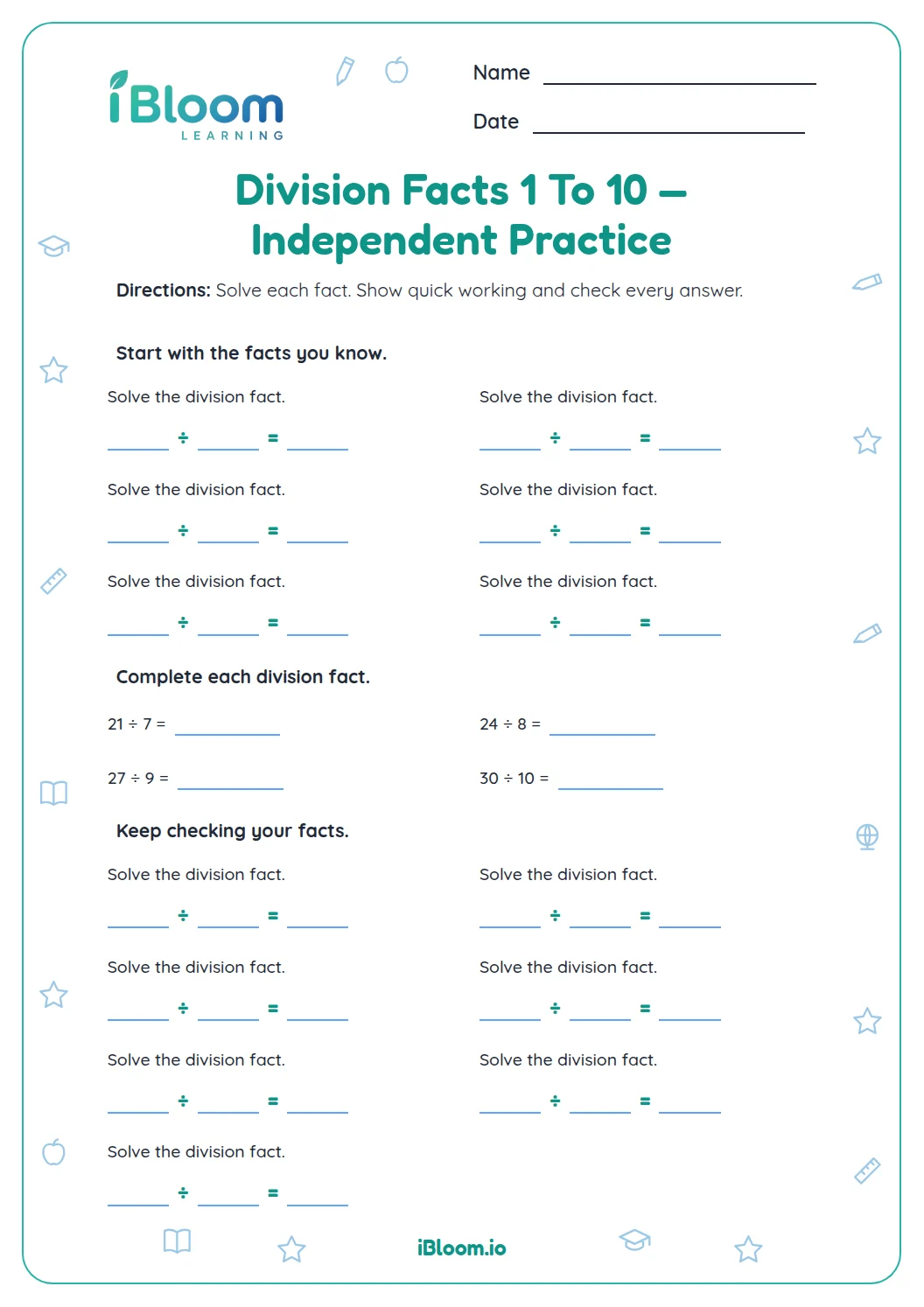
The first part deliberately includes divisors 1 through 12 once each. The remaining questions move from related multiplication facts to missing divisors and equal sharing.
- Part A: 12 division facts covering divisors 1–12
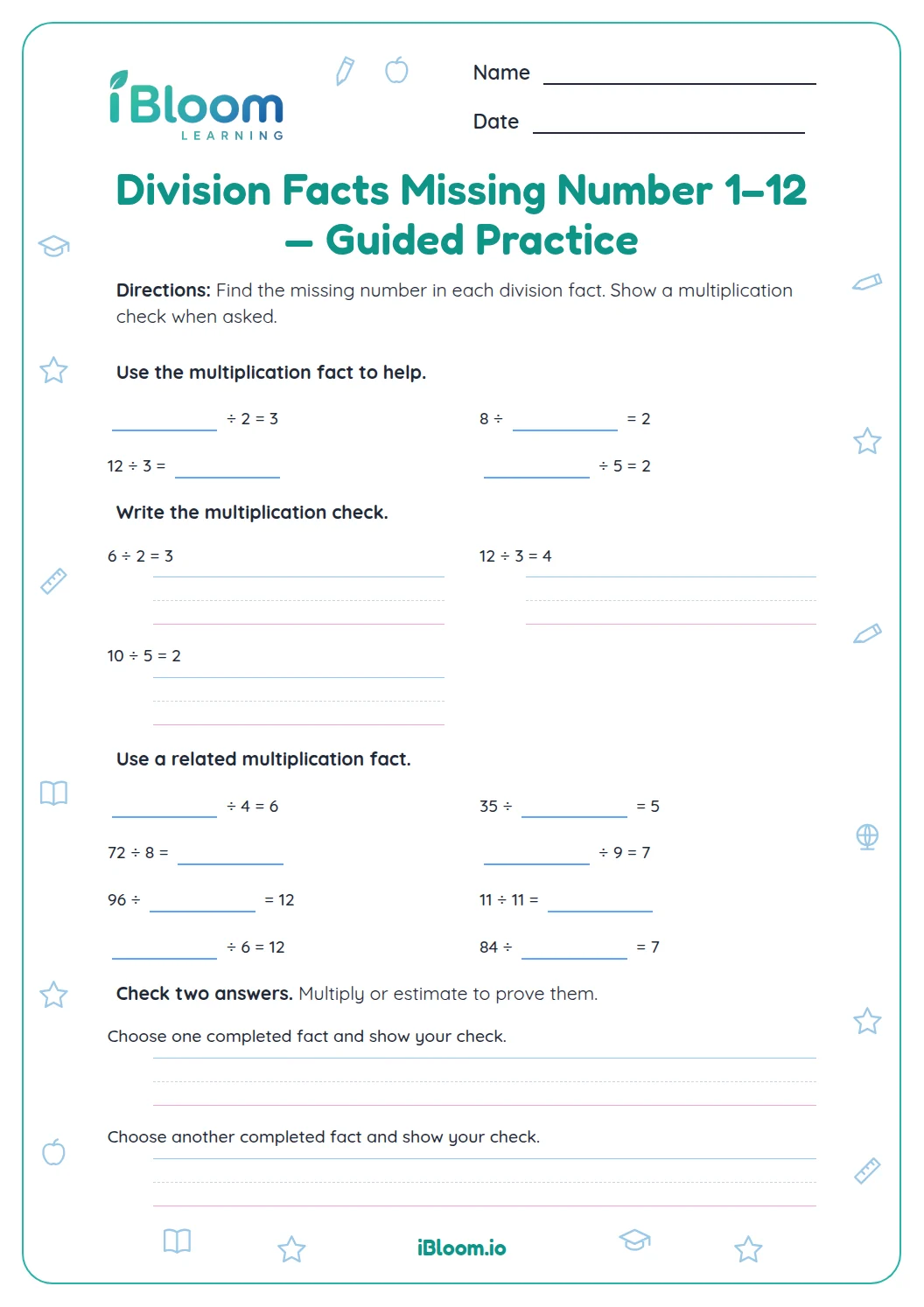
- Part B: four missing factors
- Part C: two missing divisors
- Part D: two equal-sharing stories
How does multiplication help with division?
For 42 ÷ 6, ask what number multiplied by 6 equals 42. Since 6 × 7 = 42, the quotient is 7.
How can children check a quotient?
Multiply the quotient by the divisor. The product should match the dividend. For an equal-sharing story, also check that the number of groups and amount in each group match the question.
How to use this worksheet
- 1Read the dividend and divisor carefully.
- 2Use a related multiplication fact when a quotient is not immediate.
- 3For a missing divisor, ask what number divides the dividend to make the quotient.
- 4Write a division equation for each sharing story.
- 5Check each quotient by multiplying it by the divisor.
Division facts to check
The mistake
Reversing the dividend and divisor.
The fix
The dividend is the number being split; the divisor tells how many groups or how many in each group.
The mistake
Using the quotient as the divisor.
The fix
Check by multiplying divisor × quotient to get the dividend.
The mistake
Giving a story answer without checking the equal groups.
The fix
Multiply the number in each group by the number of groups.
Common Core alignment
This worksheet practices CCSS.MATH.CONTENT.3.OA.C.7 with focused questions at Grade 3 level.
Fluently multiply and divide within 100 using related facts and strategies.
On this sheet: The division facts, related multiplication, and equal-sharing items practice this standard.
Show the official wordingHide the official wording
Fluently multiply and divide within 100, using strategies such as the relationship between multiplication and division (e.g., knowing that 8 × 5 = 40, one knows 40 ÷ 5 = 8) or properties of operations. By the end of Grade 3, know from memory all products of two one-digit numbers.
What to practice next
Make more practice
Further reading
Questions parents and teachers ask
Are all divisors from 1 to 12 included?
Yes. Part A has 12 division facts, one for each divisor from 1 through 12. Later parts use related multiplication facts, missing divisors, and equal-sharing stories to reinforce the same relationship and provide a second way to check answers.
How many questions are on the worksheet?
The worksheet has 20 questions in four parts across two practice pages. Part A has 12 quotient facts, Part B has four missing factors, Part C has two missing divisors, and Part D has two sharing stories. A separate answer key is included.
How can multiplication check division?
Multiply the divisor by the quotient. For example, 42 ÷ 6 = 7 checks because 6 × 7 = 42. If the product does not match the original dividend, revisit the quotient and check which number is being divided.
What does equal sharing mean in a division story?
Equal sharing means each group receives the same number. For the sticker story, divide 36 stickers among 4 children to find 9 stickers per child. Multiplying 9 by 4 checks that all 36 stickers are accounted for in equal groups.
Can a child use this for independent practice?
The directions and equations are short enough for independent work after a child understands division as equal groups. For a difficult fact, encourage the child to write or say its related multiplication fact, then check the result with the separate key.