




About this worksheet
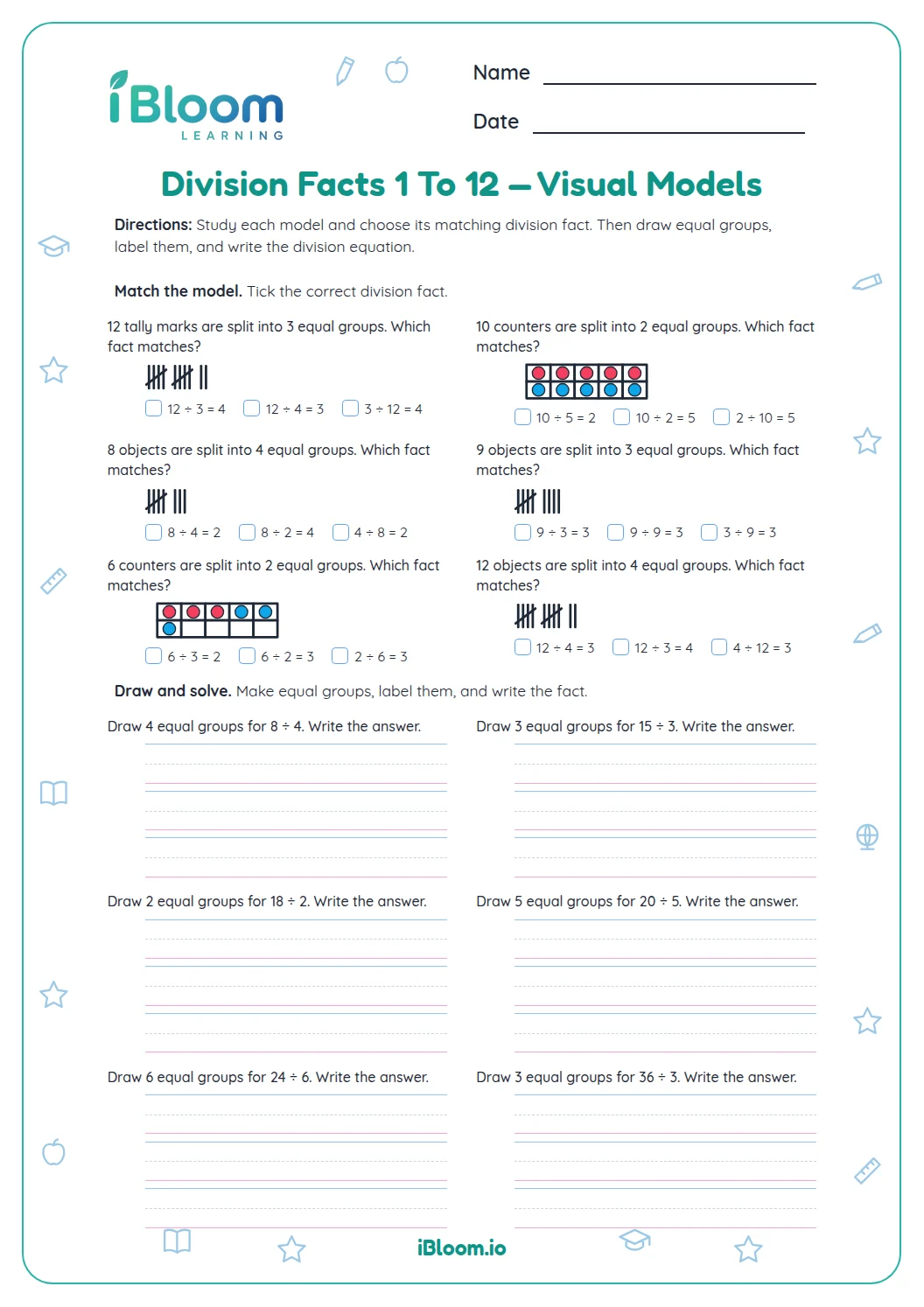
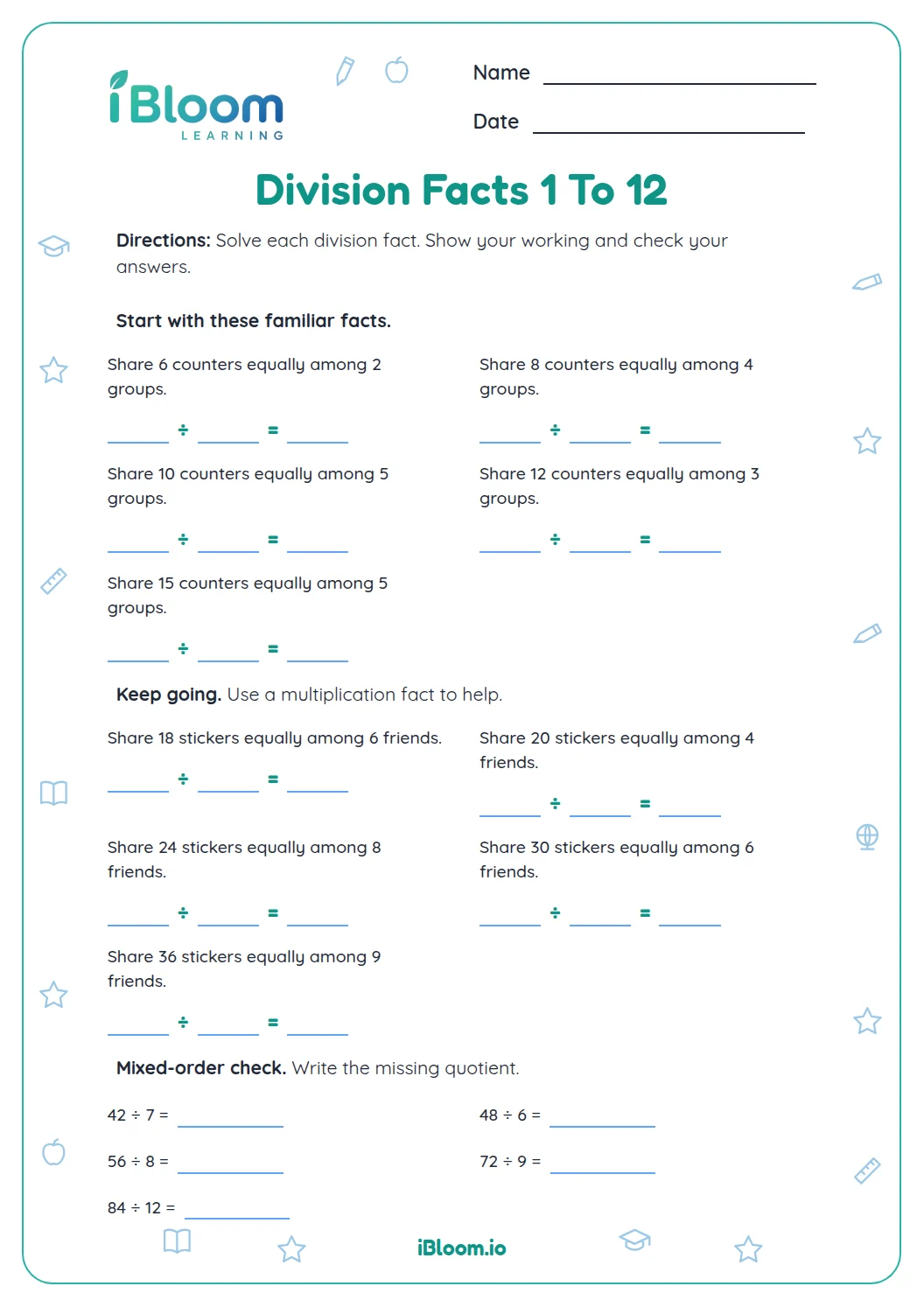
This Grade 3 worksheet turns equal shares and equal groups into division equations. Fourteen short stories use whole-number facts with divisors from 1 through 12, and the separate key shows each quotient so students can check their reasoning.
Aligned to 3.OA.A.3
How do you turn a sharing story into division?
Identify the total and the number of equal groups, then divide. If 36 stickers are shared among 4 teams, write 36 ÷ 4 = 9. The quotient answers how many stickers each team receives.
For a grouping story, the group size is given and the quotient tells how many groups can be made.
- 136 stickers shared among 4 teams
- 236 ÷ 4 = 9 stickers per team
- 3Check: 9 × 4 = 36
How can you tell what the quotient means?
Look at the question after you divide. “How many in each team?” asks for the size of one group; “How many bags?” asks for the number of groups. The same division fact can describe either situation, so name the unit in your answer.
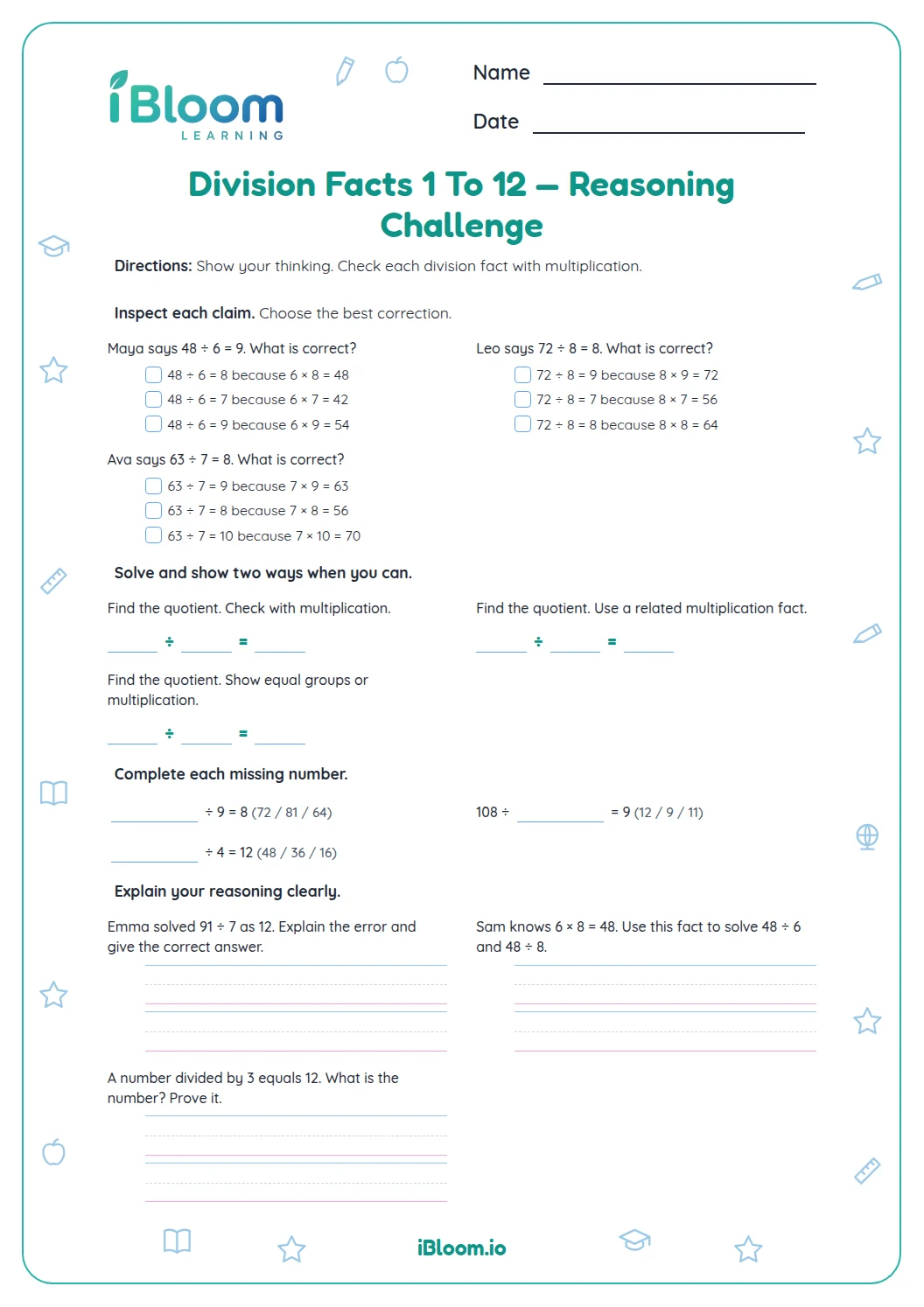
How can multiplication check a division answer?
Multiply the quotient by the group count or group size from the story. For question 12, 90 pencils split among 10 rooms gives 9 per room; 9 × 10 returns 90.
- 190 ÷ 10 = 9
- 29 × 10 = 90
How to use this division worksheet
- 1Read the story and underline the total and the equal-group information.
- 2Decide whether the unknown is the number in each group or the number of groups.
- 3Write the total divided by the known group amount.
- 4Solve, then label the quotient with the story’s unit.
- 5Multiply to check that the groups rebuild the total.
Common mistakes and quick fixes
The mistake
Dividing the smaller number by the total.
The fix
Use the total as the dividend, then divide by the known number of groups or items per group.
The mistake
Giving a quotient without its meaning.
The fix
Reread the final question and name what one group or the number of groups represents.
The mistake
Choosing equal sharing when the group size is given.
The fix
If each bag or row already has a set amount, divide by that amount to find how many groups.
Common Core alignment
This worksheet gives students practice with 3.OA.A.3 through the questions on the sheet.
Solve equal-group and equal-sharing word problems with multiplication and division within 100.
On this sheet: Solve equal-group and equal-sharing word problems with multiplication and division within 100.
Show the official wordingHide the official wording
Use multiplication and division within 100 to solve word problems in situations involving equal groups, arrays, and measurement quantities, e.g., by using drawings and equations with a symbol for the unknown number to represent the problem.
What to practice next
Make more practice
Further reading
Questions parents and teachers ask
How do I choose the division equation?
Find the total amount and the equal groups described in the story. Divide the total by the number of groups when you need the amount in each group, or by the amount in each group when you need the number of groups. Read the final question to decide what the quotient represents.
How can I check a quotient?
Multiply the quotient by the number of groups or by the group size given in the story. For question 1, 36 stickers shared among 4 teams gives 9 per team; 9 × 4 = 36. The product should match the total in the problem.
Does the worksheet use facts through 12?
Yes. Across the stories, the divisors range from 1 through 12, and each answer is a whole number. For example, one story divides 24 stickers between 2 friends and another shares 96 beads among 12 bracelets. Students can explain the group count before calculating.
What should a student include in each answer?
Write a division equation and the quotient, then include the unit named by the story when useful. “9” is the quotient for 36 stickers shared among 4 teams; “9 stickers per team” makes its meaning clear. The answer key accepts the same quotient with a clear unit.
How many problems are on the printable?
The worksheet has 14 short real-world problems arranged in two practice parts. The first part introduces equal sharing and grouping; the second continues with facts across the 1–12 divisor range. A separate answer key lists the quotients. Facts include every divisor from 1 through 12.