
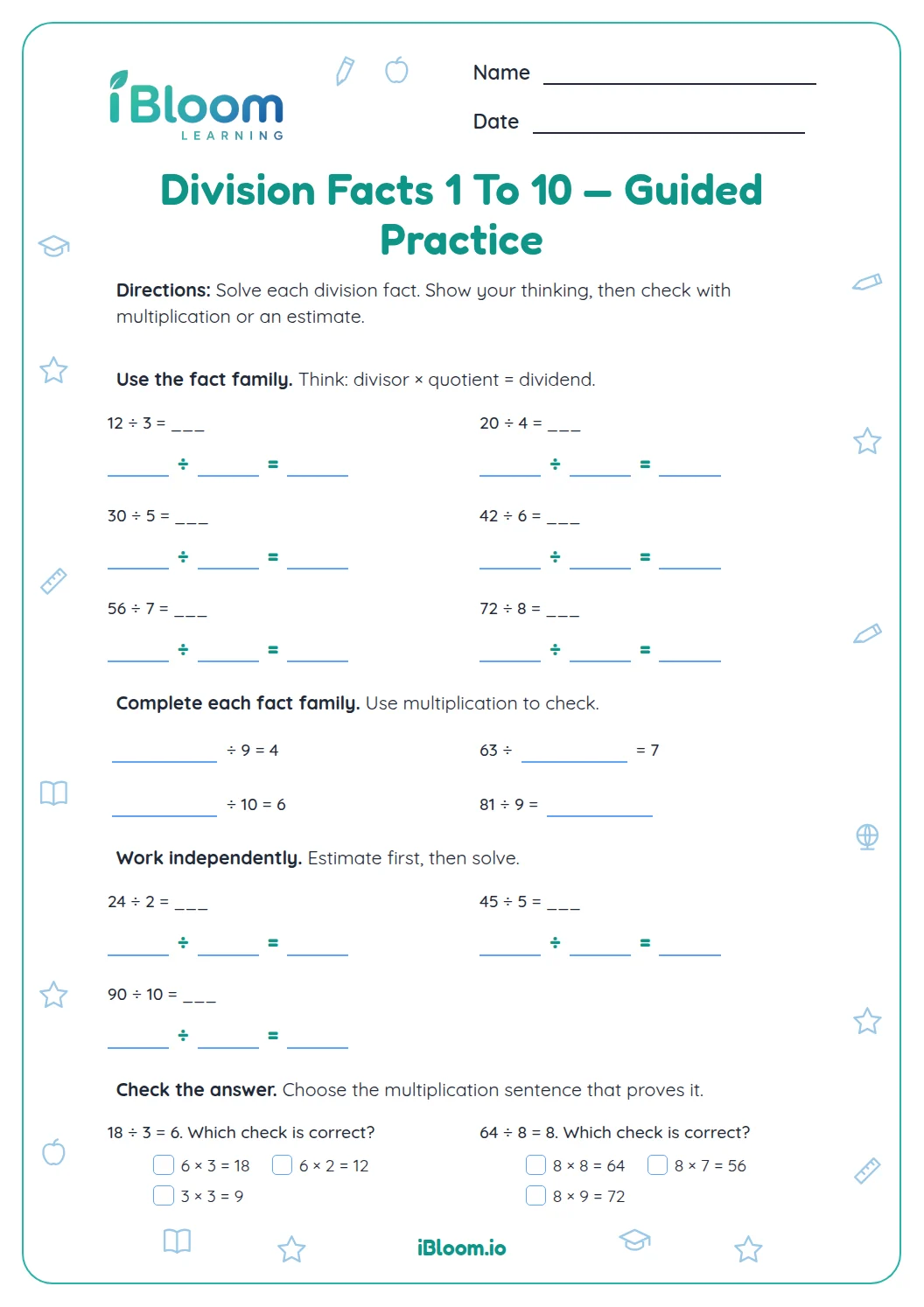

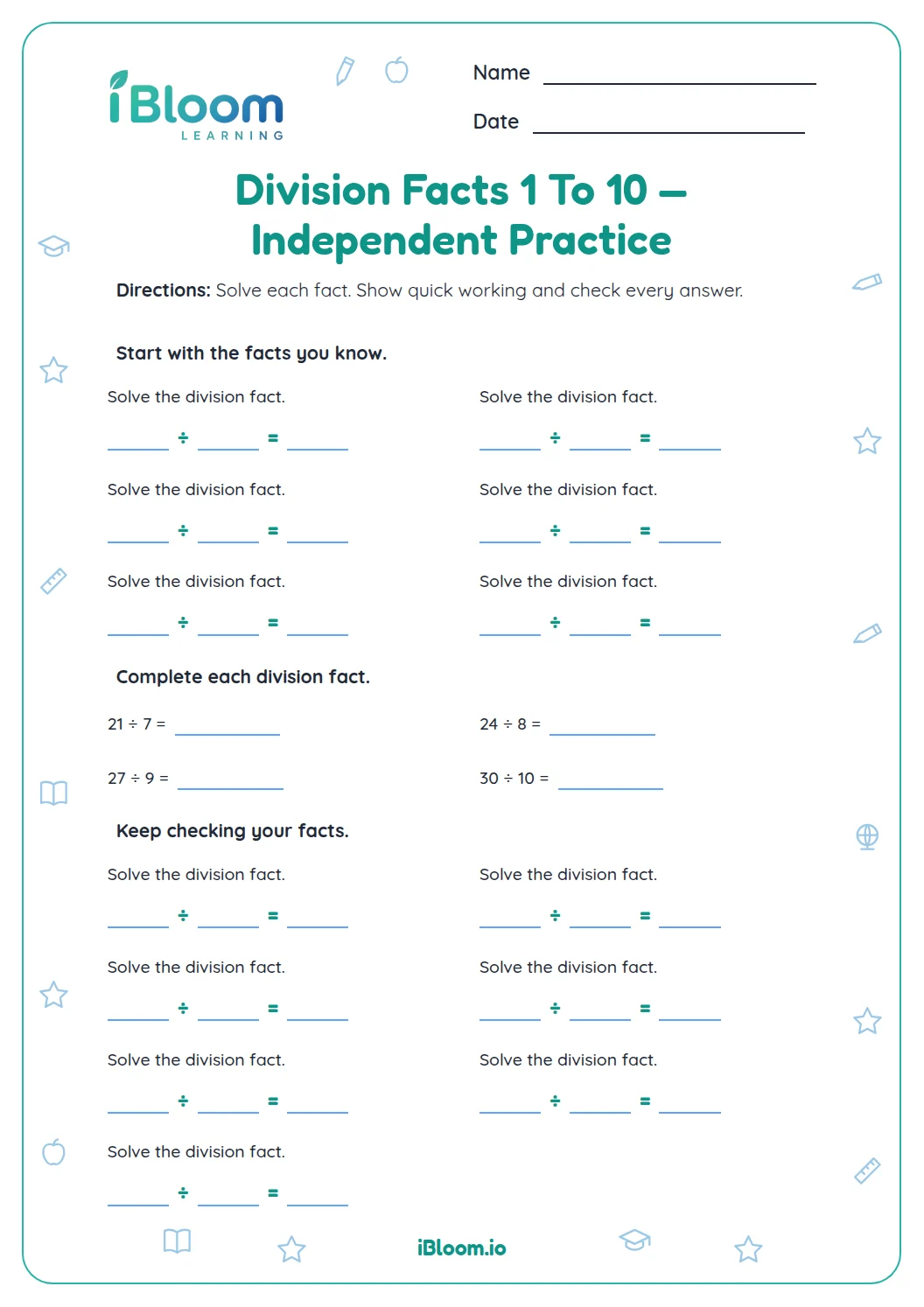
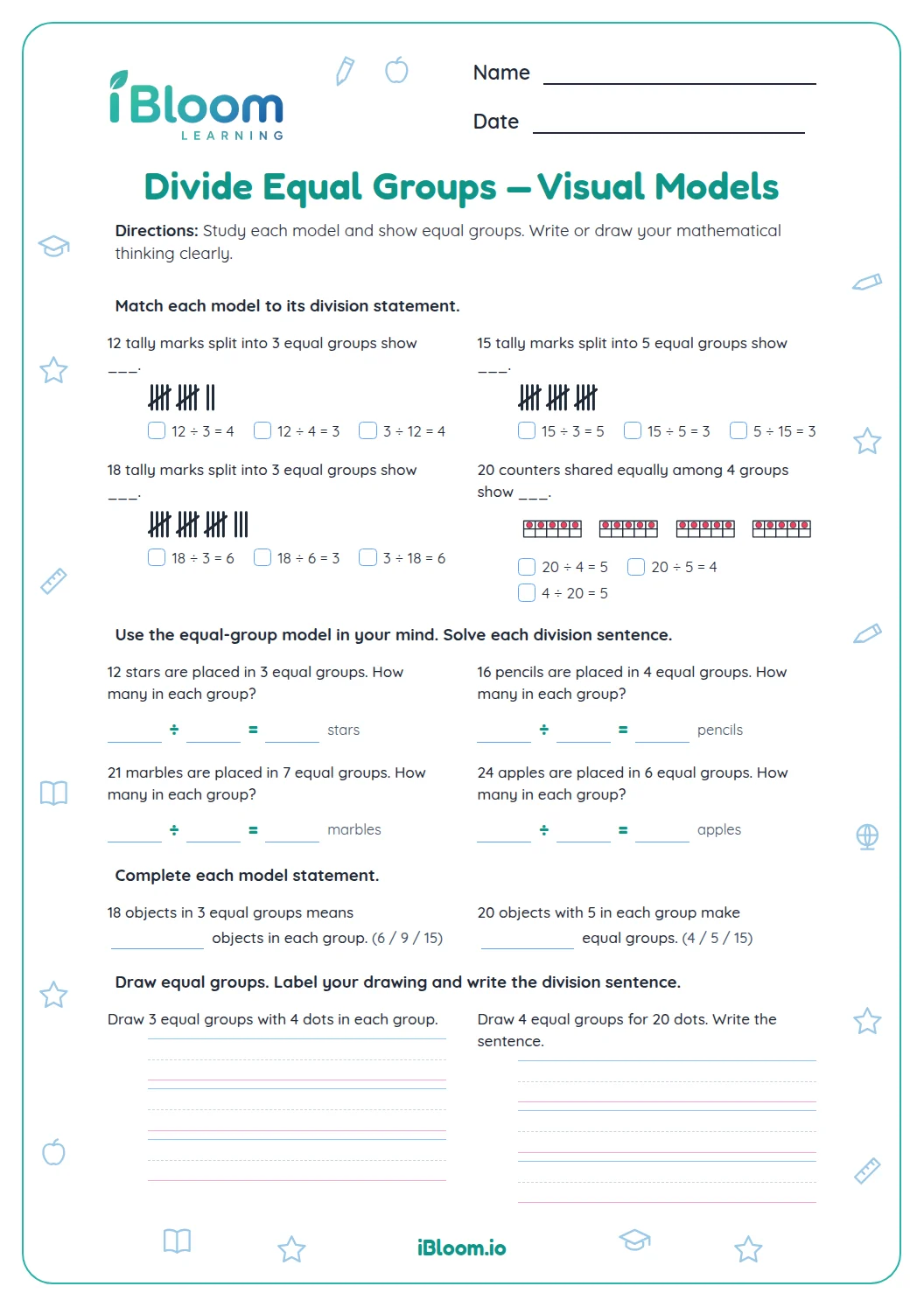

About this worksheet
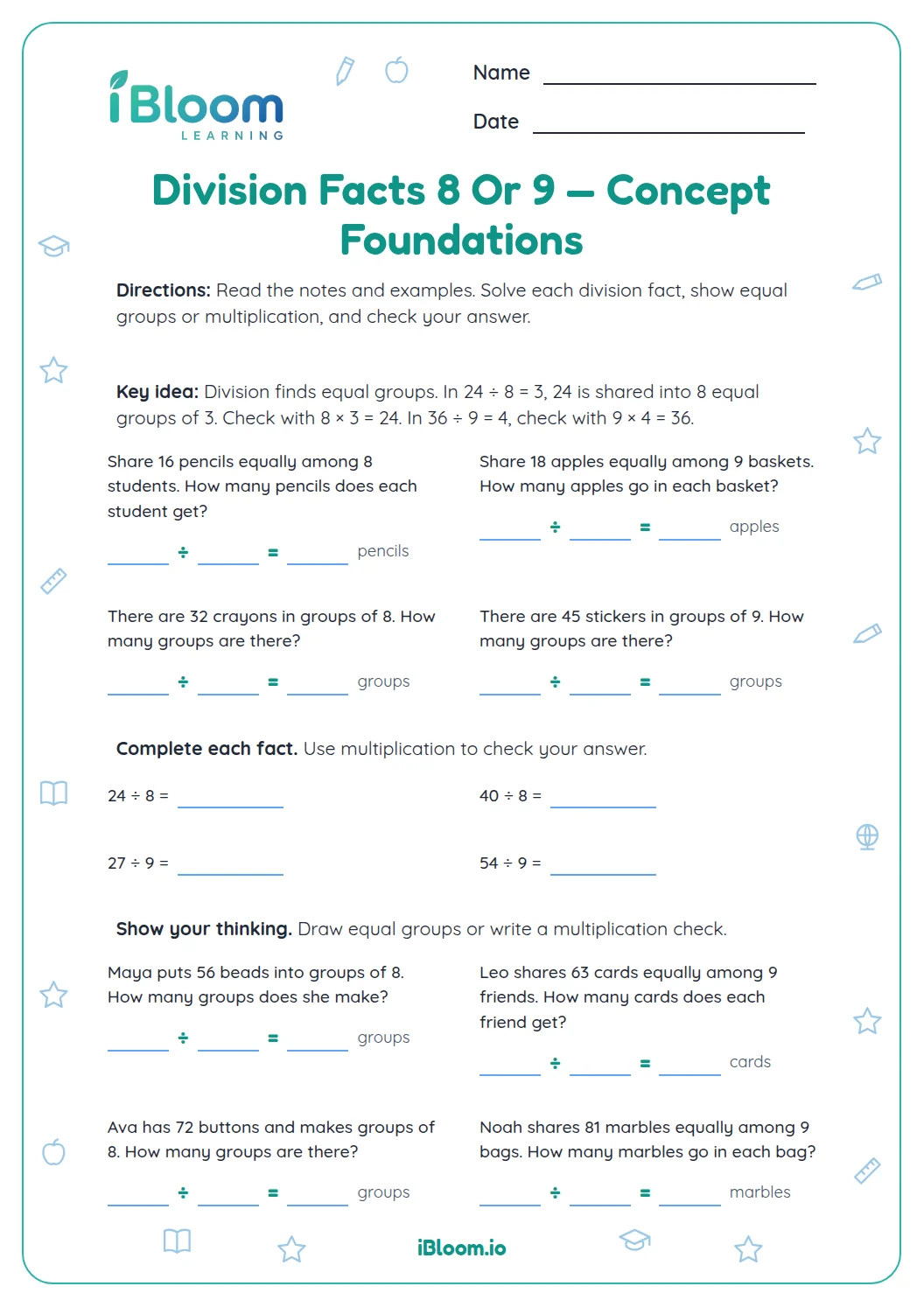
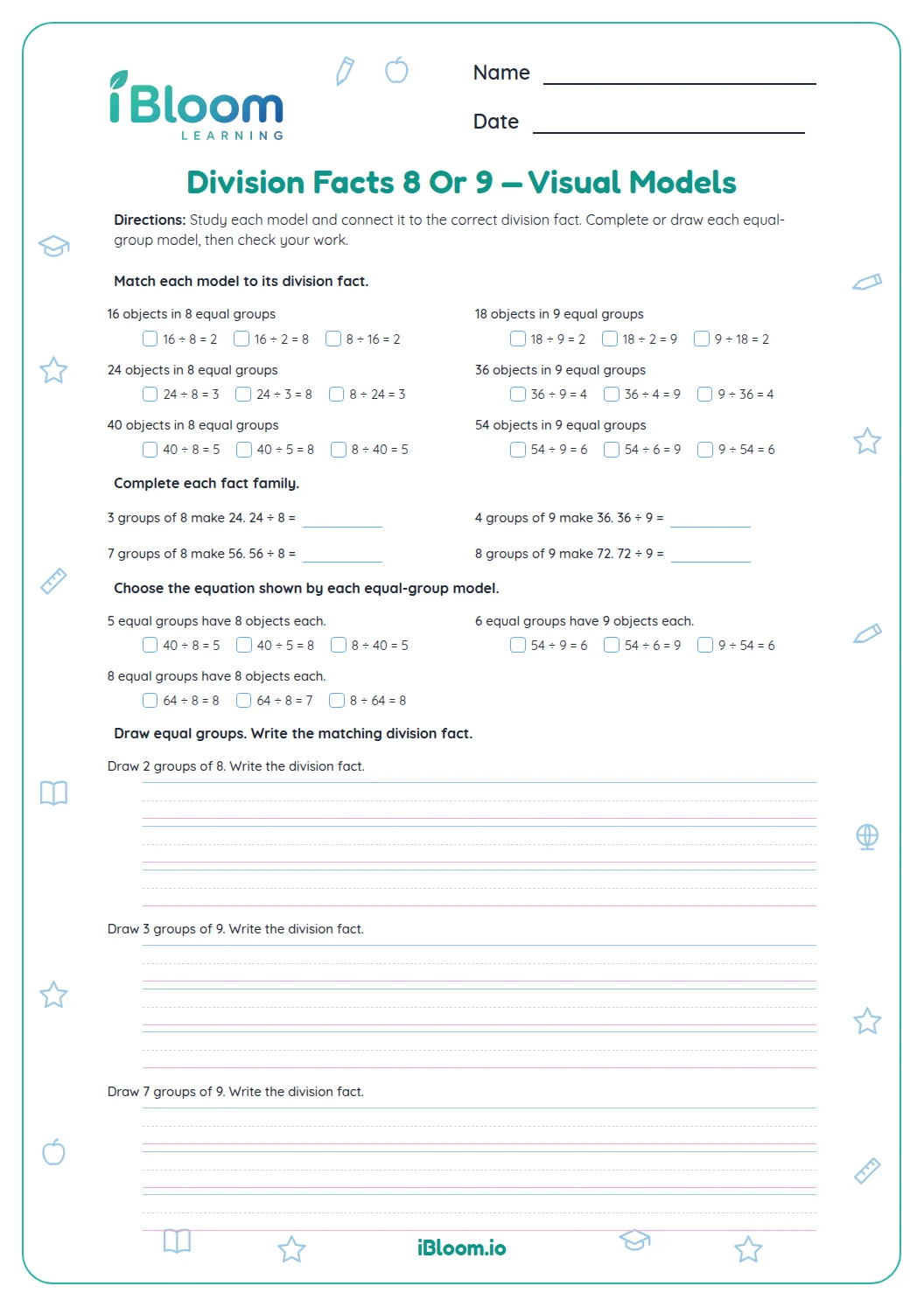
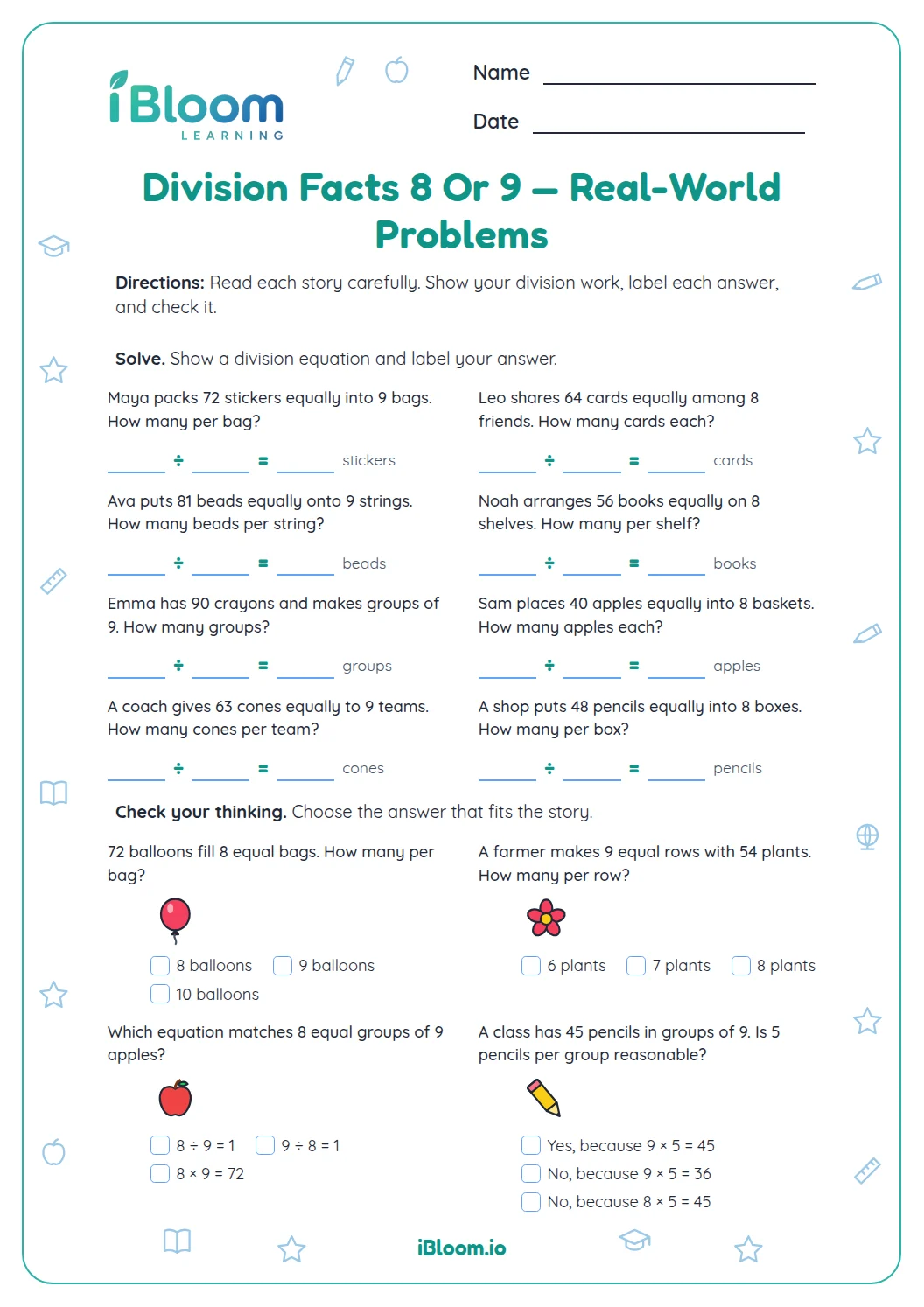
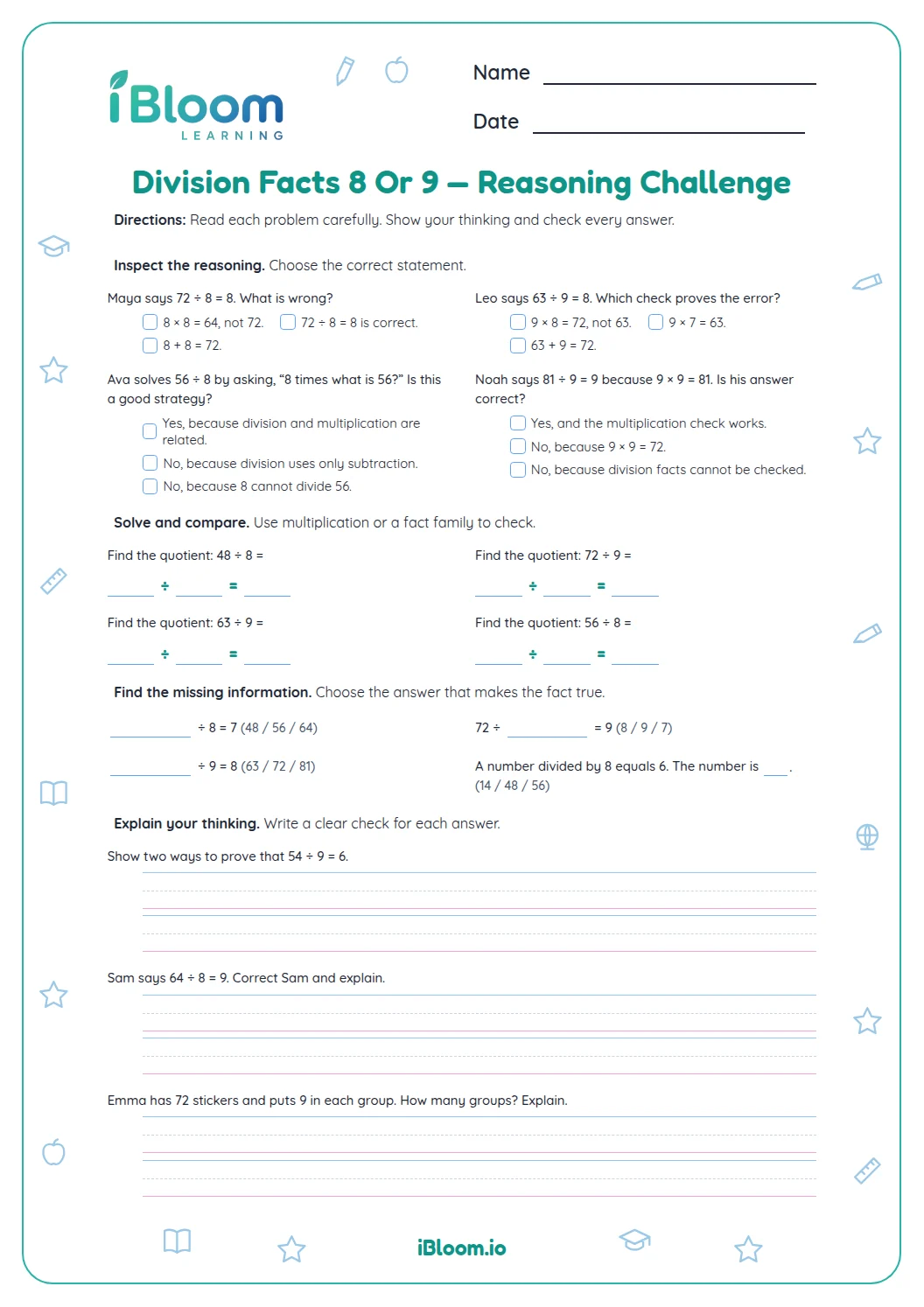
This Grade 3 worksheet gives students 16 chances to practice division facts with 8 and 9. It starts with direct quotients, then asks students to find a missing dividend, and finishes by connecting multiplication facts to the same products. The work supports Common Core 3.OA.C.7, fluently multiplying and dividing within 100. The separate key lists every answer.
Aligned to 3.OA.C.7
How does a multiplication fact help solve division?
Division asks how many groups or how many in each group. For 32 ÷ 8, ask which number multiplied by 8 makes 32. Because 4 × 8 = 32, the quotient is 4.
- 132 ÷ 8 = ___
- 28 × 4 = 32
- 332 ÷ 8 = 4
What kinds of facts are on the page?
Part A practices direct facts with divisors 8 and 9. Part B reverses the fact and gives the divisor and quotient so students find the dividend. Part C connects multiplication equations to those same fact families.
How to use this worksheet
- 1Read the divisor and dividend before choosing a fact.
- 2For a missing dividend, multiply the quotient by the divisor.
- 3Use the answer key to check each response.
- 4For a missed fact, say its multiplication partner aloud and try it again.
Common mistakes and quick fixes
The mistake
Dividing by the wrong number in a fact family.
The fix
Point to the divisor and say the matching fact in the form divisor × quotient = dividend.
The mistake
Using an 8 fact when the problem has a divisor of 9.
The fix
Circle the divisor first, then skip-count by that number to check the product.
The mistake
Writing the dividend in the quotient blank.
The fix
Check what the blank asks for: in ___ ÷ 8 = 7, the missing number is 56.
Common Core alignment
This practice supports Grade 3 fluency with multiplication and division facts within 100.
Use multiplication facts to solve related division facts with 8 and 9.
On this sheet: Every item practices a quotient, related dividend, or multiplication fact within 100.
Show the official wordingHide the official wording
Fluently multiply and divide within 100, using strategies such as the relationship between multiplication and division (e.g., knowing that 8 × 5 = 40, one knows 40 ÷ 5 = 8) or properties of operations. By the end of Grade 3, know from memory all products of two one-digit numbers.
What to practice next
Make more practice
Further reading
Questions parents and teachers ask
What facts does this worksheet practice?
It practices division facts with 8 and 9. The first part asks students to find quotients, the next part asks for missing dividends, and the last part connects multiplication facts to the same products. Every fact stays within 100, and a separate answer key is included.
How does multiplication help with division?
A division fact can be read as a missing-factor multiplication fact. For 54 ÷ 9, ask what number times 9 equals 54. Since 9 × 6 = 54, the quotient is 6. Students use this connection repeatedly to solve facts and check their work.
What grade is this worksheet for?
This page is written for Grade 3 and practices Common Core 3.OA.C.7. Students use multiplication and division facts within 100, with a focused set of divisors 8 and 9. The problems move from direct quotients to missing dividends and related multiplication facts.
How should students use the answer key?
Have students try all three parts before checking the key. If an answer is incorrect, rebuild the related multiplication fact, such as 8 × 7 = 56, then use it to check 56 ÷ 8 = 7. This makes the correction a quick fact-family review.
How long does the practice take?
Most students can work through the 17 problems in about 15 minutes. The missing-dividend questions may take longer because students must reverse the division fact before writing the number. Check each answer by multiplying the quotient and divisor.