

About this worksheet
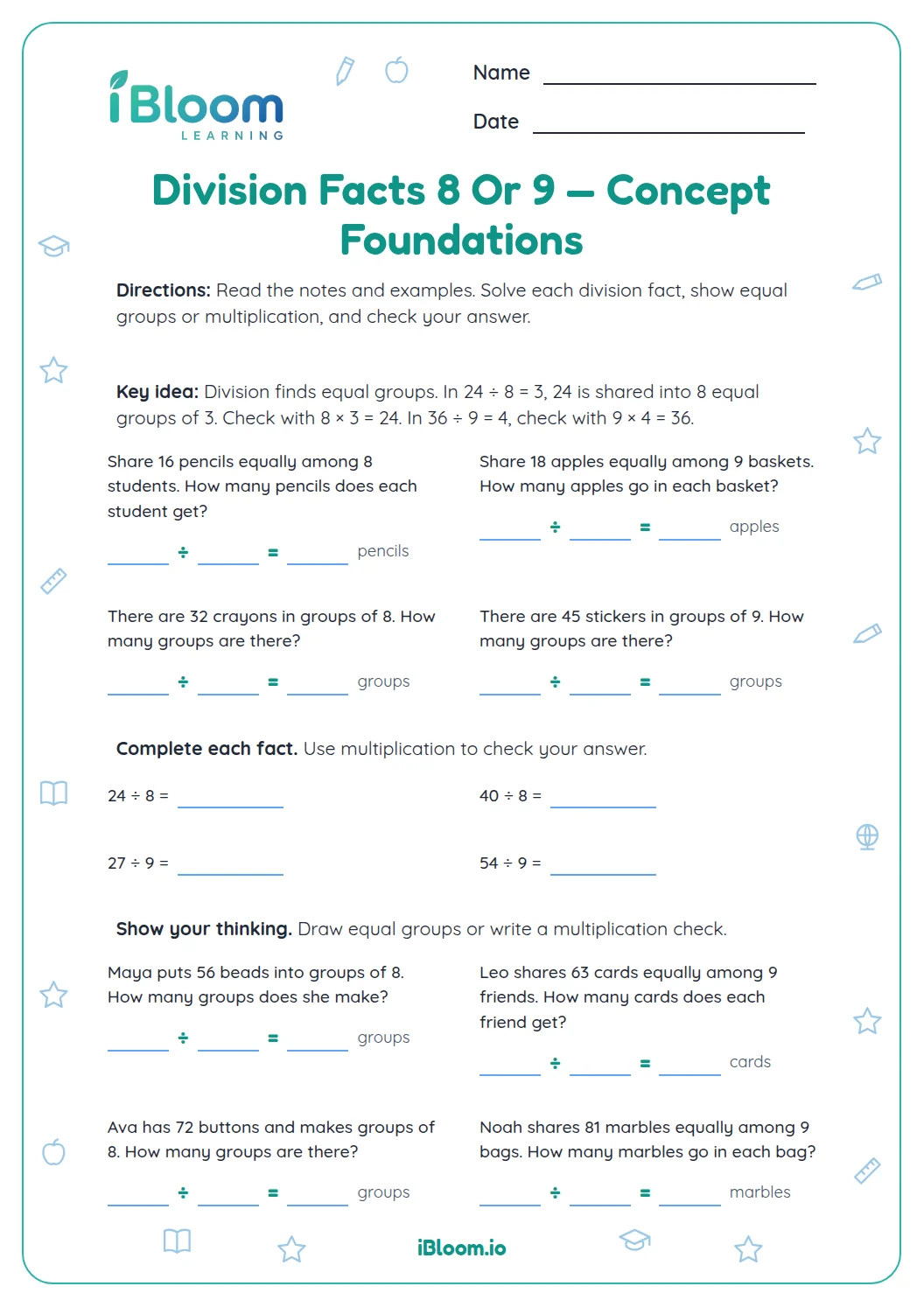
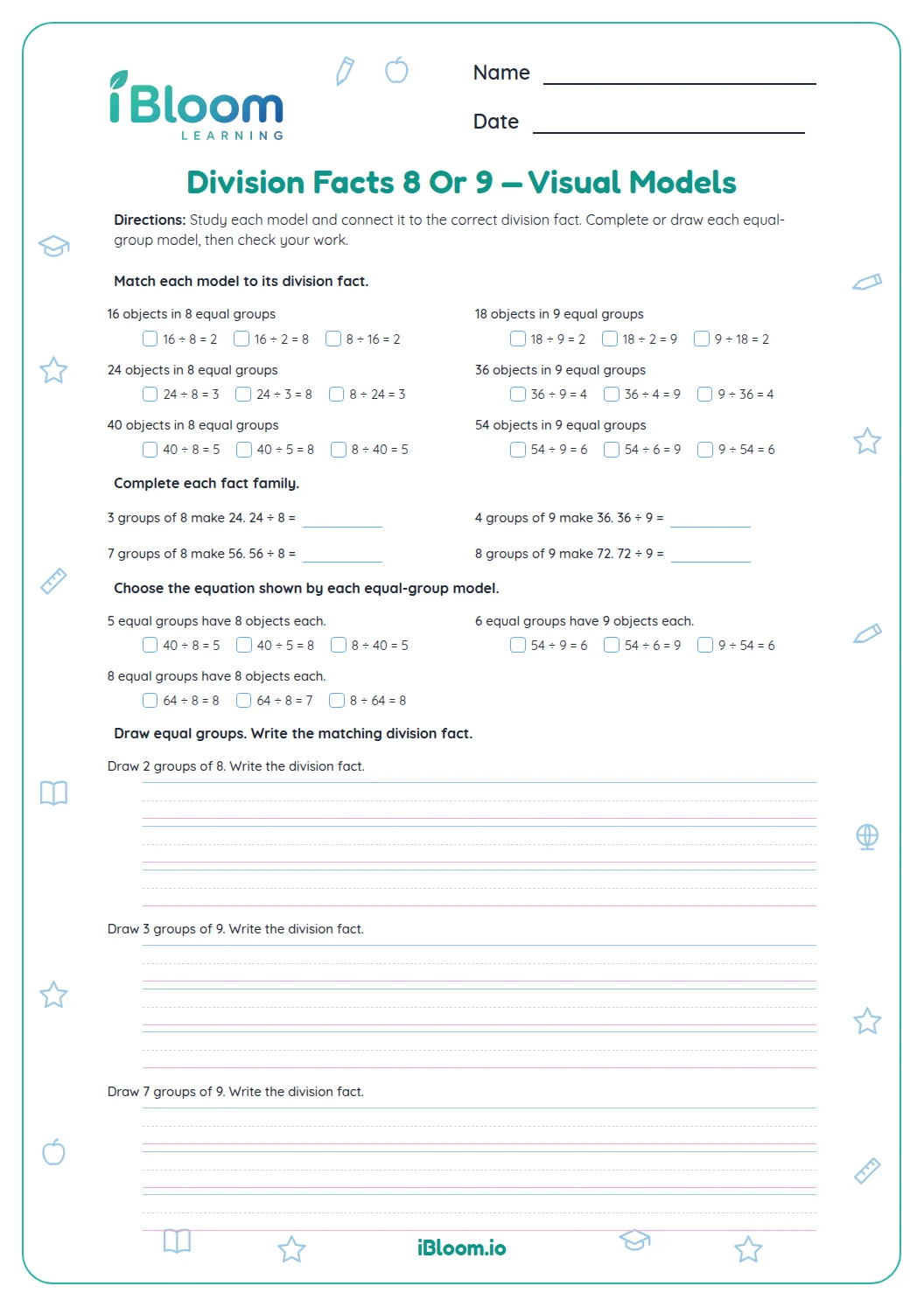
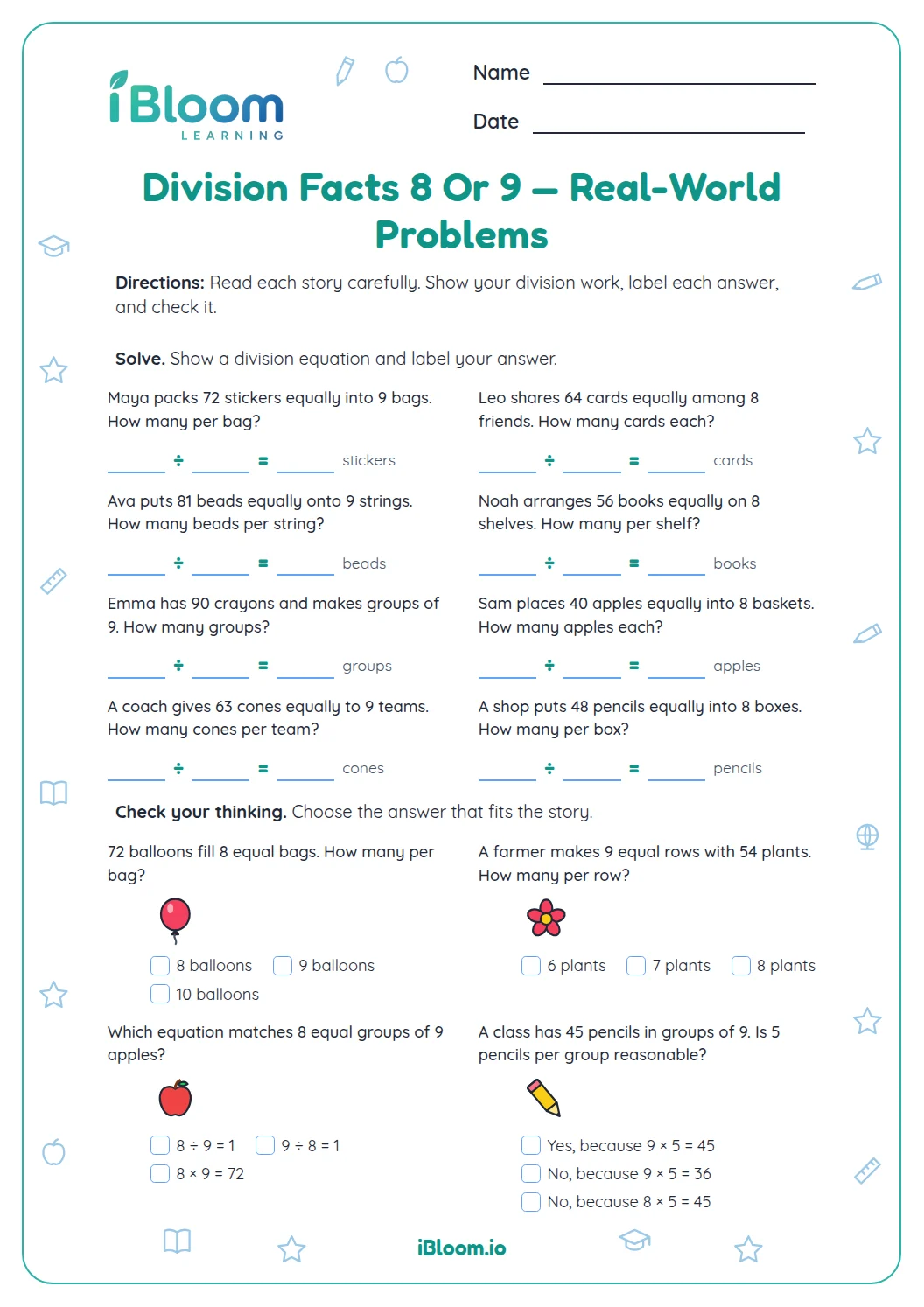
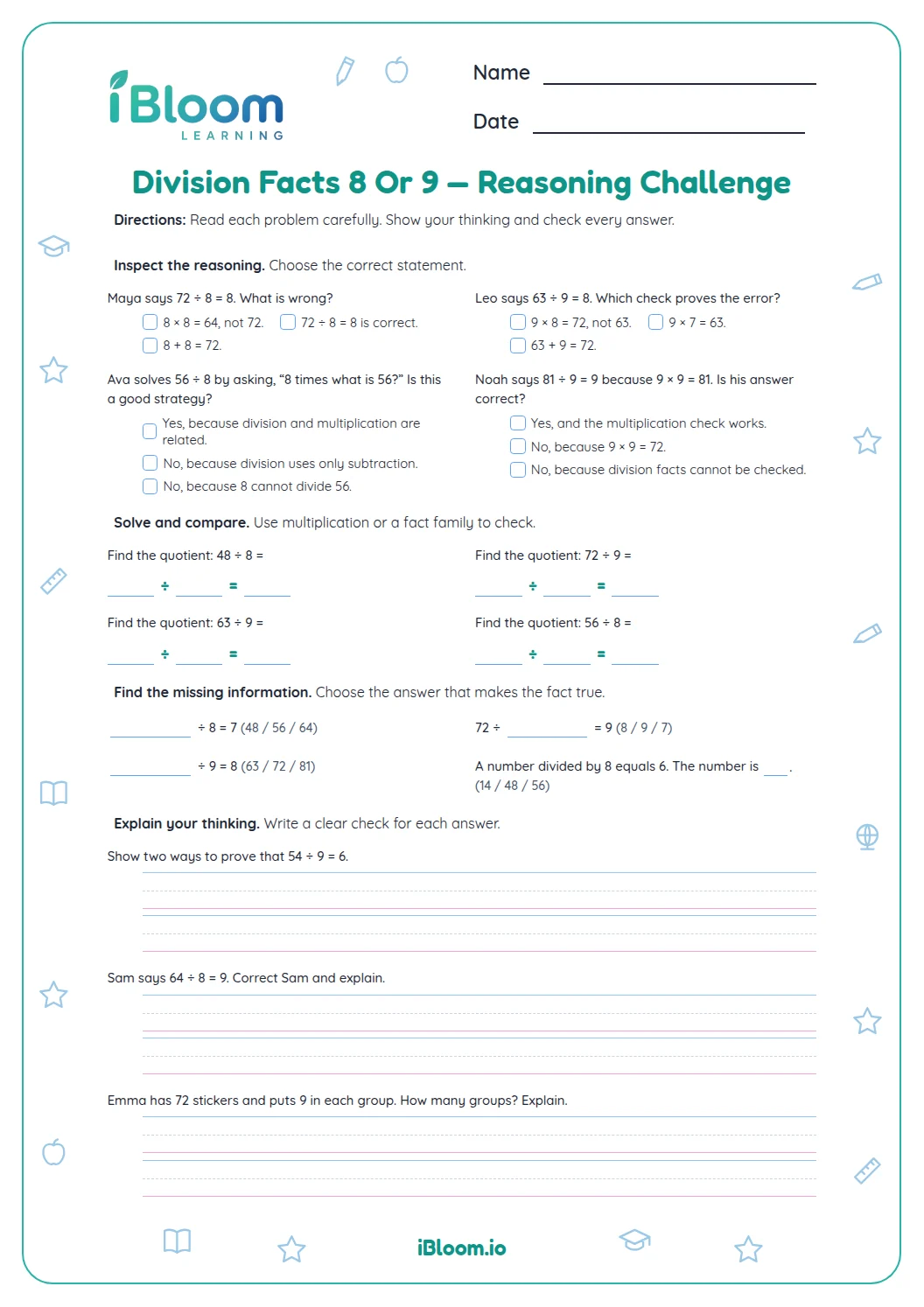
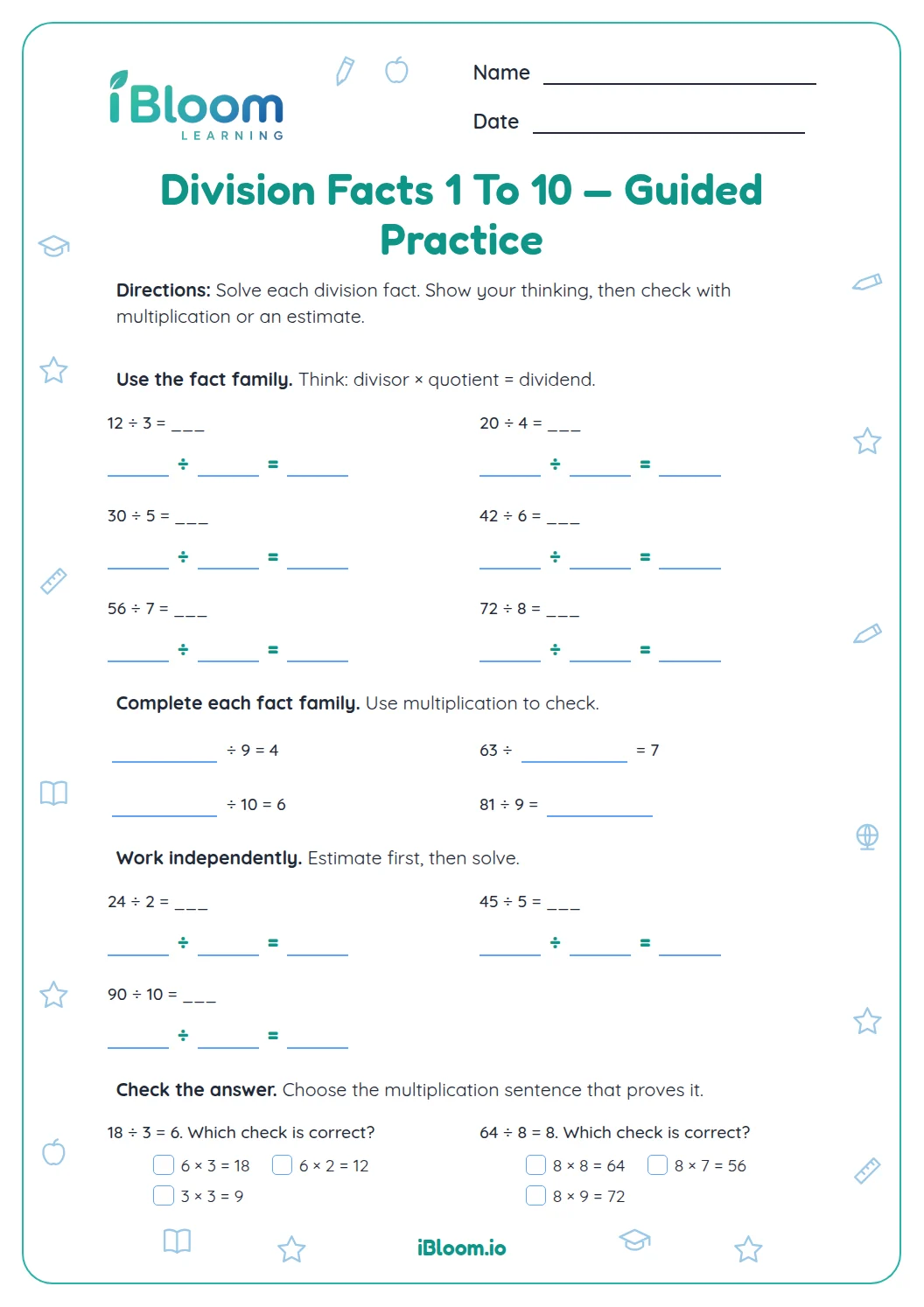
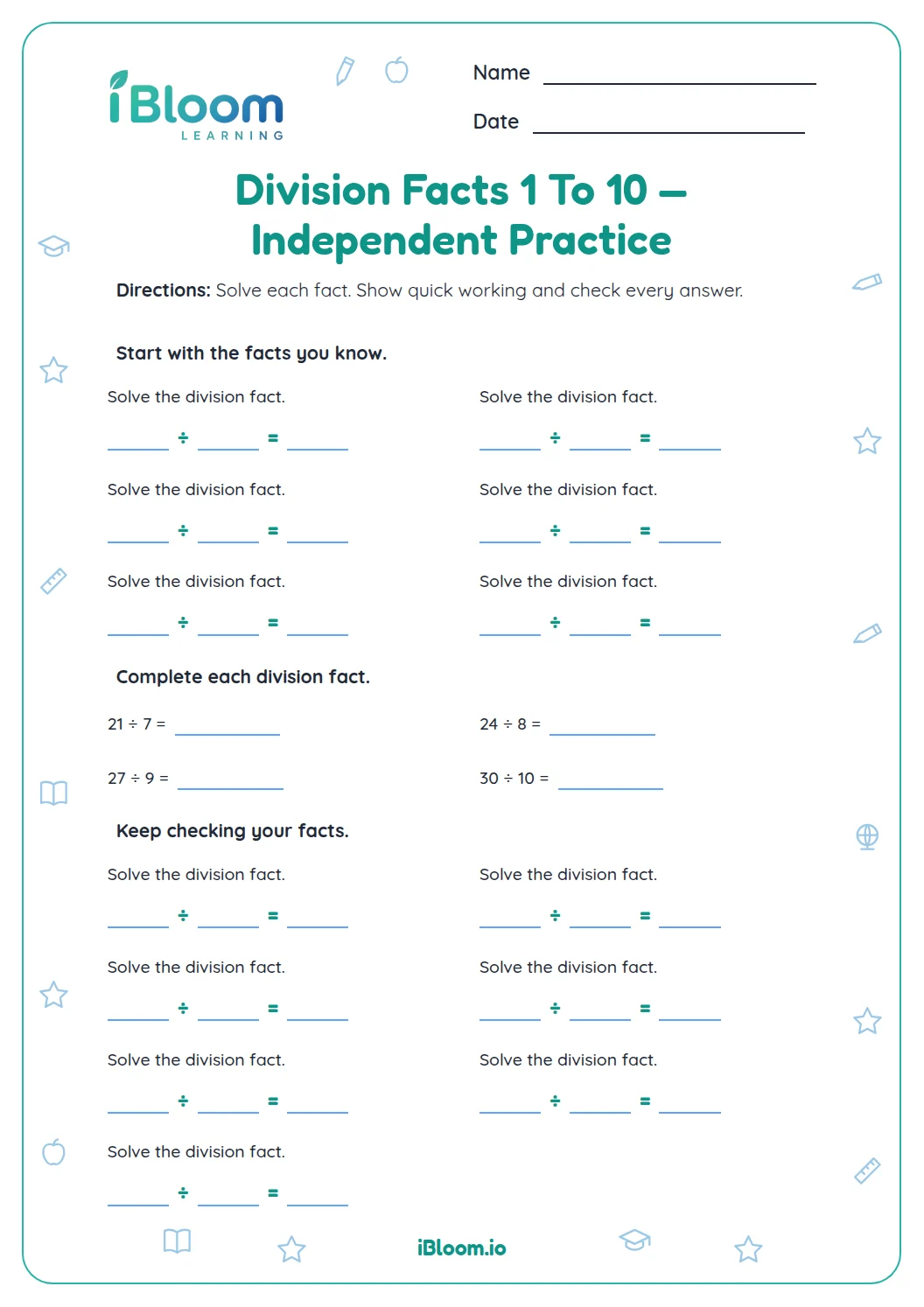
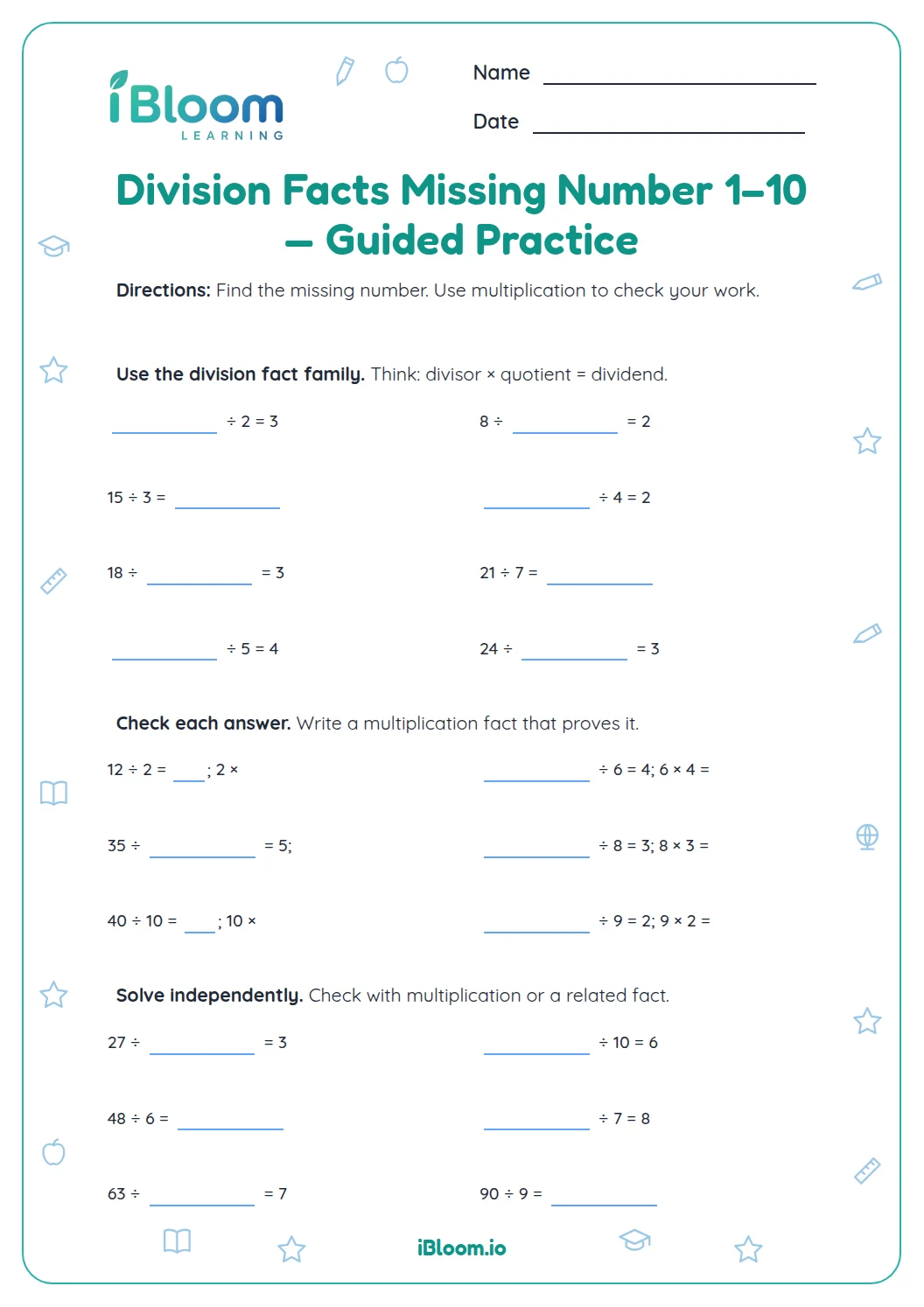
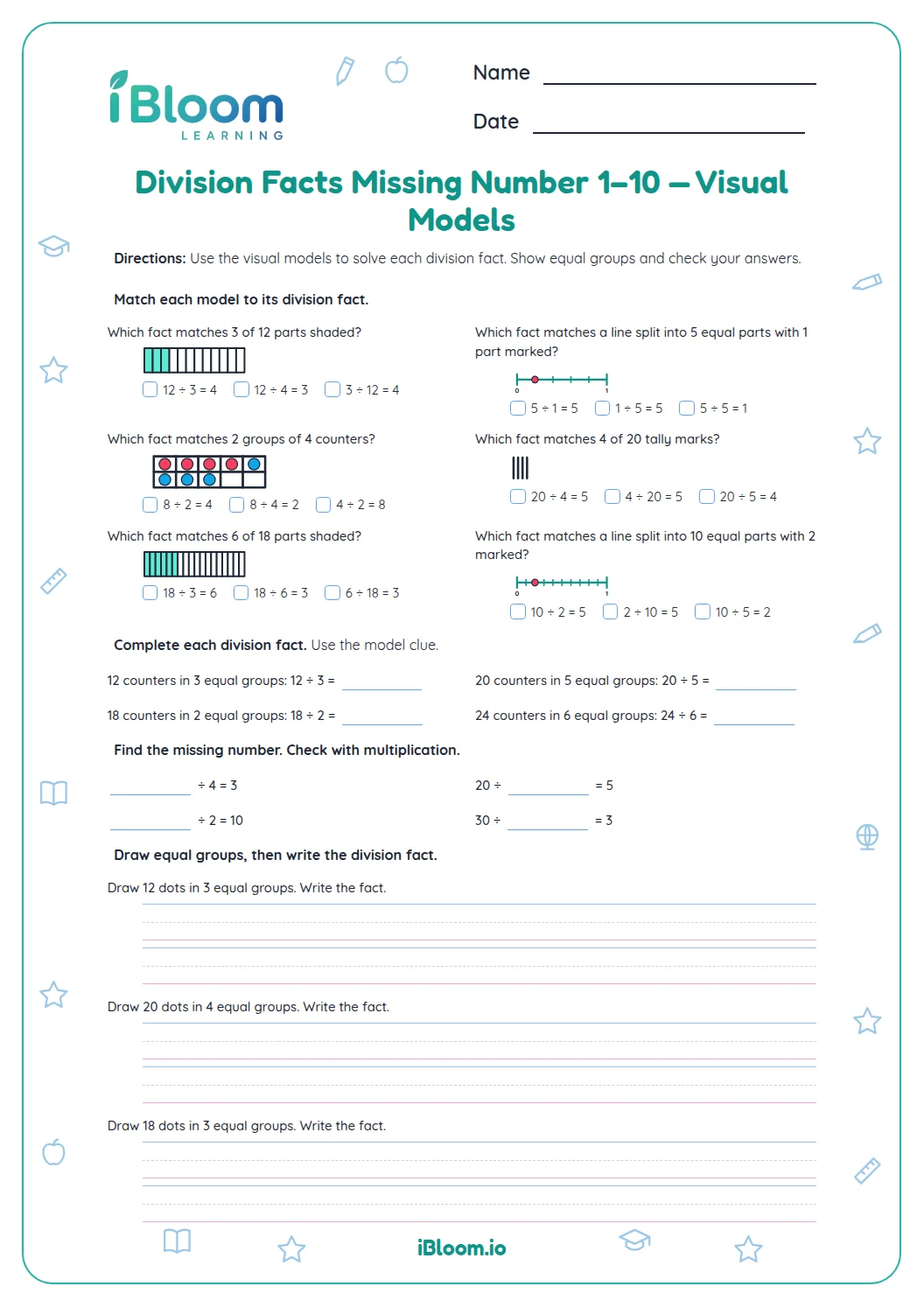
This Grade 3 independent-practice sheet has 16 equations using division facts with 8 and 9, related multiplication facts, and missing numbers. Students solve quotients, use multiplication as a check, and identify an unknown factor, dividend, or product from its position. All facts stay within 100. A separate answer key lists each value. The practice aligns with CCSS 3.OA.C.7.
Aligned to 3.OA.C.7
How do I solve a fact such as 56 ÷ 8?
Turn the division fact into a multiplication question: 8 times what equals 56? The factor is the quotient.
- 156 ÷ 8 = ___
- 2Ask: 8 × what = 56?
- 3So 56 ÷ 8 = 7.
How do multiplication and division connect?
A multiplication fact and two division facts belong to the same fact family. From 8 × 7 = 56, we know 56 ÷ 8 = 7 and 56 ÷ 7 = 8.
How do I find a missing number?
Read the whole equation and identify what the blank represents: a quotient, factor, or product. Use the matching operation to solve it.
How can I use this worksheet?
- 1Read the whole equation before calculating.
- 2If dividing, ask which number times the divisor makes the dividend.
- 3Use skip-counting by 8 or 9 if needed.
- 4Write the quotient in the blank.
- 5Multiply back to check.
Common mistakes and quick fixes
The mistake
Reversing the dividend and divisor.
The fix
Use divisor × quotient = dividend to check the fact.
The mistake
Mixing up the two factors.
The fix
For 72 ÷ 9, ask how many groups of 9 make 72.
The mistake
Writing the product in a quotient blank.
The fix
Check the symbols and make sure the blank fits the equation.
Curriculum alignment
This page practices the following standard through its questions and models.
Build fluency with division facts and related multiplication facts within 100.
On this sheet: The worksheet practices division facts for 8 and 9 and uses multiplication to find or check unknowns.
Show the official wordingHide the official wording
Fluently multiply and divide within 100, using strategies such as the relationship between multiplication and division (e.g., knowing that 8 × 5 = 40, one knows 40 ÷ 5 = 8) or properties of operations.
What to practice next
Make more practice
Further reading
Questions parents and teachers ask
What multiplication fact helps solve 72 ÷ 9?
Use 9 × 8 = 72. Since eight groups of 9 make 72, 72 ÷ 9 = 8. Multiplication gives a way to reason about or check the quotient. This is the related multiplication fact in the same fact family.
How can I check a division answer?
Multiply the quotient by the divisor. For 56 ÷ 8 = 7, check 7 × 8 = 56. If the product matches the dividend, the division equation is correct. Multiplication reverses division and confirms that the quotient is correct.
What does the blank mean in 8 × ___ = 40?
The blank is the factor that makes the product 40. Ask what number multiplied by 8 equals 40, or solve 40 ÷ 8. The missing factor is 5. The missing factor is 5 because 8 groups of 5 make 40.
Why are both 8 and 9 used on this worksheet?
The sheet gives practice with two fact families: groups of eight and groups of nine. Each division fact can be connected to multiplication, so students can use a known product to reason about a quotient. The worksheet mixes both divisors in equations and uses products no greater than 90.
How much time should this independent practice take?
Plan for about 20 minutes for the 16 equations, depending on how quickly the student recalls facts and checks answers. Students can show a multiplication check beside each quotient before moving to the next problem. The key is separate, so students can complete both worksheet pages before checking.