

About this worksheet
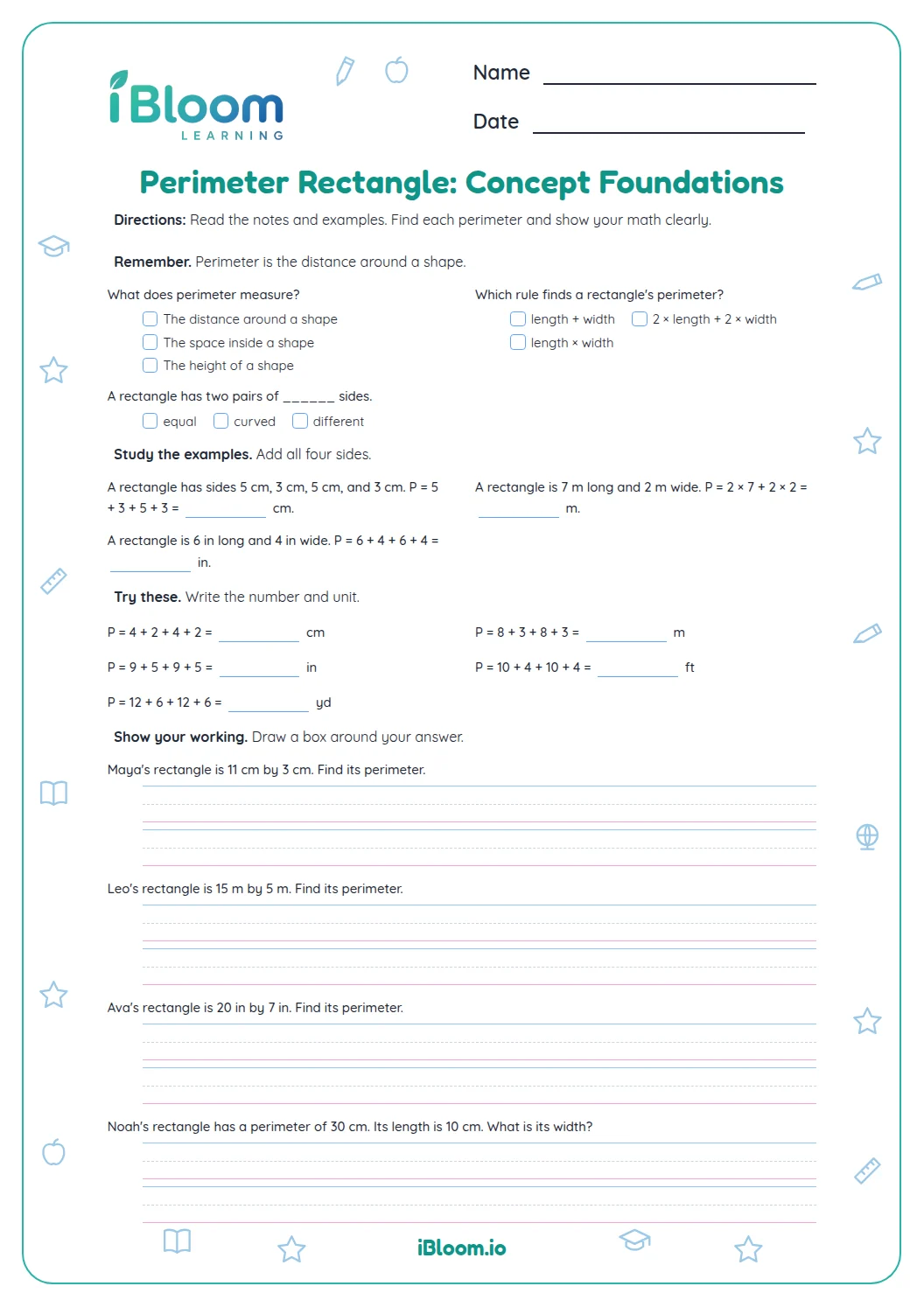
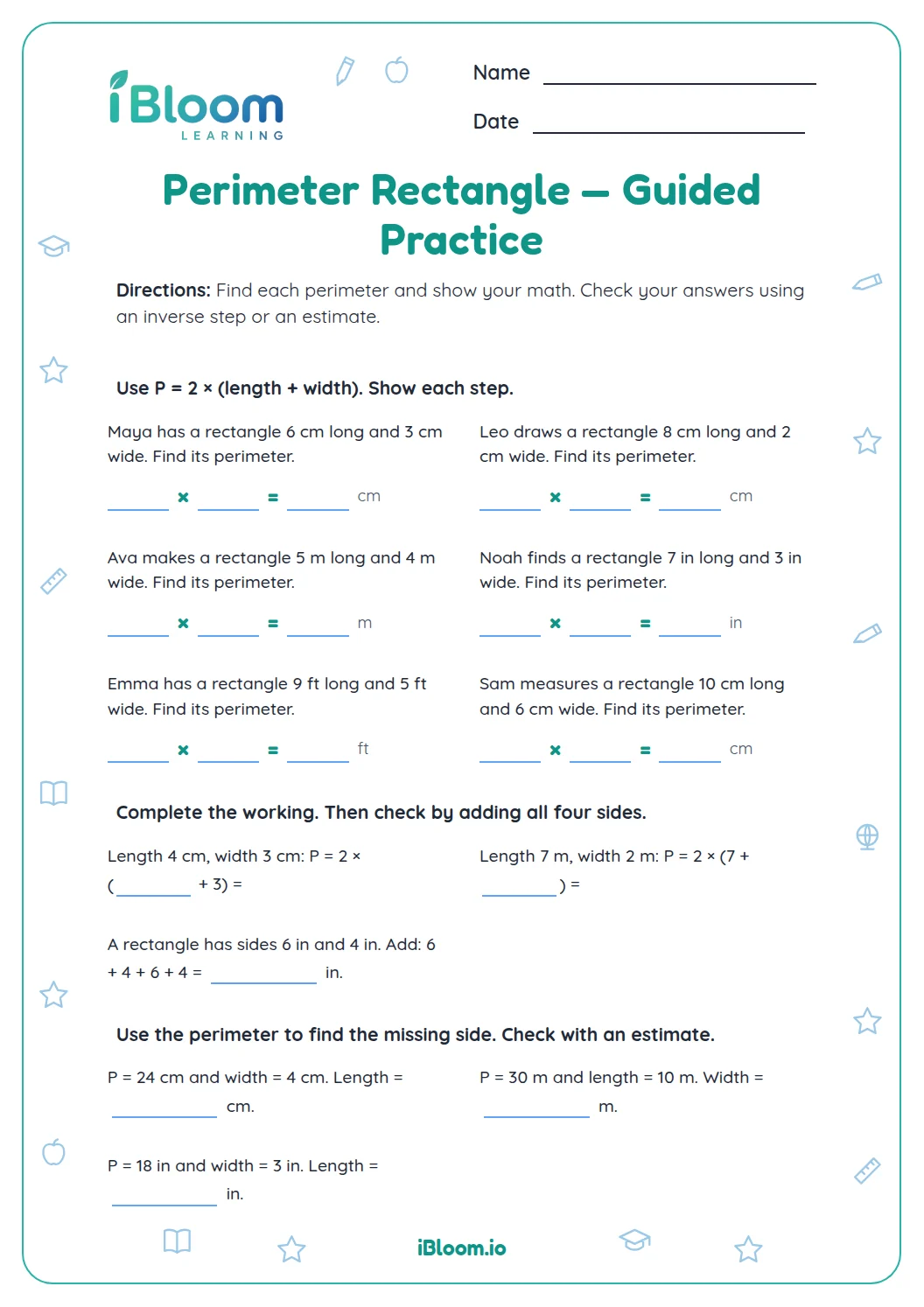
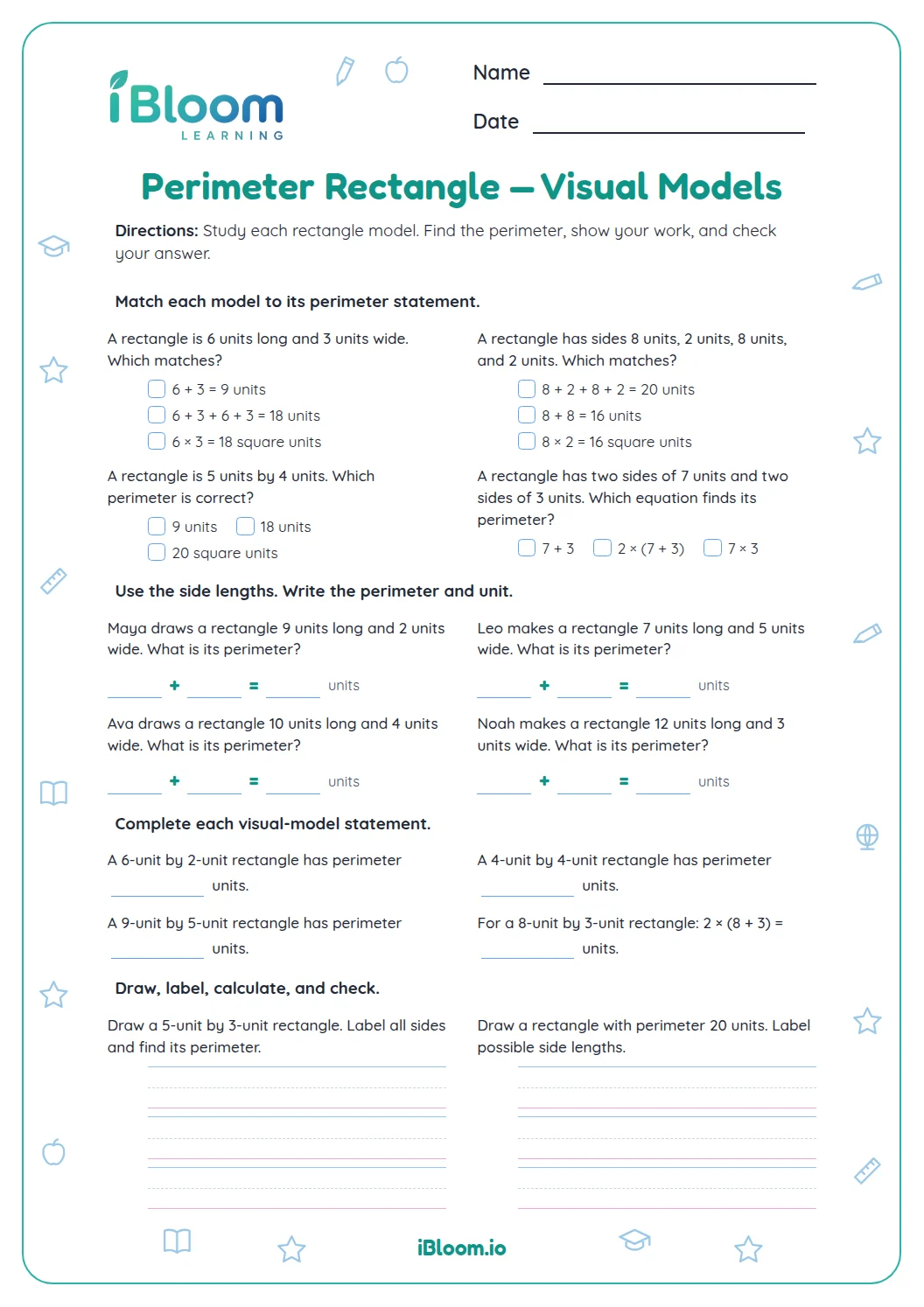
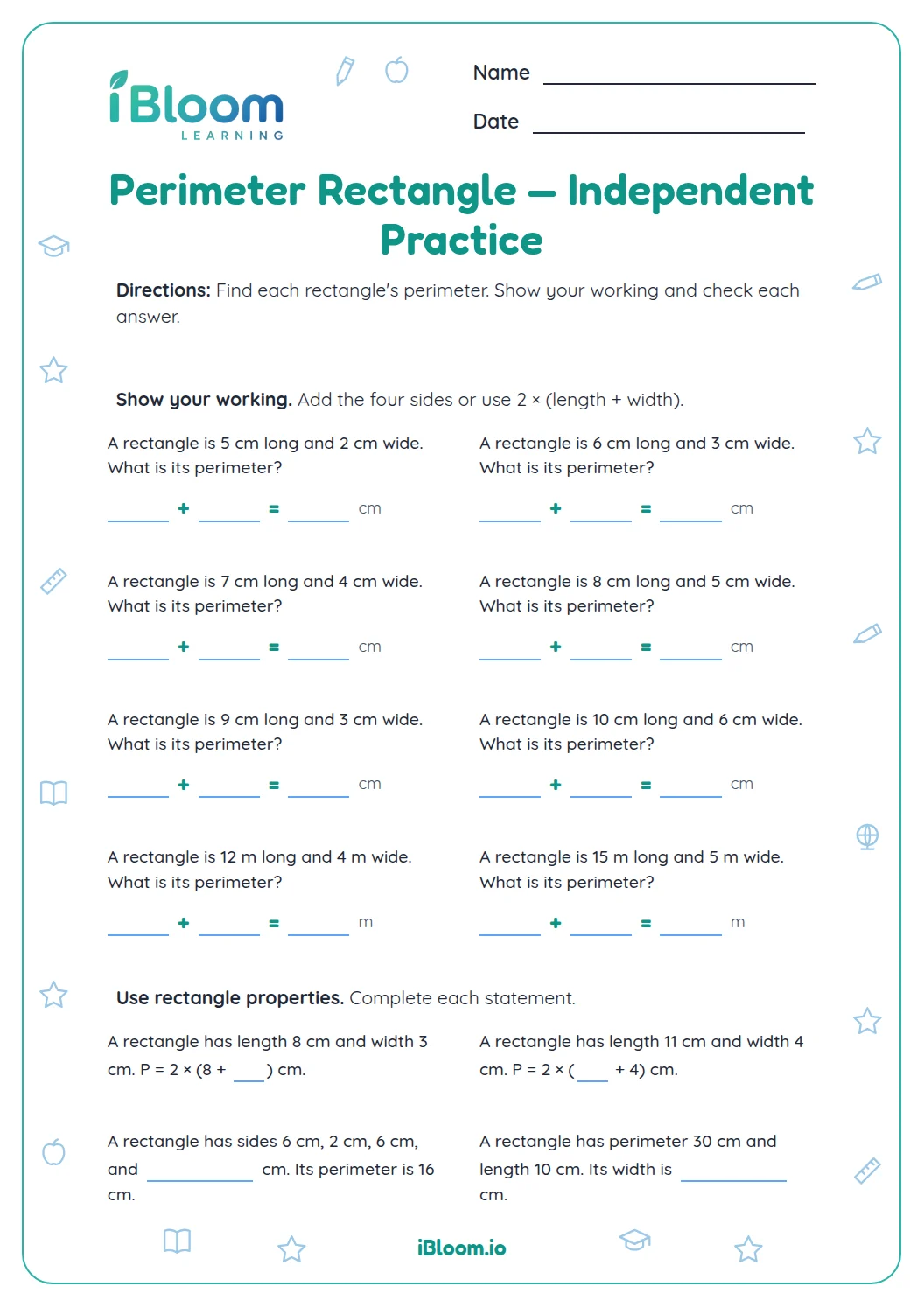
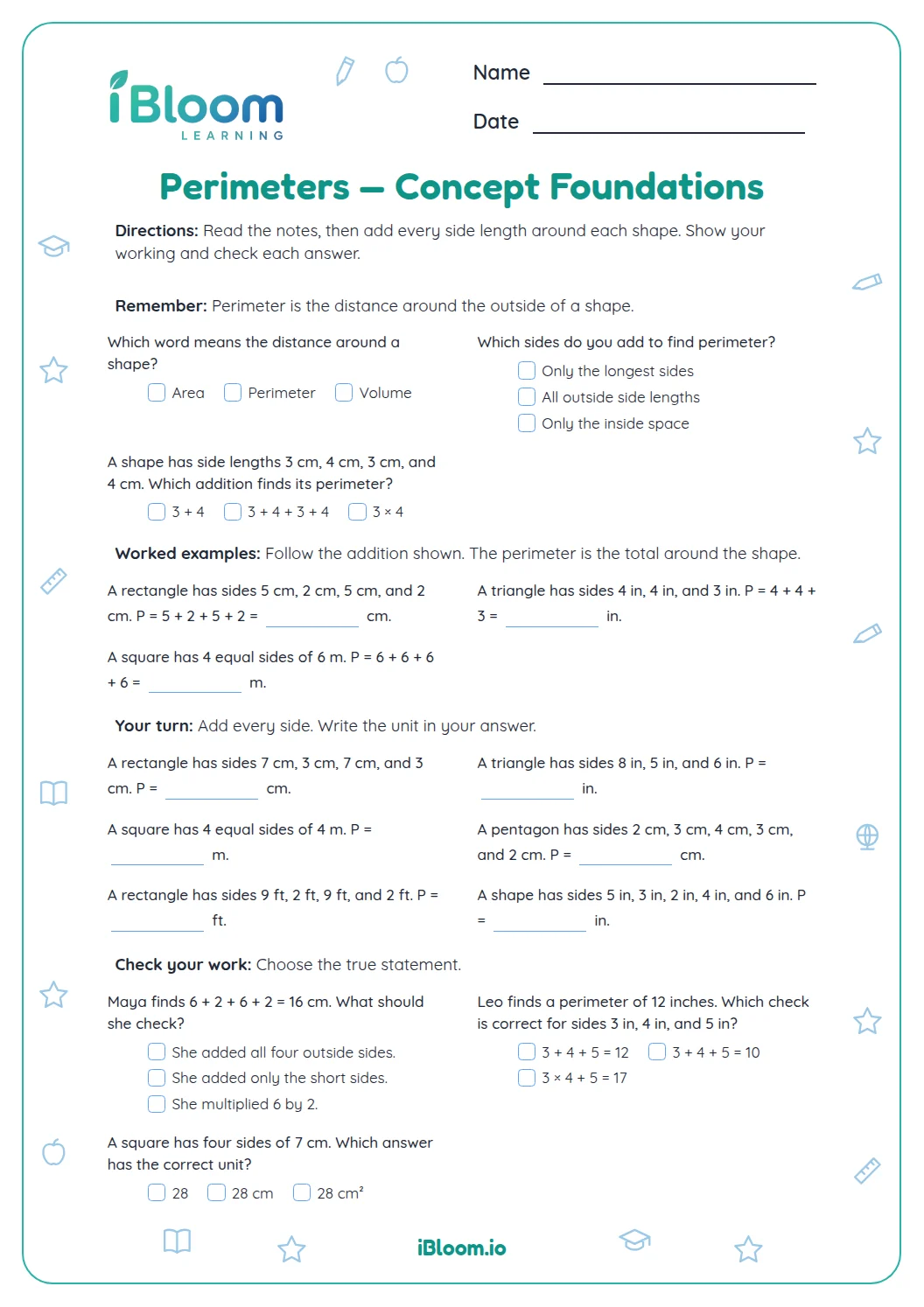
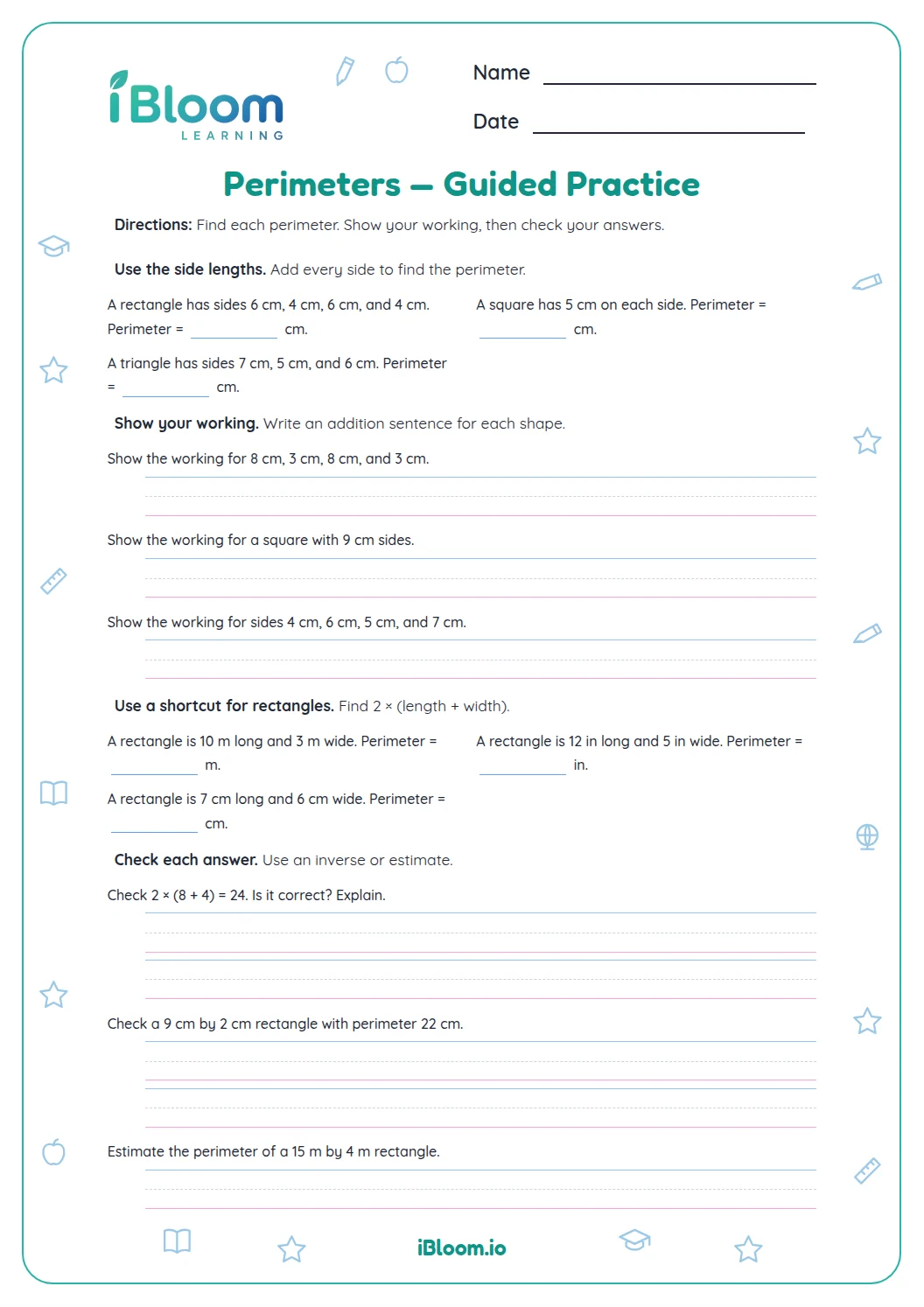
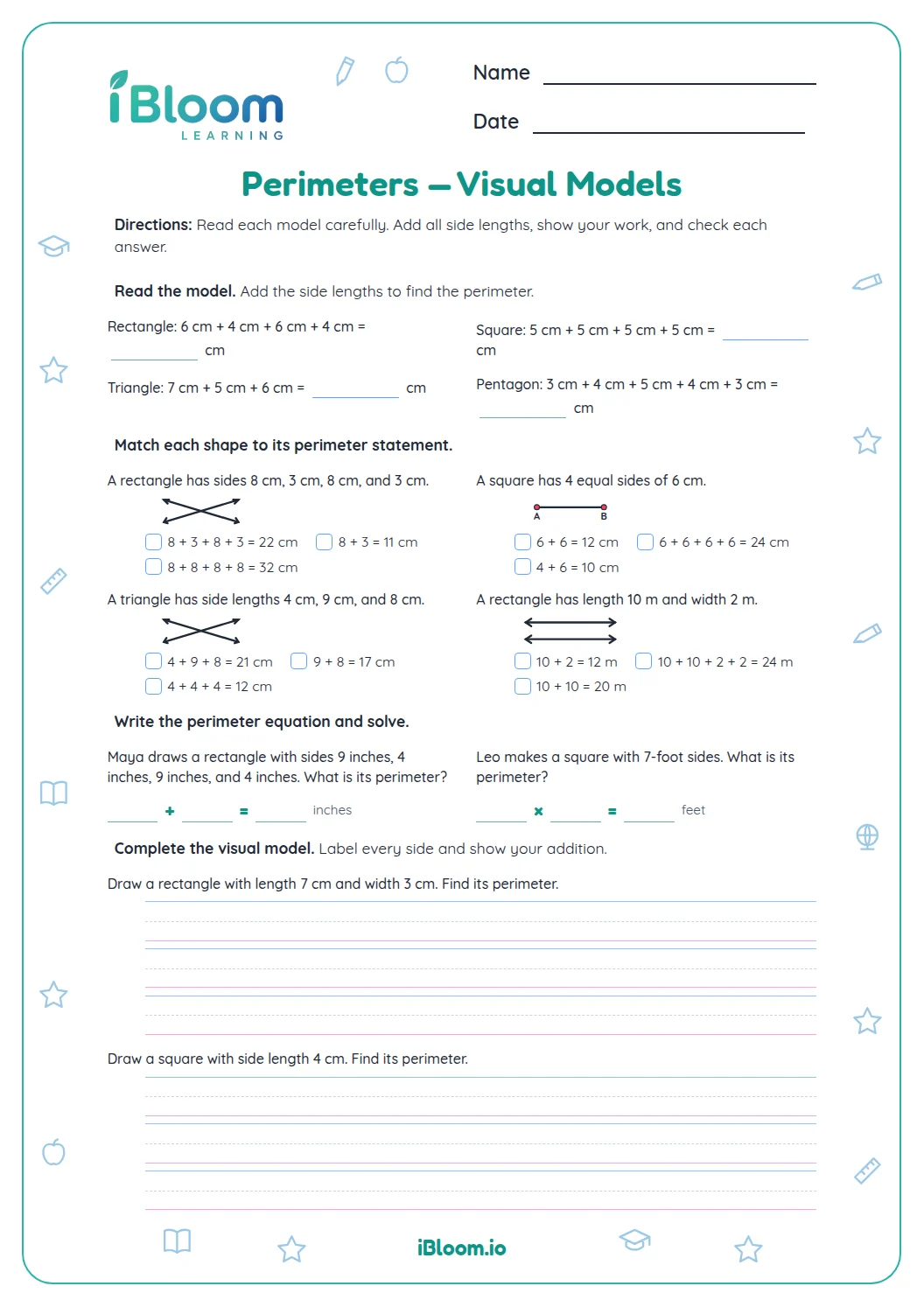
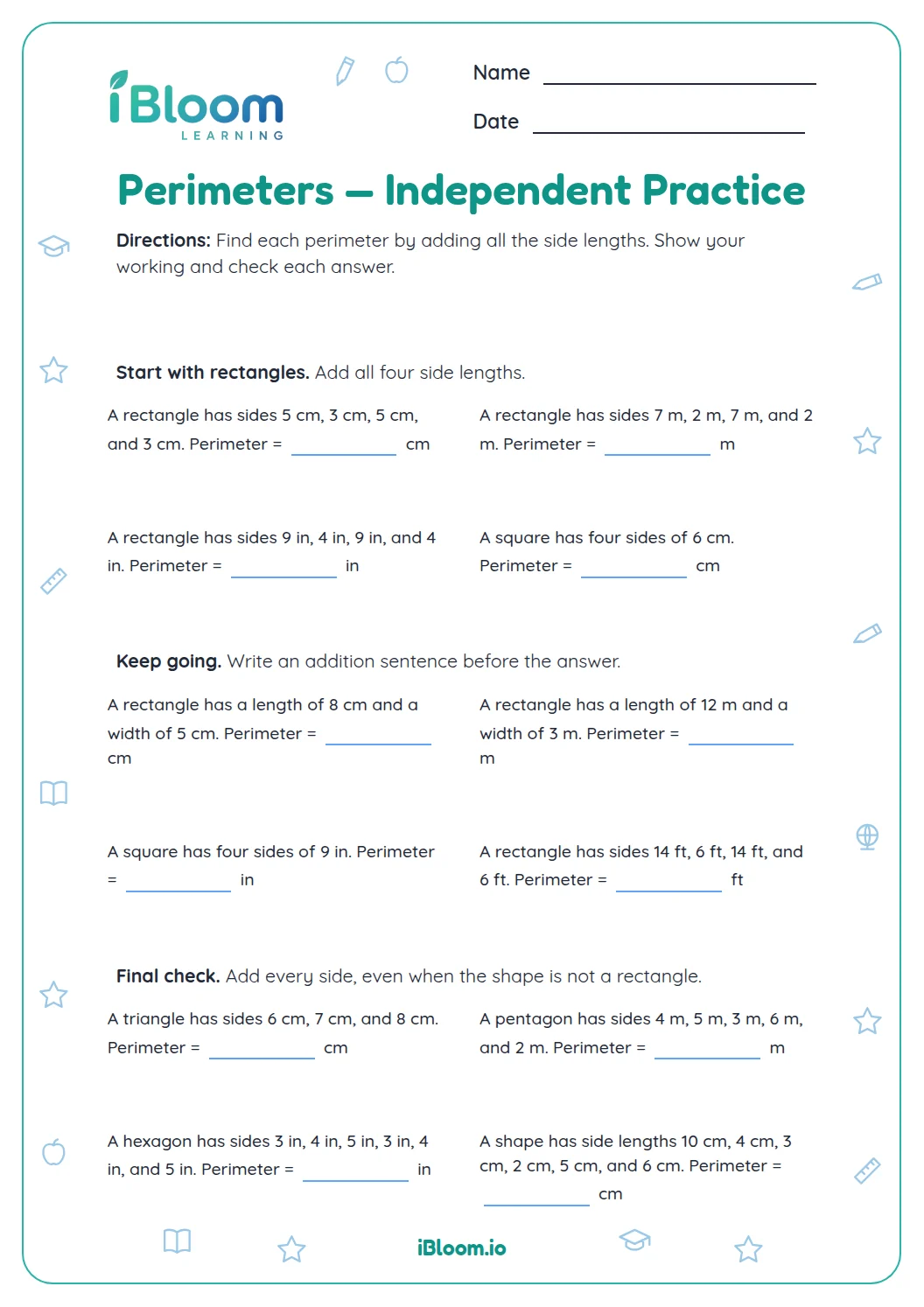
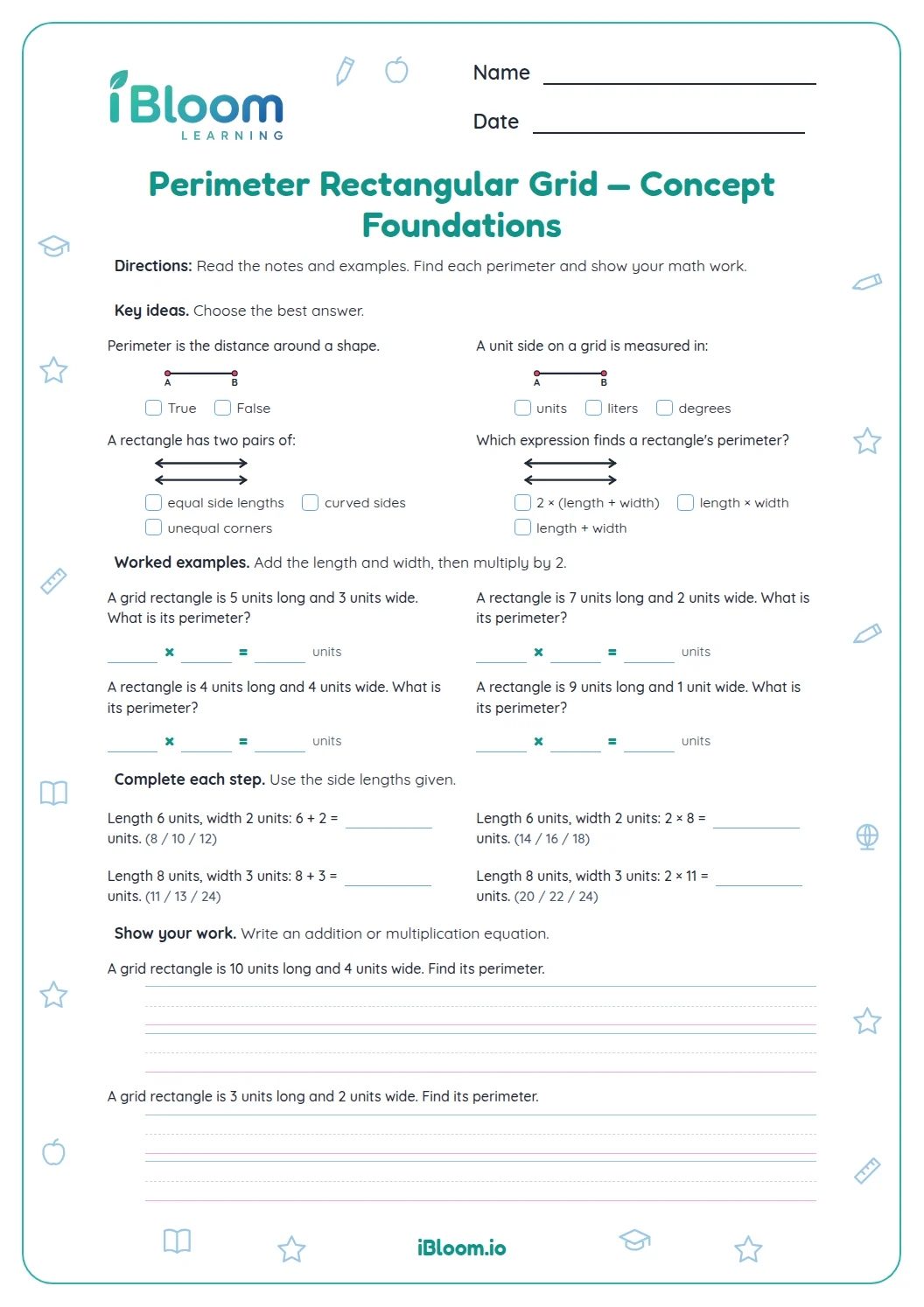
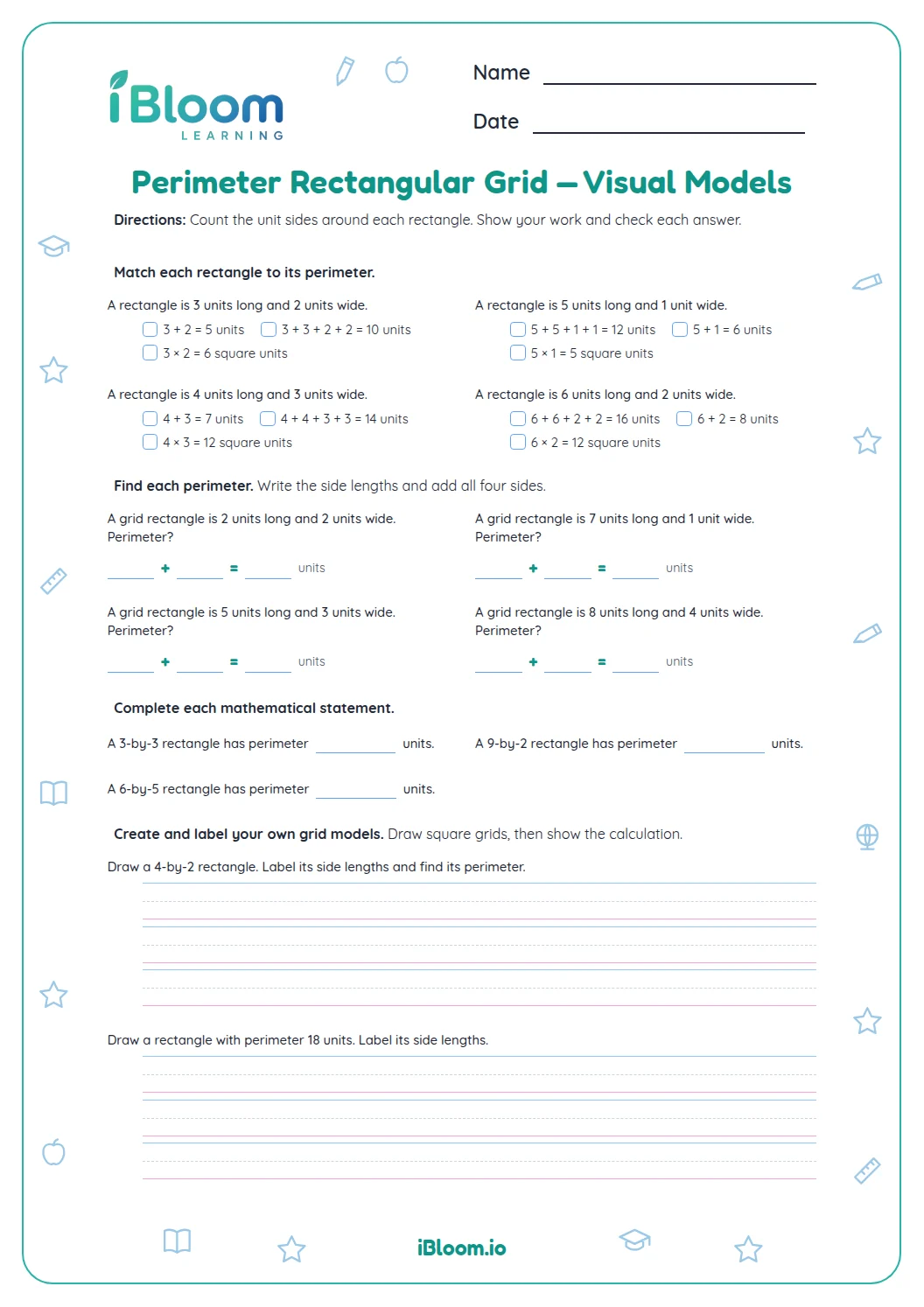
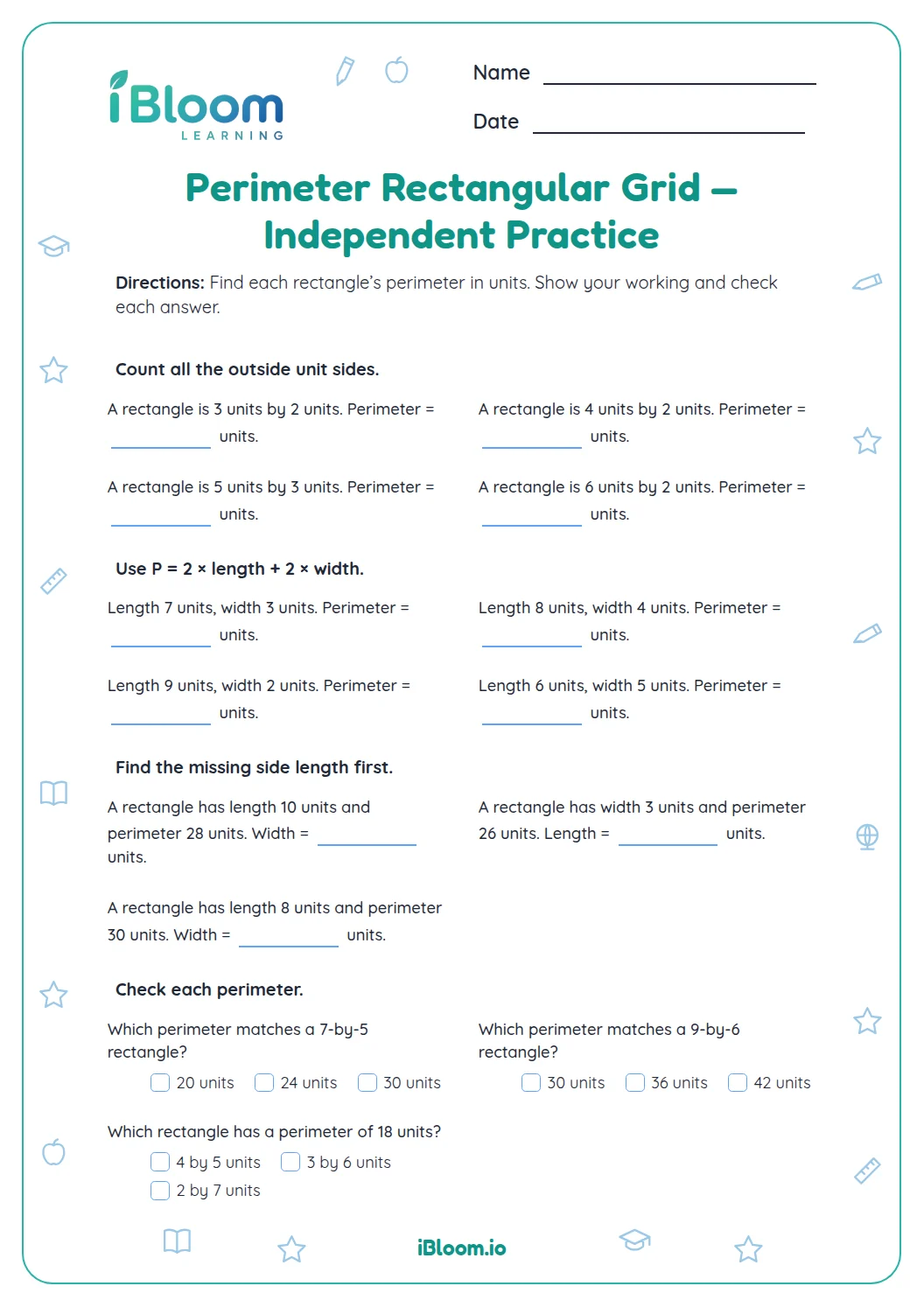
This free Grade 3 worksheet gives students 15 real-world problems about the perimeter of rectangles. They add all four side lengths, use equal opposite sides, and work backward from a known perimeter in a few problems. Contexts include a garden, rug, picture frame, dog pen, table, and sandbox. One item compares two designs with the same total perimeter. The questions align with Common Core 3.MD.D.8, which applies perimeter to real-world and mathematical problems. A separate answer key lists the answers with units.
Aligned to 3.MD.D.8
What situations do the problems use?
The worksheet uses familiar rectangles: a garden, rug, picture frame, dog pen, mat, table, flower bed, banner, court, and sandbox. Questions 1–11 ask for the total distance around a rectangle. Questions 12–14 give the perimeter and one side so students can find a missing side. Question 15 compares two gardens.
- Lengths are given in consistent units for each rectangle
- Answers include feet, inches, yards, meters, centimeters, or tiles
- One problem asks students to reason backward from perimeter
What is a reliable way to find the perimeter?
A rectangle has two equal lengths and two equal widths. Add each side once, or add length and width and double the sum. Keep the unit attached to the result.
- 1Garden: 6 ft long and 3 ft wide
- 2Add all sides: 6 + 3 + 6 + 3 = 18
- 3The garden needs 18 ft of fencing.
How do you find a missing side?
For question 12, the perimeter is 26 ft and the length is 8 ft. Two long sides use 16 ft, leaving 10 ft for both widths. Divide 10 by 2 to get a width of 5 ft. Check: 8 + 5 + 8 + 5 = 26.
Why do units matter in perimeter answers?
Perimeter is a distance, so report the same unit used for the sides. If a question describes a 12-inch banner, write the perimeter in inches. The unit makes the answer useful for buying trim or fencing.
How to use this worksheet
- 1Mark the length and width in each rectangle story.
- 2Write each of the four side lengths in an addition sentence.
- 3Add carefully, then copy the correct unit into the answer.
- 4For a missing side, subtract known sides from the perimeter and split any leftover pair equally.
- 5Use the answer key to check both the total and its unit.
Common perimeter mistakes
The mistake
Multiplying length by width to find perimeter.
The fix
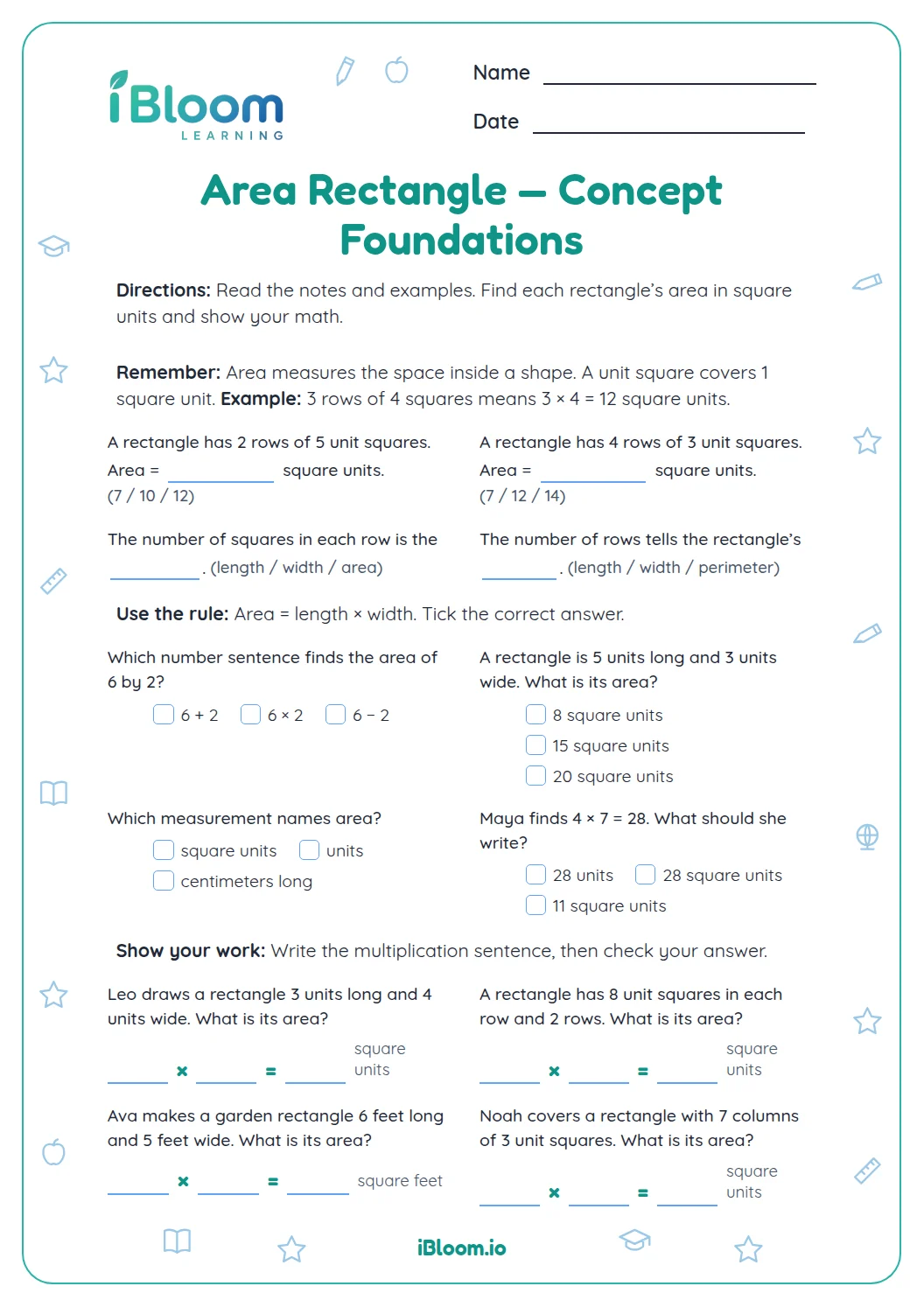
Ask whether the question wants the space inside or the distance around; perimeter follows the outside edges.
The mistake
Adding only the length and width once.
The fix
A rectangle has two lengths and two widths, so include both equal pairs.
The mistake
Writing a number without a unit.
The fix
Copy the unit from the side measurements into the final distance.
Common Core alignment
Solve perimeter problems by finding unknown sides and comparing rectangle designs.
On this sheet: Students find rectangle perimeters, work backward to a side, and compare two designs.
Show the official wordingHide the official wording
Solve real world and mathematical problems involving perimeters of polygons, including finding the perimeter given the side lengths, finding an unknown side length, and exhibiting rectangles with the same perimeter and different areas or with the same area and different perimeters.
What to practice next
Make more practice
Further reading
Questions parents and teachers ask
What does perimeter measure?
Perimeter is the distance around a flat shape. For a rectangle, add all four side lengths. A 6 ft by 3 ft garden has a perimeter of 18 ft, which tells how much fencing is needed to go around it.
Can students use a shortcut for rectangles?
Yes. Add the length and width, then double the sum because opposite sides of a rectangle are equal. For a 6 ft by 3 ft rectangle, (6 + 3) × 2 = 18 ft. Students can also write all four sides to show why the shortcut works.
How many problems are on the worksheet?
There are 15 problems in three parts. They include perimeter calculations, real-world situations, missing-side questions, and a comparison of two garden designs. Students can show their addition in the working space and label each result with the matching unit.
What should an answer include?
Include the distance and the unit, such as 18 ft or 24 in. Use the same unit given for the side measurements. A labeled answer makes clear how much fence, trim, or edging a situation needs, and helps distinguish a length from a count of objects.
Does the worksheet include a missing-side question?
Yes. Questions 12 and 14 give a rectangle’s perimeter and one side. Subtract the known pair of sides from the perimeter, then split the remaining distance equally between the two unknown sides. Check by adding all four sides.