
About this worksheet
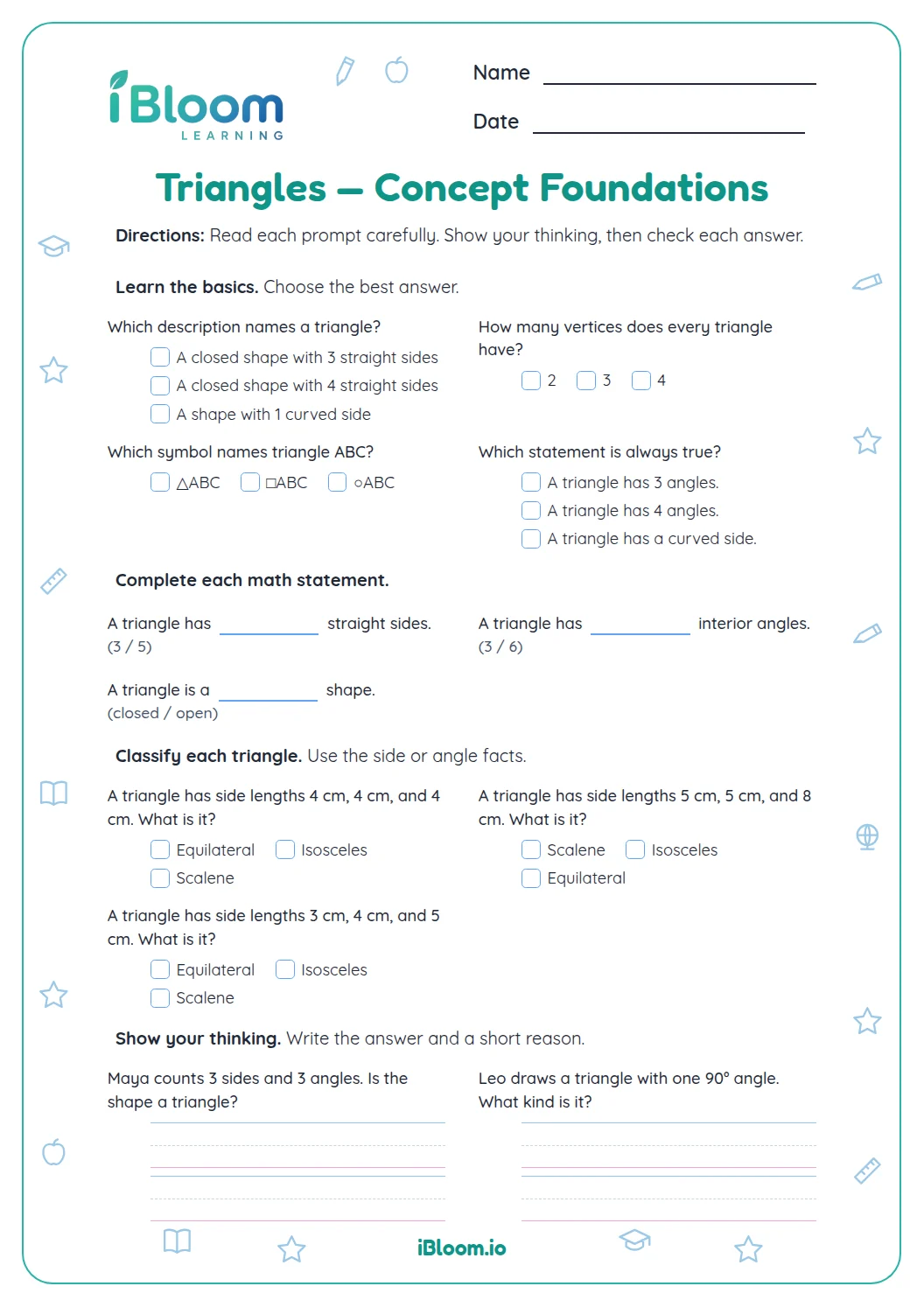
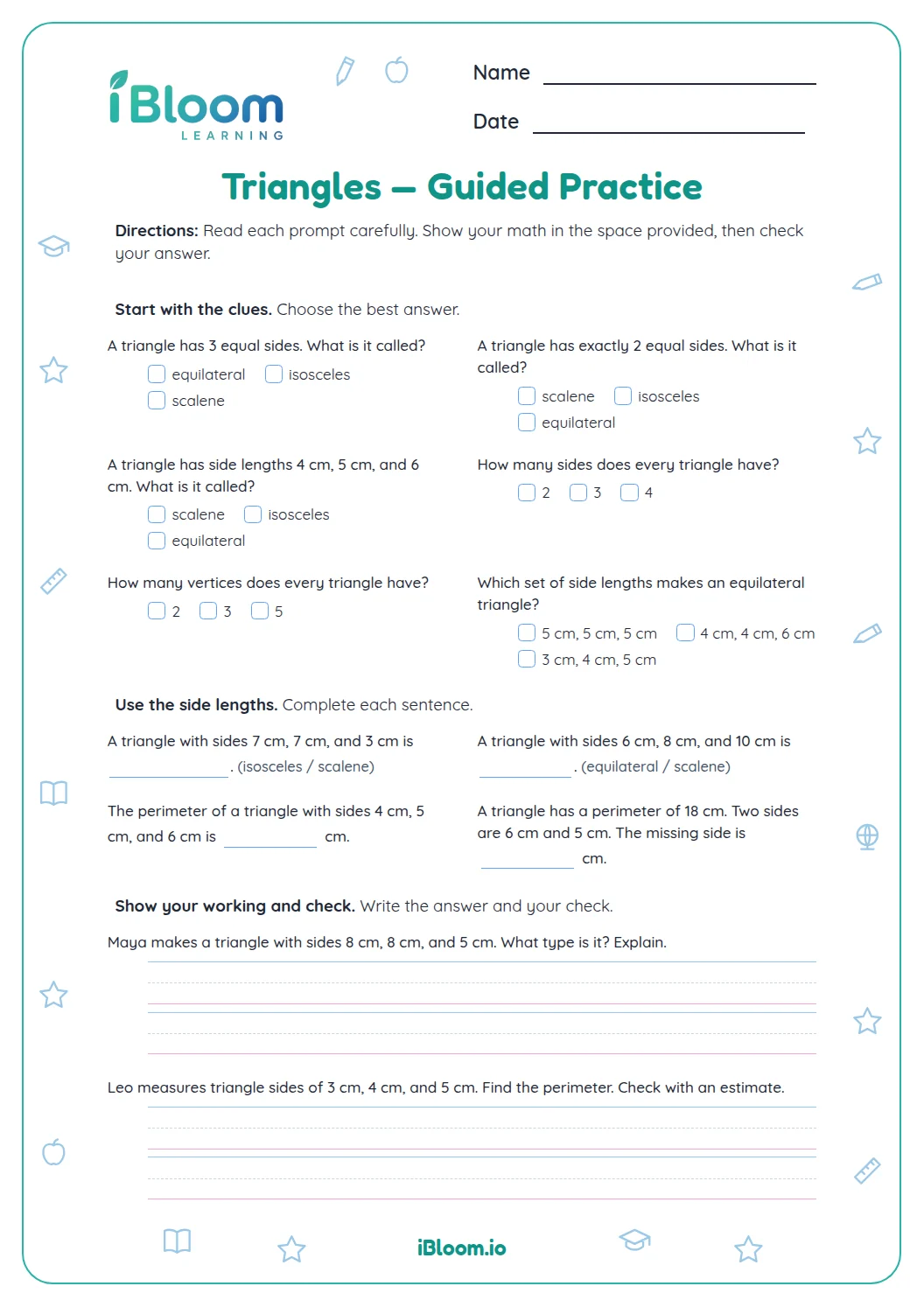
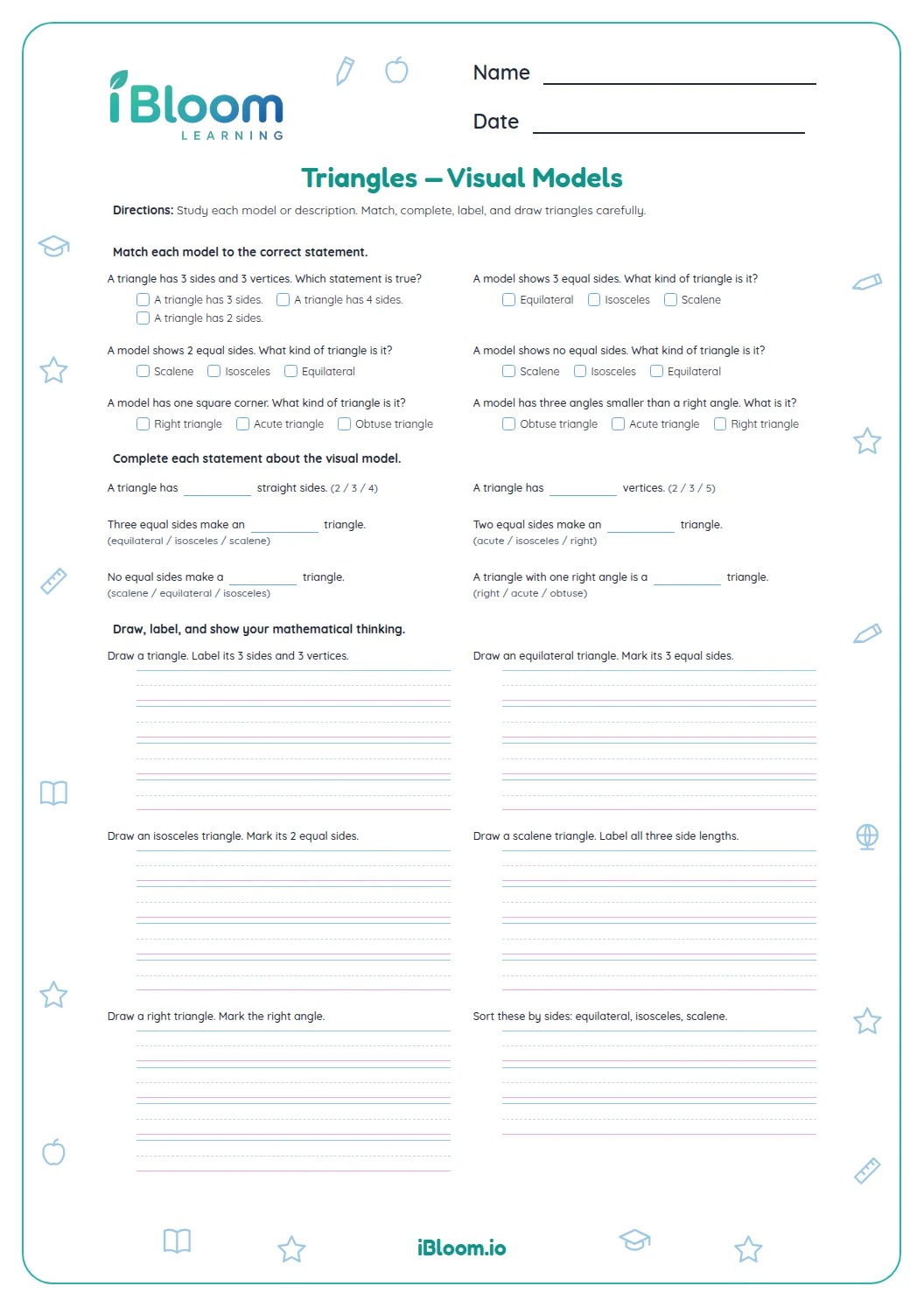
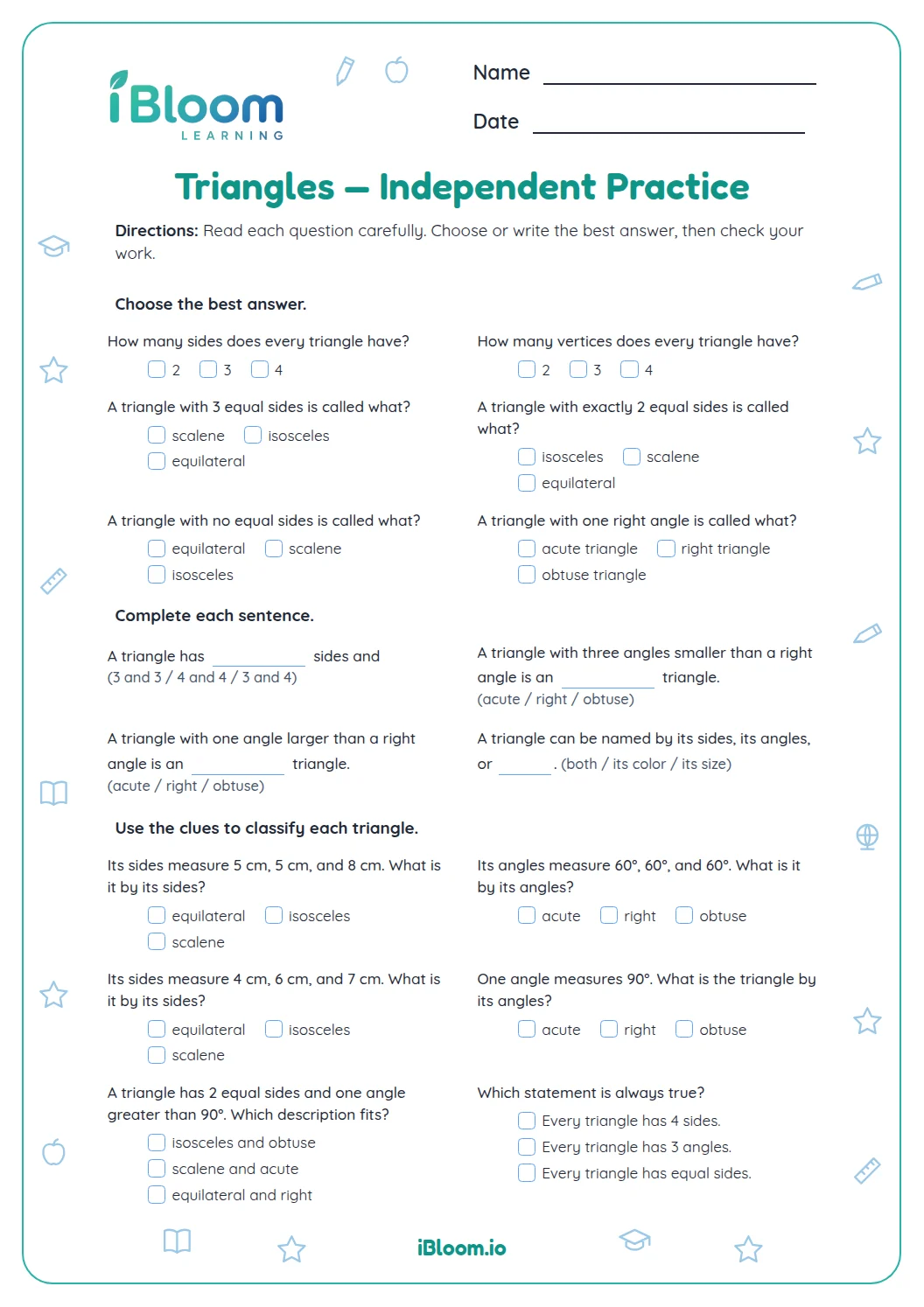
This printable Grade 3 worksheet uses familiar settings such as signs, roof braces, sails, and flags to practice naming triangles from side and angle clues. The final two questions ask learners to find perimeter from three given side lengths. A separate answer key lists each triangle name and perimeter result.
Aligned to 4.G.A.2 and 3.MD.D.8
How do side lengths describe a triangle?
Equal side lengths give useful names: three equal sides make an equilateral triangle, while exactly two equal sides make an isosceles triangle. Three different side lengths make a scalene triangle.
- 1A road sign triangle has 3 equal sides.
- 2Three equal sides means equilateral.
How do angles describe a triangle?
Angle clues use familiar corners. A square corner is a right angle; a triangle with one is a right triangle. A corner wider than a square corner is obtuse, and three smaller corners make an acute triangle.
What real-world examples are included?
The 14 prompts connect triangles to road signs, roof braces, sails, gardens, flags, and tiles. Learners identify side and angle attributes, then solve two perimeter situations using given side lengths.
- Part A matches everyday objects to side and angle clues.
- Part B applies triangle names and solves two perimeter word problems.
- The key lists a triangle category or perimeter for each answer.
How to use this worksheet
- 1Read the situation and identify whether it gives a side or angle clue.
- 2Look at the triangle model and its marks.
- 3Choose the name that matches the stated attribute.
- 4For multiple choice, reread the clue before marking one answer.
- 5Use the key to review any attribute that was mixed up.
Common mistakes and quick fixes
The mistake
Mixing side and angle names
The fix
Check whether the clue describes side lengths or angle sizes.
The mistake
Calling a triangle with two equal sides equilateral
The fix
Equilateral means all three sides are equal.
The mistake
Calling every wide angle a right angle
The fix
A right angle is exactly square; a wider angle is obtuse.
Common Core alignment
The sheet identifies right triangles by a square corner and finds perimeter from side lengths.
Recognize right triangles and identify them from their square corner.
On this sheet: Question 4 and question 9 identify a right triangle from its square corner.
Show the official wordingHide the official wording
Classify two-dimensional figures based on the presence or absence of parallel or perpendicular lines, or the presence or absence of angles of a specified size. Recognize right triangles as a category, and identify right triangles.
Find polygon perimeter in real-world problems when side lengths are given.
On this sheet: The last two real-world questions find triangular perimeters from the given side lengths.
Show the official wordingHide the official wording
Solve real world and mathematical problems involving perimeters of polygons, including finding the perimeter given the side lengths, finding an unknown side length, and exhibiting rectangles with the same perimeter and different areas or with the same area and different perimeters.
What to practice next
Make more practice
Further reading
Questions parents and teachers ask
What makes a triangle equilateral?
An equilateral triangle has three equal side lengths. Question 1 describes a triangular road sign with three equal sides, then asks for the matching name. The key gives the category so learners can check how the stated side clue maps to the term.
How is an isosceles triangle different from a scalene triangle?
An isosceles triangle has two equal sides, while a scalene triangle has three sides of different lengths. The worksheet uses objects such as a roof brace and a sail to help connect those descriptions to familiar contexts. A quick sketch with side marks can make the difference visible.
What is a right triangle?
A right triangle has one square corner, which is a right angle. Question 9 gives the familiar corner clue and asks learners to name its angle type. Learners match the clue to the geometry vocabulary they have practiced.
Can a triangle be named by both sides and angles?
Yes. Side names and angle names describe different attributes. For example, a triangle can be both isosceles and acute. This worksheet asks learners to attend to the specific side or angle clue stated in each item. The question tells which kind of attribute to use each time.
How many questions are on the sheet?
There are 14 questions across two worksheet pages and a separate answer key. Ten questions classify triangles by side or angle clues; four ask learners to add the three side lengths to find perimeter. The answer key shows the triangle names and perimeter totals.
What can learners do if they are unsure of a triangle name?
Underline the clue first: equal sides, different sides, a square corner, or an angle wider than a square corner. Then match the clue to the triangle name. For the last two items, add all three side lengths to find the perimeter.