
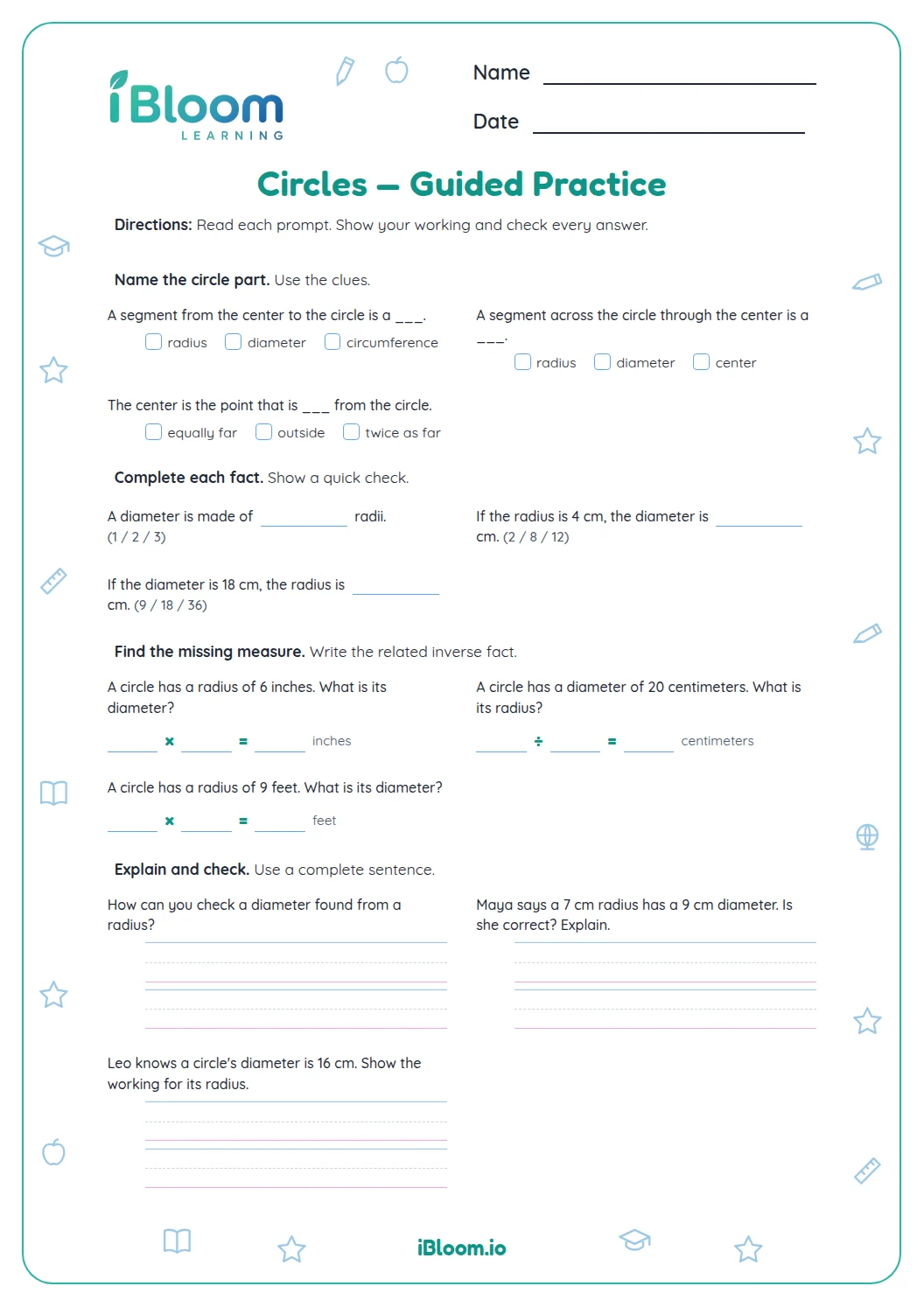
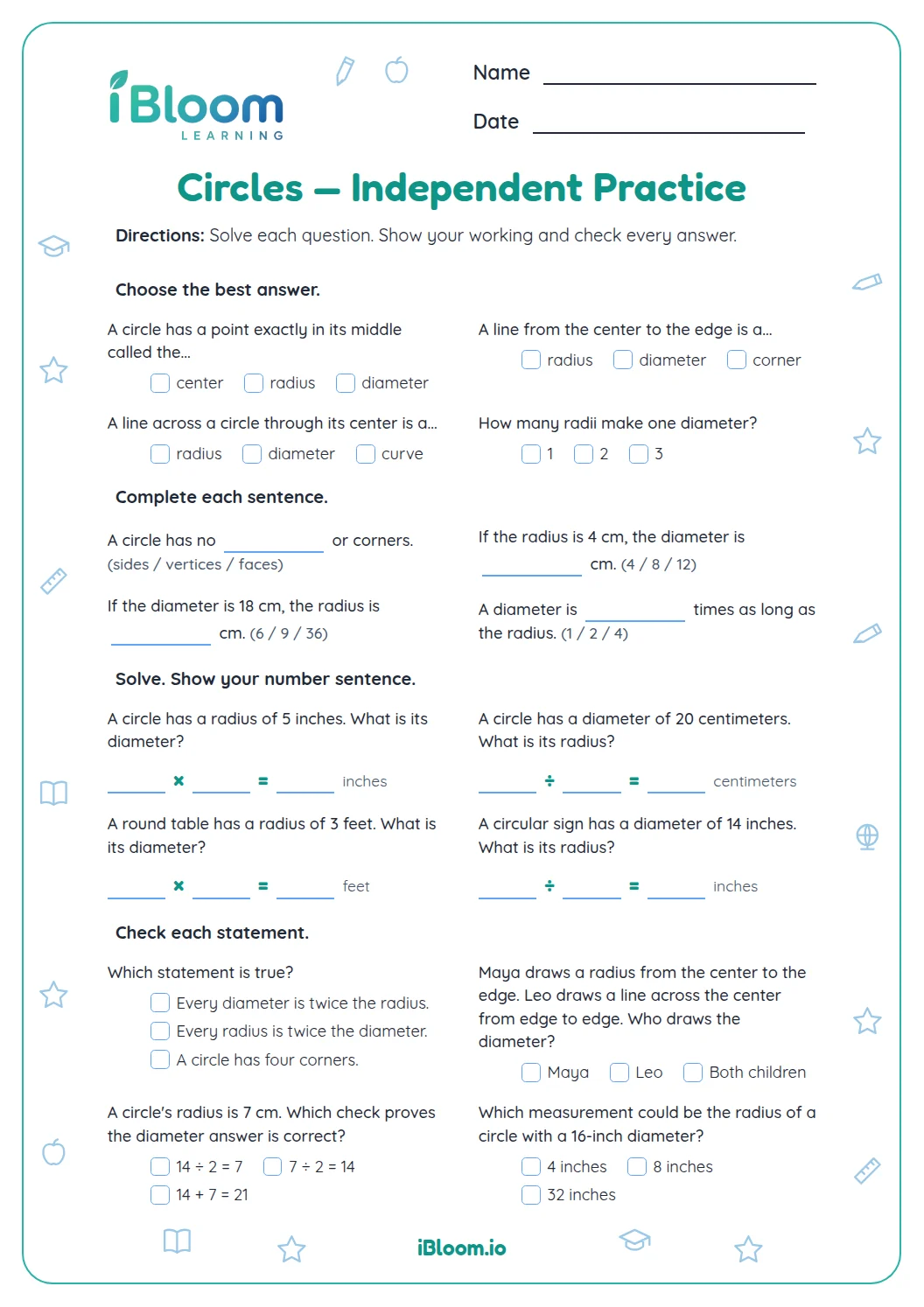
About this worksheet
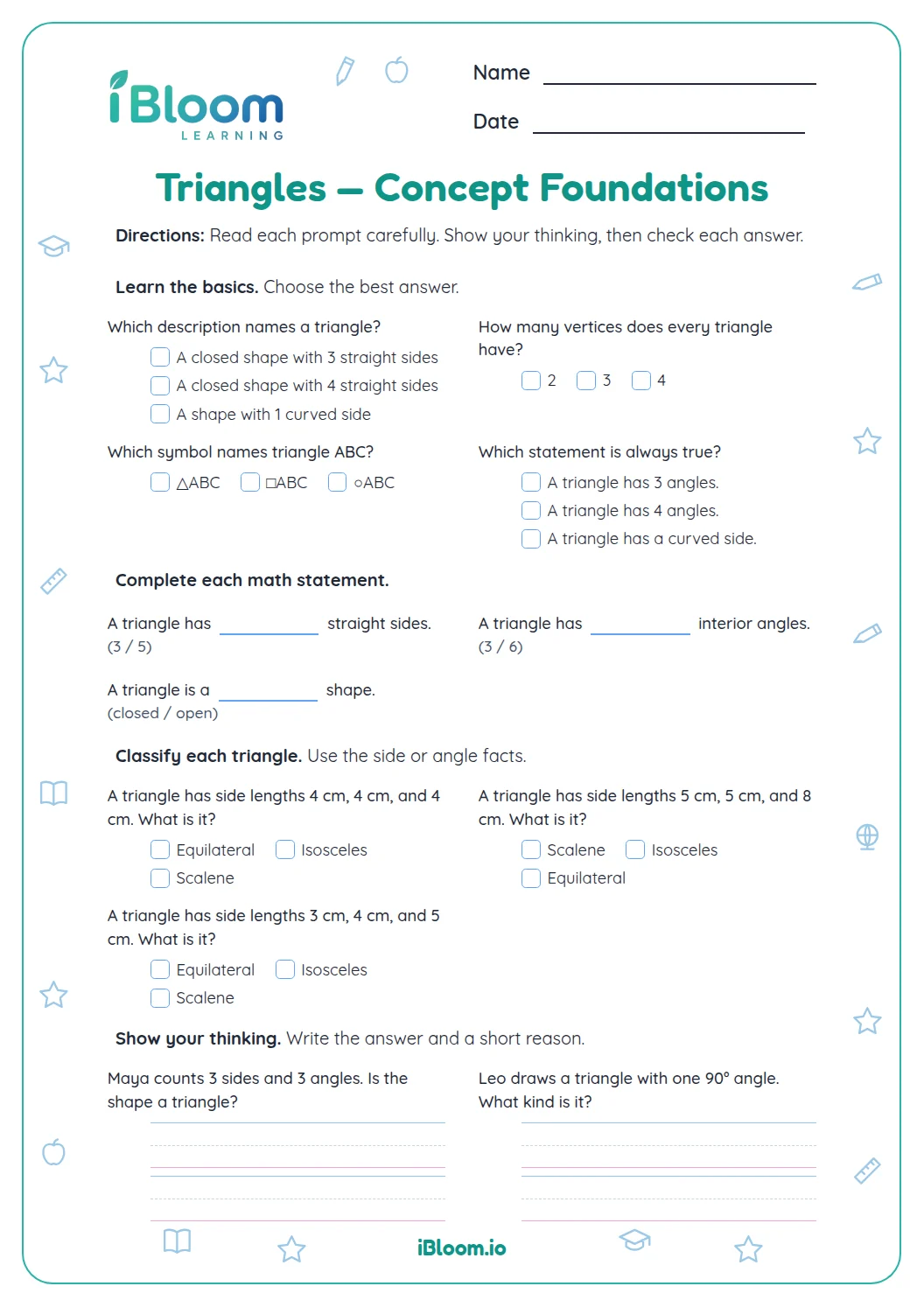
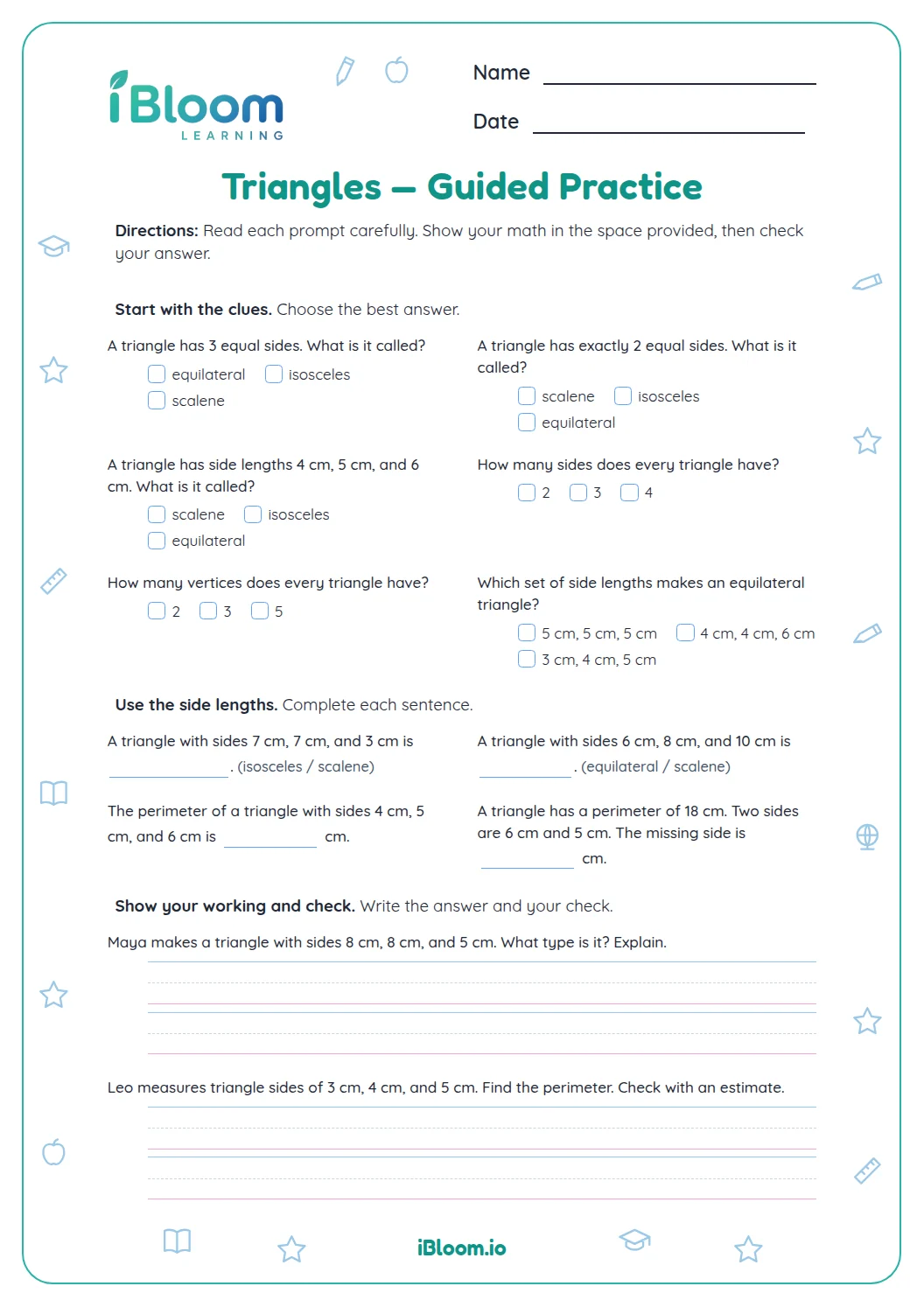
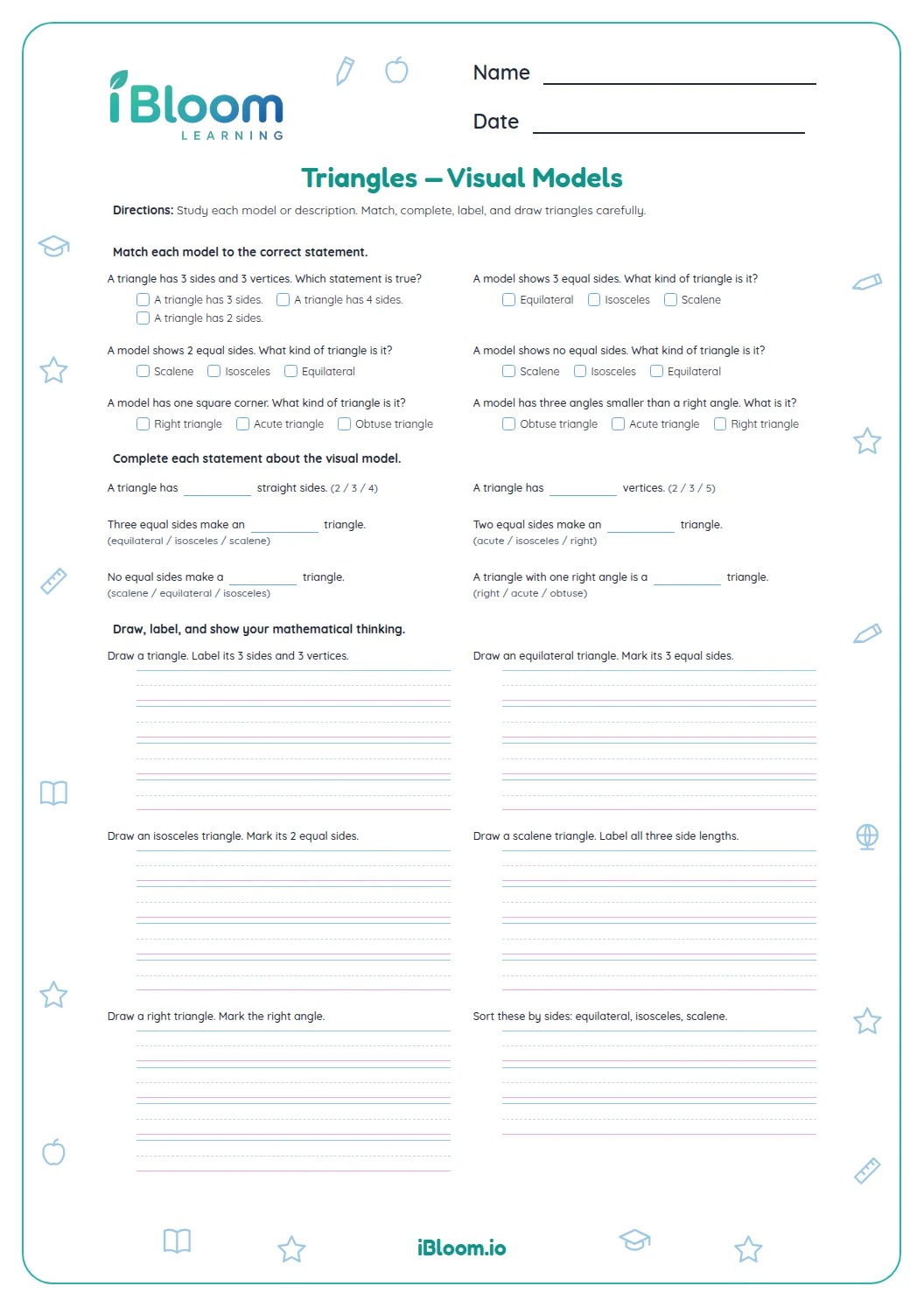
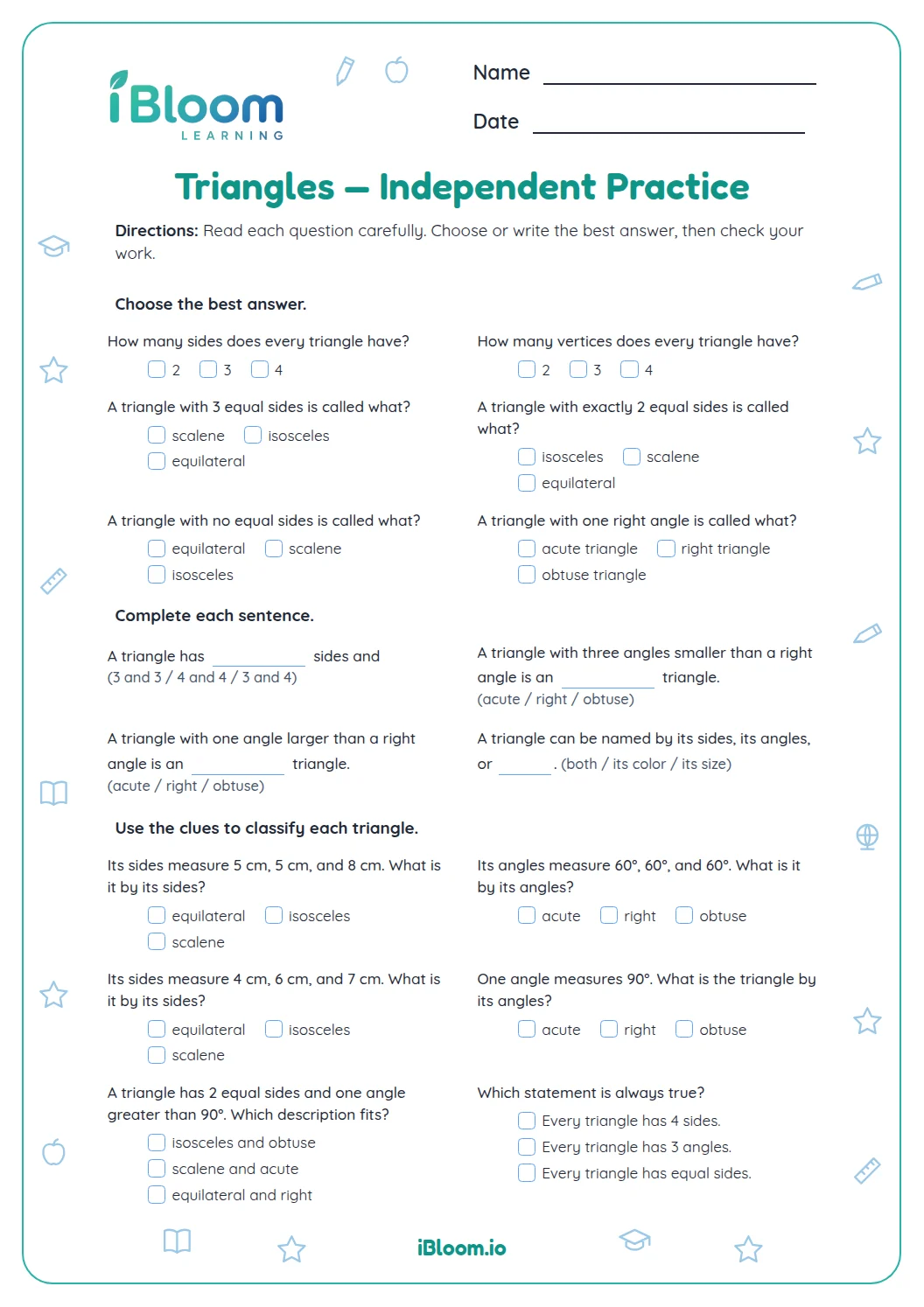
This Grade 3 worksheet focuses on how triangle sides and angles define different types. Learners use six shape drawings to identify equilateral, isosceles, scalene, acute, right, and obtuse triangles, then answer questions about shared triangle properties. It practices sorting shapes by attributes under Common Core 3.G.A.1. A separate key is included.
Aligned to 3.G.A.1
How do side clues name a triangle?
Compare the three side lengths. For this worksheet, equilateral means three equal sides, isosceles means exactly two equal sides, and scalene means no equal sides. Angle types are acute, right, or obtuse.
- 1Question 3 asks for a triangle with no equal sides. That is a scalene triangle.
How to use this worksheet
- 1Read whether the clue describes sides or angles.
- 2For side clues, compare the three lengths.
- 3For angle clues, look for a right, acute, or obtuse angle.
- 4Remember that every triangle has three sides and three angles.
- 5Check each response with the answer key.
Common mistakes and fixes
The mistake
Calling a triangle by its orientation.
The fix
Turn the page if needed; side and angle properties stay the same.
The mistake
Mixing up isosceles and equilateral.
The fix
Isosceles means at least two sides match; equilateral means all three match.
The mistake
Thinking a triangle can have two right angles.
The fix
A right angle uses 90 degrees, and two would already total 180 degrees before the third angle.
Curriculum alignment
Classify shapes by shared attributes, including side and angle properties.
On this sheet: The questions sort triangles using the attributes of their sides and angles.
Show the official wordingHide the official wording
Understand that shapes in different categories (e.g., rhombuses, rectangles, and others) may share attributes (e.g., having four sides), and that the shared attributes can define a larger category (e.g., quadrilaterals). Recognize rhombuses, rectangles, and squares as examples of quadrilaterals, and draw examples of quadrilaterals that do not belong to any of these subcategories.
What to practice next
Make more practice
Further reading
Questions parents and teachers ask
What triangle types are practiced?
The questions classify triangles by sides as equilateral, isosceles, or scalene, and by angles as acute, right, or obtuse. The sheet also reviews facts shared by every triangle. Point to the relevant side or angle clue and have the learner explain how that feature supports the selected triangle name.
Are triangles drawn on the worksheet?
Yes. The first six questions include shape drawings alongside non-triangle shapes, so learners identify the triangle that matches each side or angle clue. Point to the relevant side or angle clue and have the learner explain how that feature supports the selected triangle name.
What does scalene mean?
A scalene triangle has no equal side lengths. Compare all three sides; if each differs, the triangle is scalene. Point to the relevant side or angle clue and have the learner explain how that feature supports the selected triangle name.
Can a triangle have two right angles?
No. Two right angles already total 180 degrees, leaving no angle for a third corner. A triangle’s three interior angles together make 180 degrees. Point to the relevant side or angle clue and have the learner explain how that feature supports the selected triangle name.
Is an answer key included?
Yes. The separate key gives the selected triangle name or fact for each of the 16 questions. Point to the relevant side or angle clue and have the learner explain how that feature supports the selected triangle name. It lists each response clearly.