

About this worksheet
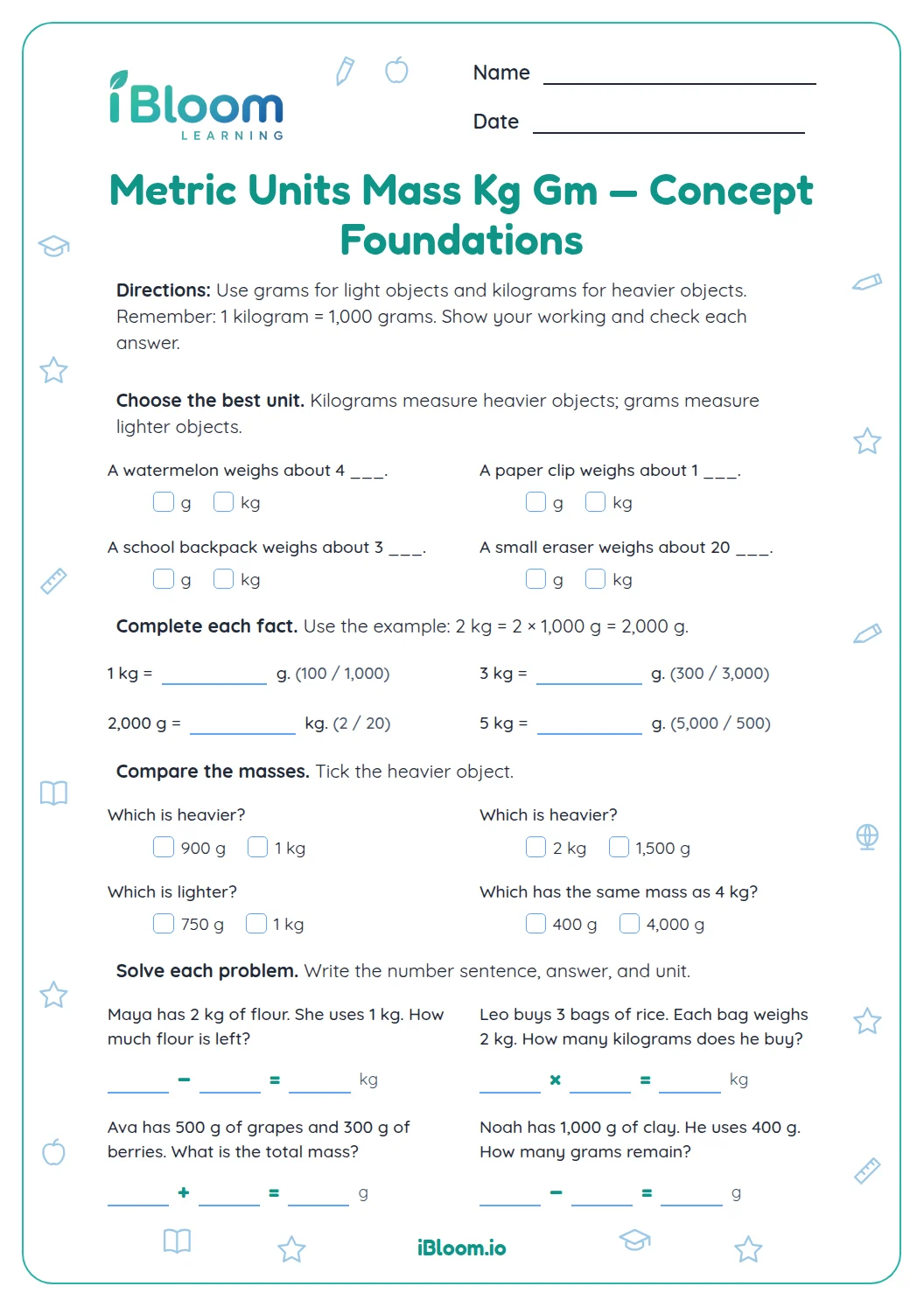
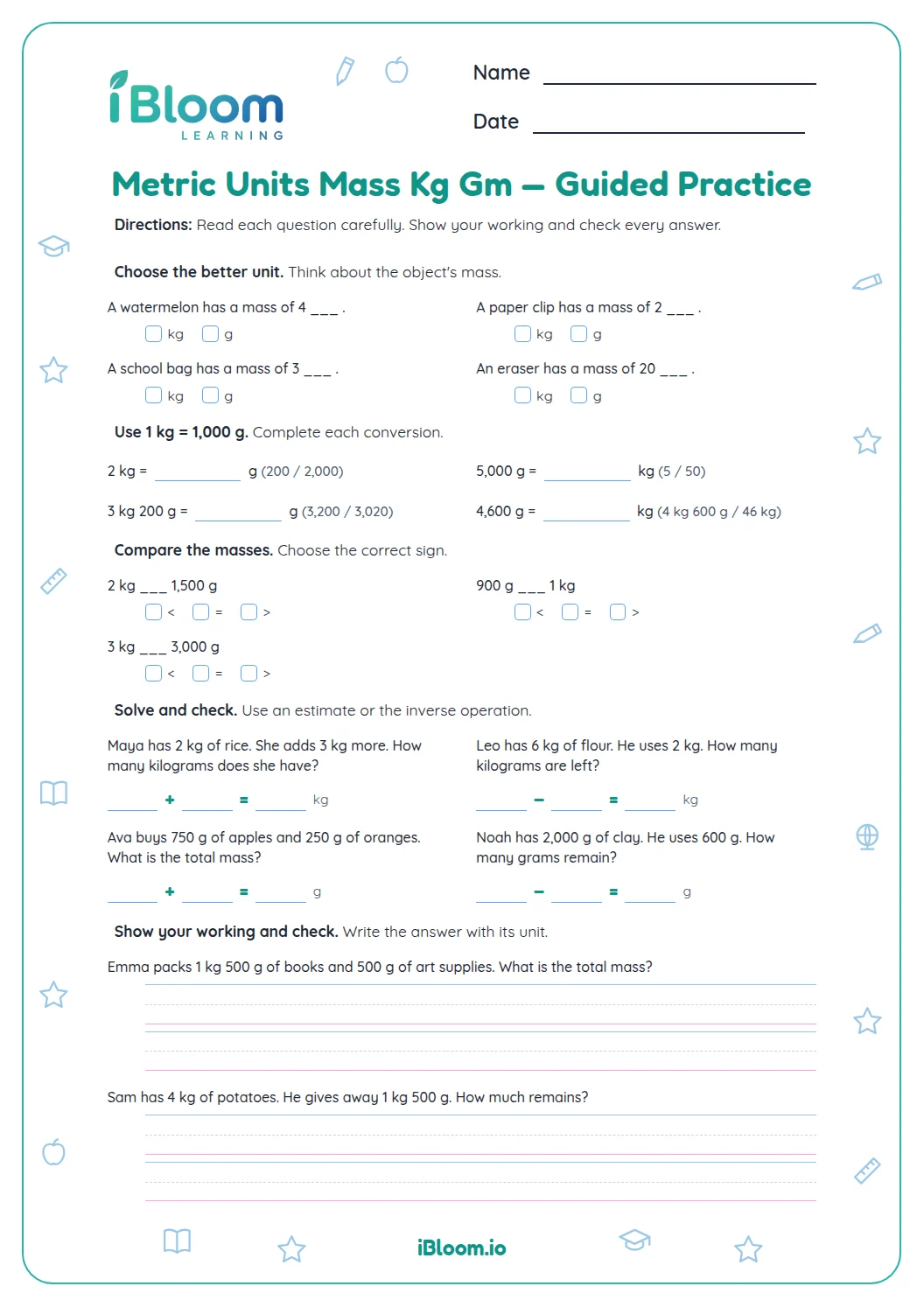
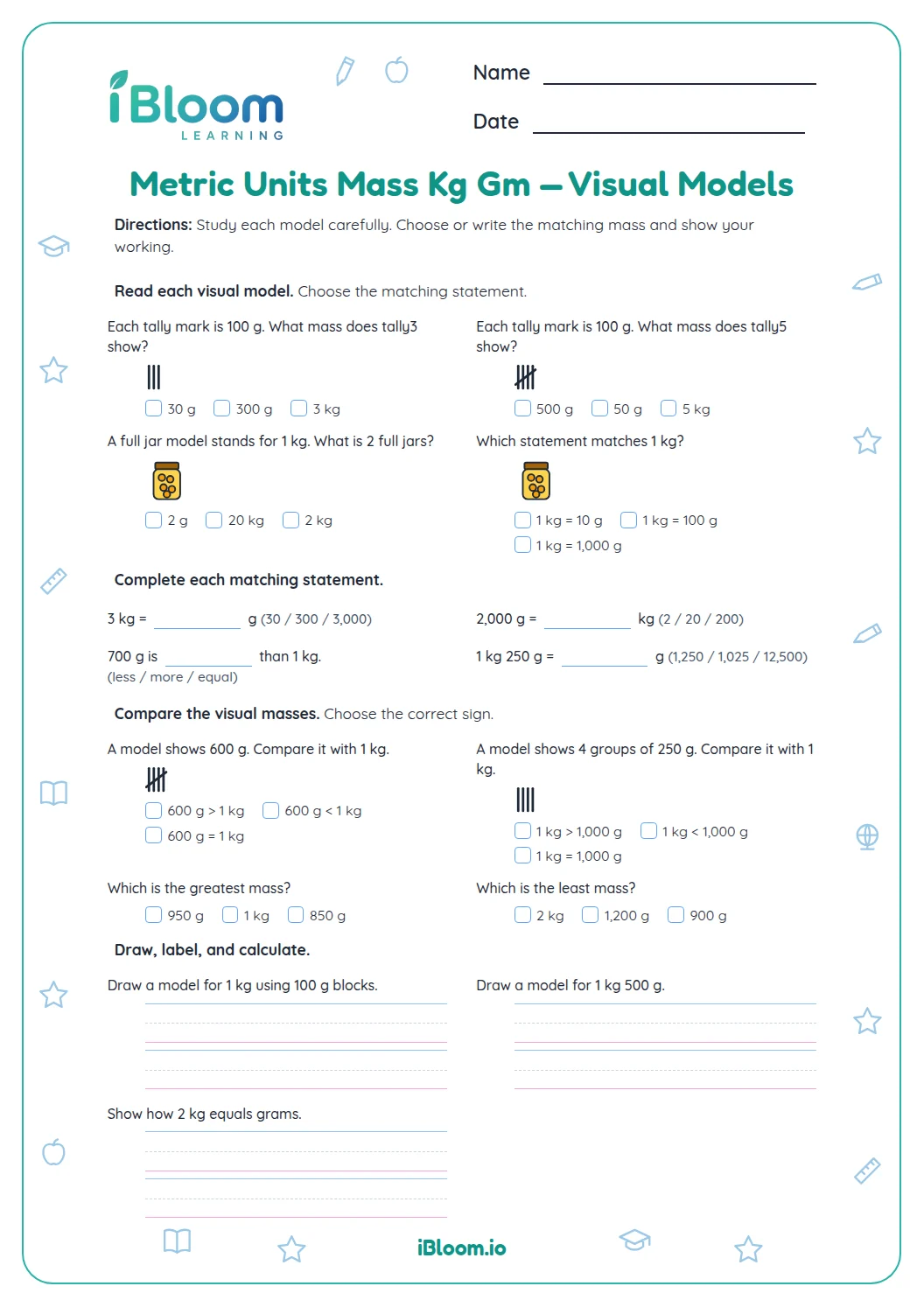
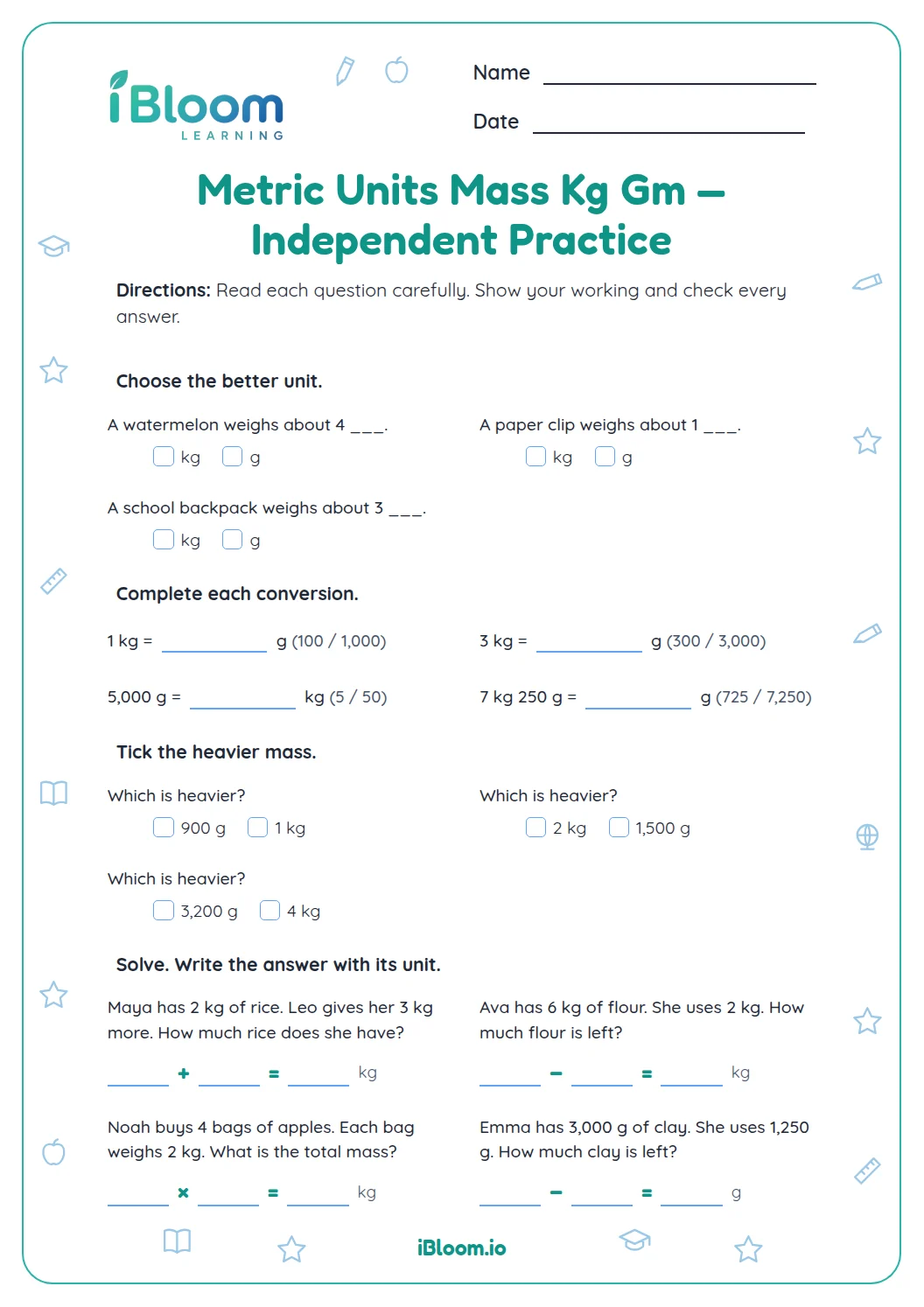
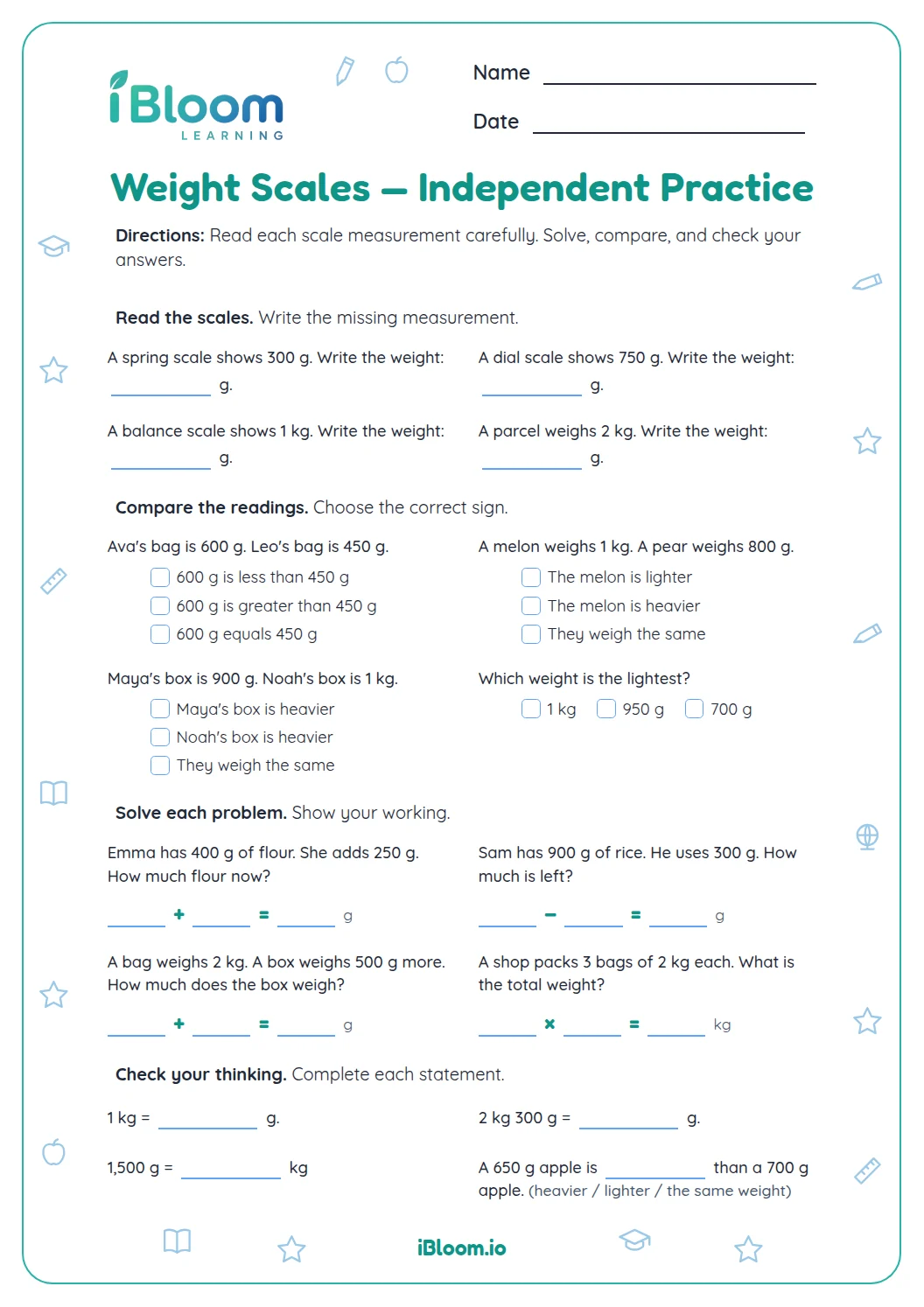
This Grade 4 worksheet practices metric mass with grams and kilograms. Children choose a sensible unit, compare masses, convert using 1 kilogram = 1,000 grams, and solve short everyday problems. These activities connect to CCSS 4.MD.A.1, which includes measuring and estimating mass in standard units. The printable has 16 questions and a separate answer key.
Aligned to 4.MD.A.1
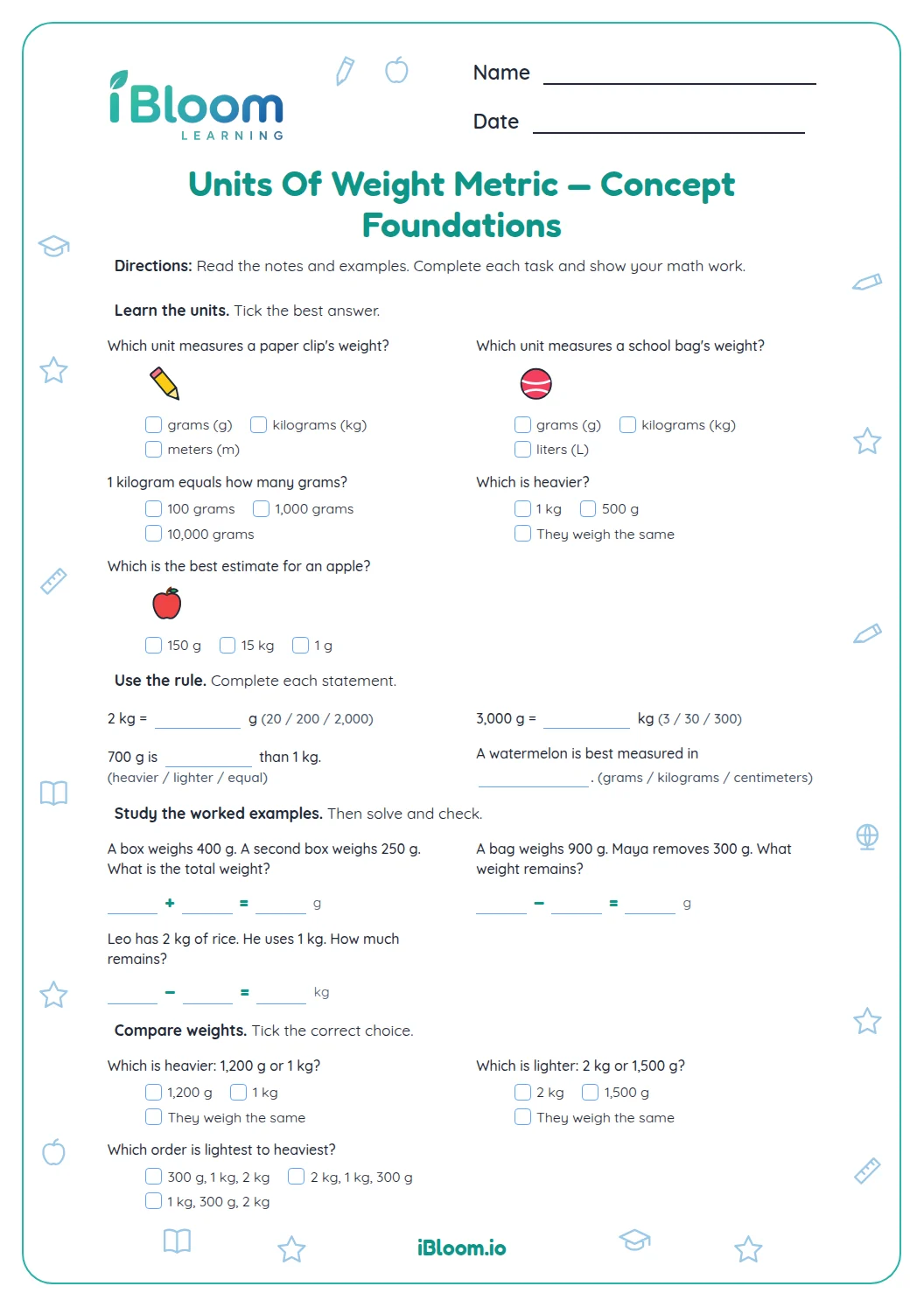
How many grams are in 2 kilograms?
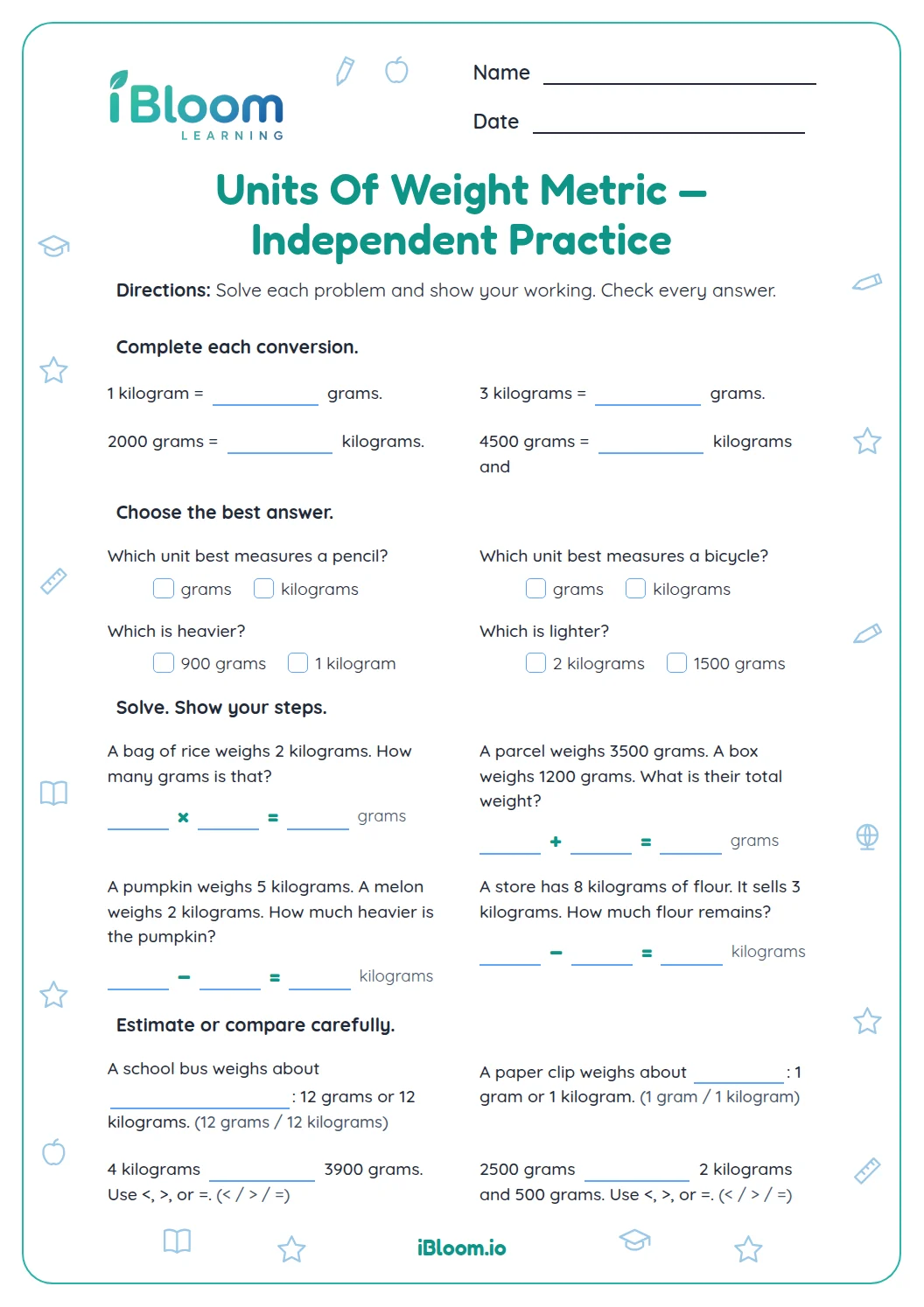
Use 1 kg = 1,000 g. So 2 kg = 2 × 1,000 = 2,000 g. Part A starts with conversions and sensible units.
- 12 kg = ___ g
- 2Since 1 kg = 1,000 g, 2 × 1,000 = 2,000 g.
How do I solve a mass story?
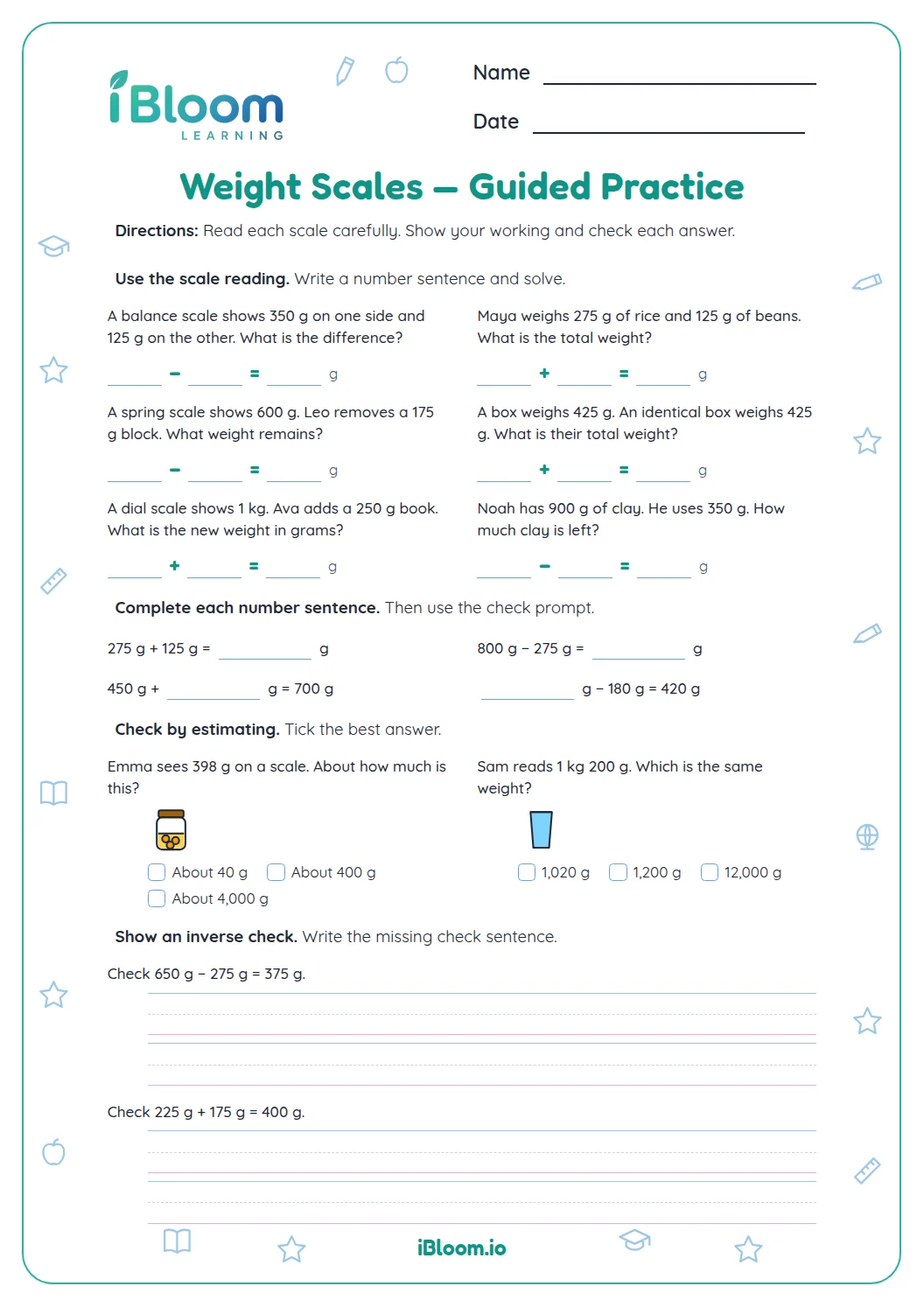
For the flour and sugar story, change 2 kg to 2,000 g, then add 750 g. The total is 2,750 g. Part B uses conversions before adding, comparing, or sharing masses.
Why write the unit in the answer?
Include g or kg so the answer tells exactly what mass you found and can be checked against the question.
How to use this worksheet
- 1Write 1 kg = 1,000 g beside the first conversion.
- 2Multiply kilograms by 1,000 to find grams.
- 3For grams to kilograms, count groups of 1,000.
- 4In a story, decide whether to add, subtract, or divide.
- 5Write the unit and check the answer key.
Common mistakes and quick fixes
The mistake
Multiplying by 100 instead of 1,000.
The fix
Record 1 kg = 1,000 g before converting.
The mistake
Calling 4,000 g four grams.
The fix
Keep the unit attached: 4,000 grams is 4 kilograms.
The mistake
Adding 2 kg and 750 g without converting.
The fix
Rewrite 2 kg as 2,000 g before adding.
Common Core alignment
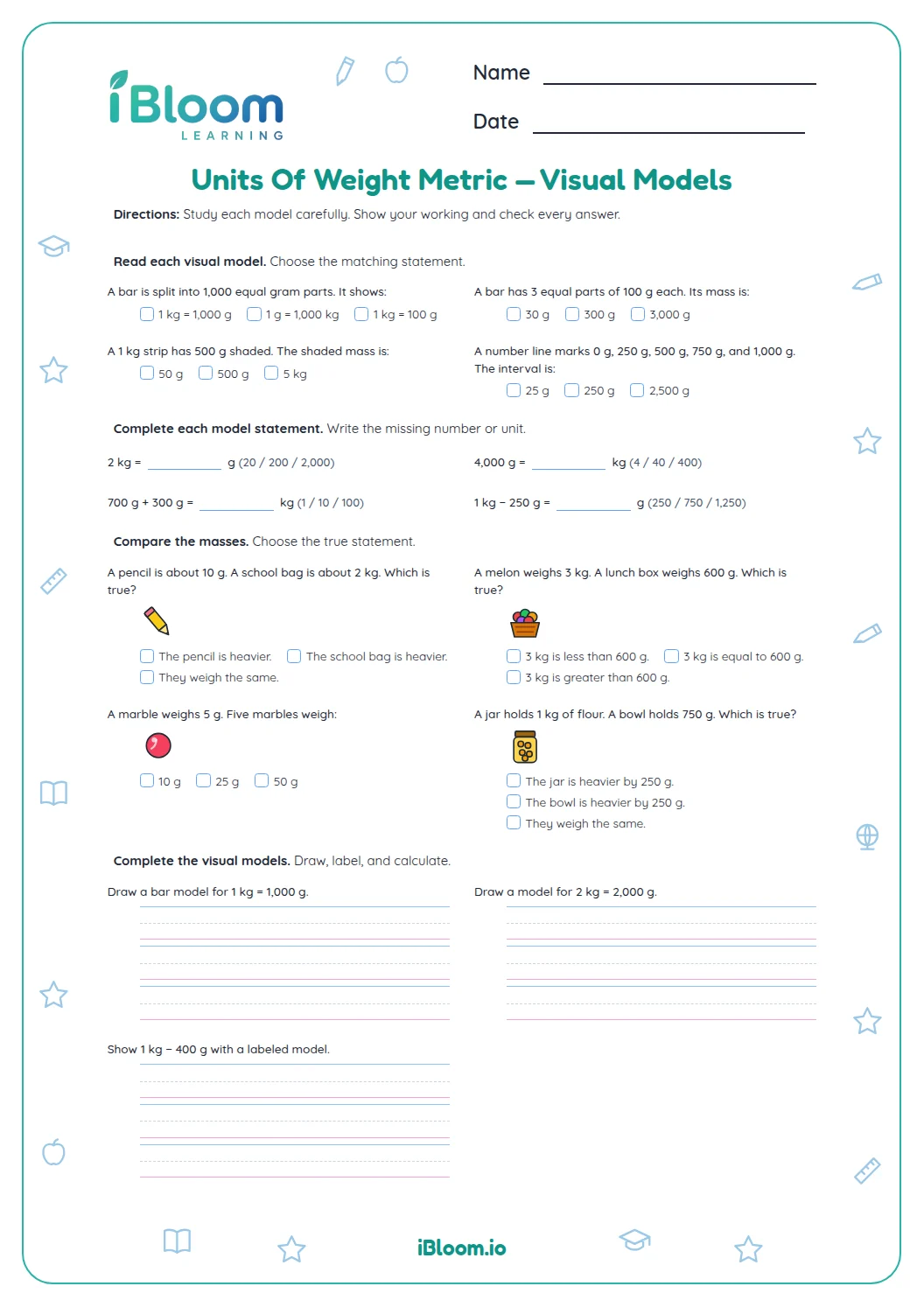
The questions express equivalent masses in grams and kilograms.
Convert between kilograms and grams and record equivalent masses.
On this sheet: Convert between kilograms and grams in real-world mass problems.
Show the official wordingHide the official wording
Know relative sizes of measurement units within one system of units including km, m, cm; kg, g; lb, oz; l, ml; hr, min, sec. Within a single system of measurement, express measurements in a larger unit in terms of a smaller unit. Record measurement equivalents in a two-column table.
What to practice next
Make more practice
Further reading
Questions parents and teachers ask
How many grams are in a kilogram?
One kilogram equals 1,000 grams. To change kilograms to grams, multiply by 1,000: 2 kg is 2,000 g. To change grams to kilograms, group the grams into sets of 1,000. For instance, 4,000 g is 4 kg. Always write the unit with your answer.
Which unit fits a paper clip?
Grams are the sensible unit for a very light object such as a paper clip. Kilograms are better for heavier objects, such as a watermelon or a school backpack. This worksheet asks children to choose between grams and kilograms, then compare and convert masses using the relationship between the units.
How do I add kilograms and grams?
First express both masses in the same unit. For 2 kg and 750 g, change 2 kg to 2,000 g. Then add 2,000 + 750 to get 2,750 g. Keeping the units the same makes the addition clear and lets you check whether the total is reasonable.
How many questions are included?
The printable has 16 questions across unit choices, conversions, comparisons, and mass stories. Children work with grams and kilograms and use 1 kg = 1,000 g. The separate answer key lists the expected unit or value for each item, including the short story problems.