



About this worksheet
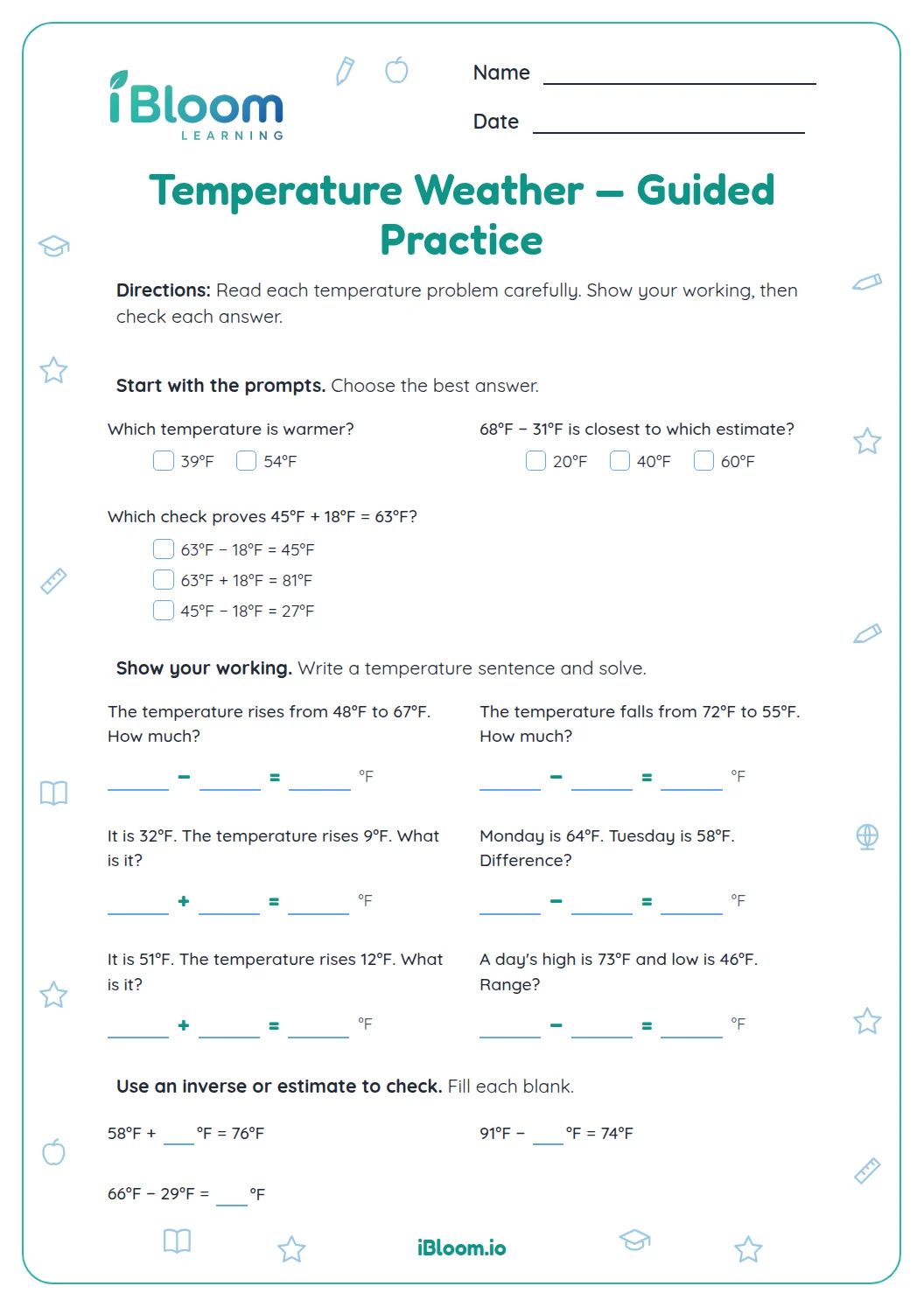
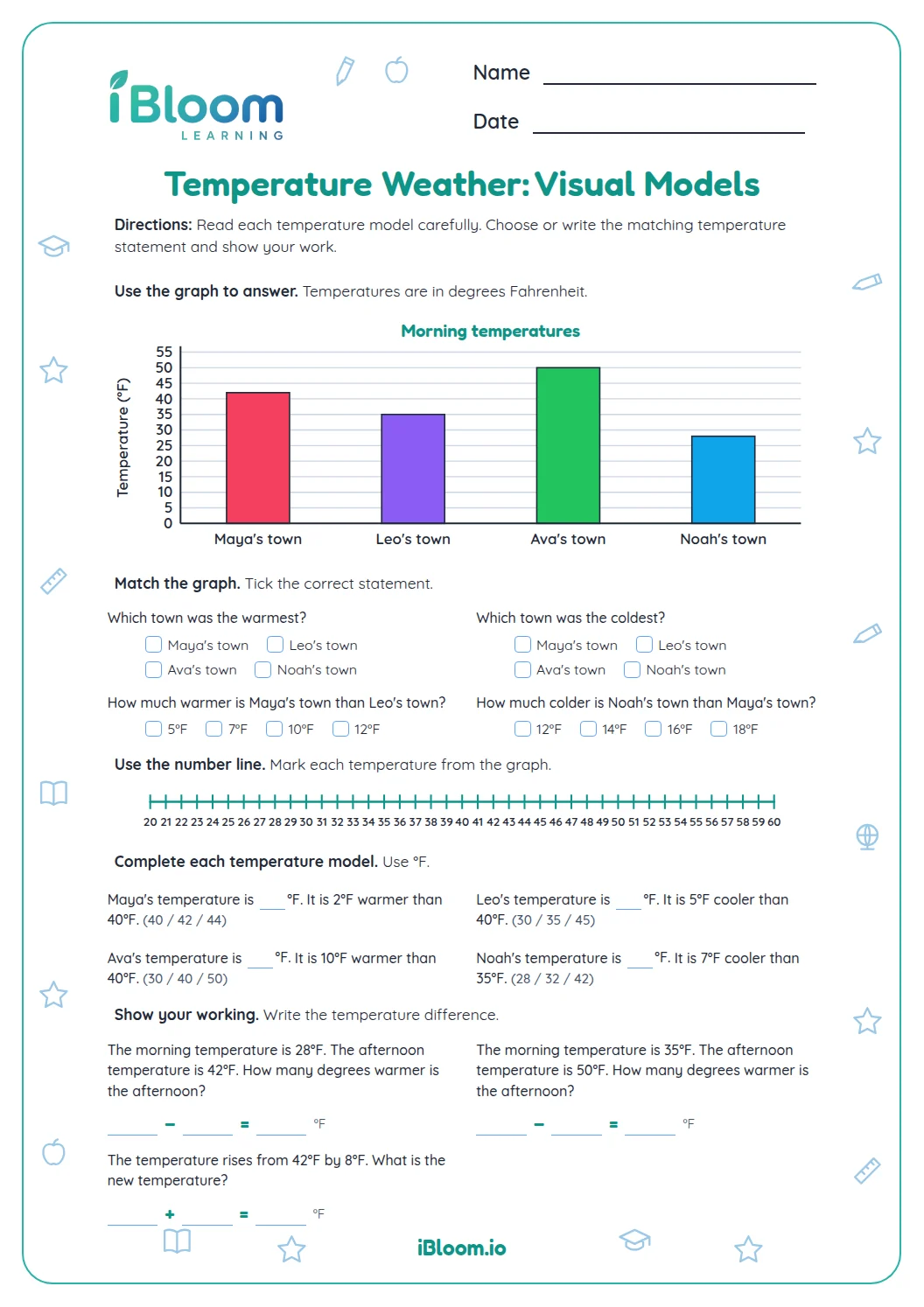
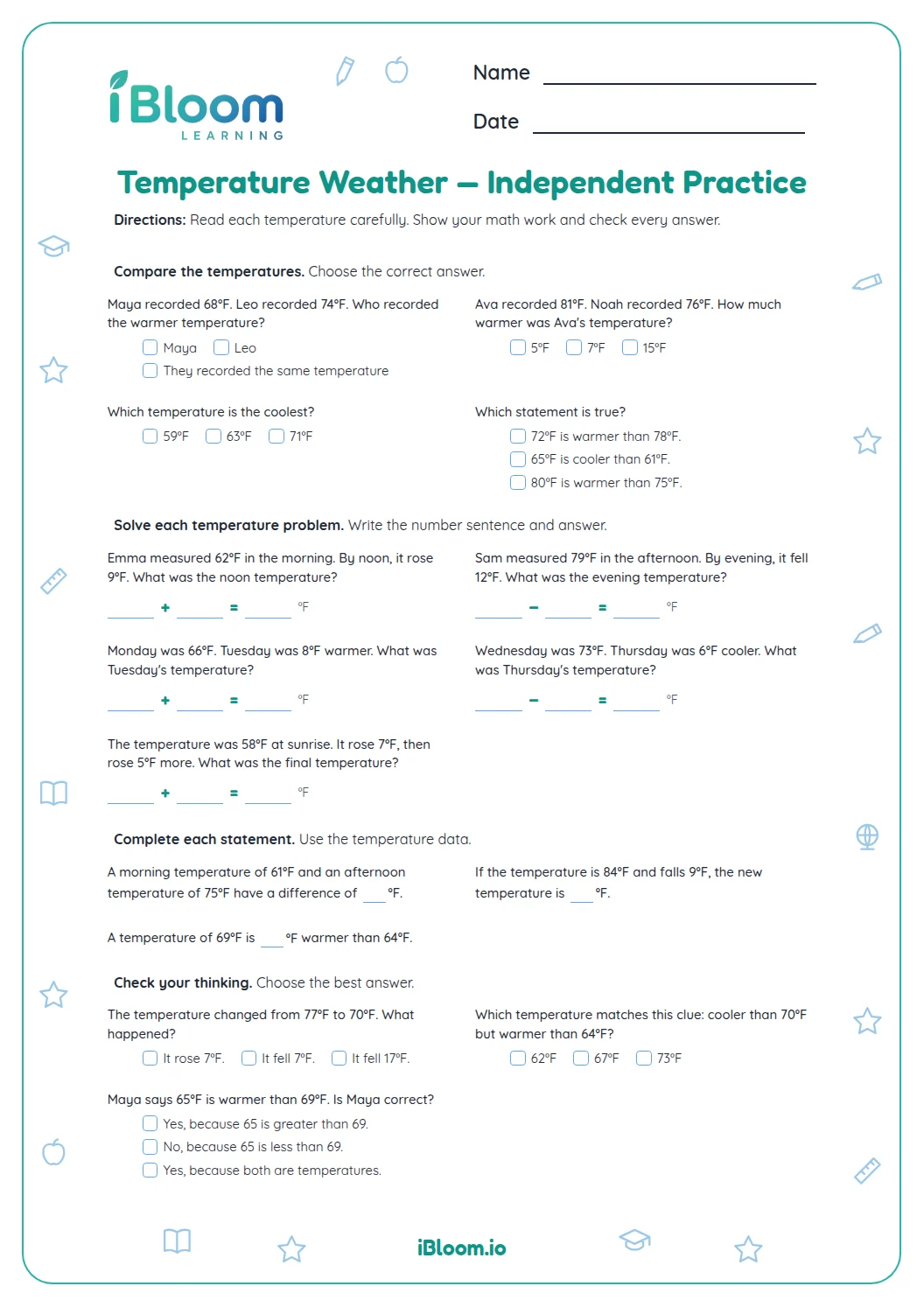
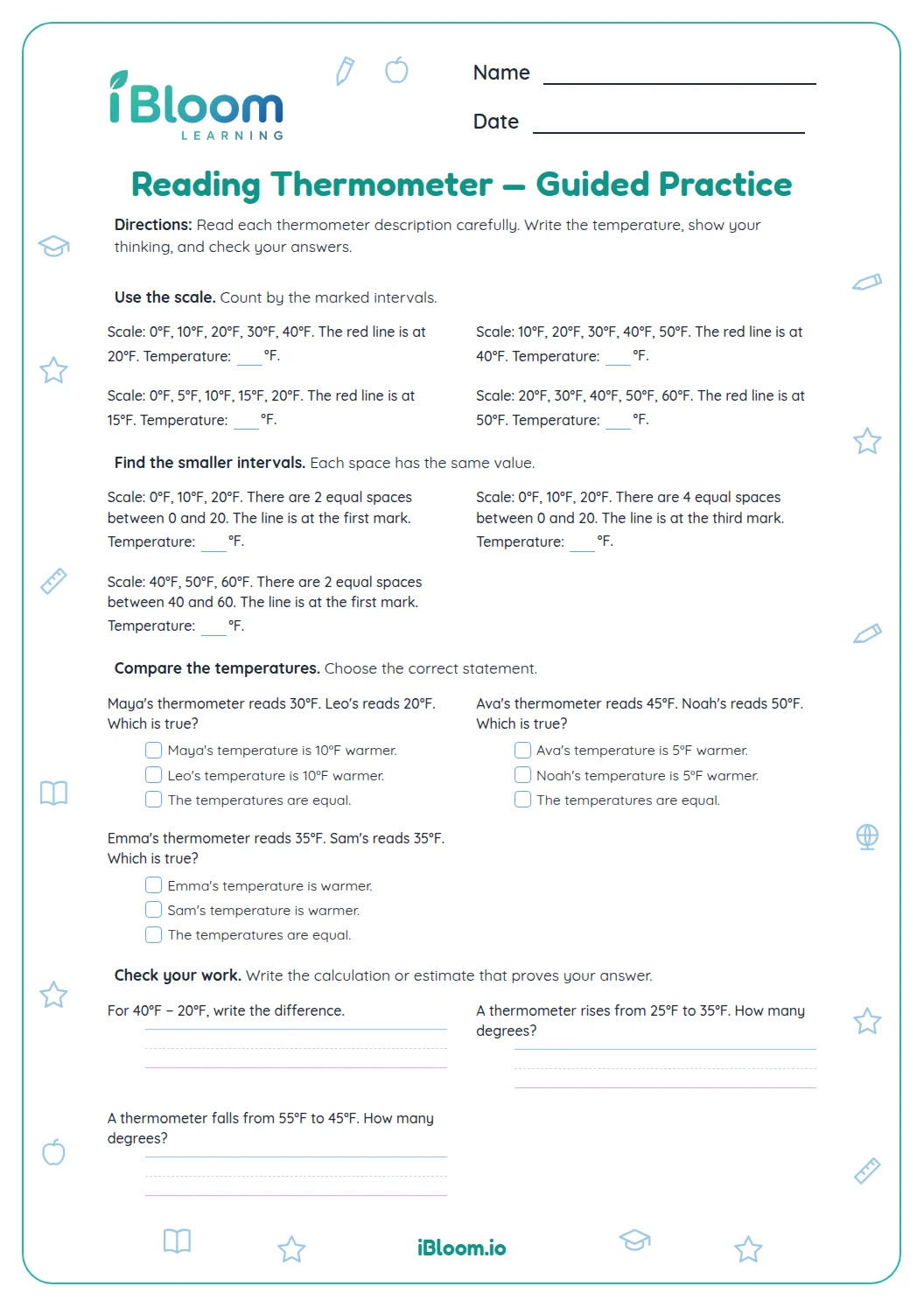
This free Grade 3 measurement worksheet puts temperature changes into everyday weather situations. Students compare Fahrenheit readings, find how many degrees a temperature rises or falls, and solve short multi-step problems. The 14 questions progress from selected answers to written calculations with workspace. A separate answer key lists each result; the prompts name every temperature so students can focus on the change and the operation.
How do you compare two temperatures?
Subtract the lower reading from the higher reading to find how many degrees apart they are. In a weather situation that asks how much warmer noon is than sunrise, subtract the sunrise temperature from the noon temperature.
- 1Sunrise is 12°F and noon is 25°F.
- 225 − 12 = 13, so noon is 13°F warmer.
How can you tell whether to add or subtract?
When a temperature rises, add the change to the starting reading. When it drops, subtract the change. A question asking for the size of the change uses subtraction between the two readings.
What should you do in a two-step weather problem?
Follow each change in order, keeping track of the current temperature. If a reading begins at 6°F, drops 4°F, and then rises 9°F, calculate 6 − 4 first and add 9 to that result.
How to use this worksheet
- 1Circle the starting and ending temperatures in the prompt.
- 2Decide whether the question asks for a difference, change, or new reading.
- 3Use addition for a rise and subtraction for a drop.
- 4For a two-step situation, update the temperature after each change.
- 5Write °F with each final answer and check the operation.
Common temperature calculation slips
The mistake
Adding both readings to find how much warmer one time is.
The fix
Subtract the earlier, lower reading from the later, higher reading.
The mistake
Adding a drop to the starting temperature.
The fix
A drop makes the reading smaller, so subtract the number of degrees.
The mistake
Applying two changes in the wrong order.
The fix
Start with the stated temperature, apply the first change, then use that result for the next change.
What to practice next
Make more practice
Questions parents and teachers ask
Does this worksheet use Fahrenheit or Celsius?
Every temperature is given in degrees Fahrenheit, written °F. Students do not need to convert between temperature scales to solve these situations. Each problem states its readings and asks for a comparison, a change, or a new reading. The scale stays consistent.
How do students find how much warmer one reading is?
Subtract the lower temperature from the higher one. From 12°F to 25°F, the difference is 25 − 12, or 13 degrees. The answer tells how much warmer the later reading is than the earlier one. Keep both values in degrees.
When should a student add?
Add when the temperature rises from a starting reading. If the reading is 16°F and warms by 9 degrees, calculate 16 + 9 = 25°F. In a two-step problem, add only after applying any earlier change. Track the reading after each step.
When should a student subtract?
Subtract when the temperature drops or when finding the difference between two readings. For example, a 24°F reading that cools by 7 degrees becomes 17°F. The words “drops,” “cools,” or “colder” signal that the reading decreases. Then subtract the stated amount.
What does the answer key include?
The separate key gives the temperature result for each question. For written problems, students can compare the number and unit, then check that their addition or subtraction matches the situation and that each change was applied in the correct order.