




About this worksheet
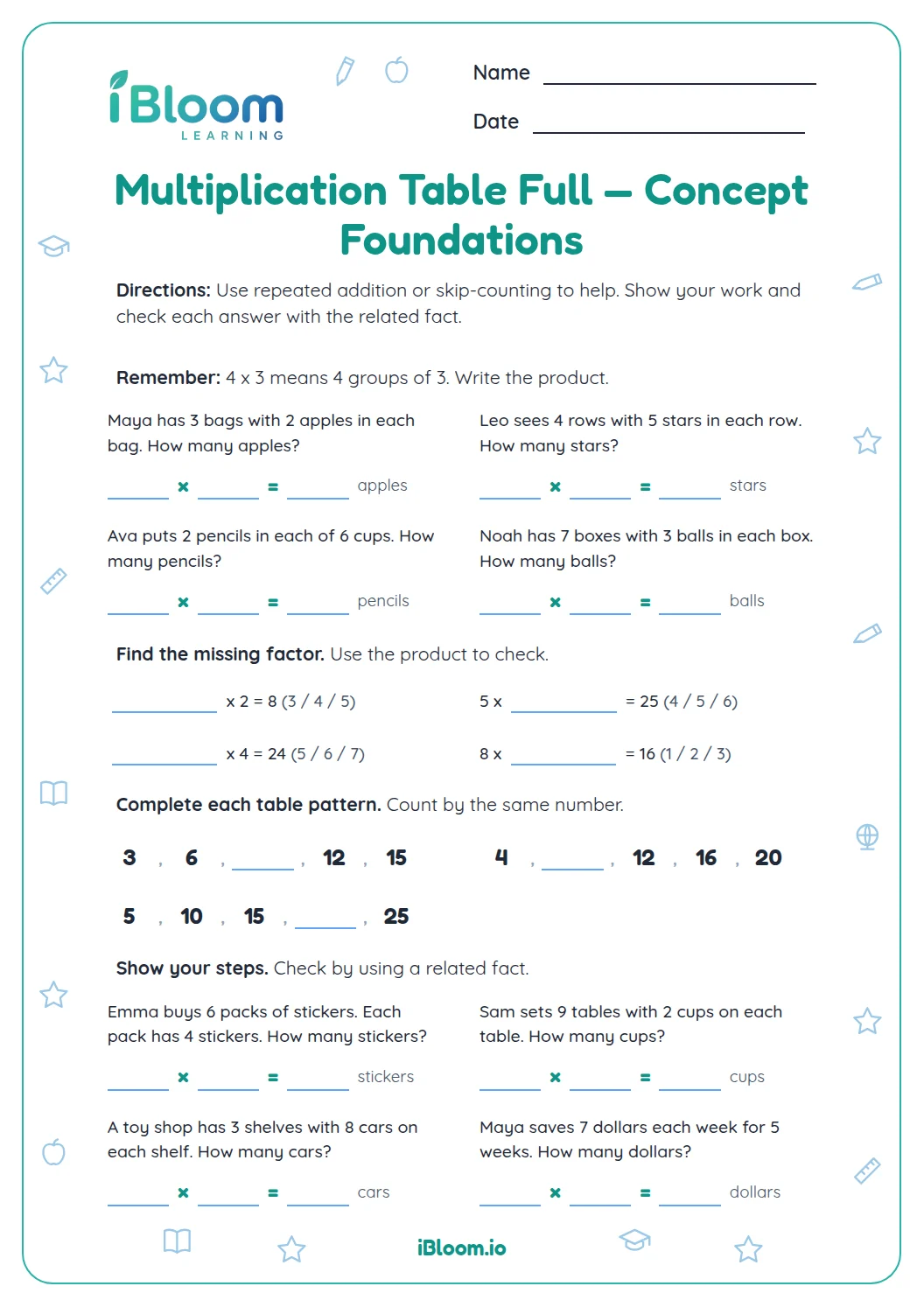
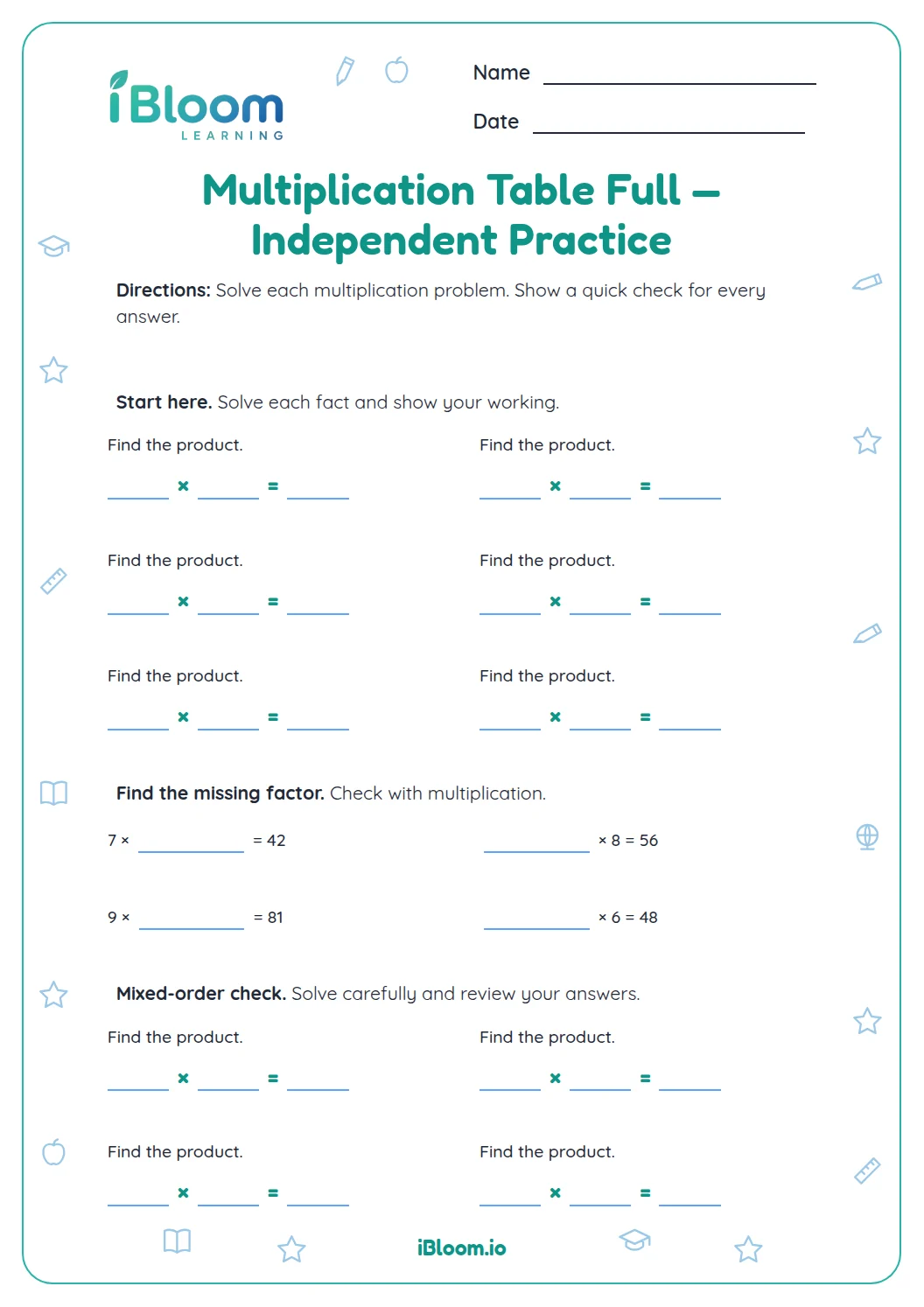
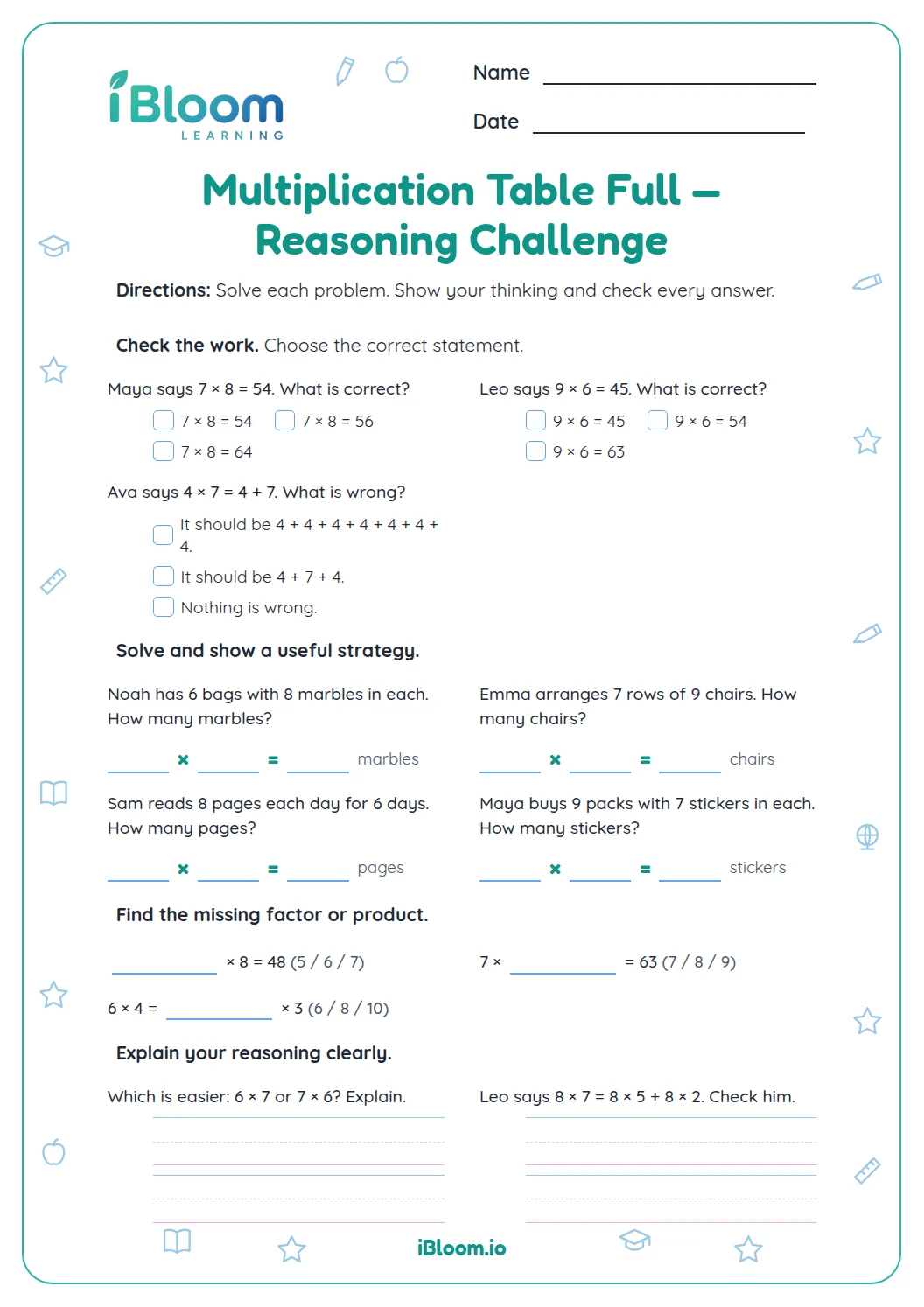
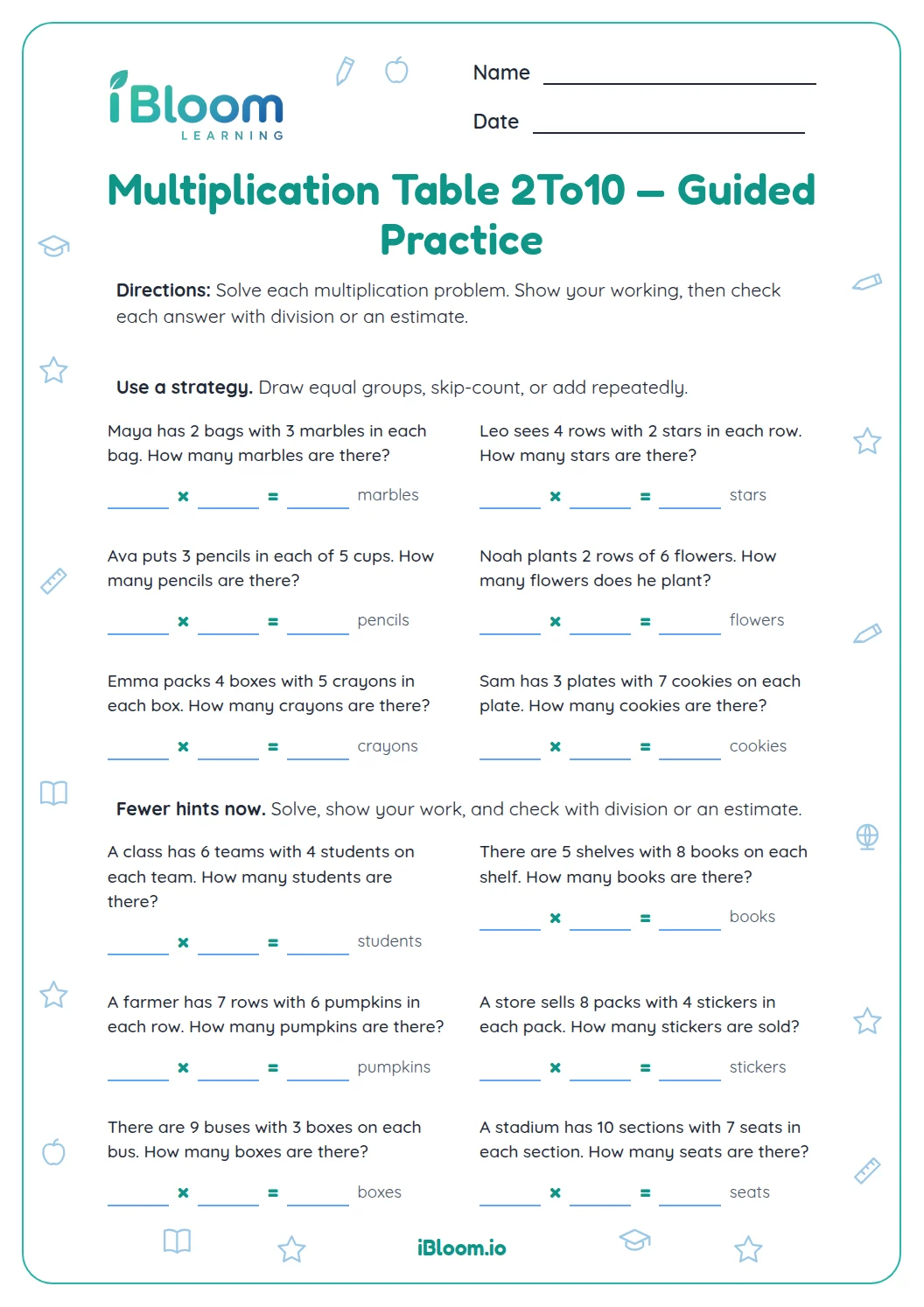
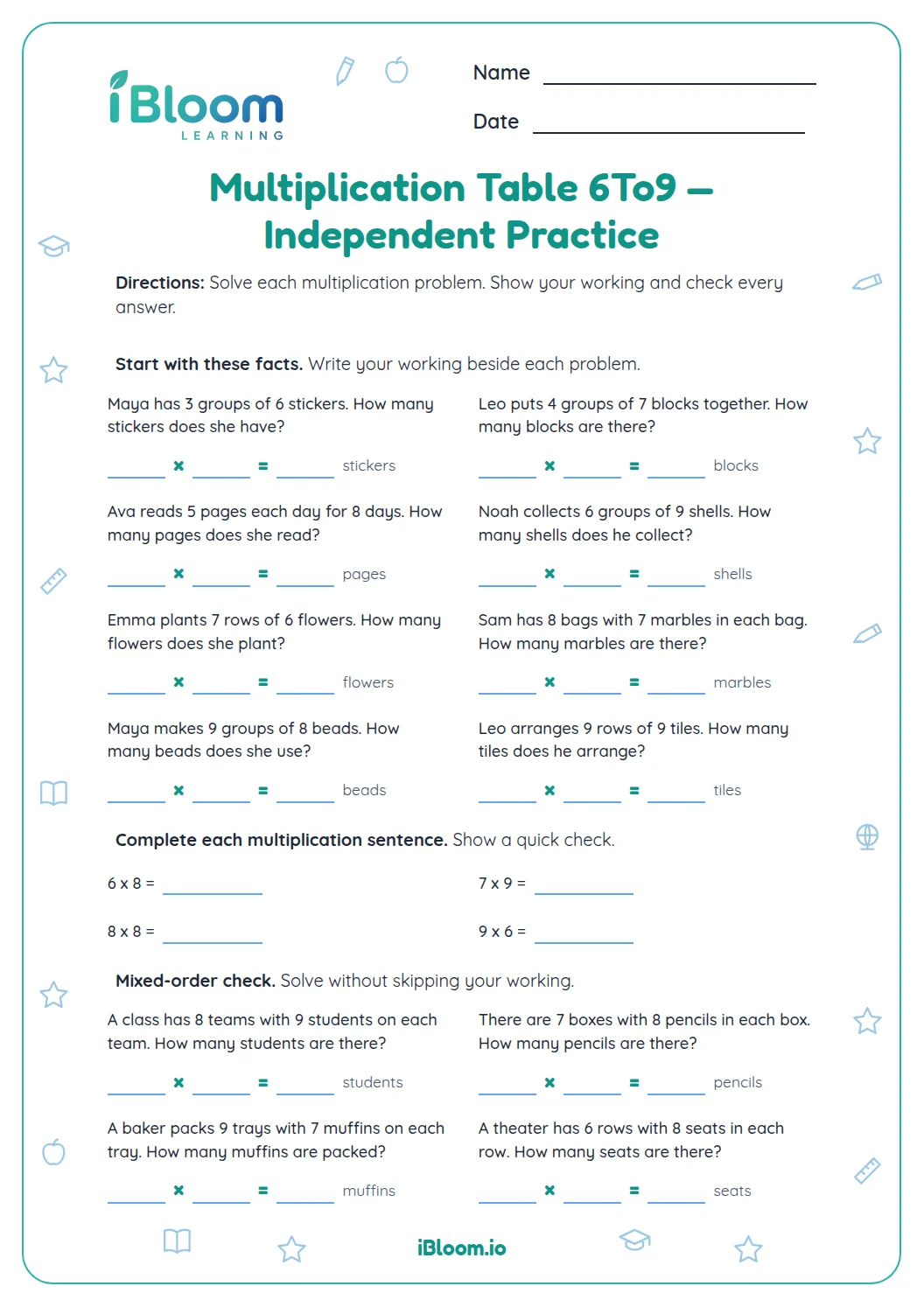
This Grade 3 multiplication worksheet builds practice across the one-digit facts through 10 × 10. Children solve products, interpret arrays, find missing factors, and choose products for short equal-group situations. Guided sections begin with familiar products and move toward applying facts and checking a mistaken product. The answer key is included. It supports Common Core 3.OA.C.7: fluently multiply and divide within 100 using strategies and properties, with one-digit products known from memory by the end of Grade 3.
Aligned to 3.OA.C.7
How can a known fact help with a harder product?
A known fact can serve as an anchor. For 6 × 7, children might use 5 × 7 = 35 and add one more group of 7. Equal groups and arrays show why the factors can be counted as rows and columns.
Question 1 asks for 6 × 7. Using 5 × 7 plus one more 7 gives 35 + 7 = 42.
- 16 × 7
- 25 × 7 = 35
- 3Add one more group of 7: 35 + 7 = 42
- 4So 6 × 7 = 42
What does an array show about multiplication?
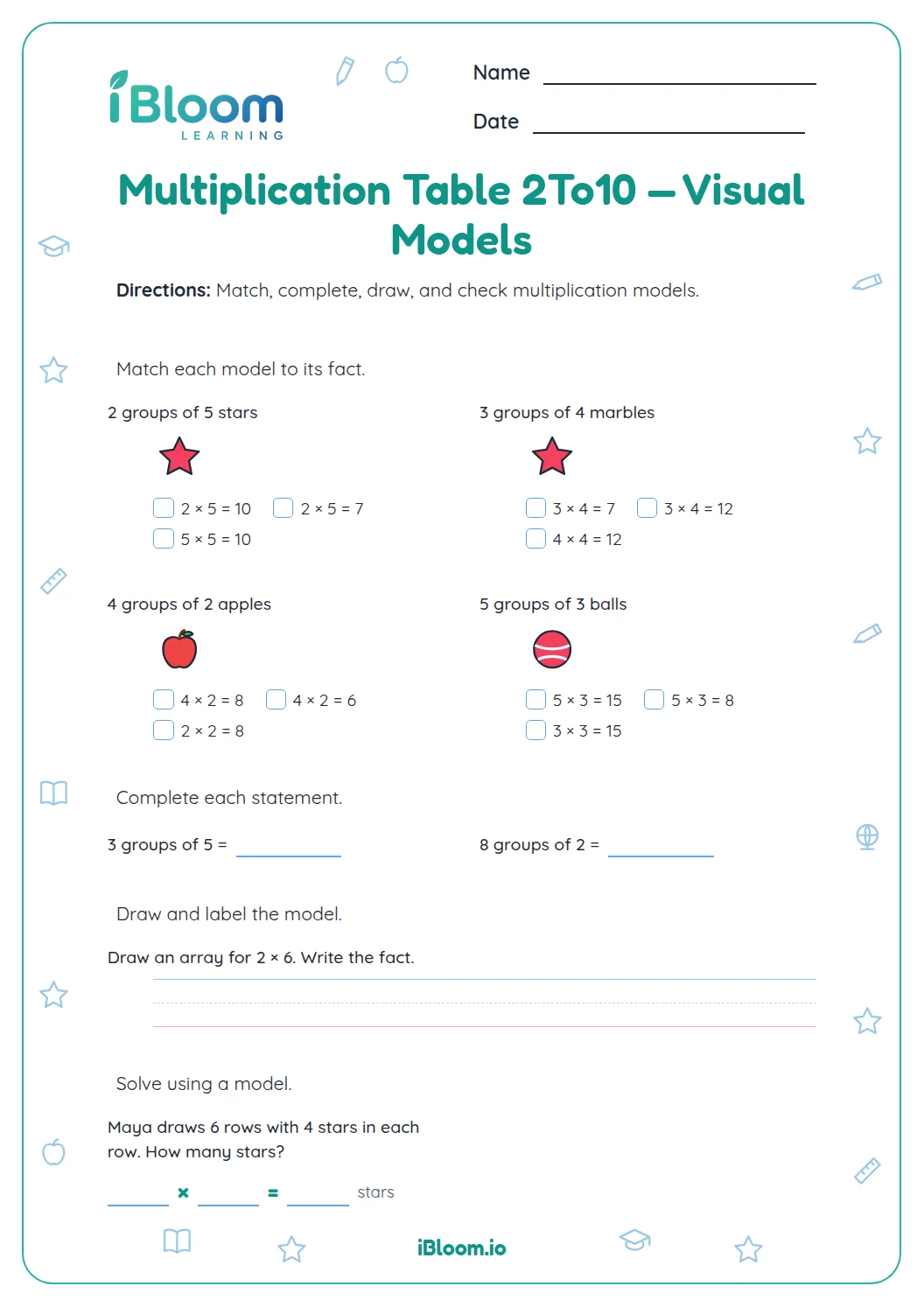
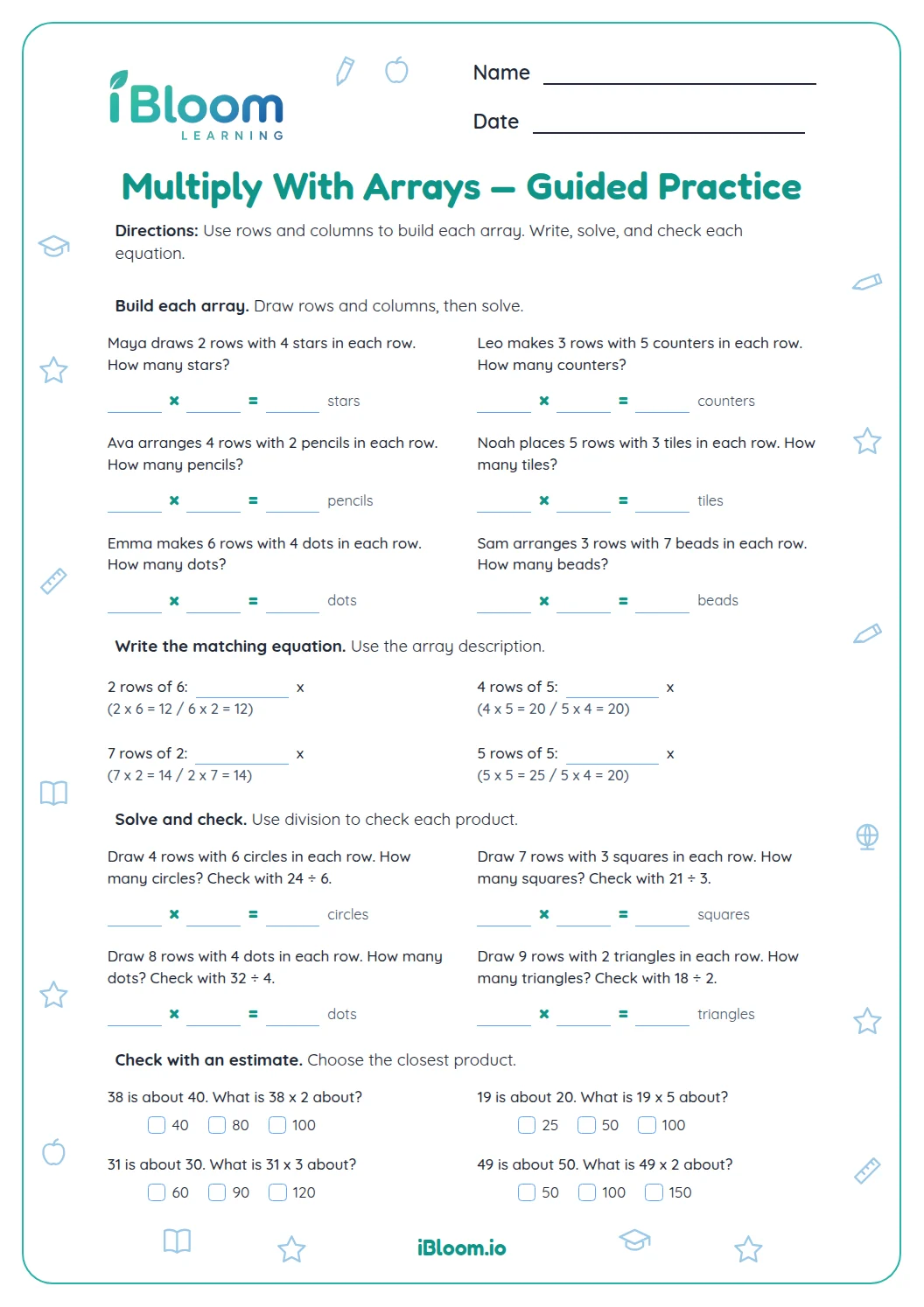
An array arranges equal objects into rows and columns. Question 5 shows 3 rows of 8 stars, so 3 × 8 counts the same total as 8 + 8 + 8. The array makes both factors visible.
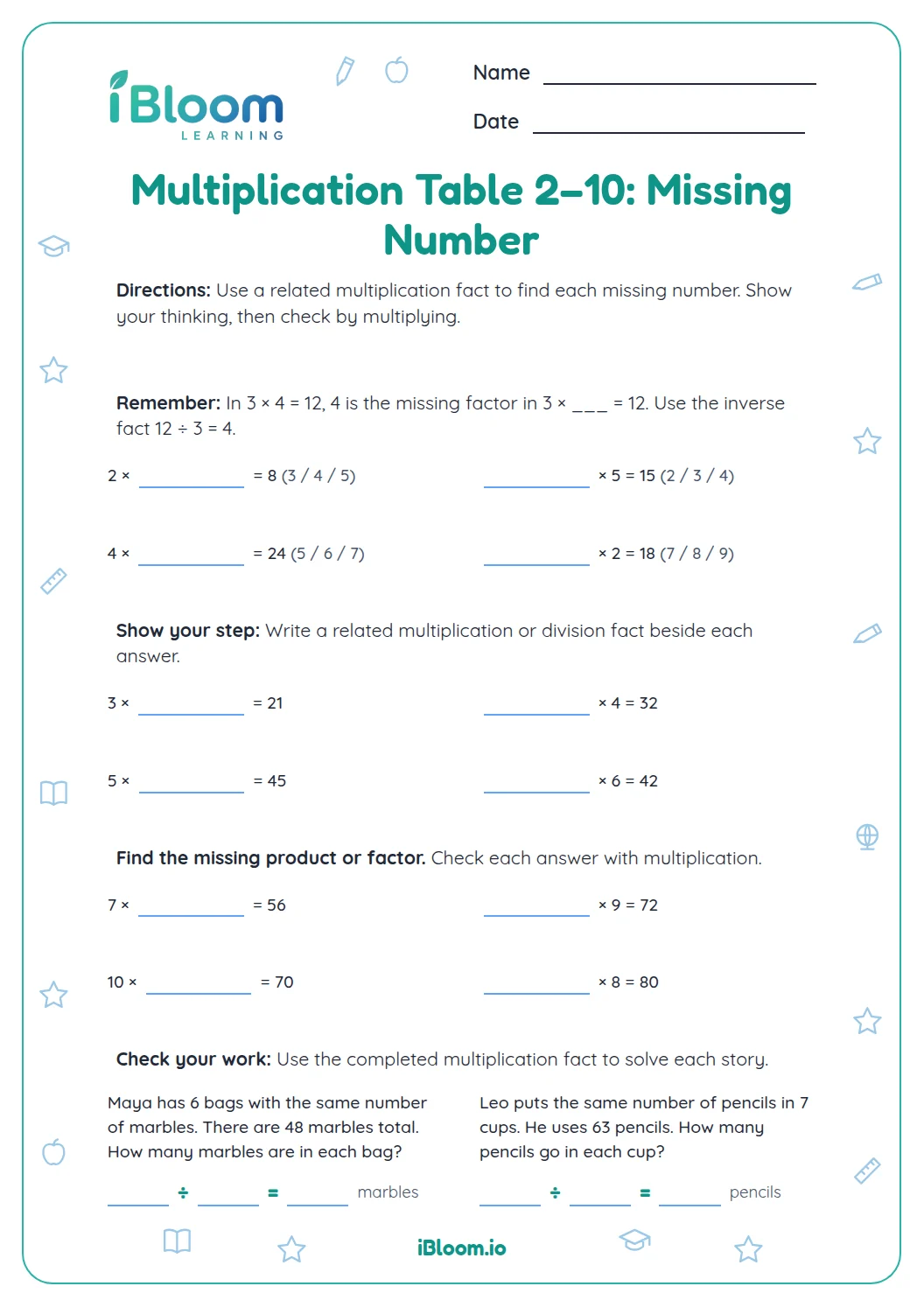
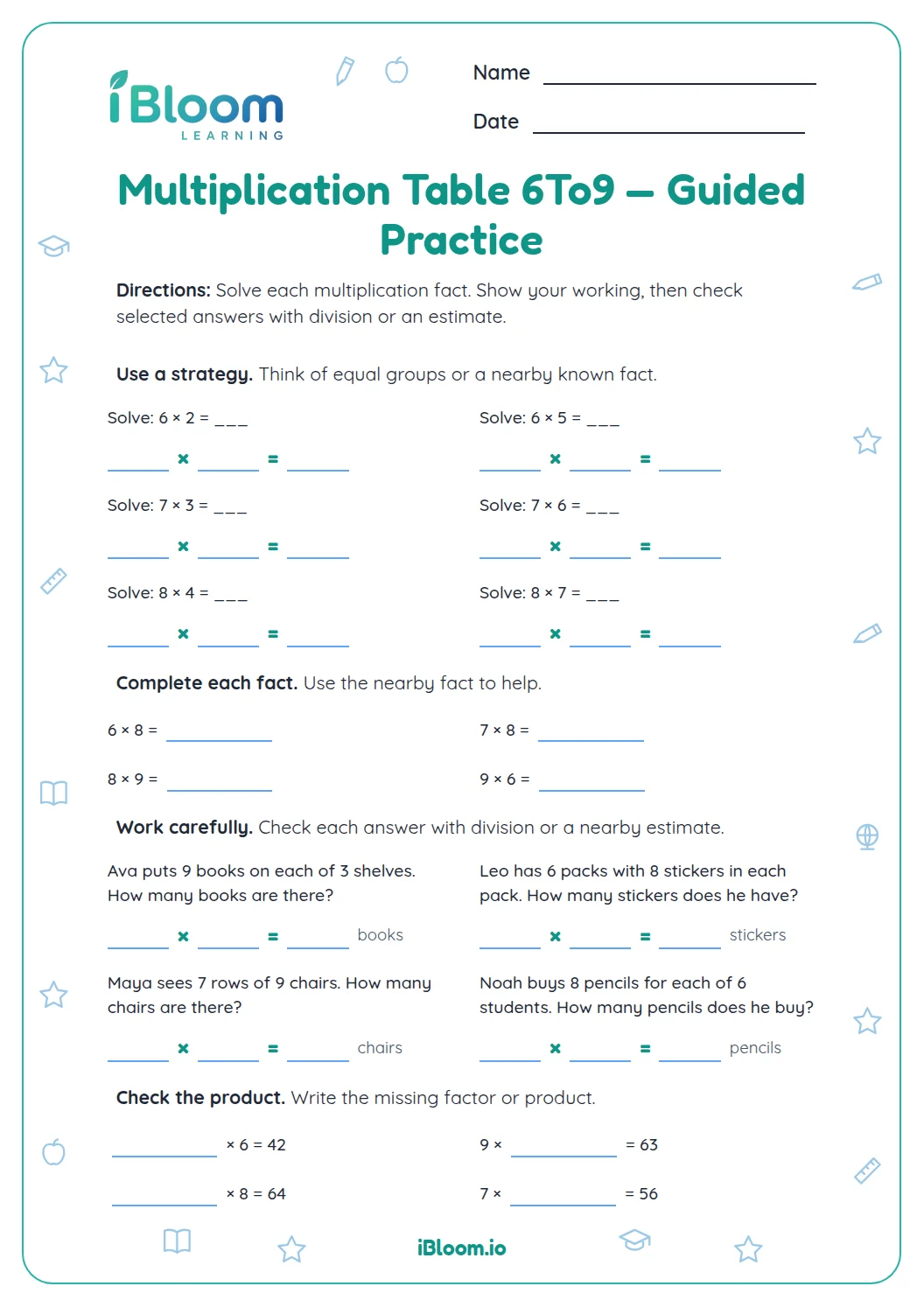
For a missing factor such as 6 × ___ = 54, ask how many groups of 6 make 54. A related division fact, 54 ÷ 6, gives the missing 9.
What kinds of multiplication questions are included?
The 14 questions move from direct facts to an array, unknown factors, and equal-group situations. Children also correct two incorrect products.
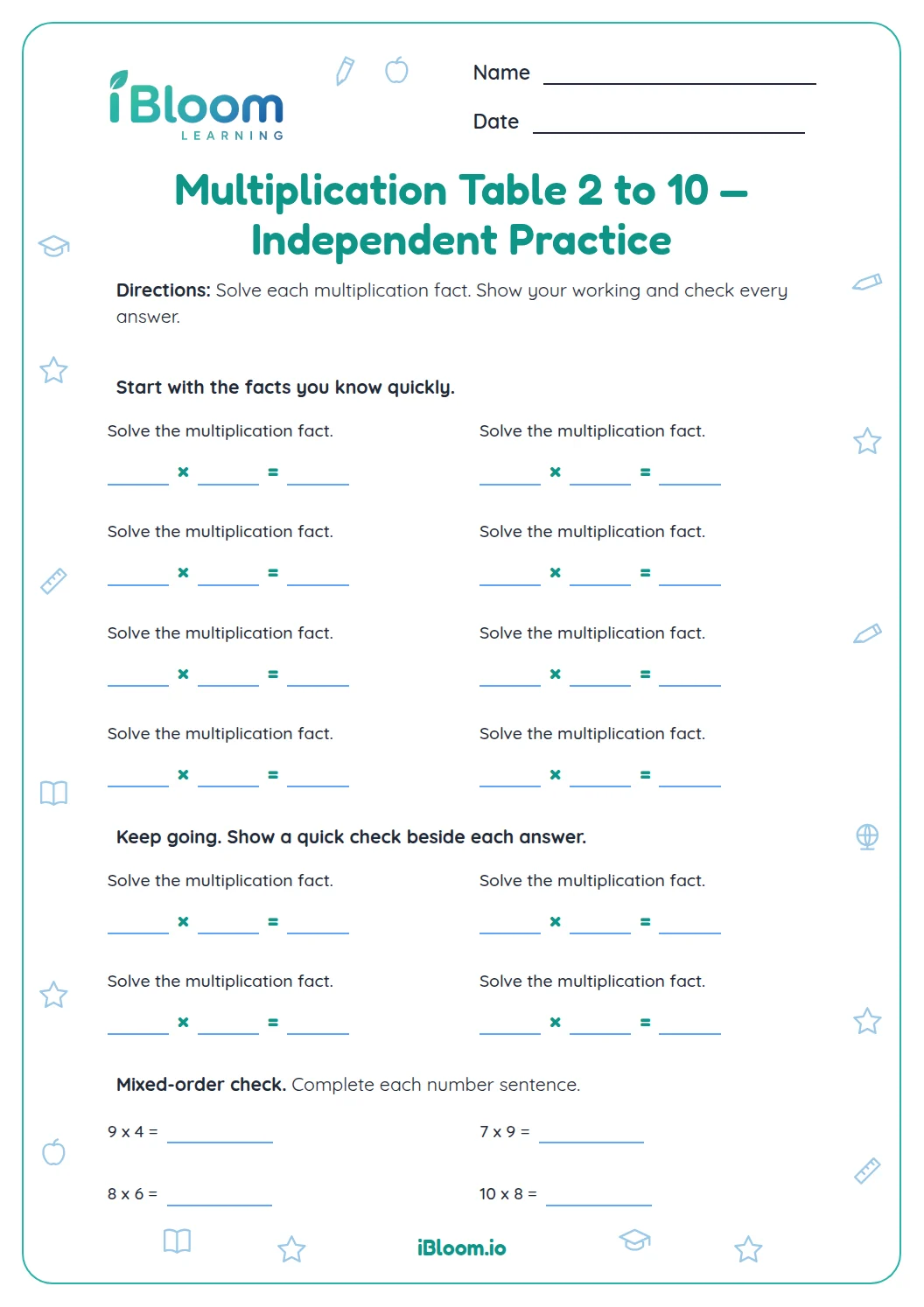
- Part A: solve multiplication facts and read an array.
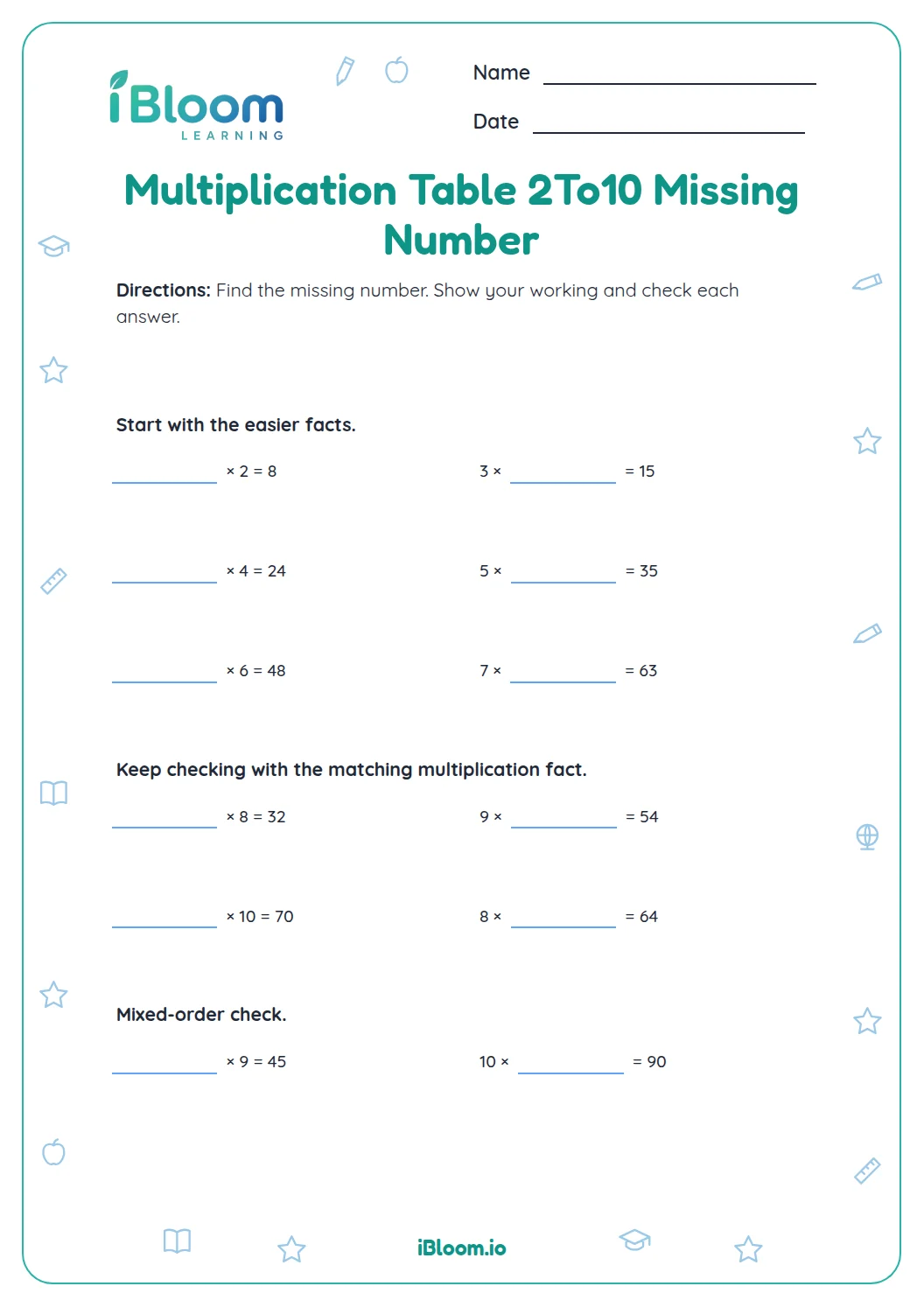
- Part B: find missing factors from known products.
- Part C: solve equal-group situations and correct two products.
How to use this worksheet
- 1Start with the factor pairs you know well.
- 2For a difficult fact, build from a nearby known fact.
- 3Read the array as rows times objects in each row.
- 4For a missing factor, ask how many groups make the product.
- 5Read each equal-group situation, identify its factors, and multiply to find the total.
- 6Check each answer against the key and correct the fact if needed.
Common mistakes and quick fixes
The mistake
Swapping the factor and product.
The fix
Read the equation aloud: the two factors are multiplied to make the product.
The mistake
Counting only one row of an array.
The fix
Count each equal row or multiply the number of rows by the number in each row.
The mistake
Guessing a missing factor.
The fix
Use the related division question to check how many groups fit the product.
Common Core alignment
The questions build one-digit multiplication fluency and connect facts to strategies and equal groups.
Build fluent recall of one-digit multiplication facts through 10 × 10.
On this sheet: Build fluent recall of one-digit multiplication facts through 10 × 10.
Show the official wordingHide the official wording
Fluently multiply and divide within 100, using strategies such as the relationship between multiplication and division (e.g., knowing that 8 × 5 = 40, one knows 40 ÷ 5 = 8) or properties of operations. By the end of Grade 3, know from memory all products of two one-digit numbers.
What to practice next
Make more practice
Further reading
Questions parents and teachers ask
Which multiplication facts does the sheet practice?
The questions include facts from the one-digit tables through 10 × 10, with direct products, arrays, and missing factors. The practice samples different facts rather than printing every cell in a 10-by-10 table. The answer key gives the product or missing factor for all 14 questions.
How should a child solve a fact they have not memorized?
Use a nearby known fact or a group model. For 6 × 7, one way is 5 × 7 plus one more group of 7: 35 + 7 = 42. The array questions show equal groups visually, while the key supports checking.
What is a missing factor?
A missing factor is one of the numbers being multiplied. In 6 × ___ = 54, the child finds how many groups of 6 make 54. The related division equation 54 ÷ 6 = 9 helps verify the answer and connect multiplication with division.
Does the worksheet include word problems?
Yes. Three short situations describe equal groups, such as tables with students or boxes with markers, and ask for the total. Children can write a multiplication sentence and solve it in the provided work area. Each situation uses one-digit factors.
Is an answer key included?
Yes. The separate answer key lists the products, array totals, missing factors, and story answers. For a mistaken fact, it shows the corrected product so a child can redo the calculation and explain the error. The key covers all 14 prompts.