


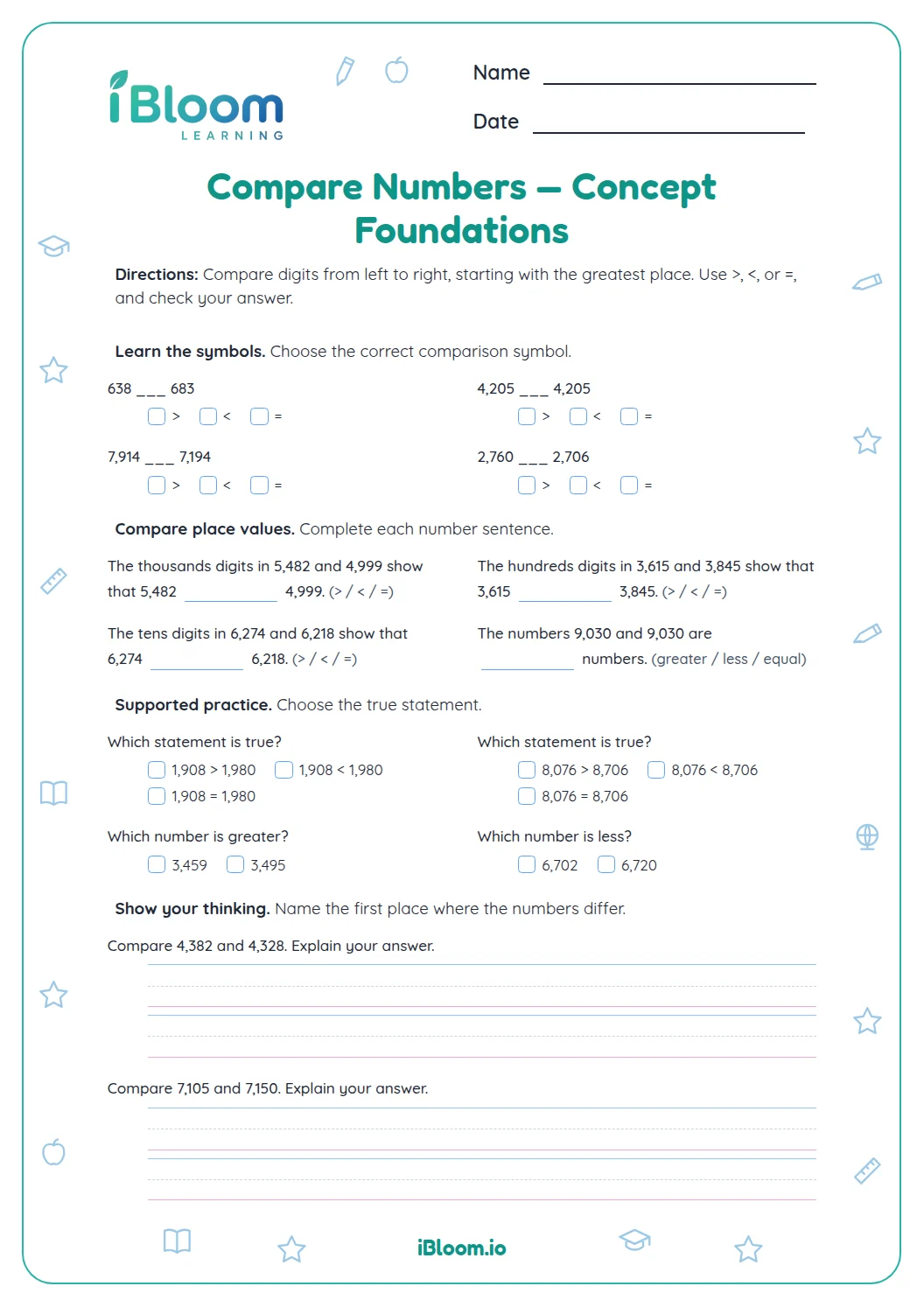

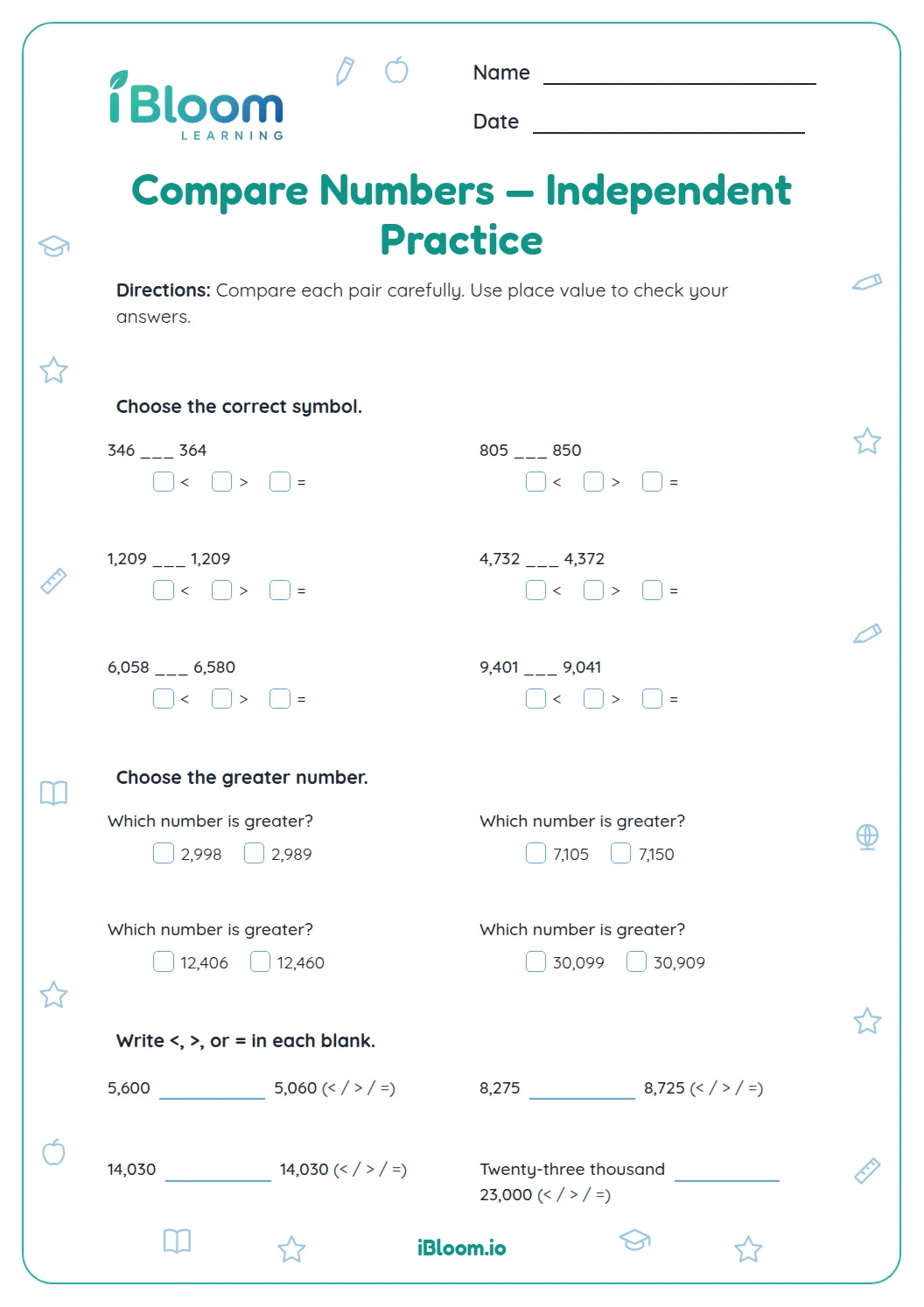
About this worksheet
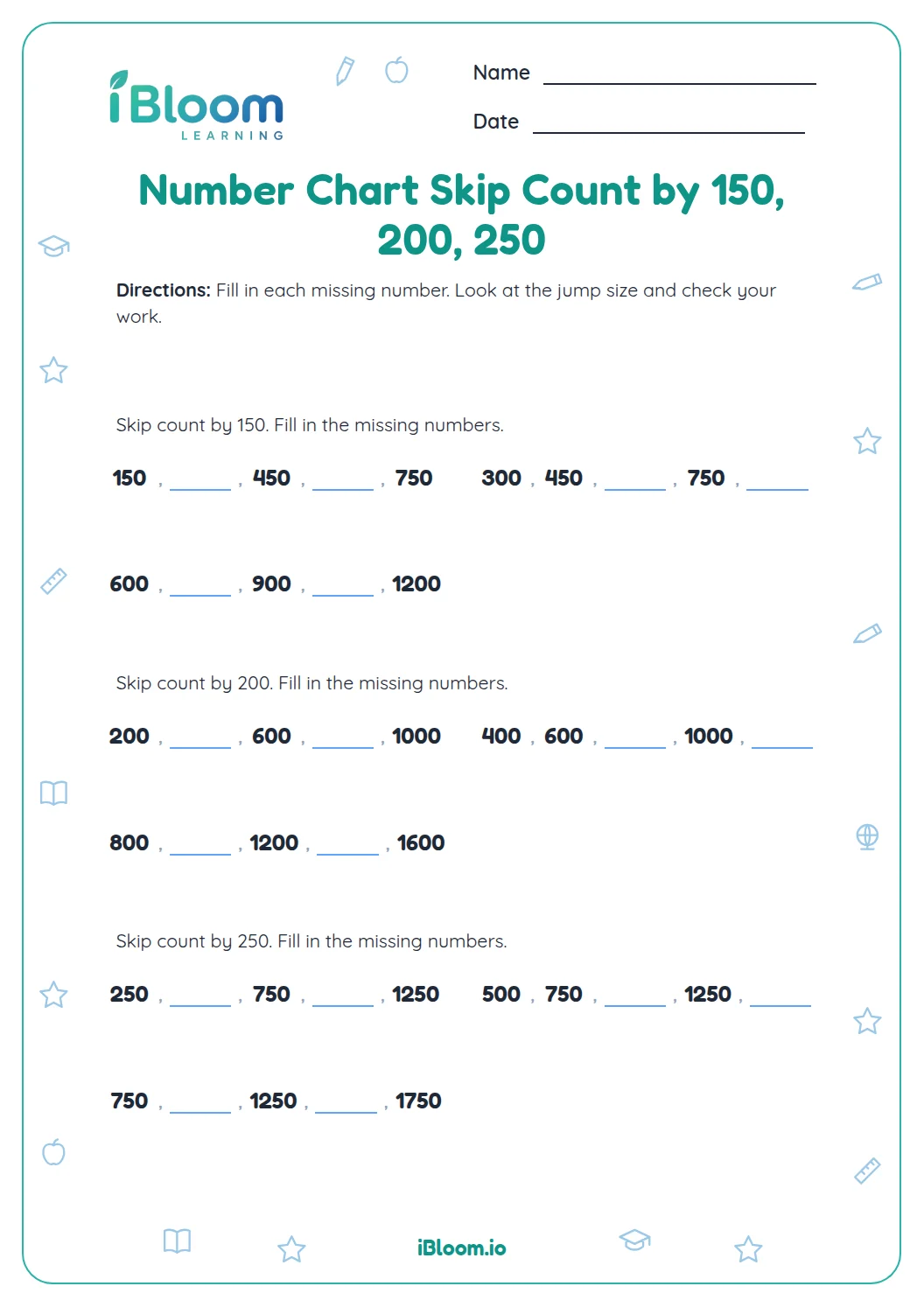
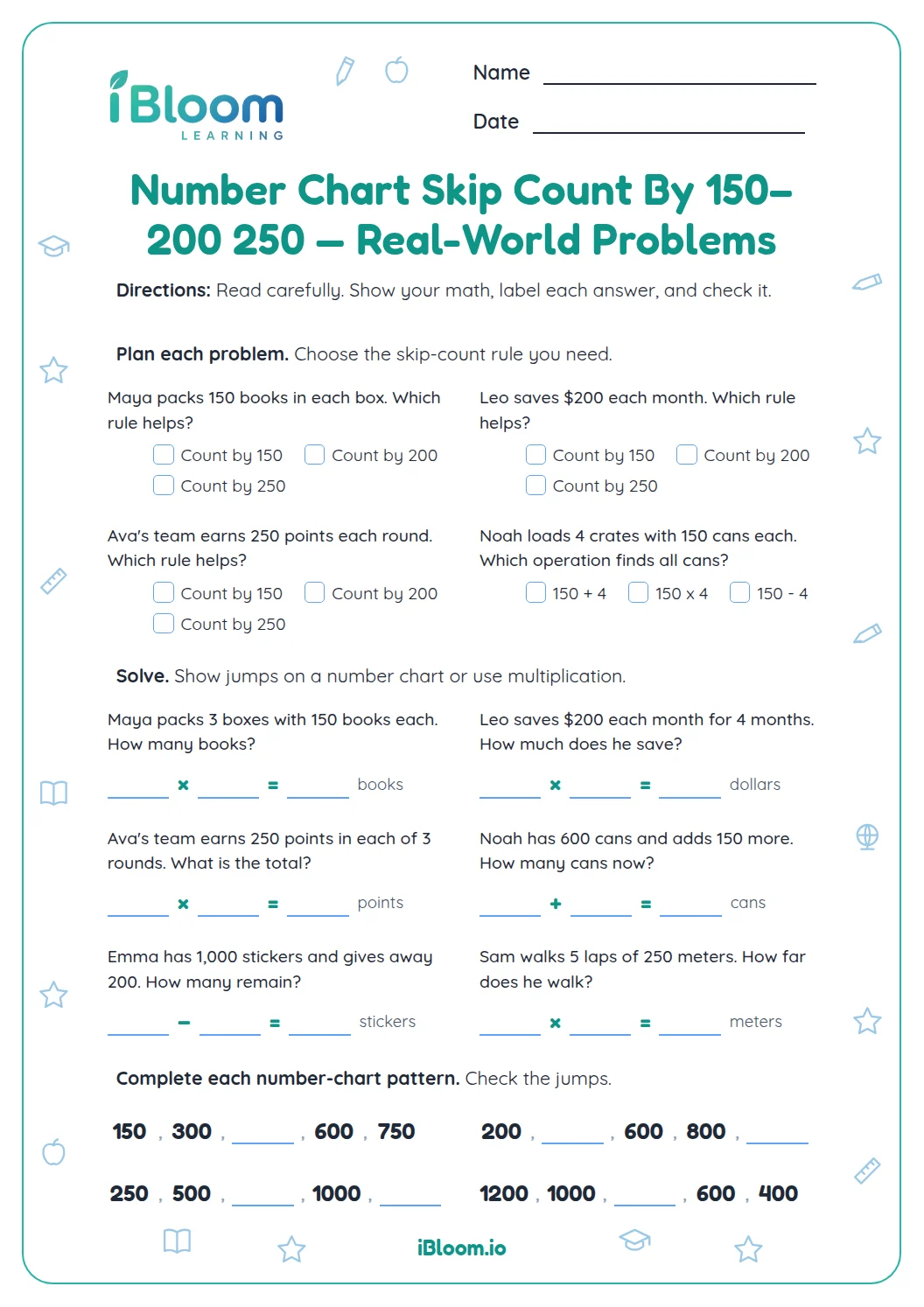
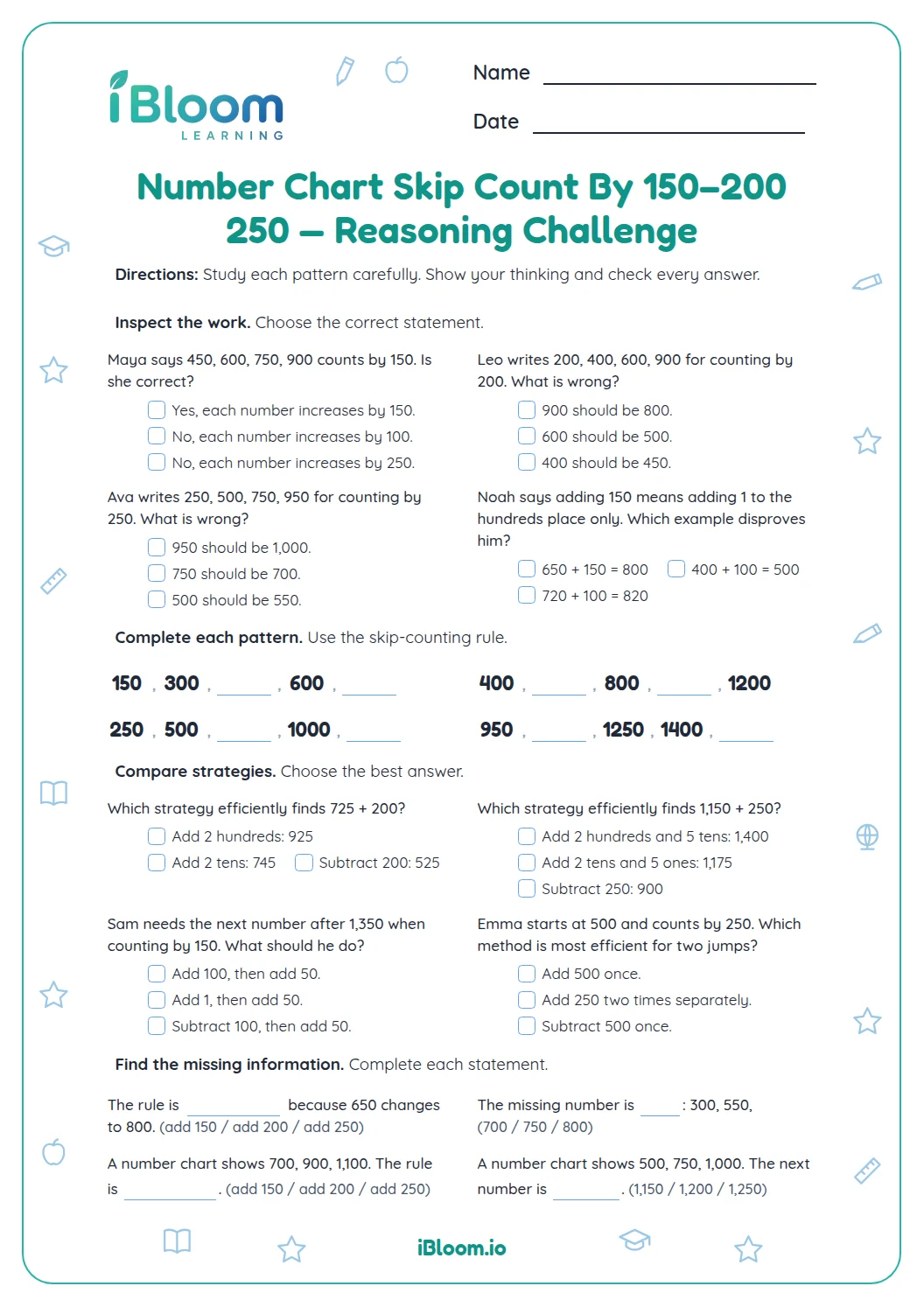
This Grade 3 printable practices skip counting by 150, 200, and 250. Eight number-line questions ask learners to read a marked point, followed by six missing-number patterns. The work connects equal jumps to addition patterns within 1,000 and aligns with CCSS 3.NBT.A.2. A separate answer key is included.
Aligned to 3.NBT.A.2
How do equal jumps show skip counting?
A number line shows equal intervals. Count each space to reach point A; a written pattern follows the same repeated-addition idea.
- 1Point A is on a line with jumps of 150.
- 2Answer: 300
- 3Two jumps from 0 reach 300.
How can a learner find a missing term?
Keep the jump fixed from one term to the next. For 150, 300, ___, 600, add 150 to 300 to find 450, then check that one more jump reaches 600.
What can an adult ask during practice?
Ask the learner to name the jump before solving and to verify a marked point by counting the equal intervals. This makes the place-value pattern visible without changing the step size.
How to use this worksheet
- 1Read the jump size printed in the prompt.
- 2On a number line, locate zero or the labeled starting value.
- 3Count equal intervals to point A and record its value.
- 4For each pattern, add the same jump to the last known term.
- 5Check one answer by repeating the jump from the previous term.
Common mistakes and quick fixes
The mistake
Changing the jump size midway through a pattern.
The fix
Compare the difference between two neighboring known numbers and keep it constant.
The mistake
Counting tick marks instead of spaces.
The fix
Start at the labeled value and count each interval as one jump.
The mistake
Adding the jump twice before filling one blank.
The fix
Write one new number for each single step in the pattern.
Common Core alignment
This worksheet practices adding equal jumps to continue number patterns.
Add the stated jump repeatedly to continue each skip-counting pattern.
On this sheet: The worksheet directly practices this skill.
Show the official wordingHide the official wording
Fluently add and subtract within 1000 using strategies and algorithms based on place value, properties of operations, and/or the relationship between addition and subtraction.
What to practice next
Make more practice
Further reading
Questions parents and teachers ask
What numbers does this worksheet use?
The questions practice jumps of 150, 200, and 250. All marked values and missing terms stay at or below 1,000, so learners focus on repeating the stated addition step and reading the number line carefully. Ask the learner to explain how the text or numbers support that answer.
How many number lines are included?
Two questions show a number line with point A marked. The remaining twelve questions ask learners to complete written skip-counting patterns using the same three jump sizes. Have the learner explain how each jump changes the value. before writing the value.
Does the worksheet include an answer key?
Yes. A separate answer key lists each point value and missing term in question order. Have the learner try a problem first, then compare the answer and check whether the same jump was used at each step. Ask the learner to explain how the text or numbers support that answer.
How can I help if a number line is confusing?
Point to the starting label and count the spaces one at a time. Say the value at each tick aloud, adding 150, 200, or 250 as directed, until reaching point A. Ask the learner to explain how the text or numbers support that answer.
How long does it take?
Plan for about 20 minutes, depending on whether the learner checks the lines aloud. The eight visual questions and six patterns can also be split into two short practice sessions. Ask the learner to explain how the text or numbers support that answer.