
About this worksheet
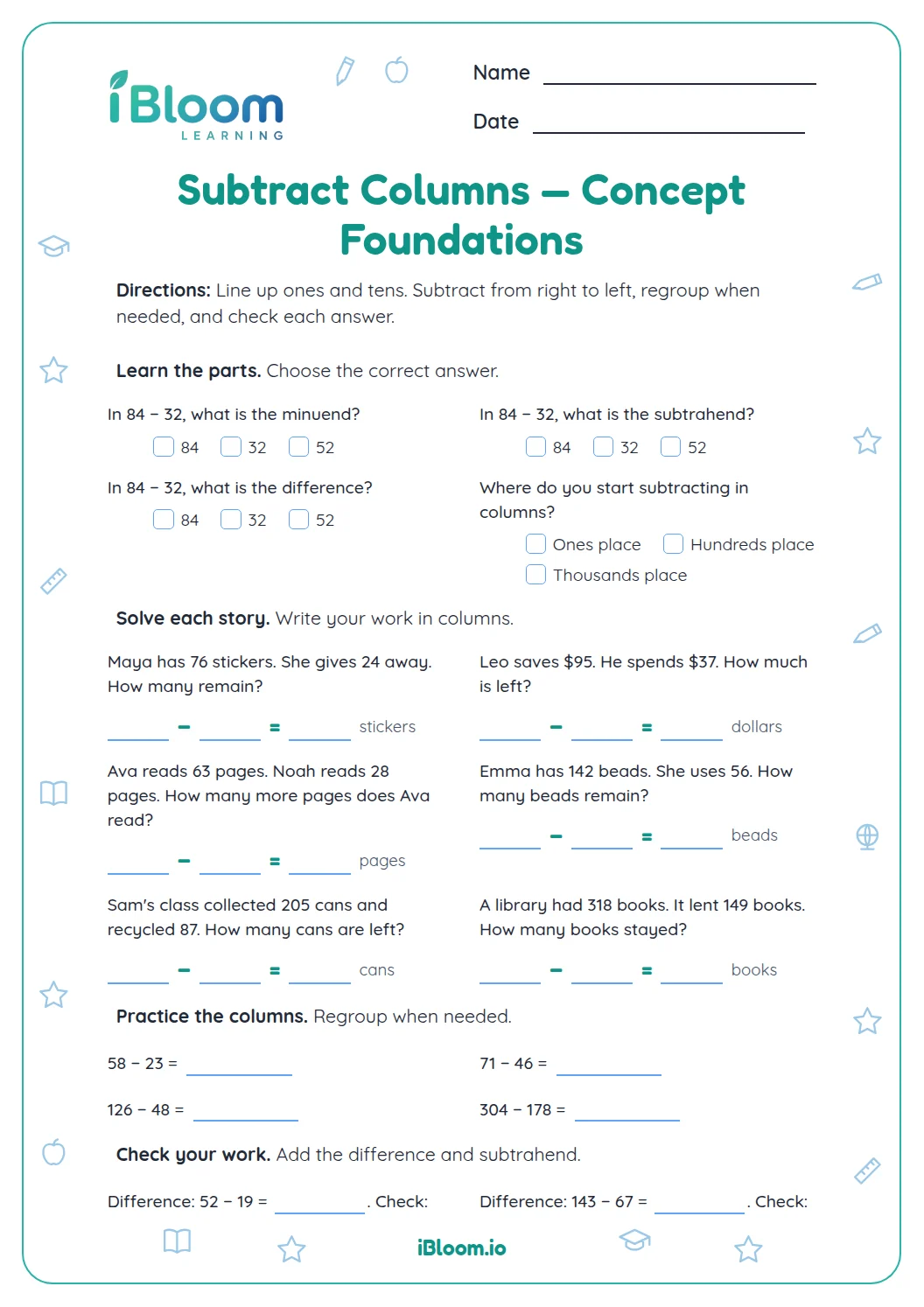
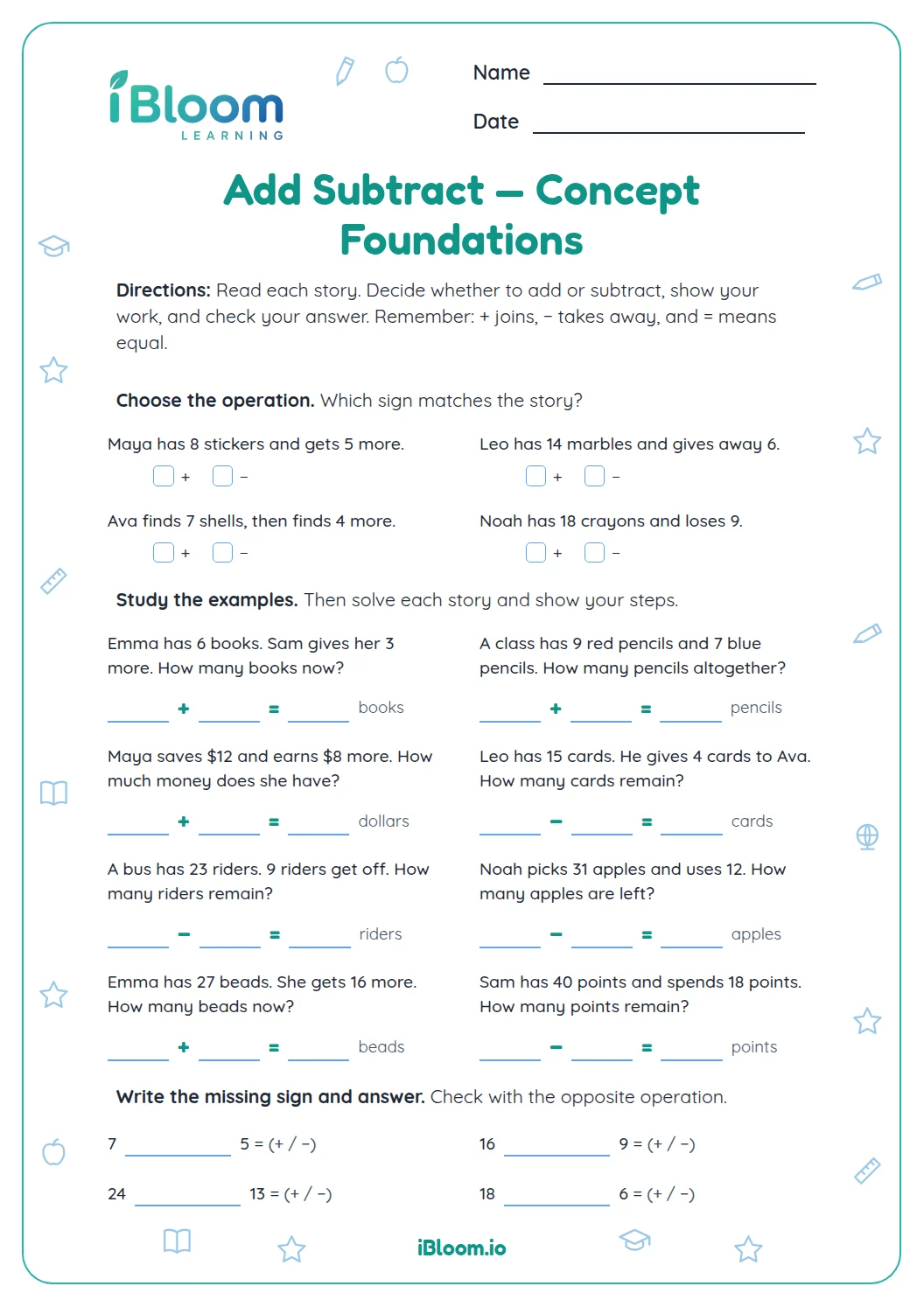
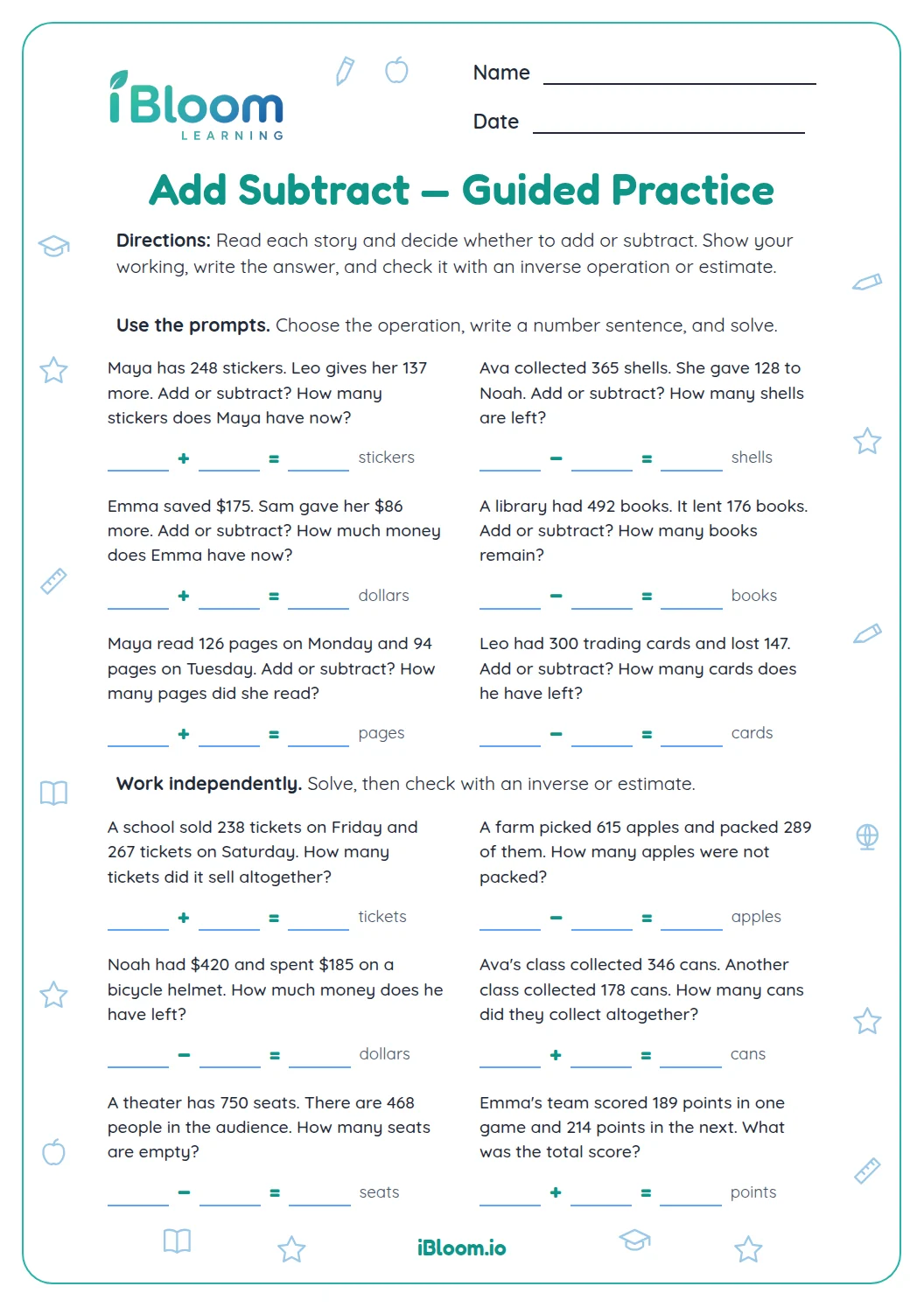
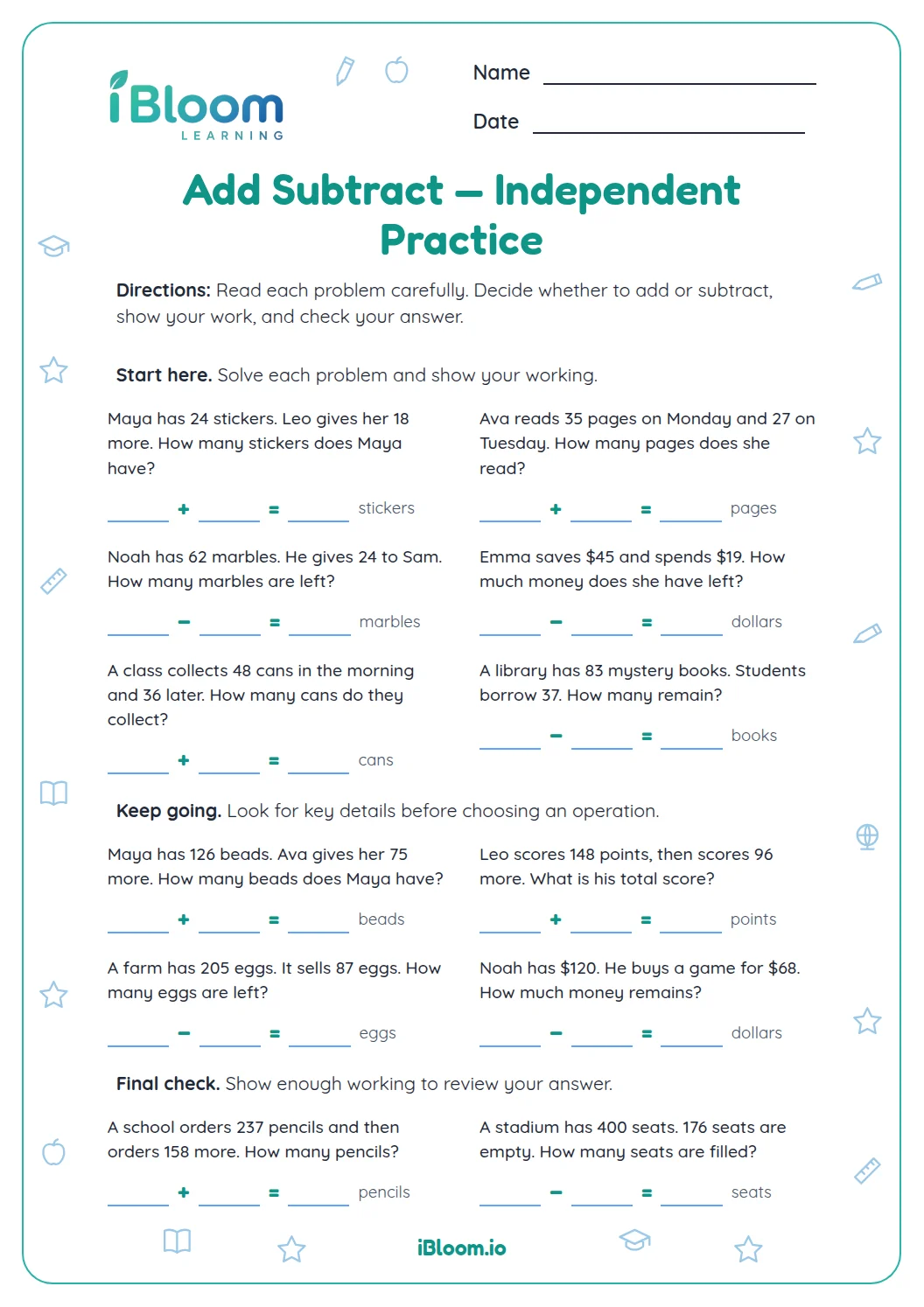
This Grade 3 worksheet turns subtraction into short stories about supplies, books, tickets, and other amounts. Learners write a subtraction equation, solve with place-value strategies, and use addition to check. The 15 questions and separate answer key practice CCSS 3.NBT.A.2.
Aligned to 3.NBT.A.2
How do you turn a story into subtraction?
Identify the starting amount and the amount used, moved, or already counted. Subtract the second amount from the first, then check whether the result answers the story question.
- 1524 sheets − 287 sheets = 237 sheets
- 2Check: 287 + 237 = 524
How can you check a regrouped answer?
Keep ones, tens, and hundreds aligned when subtracting in columns. After regrouping, add the difference to the subtracted amount. The sum should return to the starting amount, even when a zero required regrouping across places.
How to use the worksheet
- 1Underline the starting amount and the amount being removed or compared.
- 2Write a subtraction equation before calculating.
- 3Align ones under ones, tens under tens, and hundreds under hundreds.
- 4Regroup where a top digit is too small, then subtract by place.
- 5Add the difference to the subtrahend to check the result.
Common mistakes and quick checks
The mistake
Subtracting the smaller number from the larger number without reading the story
The fix
Use the starting amount as the minuend and identify what the question asks to find.
The mistake
Forgetting to regroup across a zero
The fix
Regroup from the next nonzero place, then record each place-value change.
The mistake
Stopping at the difference without checking
The fix
Add the difference to the amount removed; the total should match the starting amount.
Curriculum alignment
This worksheet practices 3.NBT.A.2.
Subtract within 1,000 using place value and check with addition.
On this sheet:
Show the official wordingHide the official wording
Fluently add and subtract within 1000 using strategies and algorithms based on place value, properties of operations, and/or the relationship between addition and subtraction.
What to practice next
Make more practice
Further reading
Questions parents and teachers ask
What subtraction situations are included?
The stories ask how many remain, how many more are needed, or how many are open, empty, or left. Each can be represented with subtraction, including three-digit amounts that require regrouping. Use the answer key to verify the difference and the story unit.
How should a learner show column work?
Write the numbers with ones, tens, and hundreds aligned. Mark any regrouping clearly before subtracting each place. Then write the answer with the item’s unit or object, such as pages, seats, or cans. Use the answer key to verify the difference and the story unit.
How can addition check subtraction?
Add the difference to the number subtracted. For example, if 524 − 287 = 237, then 287 + 237 should equal 524. This verifies the computation and connects subtraction to its inverse operation. Use the answer key to verify the difference and the story unit.
Are missing amounts included?
Yes. Some stories ask how many more are needed to reach a goal or how much farther remains. These still use subtraction: compare the goal or total with the amount already sold, collected, or traveled. Use the answer key to verify the difference and the story unit.
Does the page include an answer key?
Yes. The separate answer key lists the expected difference for each of the 15 stories. Learners can also check whether the answer makes sense in context and whether it uses the right unit or object. Use the answer key to verify the difference and the story unit.