
About this worksheet
This Grade 3 printable practices three-digit subtraction within 1,000. Students read a base-ten model, solve eight compact subtraction equations, set up one problem in columns, and apply the skill in four short stories. Regrouping appears in the ones, tens, and hundreds places. The 14-question sheet includes a separate key and practices CCSS 3.NBT.A.2.
Aligned to 3.NBT.A.2
How do the blocks show subtraction?
The model gives the starting number in hundreds, tens, and ones. In question 1, subtract 128 from 352 to find 224.
How can you set up a column subtraction?
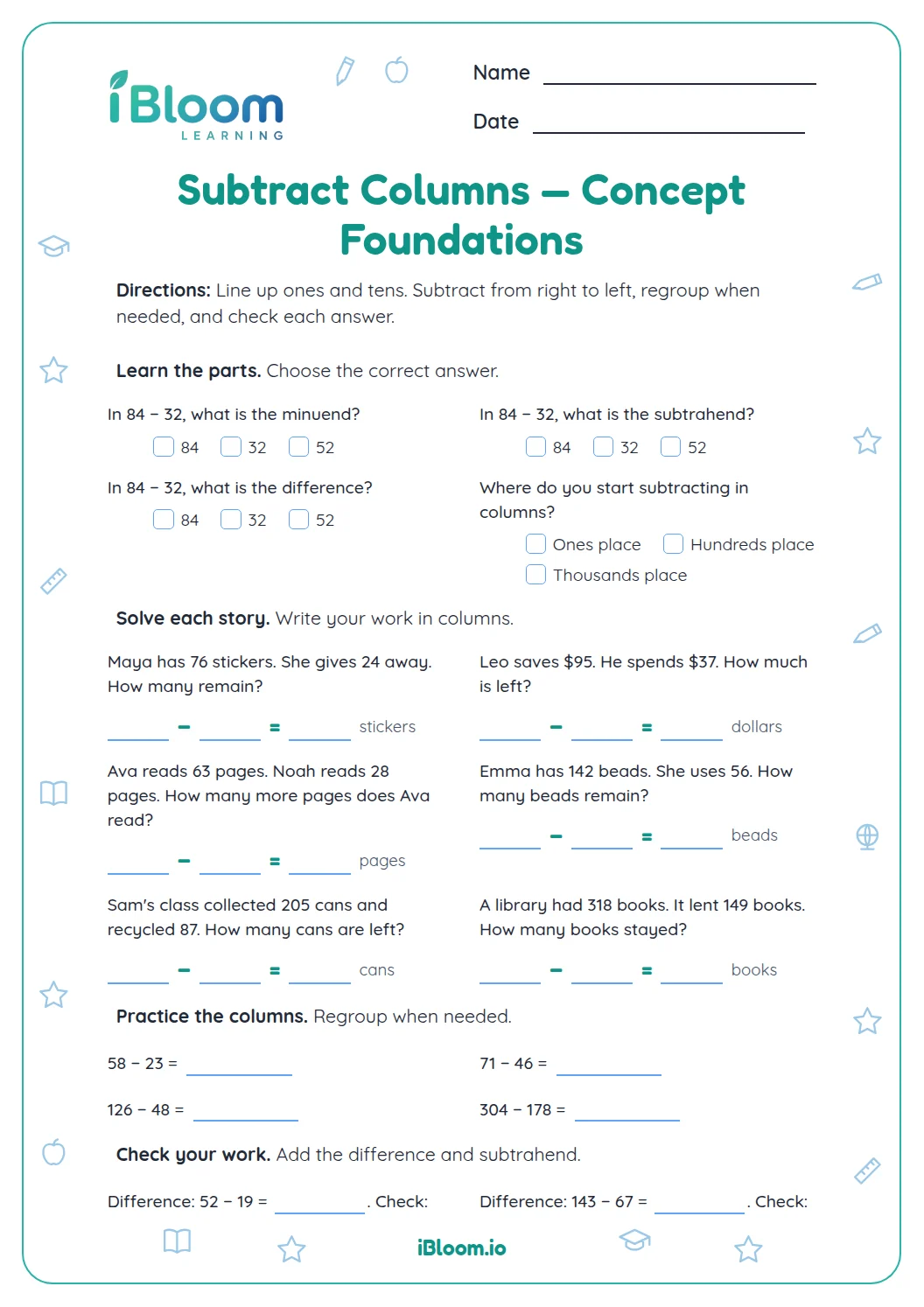
Line up matching places, regroup where needed, and subtract from right to left. Question 10 provides a grid for 482 − 159.
- 1482 − 159
- 2Regroup to subtract the ones and tens.
- 3482 − 159 = 323
How do you find what remains in a story?
Identify the starting amount and the amount taken away, then label the difference with the unit. In question 11, 643 − 286 = 357 books remain.
How to use this worksheet
- 1Write hundreds, tens, and ones in matching columns.
- 2Start with the ones column and compare the top digit with the bottom digit.
- 3Regroup one ten as 10 ones, or one hundred as 10 tens, when needed.
- 4Subtract each place value and check with addition.
- 5For a story, identify the starting amount and the amount taken away.
Common mistakes and quick fixes
The mistake
Subtracting the smaller digit from the larger digit in every column.
The fix
Regroup first when the top digit is too small, then subtract the bottom digit.
The mistake
Forgetting that a regrouped hundred leaves one fewer hundred.
The fix
After trading one hundred for 10 tens, reduce the hundreds digit by one.
The mistake
Reporting the amount taken away instead of the amount left.
The fix
Reread the question and label the difference with the unit asked for.
The questions practice three-digit subtraction strategies and algorithms within 1,000.
Three-digit subtraction uses place-value blocks, column methods, and related story problems.
On this sheet:
Show the official wordingHide the official wording
Fluently add and subtract within 1000 using strategies and algorithms based on place value, properties of operations, and/or the relationship between addition and subtraction.
What to practice next
Make more practice
Further reading
Questions parents and teachers ask
What does regrouping mean in subtraction?
Regrouping exchanges one place-value unit for ten units in the place to its right. For example, one ten becomes ten ones when the ones column needs more. The worksheet includes a column setup so students can record the trade before subtracting.
How many questions are on the sheet?
There are 14 numbered questions: one base-ten model, eight subtraction equations, one column problem, and four word problems. The separate answer key uses the same numbering, so students can check each difference and keep the story unit with the answer.
How should a student use the base-ten model?
Read the hundreds, tens, and ones in the drawing to identify the starting number. Then subtract the number in the prompt. For question 1, the blocks make 352, and 352 − 128 = 224. The key gives the result. Use its question number to find the matching entry in the separate answer key.
Why is there a column-work grid?
The grid gives students room to line up hundreds, tens, and ones and show regrouping for question 10. The other equations use compact answer spaces, while the story questions ask for a short difference with its unit. Use its question number to find the matching entry in the separate answer key.
How can a student check a subtraction answer?
Add the difference to the amount taken away and see whether the sum matches the starting amount. For a story question, also check that the unit in the answer matches what the prompt asks about. Use its question number to find the matching entry in the separate answer key.