
About this worksheet
This Grade 3 worksheet gives learners eight three-digit subtraction equations and six word problems. The problems include regrouping across tens, hundreds, and zeros, with every difference within 1,000. A separate answer key helps children check the column work and story answers.
Aligned to 3.NBT.A.2
How do you subtract in columns?
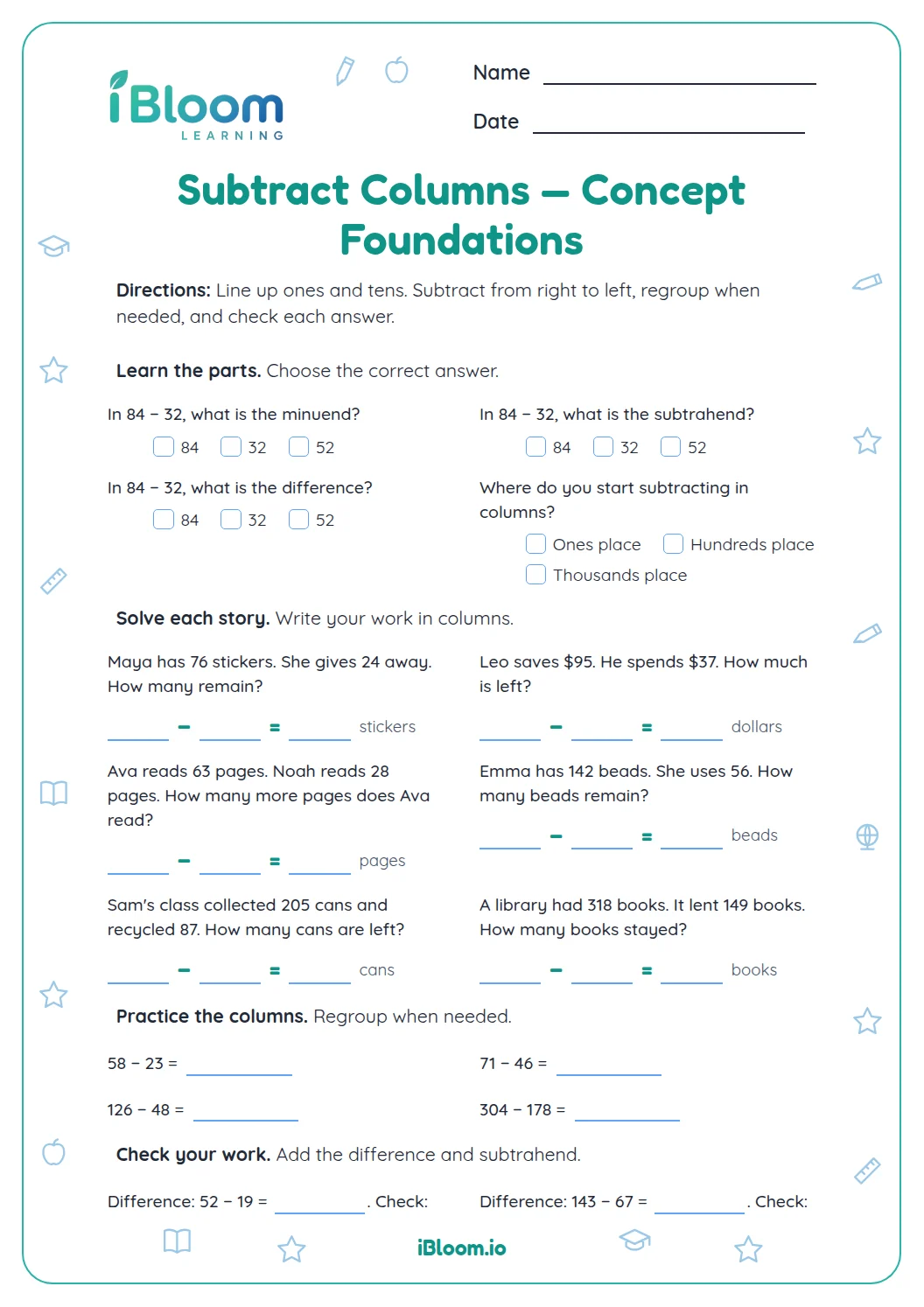
Line up hundreds, tens, and ones. Regroup when a top digit is too small to subtract the digit below it.
- 1642 − 218
- 2Regroup, then subtract each place: 424
How do the story problems work?
Each story describes a starting amount and an amount removed, used, or already completed. Subtract to find what remains.
- Identify the starting amount.
- Find what is taken away or completed.
- Subtract and include the requested unit.
How can an adult support practice?
Ask the learner to explain each regrouping exchange, especially when a zero appears in the top number. Have them estimate whether the difference is reasonable before checking the key.
How can children solve the problems?
- 1Write each equation with matching place values.
- 2Regroup from the next place when needed.
- 3Subtract ones, tens, then hundreds.
- 4For stories, identify the amount that remains.
- 5Estimate and compare answers with the key.
What should children check?
The mistake
Subtracting the smaller digit from the larger in every column.
The fix
Regroup when the top digit is smaller.
The mistake
Forgetting to reduce a place after regrouping.
The fix
Mark the exchange before continuing.
The mistake
Giving a difference without the story unit.
The fix
Include books, cans, miles, or the unit asked for.
Common Core alignment
The practice focuses on accurate three-digit subtraction and regrouping.
Fluently add and subtract within 1,000 using place value strategies.
On this sheet: All computation and story problems require subtraction within 1,000.
Show the official wordingHide the official wording
Fluently add and subtract within 1000 using strategies and algorithms based on place value, properties of operations, and/or the relationship between addition and subtraction.
What to practice next
Make more practice
Further reading
Questions parents and teachers ask
How many problems are included?
There are 14 questions: eight subtraction equations and six word problems. Each uses three-digit numbers, including examples with zeros that call for regrouping. The separate answer key lets learners finish the practice before checking every result and reviewing any regrouping step that needs another look.
What does regrouping mean?
Regrouping exchanges one unit in a place value for ten units in the place to its right. For example, a ten can be exchanged for ten ones when the ones digit in the top number is too small. The worksheet includes several problems where learners need this step.
What grade is this worksheet for?
It is labeled for Grade 3 and practices three-digit subtraction within 1,000. Learners can show the work in columns and then apply subtraction to stories about books, cans, points, apples, tickets, and distance. These place-value calculations provide practice with regrouping.
How can children check their subtraction?
They can estimate first, then add the difference to the amount subtracted to see whether it returns to the starting number. The separate answer key offers the expected results; if a result differs, check place alignment and regrouping exchanges. Adults can ask the learner to point to the prompt detail or calculation that supports each response.
Should children include units in story answers?
Yes. Units make clear what the difference counts, such as books remaining or miles left. The equation questions need only a number, while the six story problems should be answered with the matching item or measure. This makes each result clear in its context.