
About this worksheet
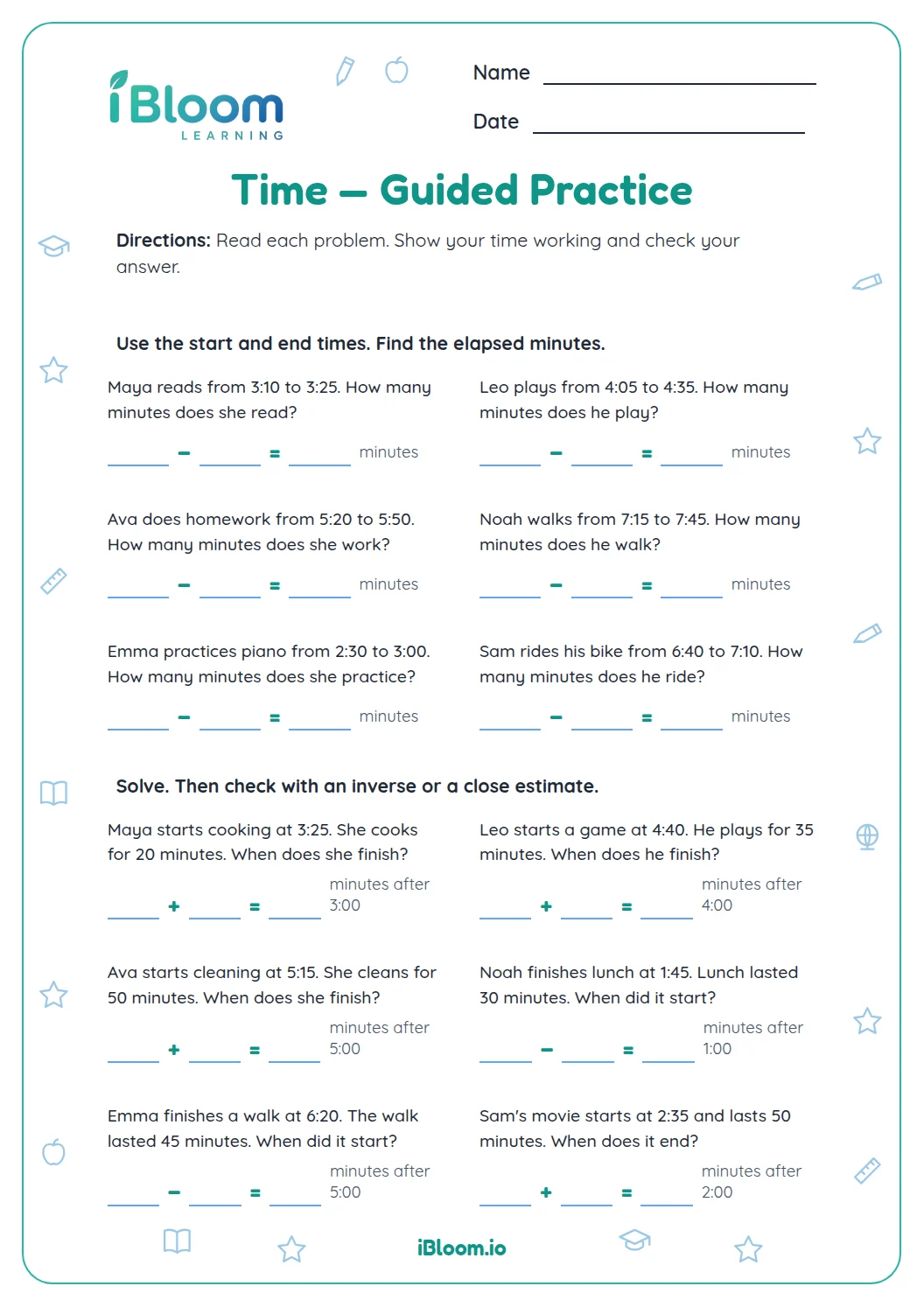
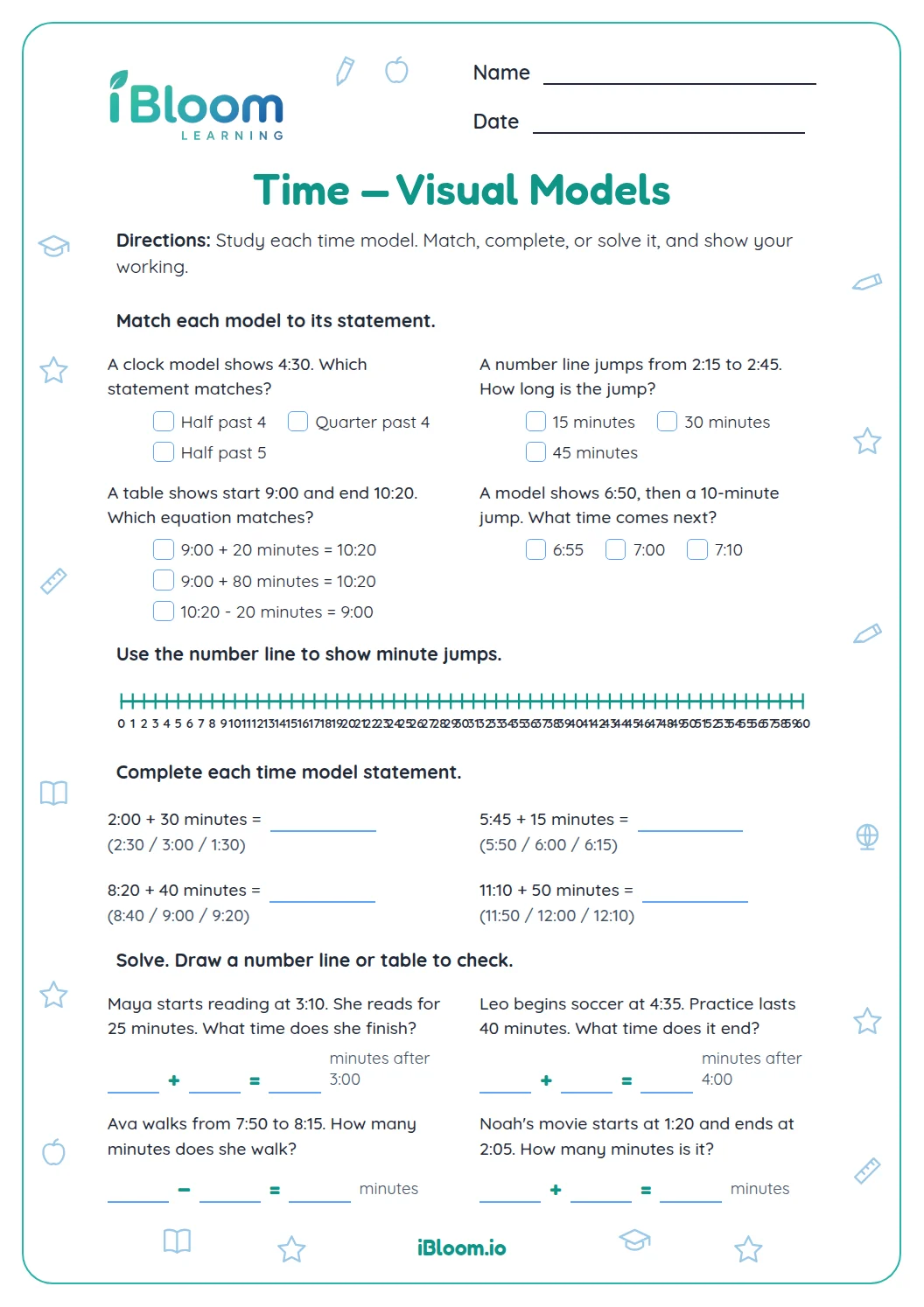
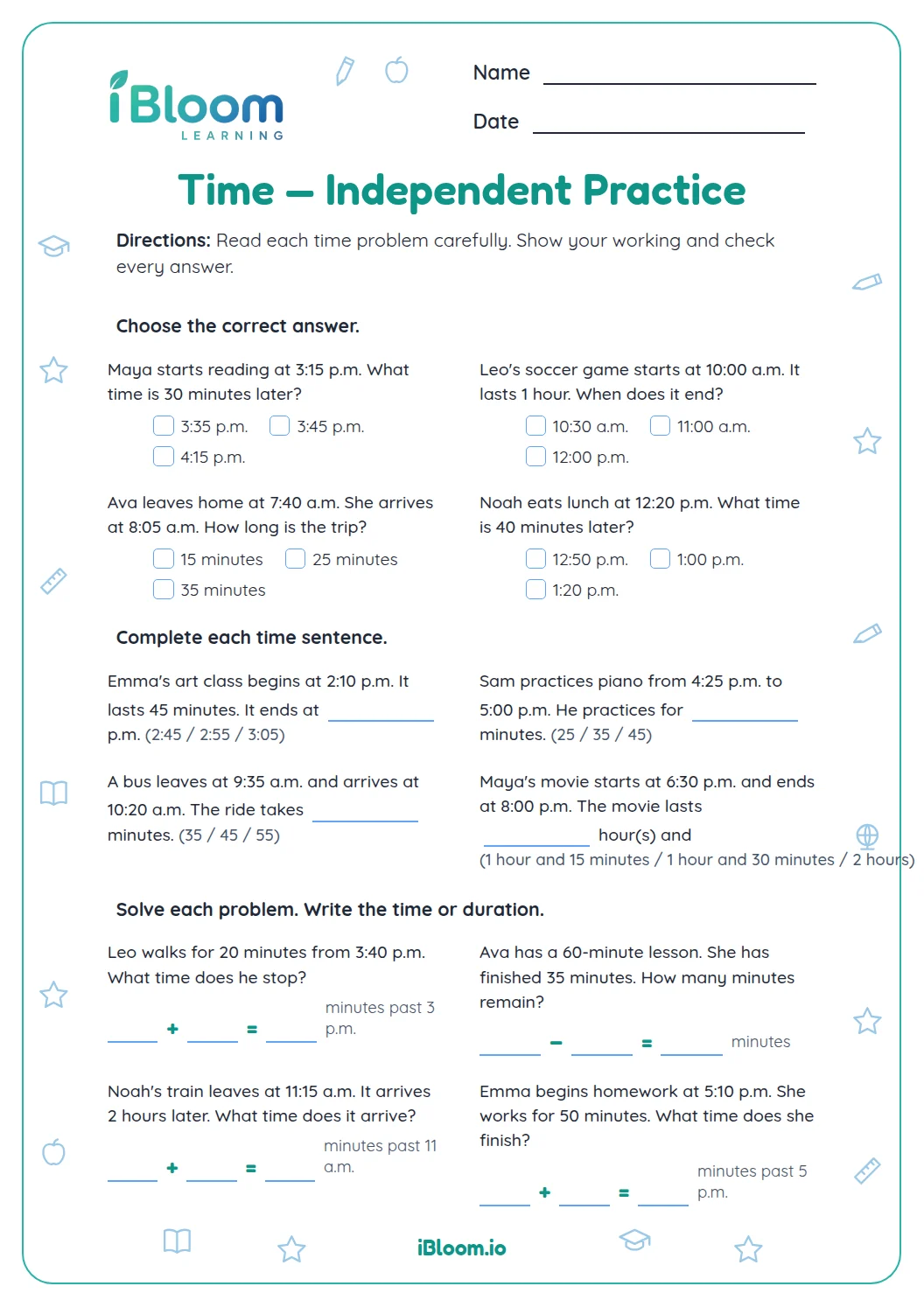
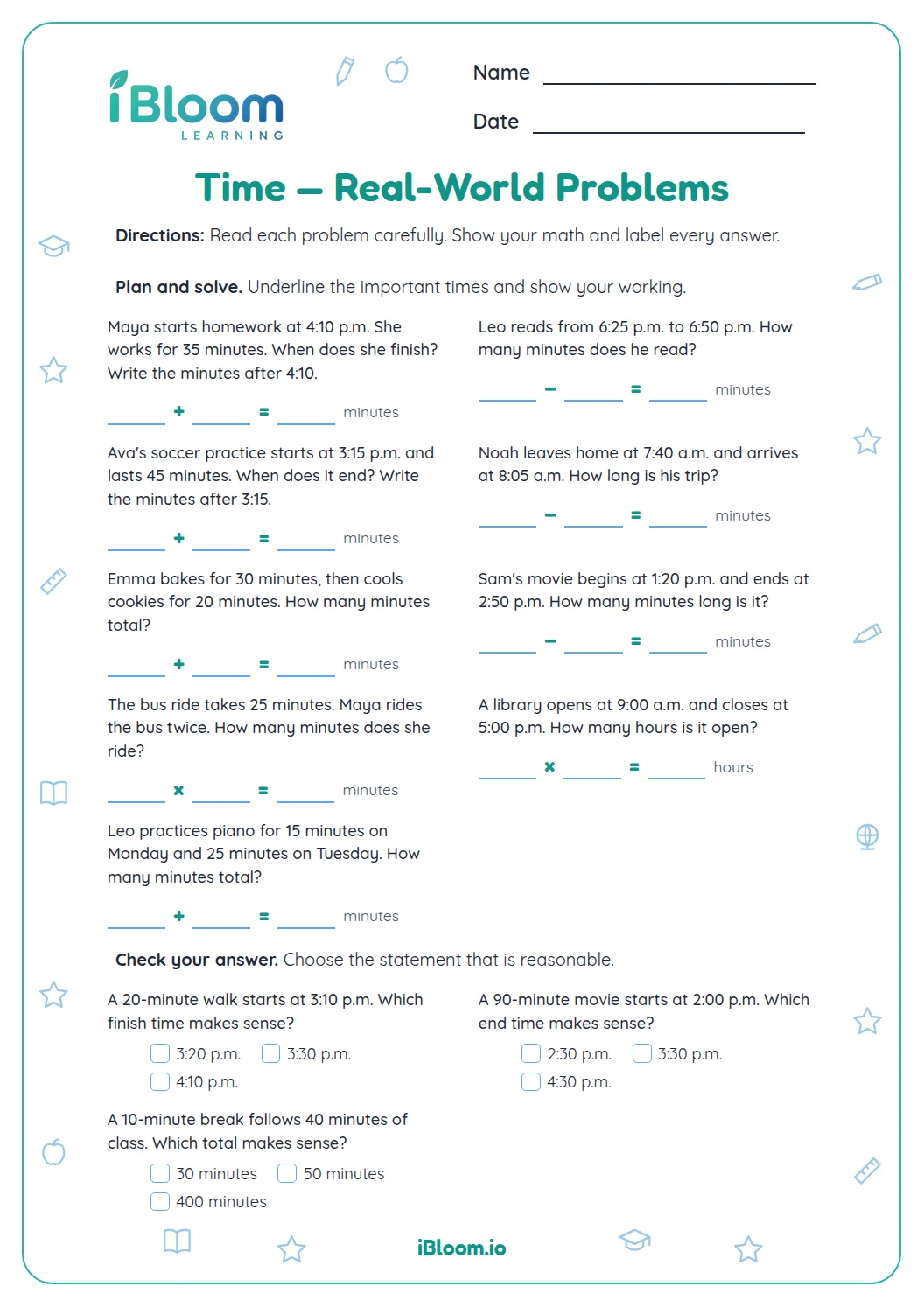
This free Grade 3 worksheet gives students 14 time questions: reading and comparing clock times, finding elapsed minutes, and working across an hour. It includes multiple-choice practice and a separate answer key. The questions practice telling time to the minute and solving minute-interval problems in Common Core standard 3.MD.A.1.
Aligned to 3.MD.A.1
How do you count across an hour?
Count to the next hour first, then count the remaining minutes. For example, 2:48 plus 25 minutes is 3:13: 12 minutes reaches 3:00, then 13 more minutes reach 3:13.
- 12:48 + 25 minutes
- 212 minutes to 3:00, then 13 more
- 3Answer: 3:13
How can you check an elapsed-time answer?
Count forward from the start to the end, or subtract the interval from the ending time. Keep track of the hour change as well as the minutes.
How to use this worksheet
- 1Read whether the question asks for a start time, end time, or interval.
- 2Mark the given time and the number of minutes.
- 3Count to the next hour before counting any leftover minutes.
- 4For an interval, split the trip at an hour if that helps.
- 5Check by reversing the time change.
Common mistakes and quick fixes
The mistake
Adding minutes without changing the hour at 60.
The fix
Count to :00, change the hour, and continue with leftover minutes.
The mistake
Subtracting the minute digits when the interval crosses an hour.
The fix
Count back to :00 first, then continue from the previous hour.
The mistake
Reporting only the minutes when asked for a time.
The fix
Include both the hour and minute in the answer.
Curriculum alignment
This worksheet practices 3.MD.A.1.
Apply time in the questions on this sheet.
On this sheet: The questions directly practice time.
Show the official wordingHide the official wording
Tell and write time to the nearest minute and measure time intervals in minutes. Solve word problems involving addition and subtraction of time intervals in minutes, e.g., by representing the problem on a number line diagram.
What to practice next
Make more practice
Further reading
Questions parents and teachers ask
How many time questions are on the worksheet?
There are 14 questions. They ask students to compare clock times, find start or end times, and measure intervals in minutes, including several that cross an hour. A separate answer key follows the worksheet so families can check the work after the student finishes.
Does the worksheet include an answer key?
Yes. The answer key is separate from the two worksheet pages and lists the correct choice for each question. Have the student try the page first, then use the key to check and talk through any time interval that needs another count.
How do students handle minutes that cross an hour?
Count from the starting time to the next hour, then count the remaining minutes. For example, 2:48 plus 25 minutes takes 12 minutes to reach 3:00 and 13 more to reach 3:13. Counting in two parts helps keep the hour and minute accurate.
What should a student do when finding an elapsed time?
Start at the earlier clock time and count forward to the later one. If the interval crosses an hour, split it at the hour mark. Students can also subtract backward from the ending time and check that the result returns to the given start.
Is this worksheet suitable for independent practice?
The questions are multiple choice, so students can work through them independently after reading the directions. An adult can support a learner by asking them to point out the start time, end time, or interval before choosing an answer. The key is useful for checking afterward.