

About this worksheet
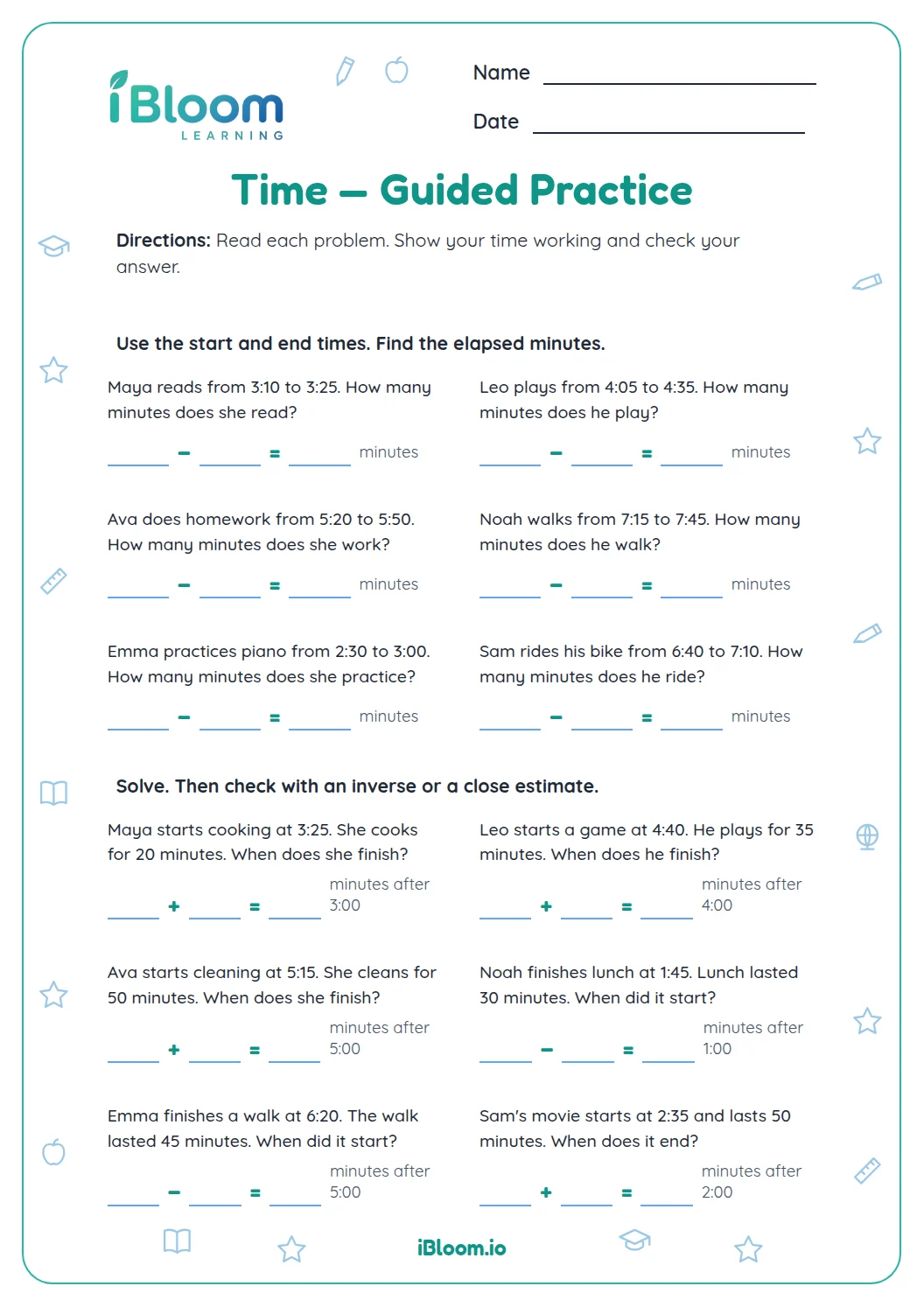
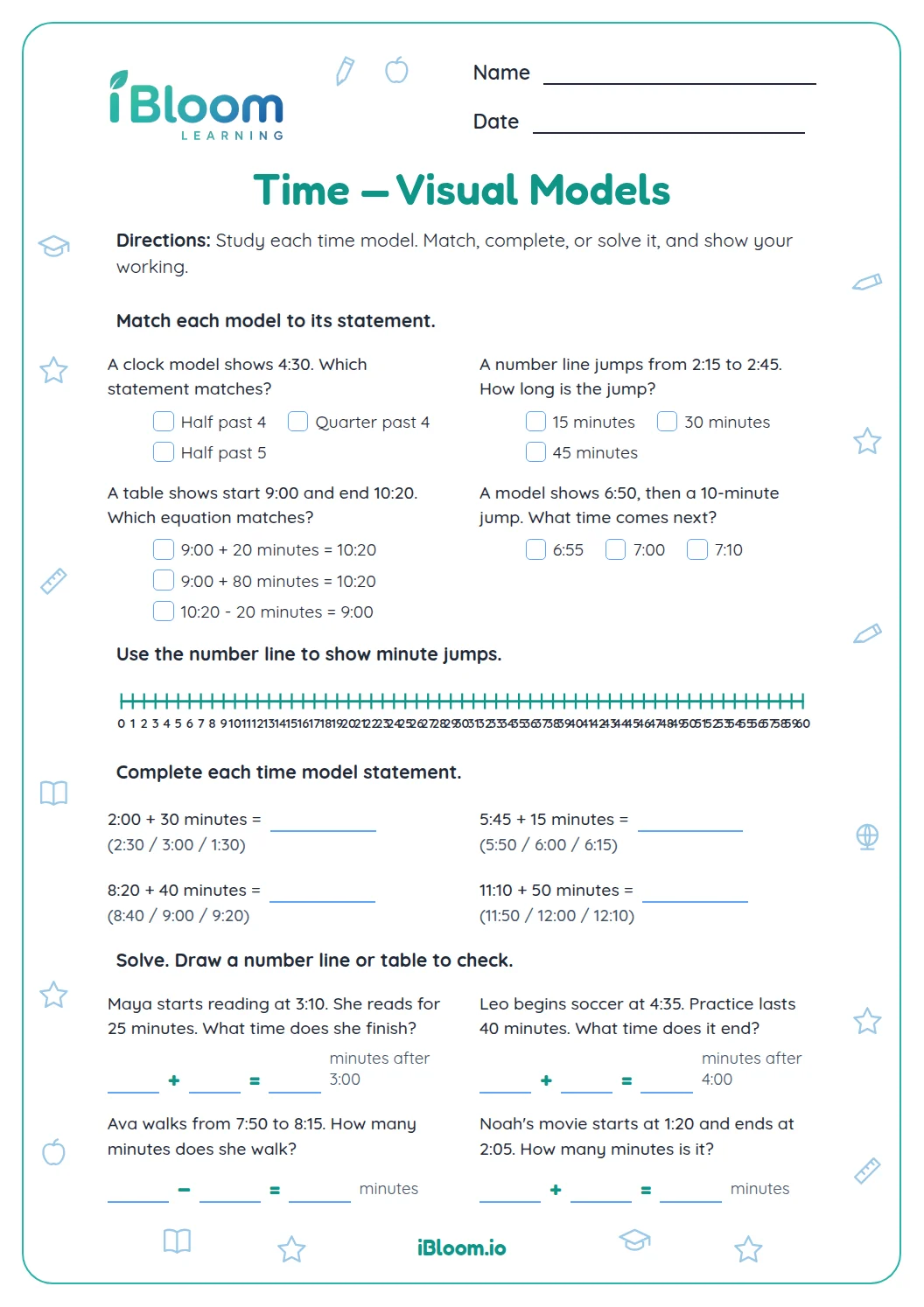
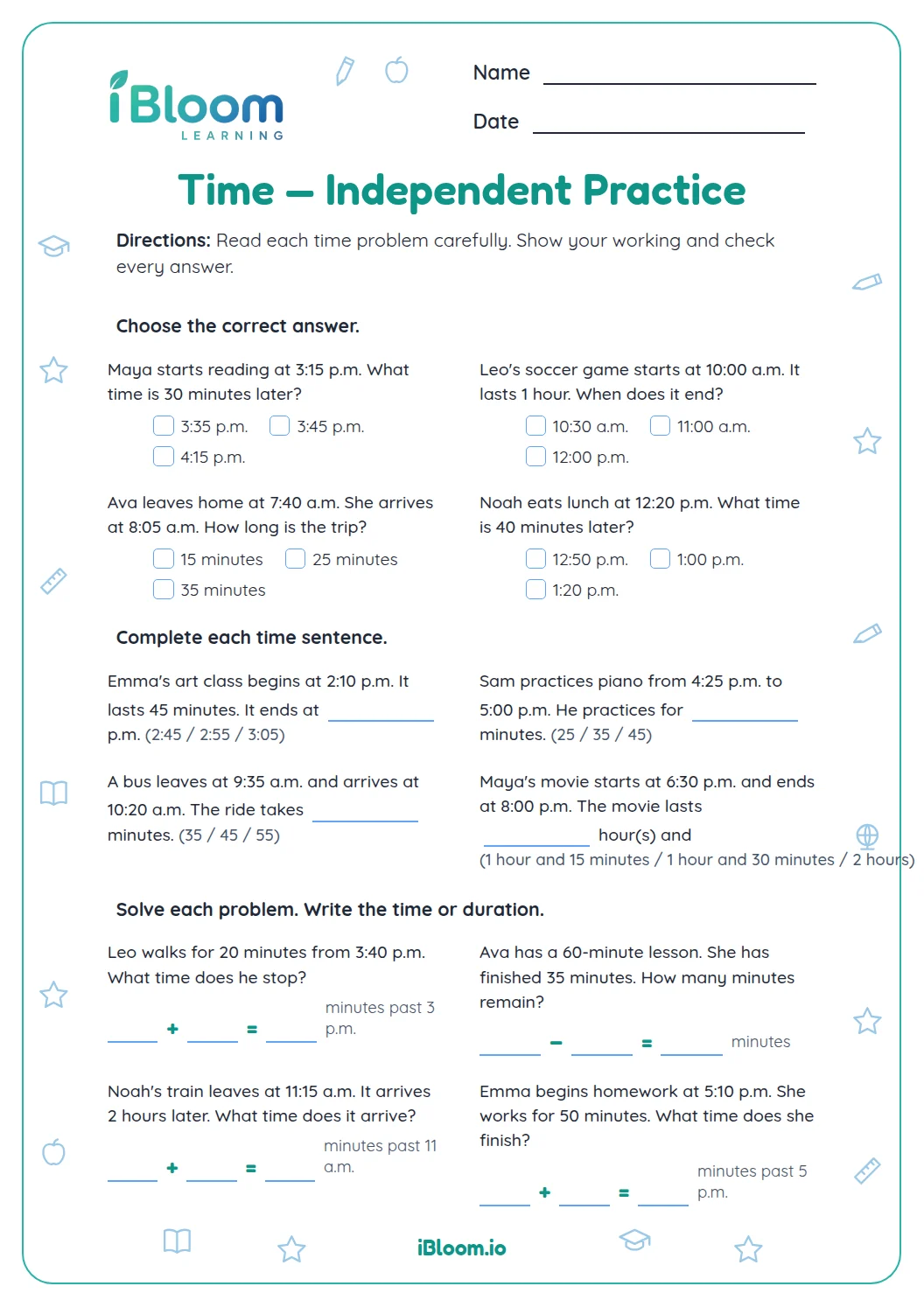
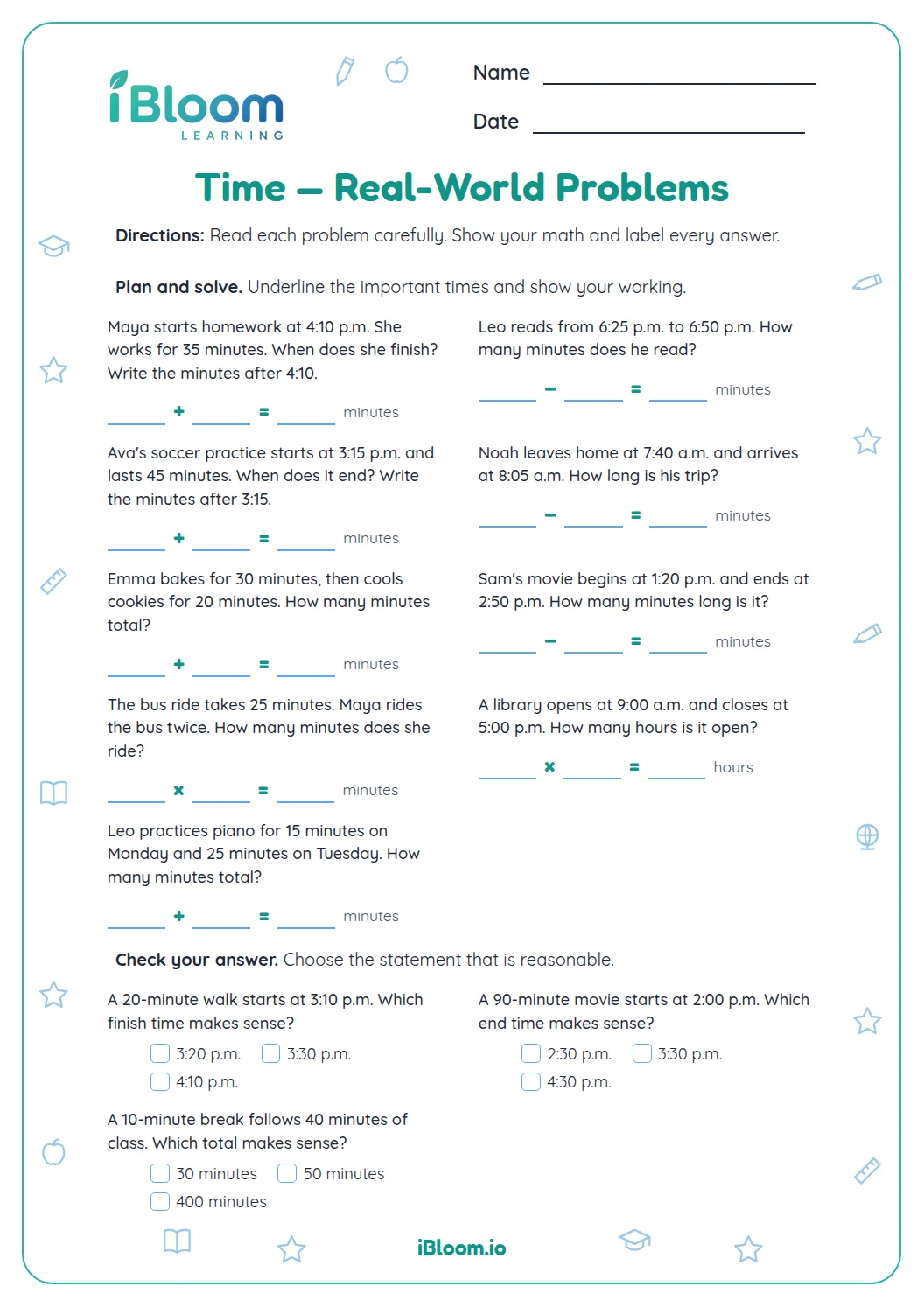
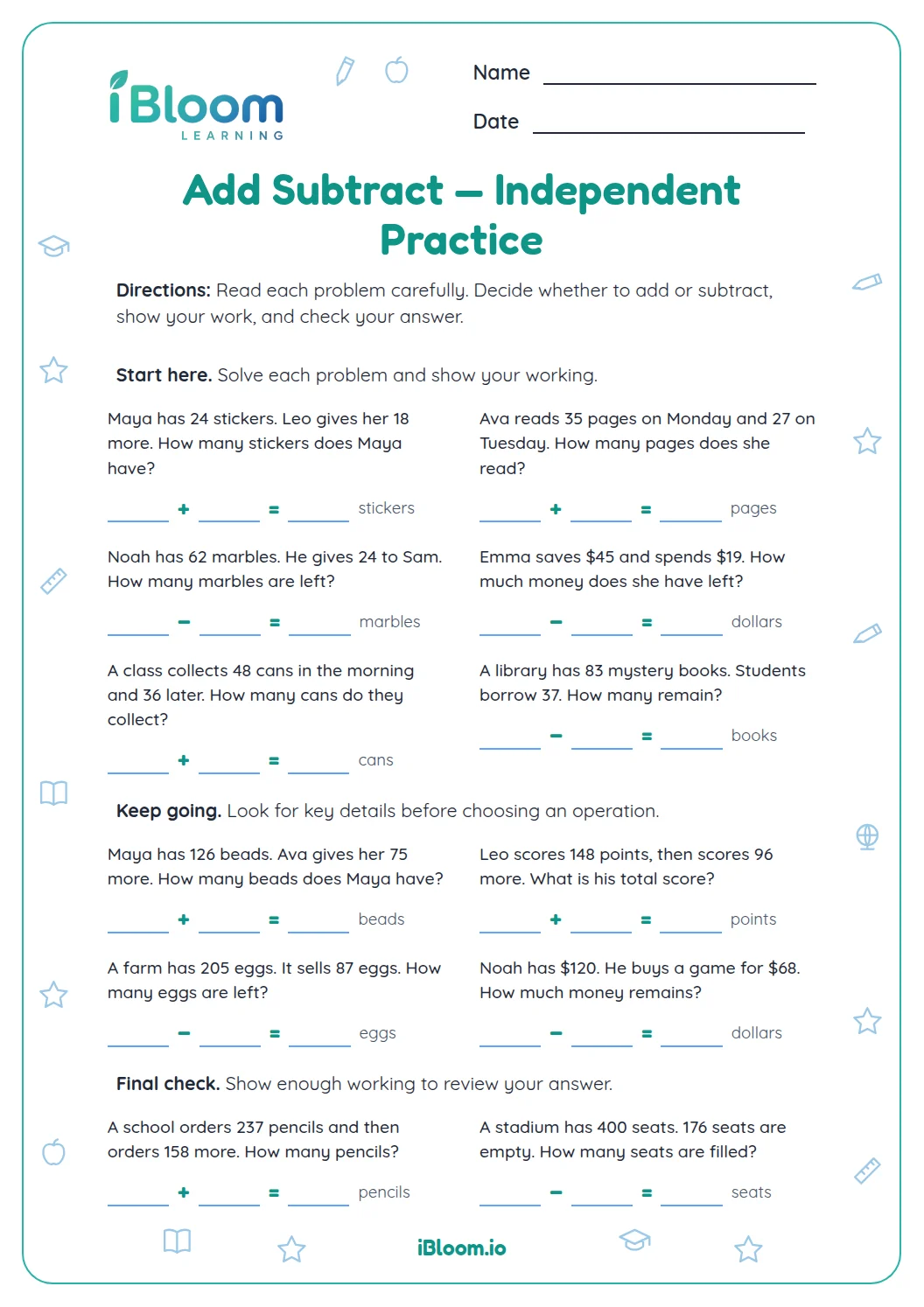
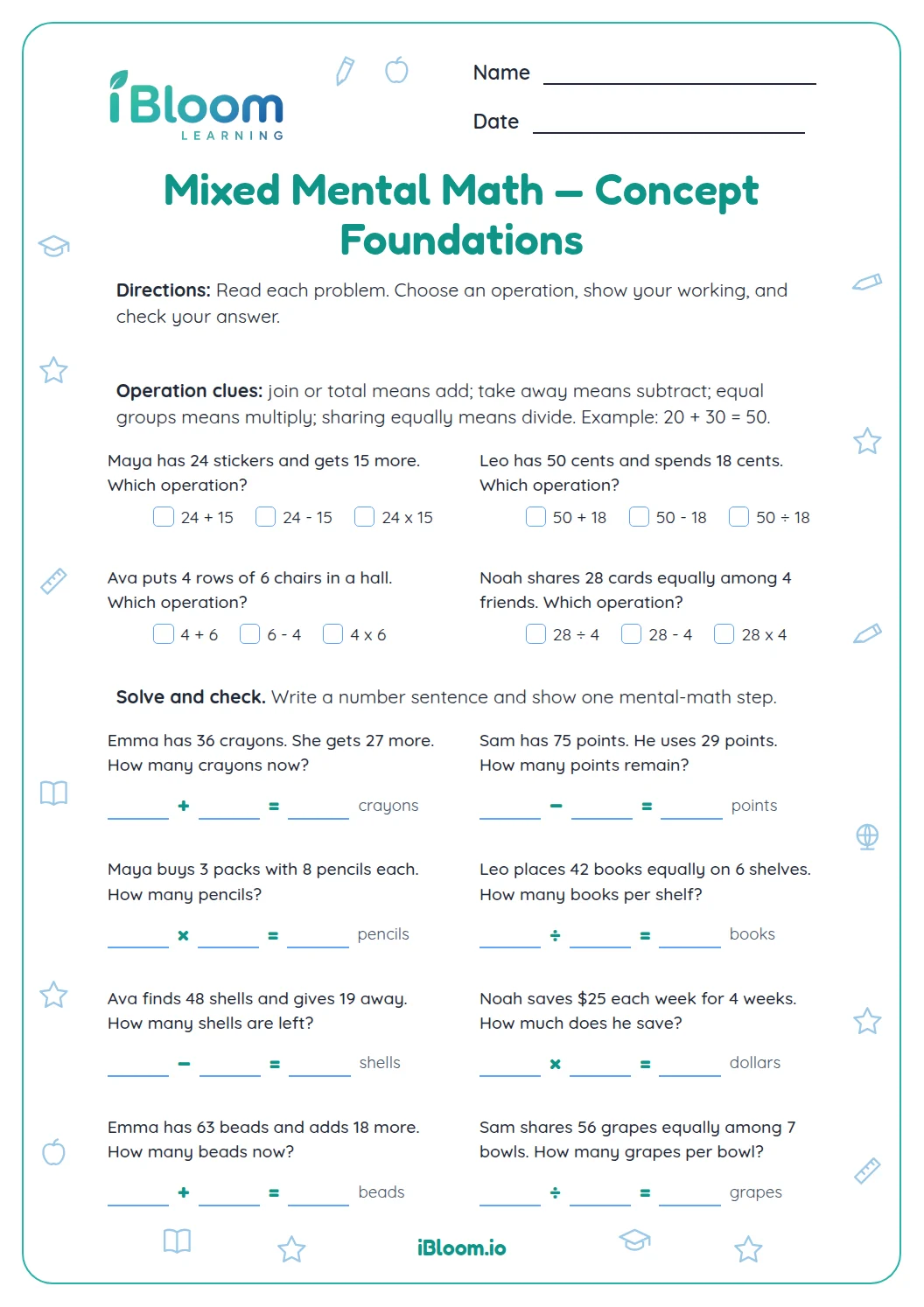
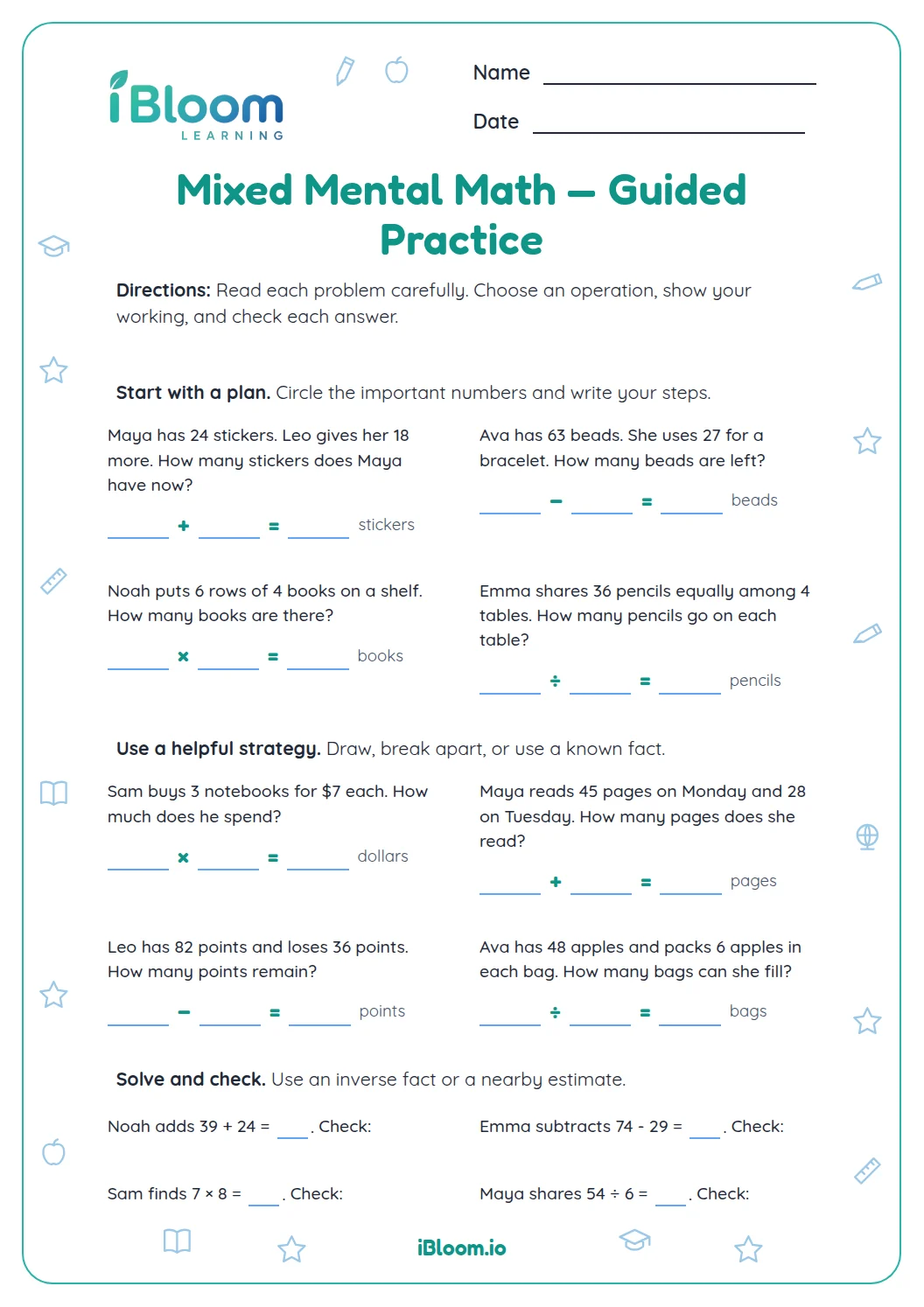
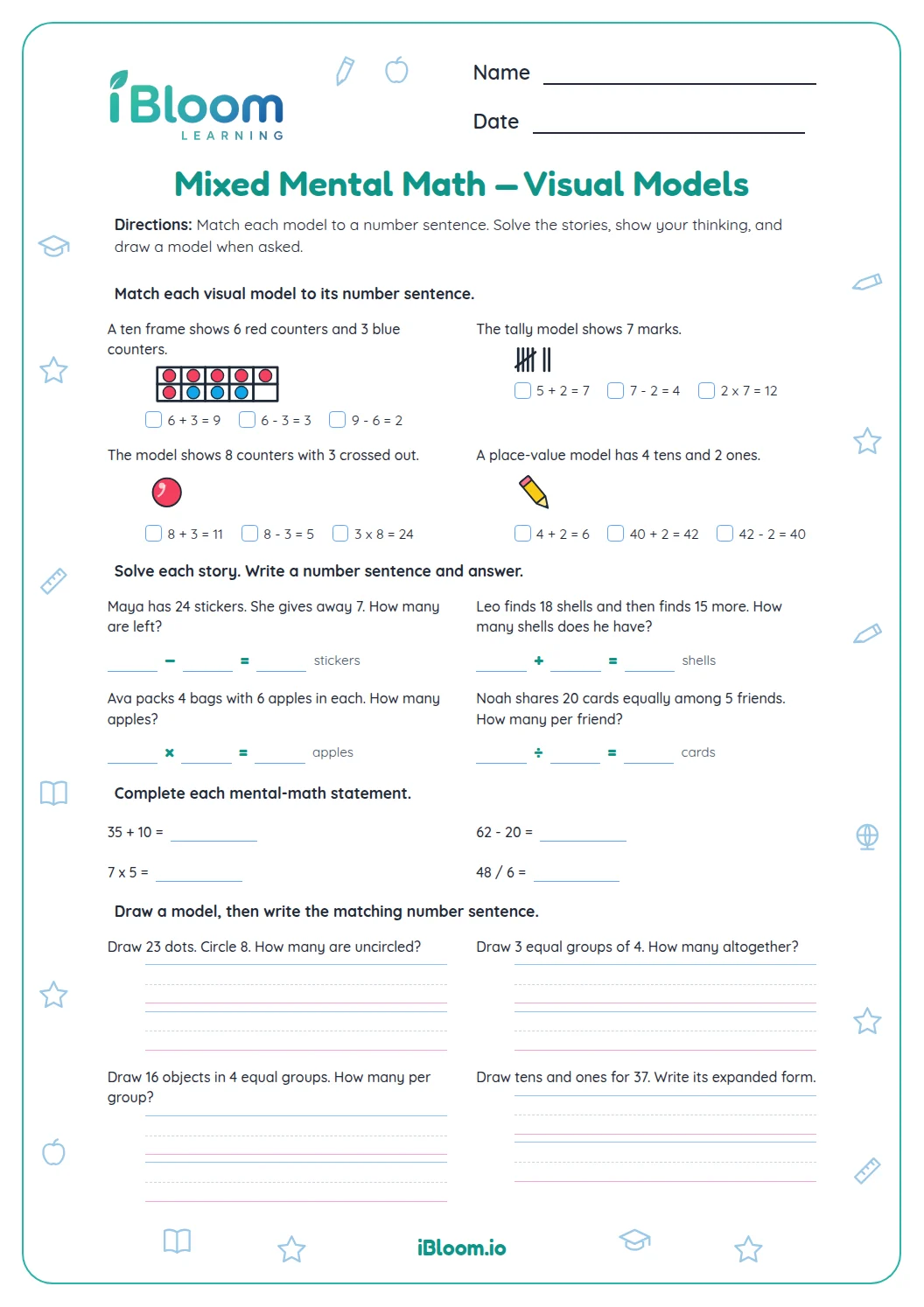
This free Grade 3 time worksheet starts with four analog clocks, then moves to elapsed-time stories and duration comparisons. Learners read times to the minute and find how long an event lasts or when it ends. The 14 questions build from reading a clock to counting forward across an hour. A separate answer key supports checking. The sheet practices CCSS 3.MD.A.1.
Aligned to 3.MD.A.1
How do you read an analog clock to the minute?
The short hand shows the hour, and the long hand points to the minute. Read the hour the short hand has reached, then count the minute marks by fives from 12 to the long hand.
On q1, the short hand is just past 2 and the minute hand points to 3, or 15 minutes. The clock reads 2:15.
- 1Short hand: just past 2.
- 2Long hand: 3 × 5 minutes = 15 minutes.
- 3Read the time as 2:15.
How can you find elapsed time?
Count forward from the start time to the end time. You can reach the next hour first, then count the remaining minutes. For example, from 8:45 to 9:20 is 15 minutes to 9:00 plus 20 more minutes, or 35 minutes.
What kinds of time problems are included?
Part A has four analog clocks to read. Part B has ten questions about elapsed minutes, ending times, or comparing durations. The contexts include practice, class, reading, a bus ride, and a train trip.
How does this page practice CCSS 3.MD.A.1?
Learners tell and write time to the nearest minute and solve elapsed-time problems by measuring intervals in minutes.
How to use this worksheet
- 1Read each clock by finding the hour, then the minute.
- 2For a story, mark the start time and identify what the question asks.
- 3Count forward to the next hour when that makes the minutes easier to track.
- 4Add the minute intervals and label the result with the requested unit.
- 5Check each time or duration against the answer key.
Time-solving slips and quick fixes
The mistake
Reading the hour hand as the minute hand.
The fix
Find the short hour hand first, then read minutes from the long hand.
The mistake
Counting elapsed time by subtracting only the hour numbers.
The fix
Count the minutes from the start to the end, including across the hour.
The mistake
Stopping at the next hour and forgetting the remaining minutes.
The fix
Split the interval at the hour, then add both parts.
Curriculum alignment
This worksheet practices the standard below through its questions and worked examples.
Tell and write time to the nearest minute and solve elapsed-time problems.
On this sheet: Read minute times and solve elapsed-time and duration stories.
Show the official wordingHide the official wording
Tell and write time to the nearest minute and measure time intervals in minutes. Solve word problems involving addition and subtraction of time intervals in minutes, e.g., by representing the problem on a number line diagram.
What to practice next
Make more practice
Further reading
Questions parents and teachers ask
How do you read the minute hand on an analog clock?
Start at 12 and count by fives as you move clockwise to the long hand. Each small mark represents one minute, so you can count single marks when the hand falls between the five-minute numbers. The first four questions use analog clock drawings.
How do you find how long an event lasted?
Count forward from the start time to the end time, keeping track of the minutes. If the interval crosses an hour, count to that hour first and then add the remaining minutes. For example, 8:45 to 9:20 is 15 + 20, or 35 minutes.
How do you find an ending time?
Add the duration to the start time. You can add minutes to the current hour, then continue into the next hour if needed. For the walk question, 5:25 plus 40 minutes is 6:05 because 35 minutes reaches 6:00 and five more minutes reach 6:05.
Does the worksheet include clock pictures?
Yes. The first four questions each show an analog clock for learners to read. Later questions use written situations about events and durations, so learners practice using times in context as well as reading clock faces and interpreting elapsed minutes.
What standard does the worksheet practice?
It practices CCSS 3.MD.A.1, which includes telling and writing time to the nearest minute and solving elapsed-time problems in minutes. The sheet includes clock reading, elapsed minutes, and ending-time questions across school, travel, and activity contexts. Learners can explain each interval by counting forward from the start time.
Is there an answer key?
Yes. The answer key gives the time shown on each of the four clocks and the elapsed-time or ending-time response for the other questions. Learners can use it to check their count forward and find where a missed interval occurred.