

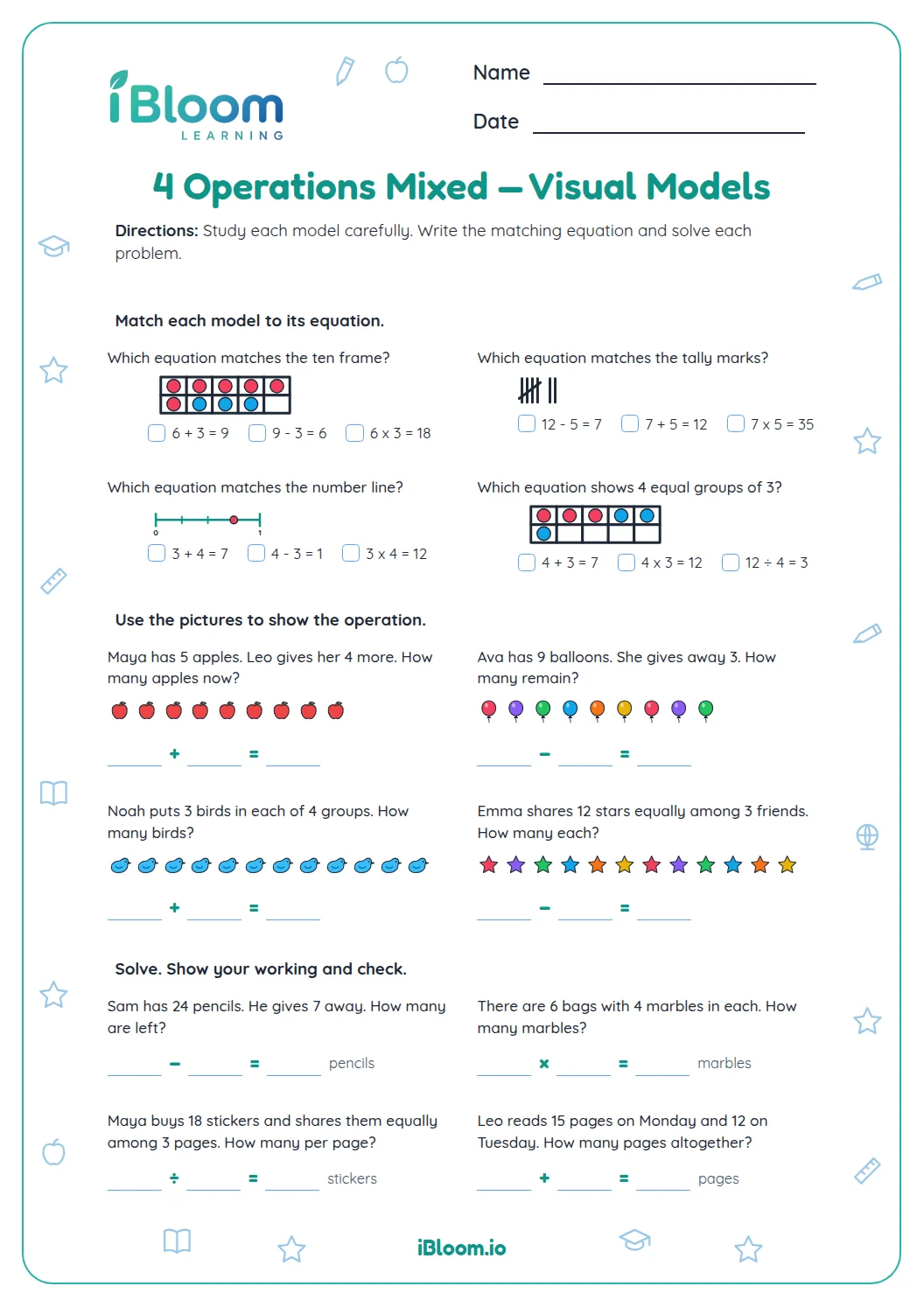
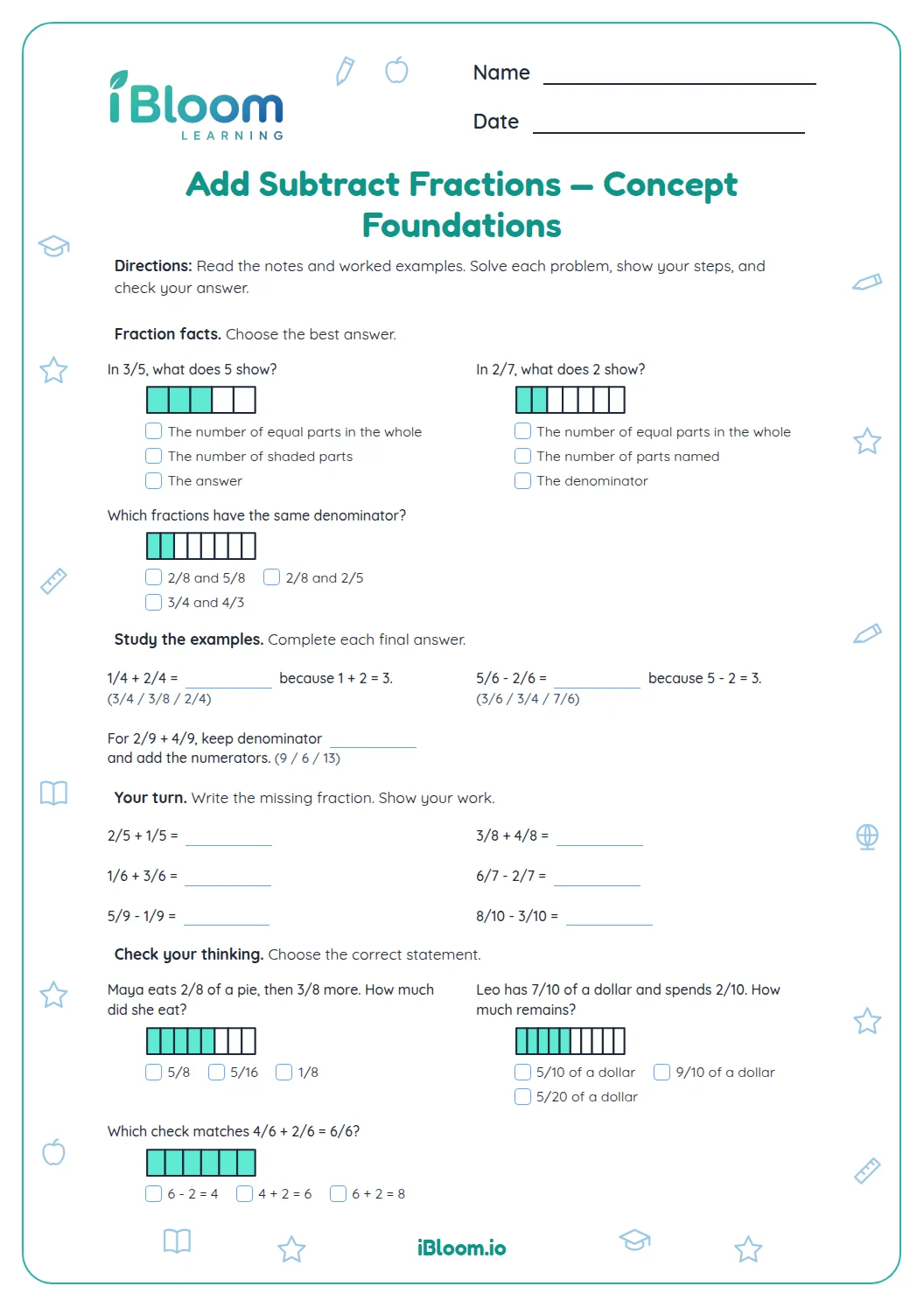
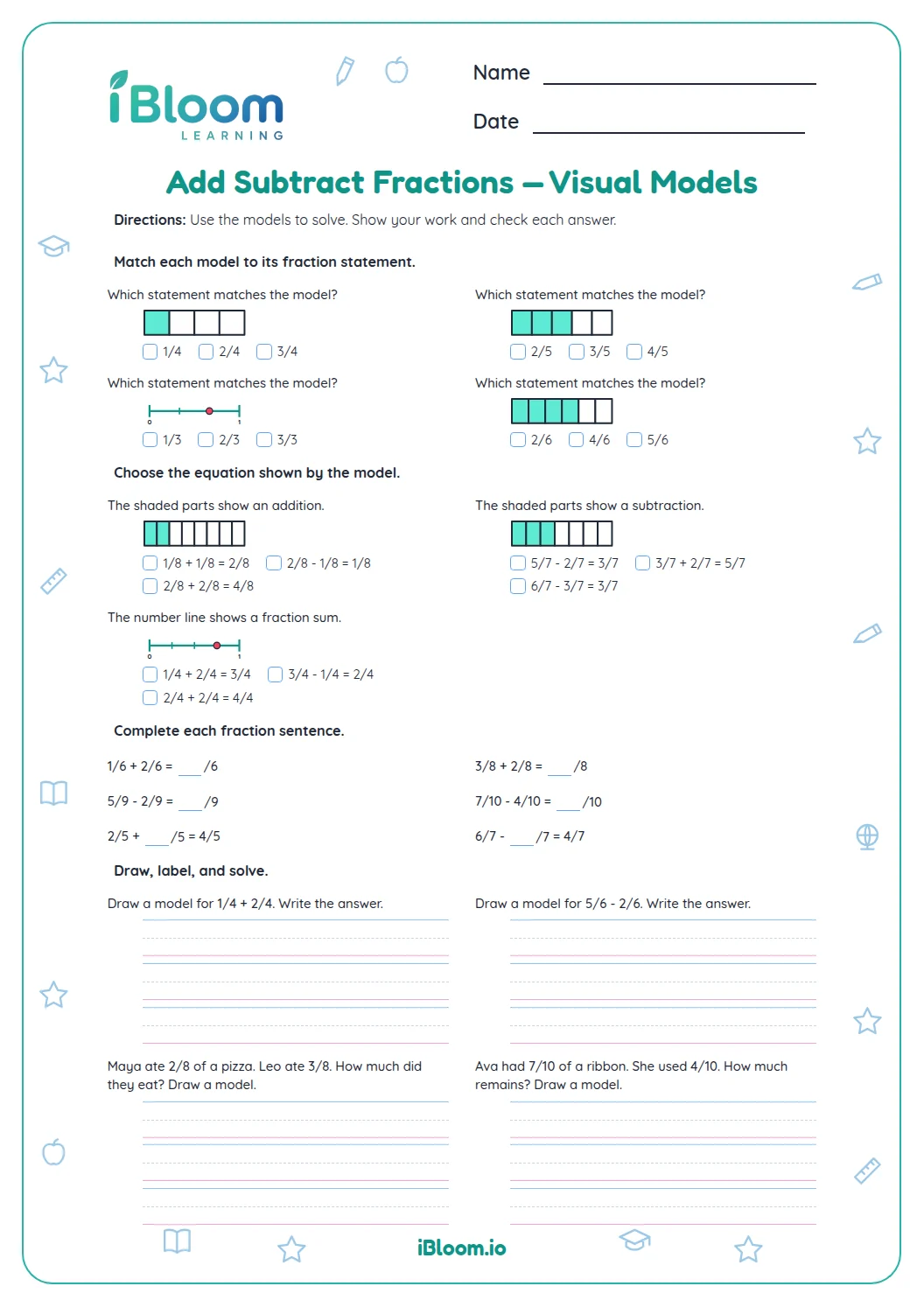
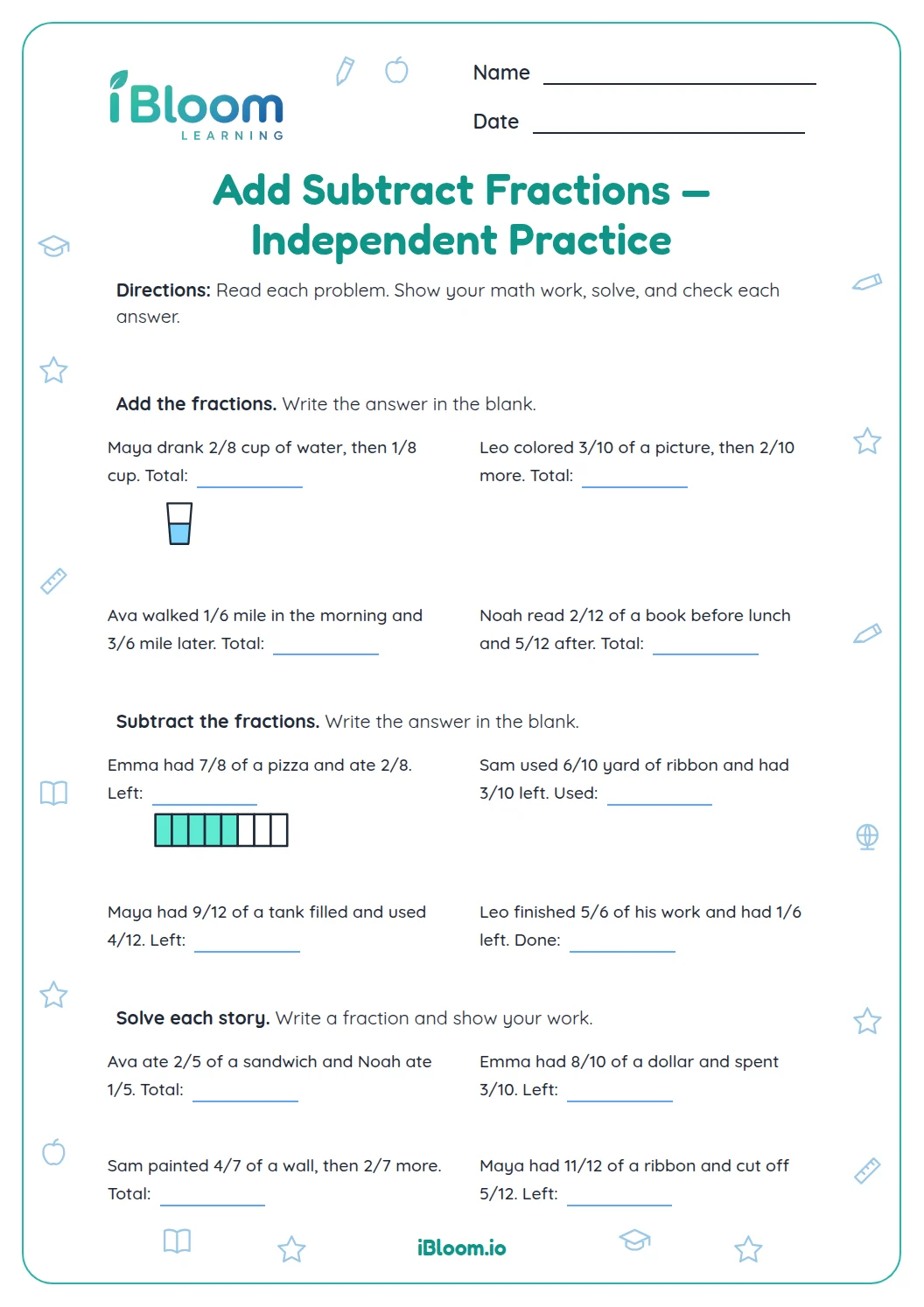
About this worksheet
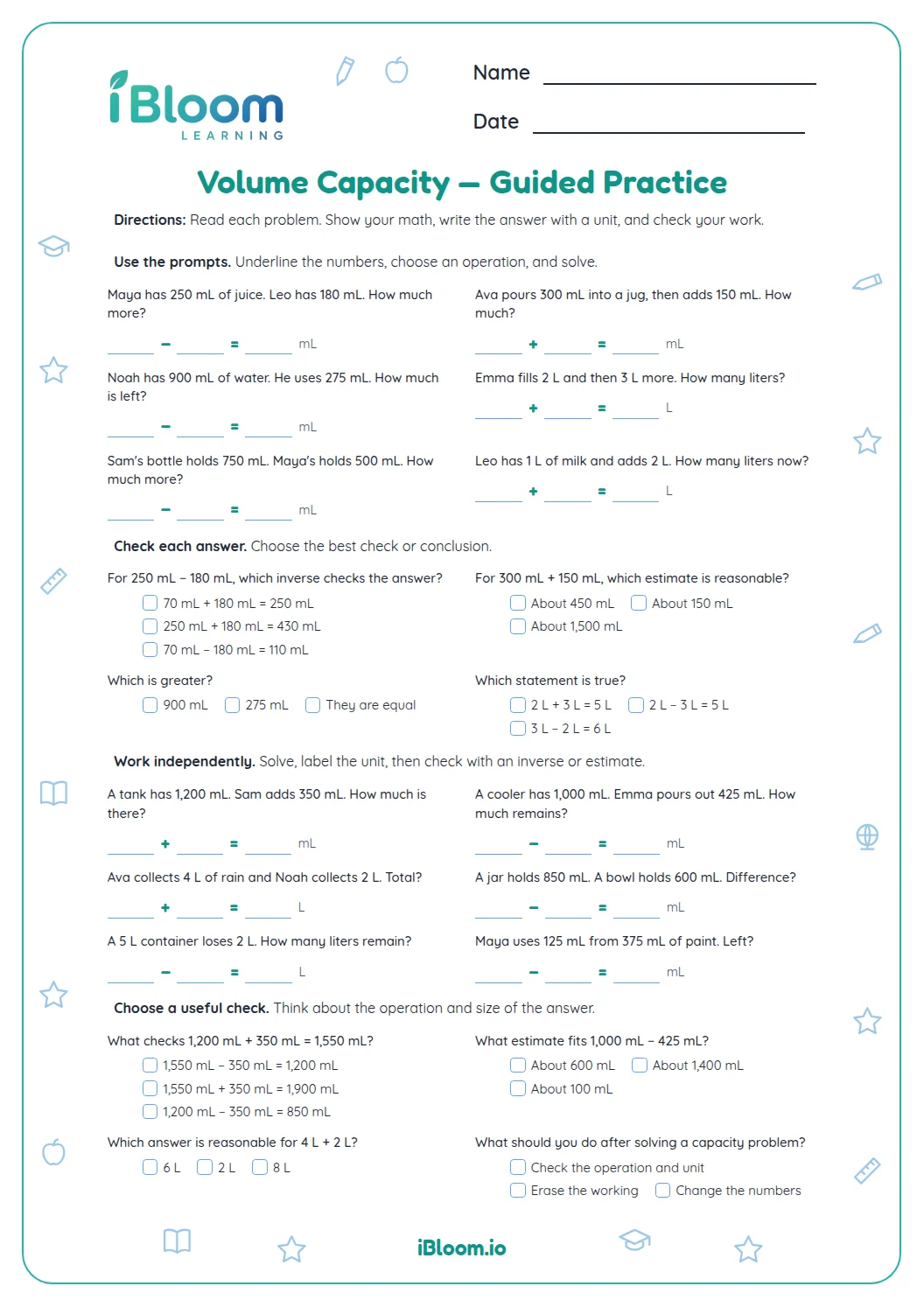
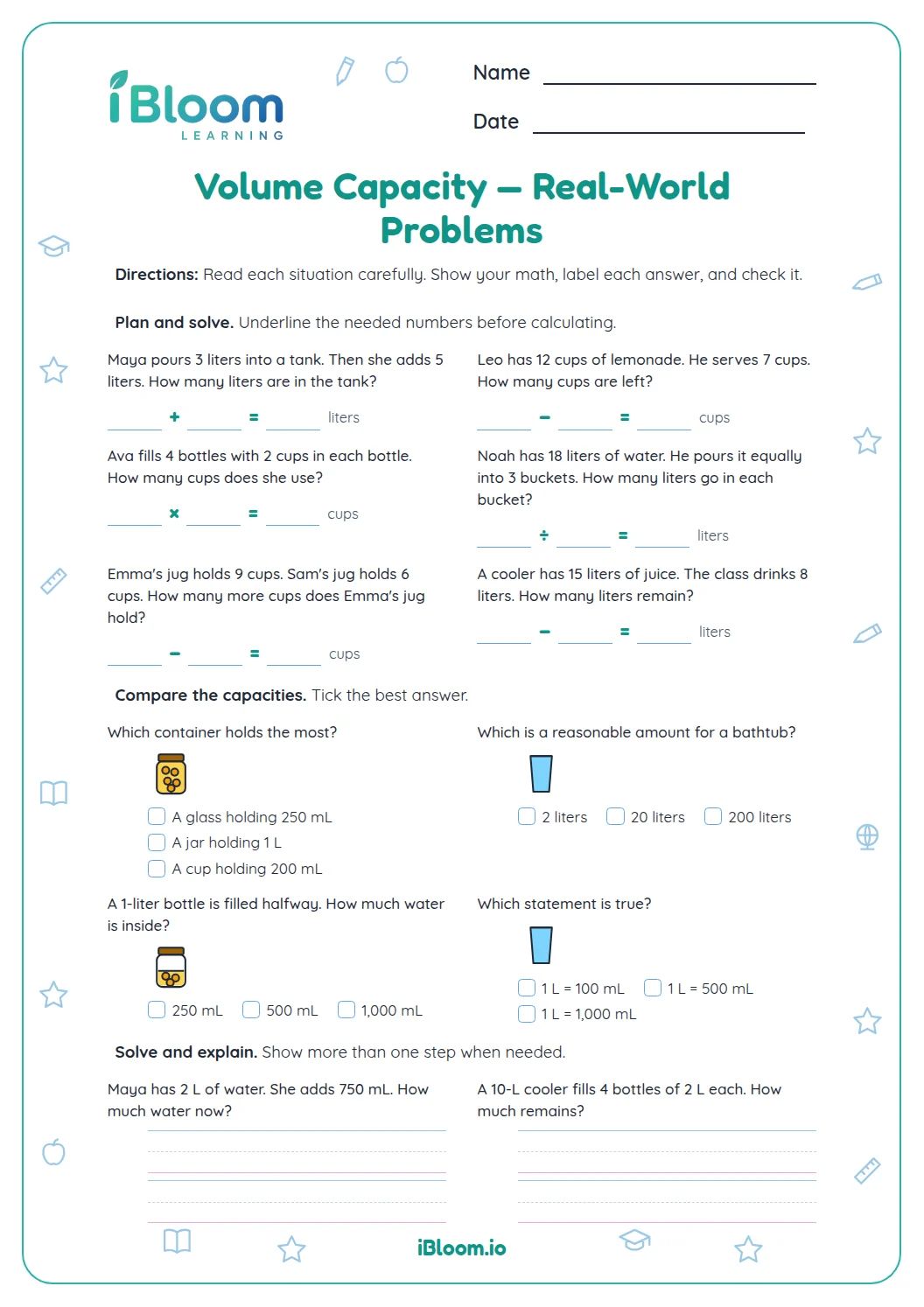
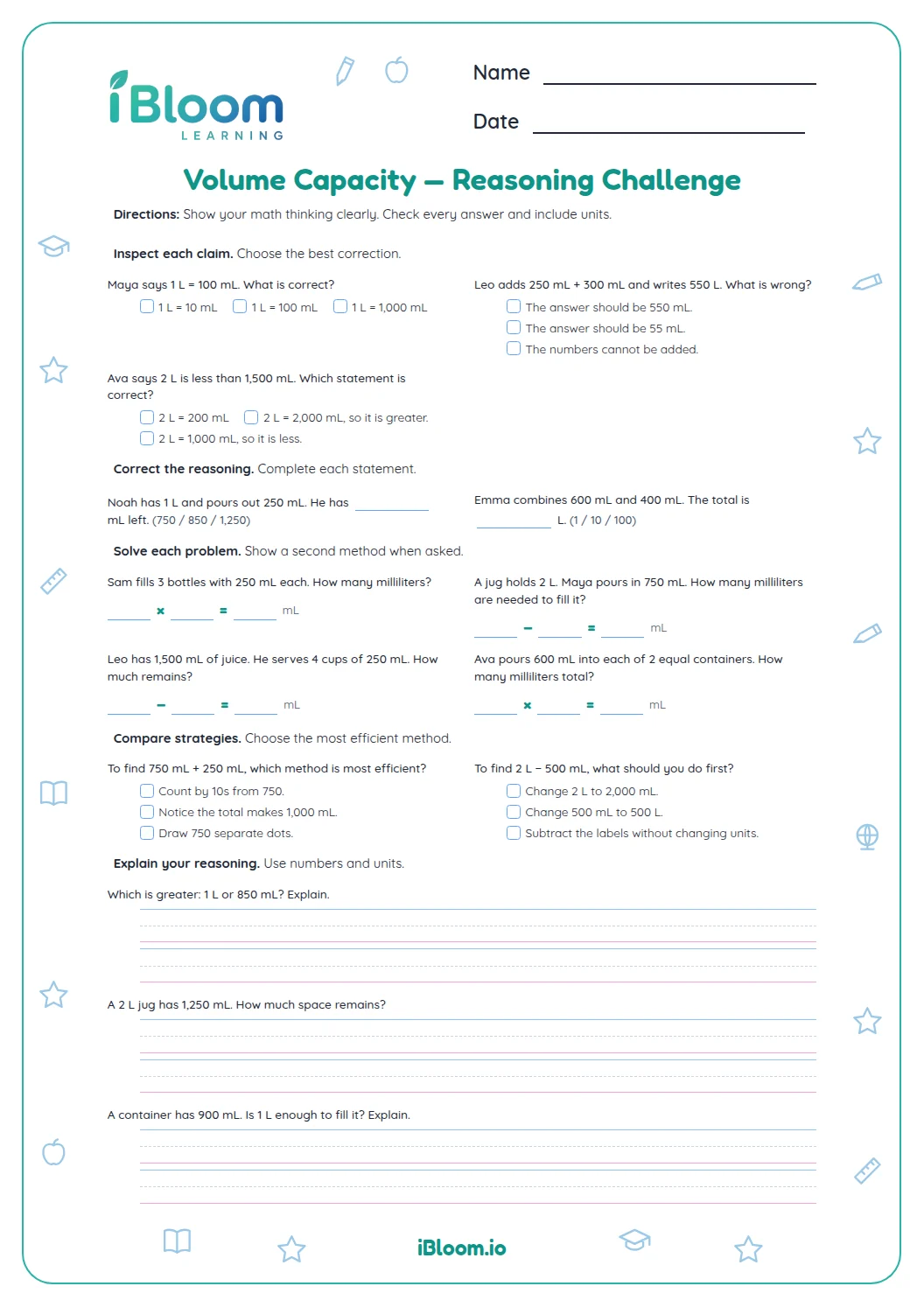
This Grade 3 worksheet combines fraction-bar models with short capacity stories. The first six questions use shaded bars to find equal shares or a fractional amount; the remaining questions apply the same ideas to milliliter situations. All arithmetic stays within 100 and uses milliliters throughout. A separate answer key gives each amount with its unit.
Aligned to 3.MD.A.2
How can a bar model show an equal share?
The full bar stands for the full capacity. When it is split into four equal parts, each part is one fourth of that amount. For a 48 mL bottle shared among four cups, find 48 ÷ 4.
- 148 mL split into 4 equal parts
- 248 ÷ 4 = 12
- 3Each cup gets 12 mL.
How do you find the shaded amount?
First find the amount in one equal part. Then multiply by the number of shaded parts. In a 80 mL bottle with three of four equal parts shaded, one part is 80 ÷ 4 = 20 mL, so the shaded amount is 20 × 3 = 60 mL.
What should you label in a capacity story?
Keep the unit in every calculation and answer. These questions use milliliters from start to finish, so the answer should also be labeled mL. Use the drawing to see whether the question asks for one part or several shaded parts.
How to use this worksheet
- 1Read whether the question asks for a share, a fractional amount, or a change in capacity.
- 2For a bar model, identify the whole and count its equal sections.
- 3For a story, choose the operation that matches what happened to the liquid.
- 4Calculate and check that the answer fits the stated capacity.
- 5Write the answer in milliliters (mL).
Mistakes to watch for
The mistake
Dividing by the number of shaded parts instead of all equal parts.
The fix
Use the full number of sections to find one part, then multiply by the shaded count.
The mistake
Giving the amount in one section when several are shaded.
The fix
After finding one section, count all shaded sections.
The mistake
Leaving off the unit.
The fix
Write mL after each capacity answer.
Common Core alignment
Students solve one-step volume problems using the same unit and read equal parts in a visual model.
Solve one-step volume problems using standard units and the same unit.
On this sheet: The stories use milliliters and one-step sharing or fractional-capacity reasoning.
Show the official wordingHide the official wording
Measure and estimate liquid volumes and masses of objects using standard units of grams (g), kilograms (kg), and liters (l). Add, subtract, multiply, or divide to solve one-step word problems involving masses or volumes that are given in the same units.
What to practice next
Make more practice
Further reading
Questions parents and teachers ask
Which unit appears in the problems?
Every capacity amount is in milliliters, abbreviated mL. Students keep that unit in their work and write it after the answer. The questions do not ask students to change between liters and milliliters. The answer key labels all results in mL.
What does the shaded bar represent?
The shaded bars in the first six items show a full capacity divided into equal sections. Each section is an equal share, and the shaded sections show the amount to find. The rest of the worksheet uses short capacity stories.
How do students solve a question with several shaded parts?
First divide the full capacity by the number of equal segments to find one part. Then multiply that amount by the number of shaded segments. For the 80 mL bottle with three of four parts shaded, each part is 20 mL and the shaded amount is 60 mL.
Are the questions all word problems?
The first six items use fraction-bar drawings. The remaining eight describe a capacity situation in words and ask students to find one amount. Every question uses milliliters and has a clear number answer. The drawings offer a second way to check each amount.
Does the worksheet include an answer key?
Yes. A separate answer key gives the milliliter answer for all 14 questions. Students can compare their number and unit, then revisit the model if their result is larger than the full capacity or does not fit the story.