


About this worksheet
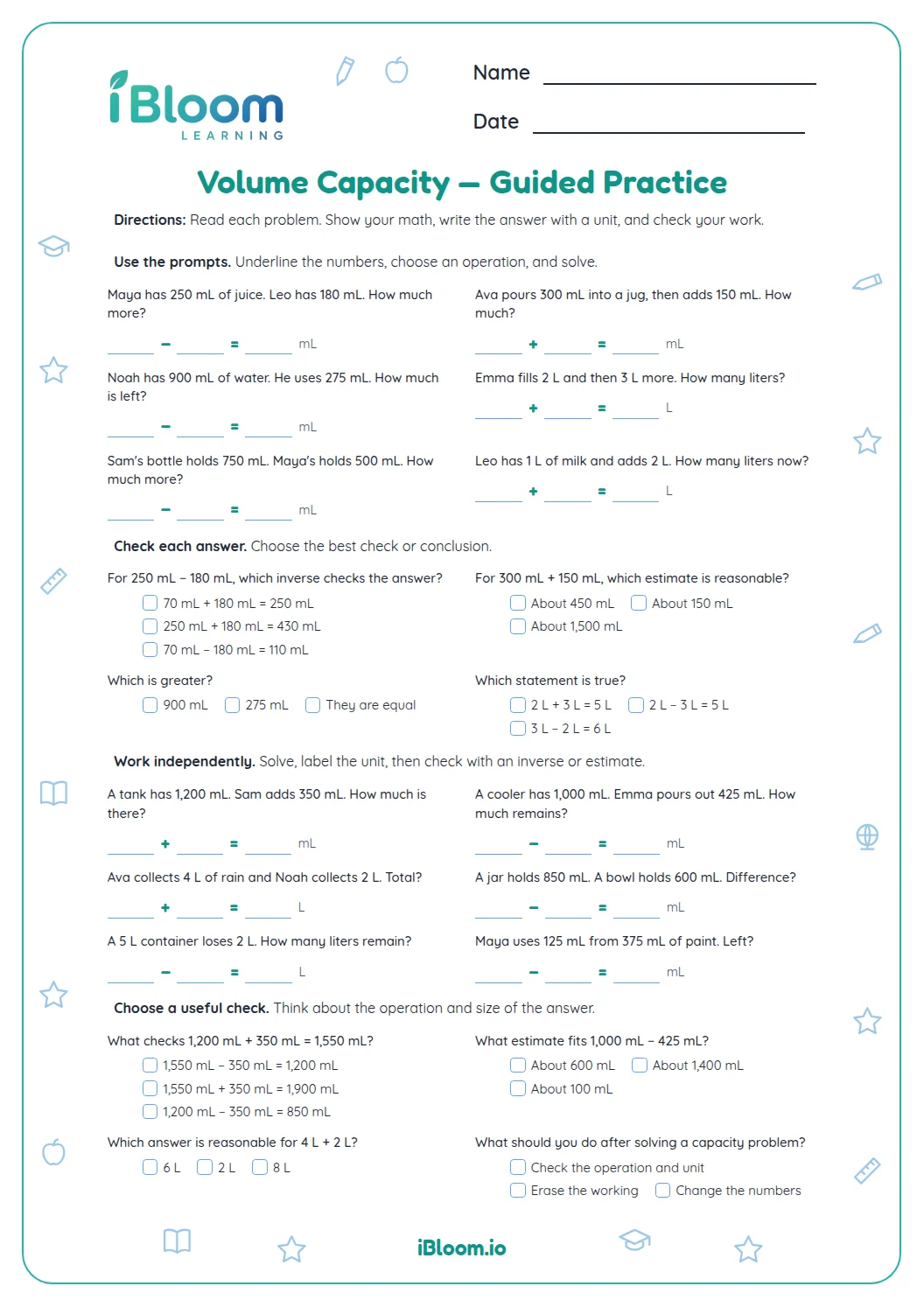
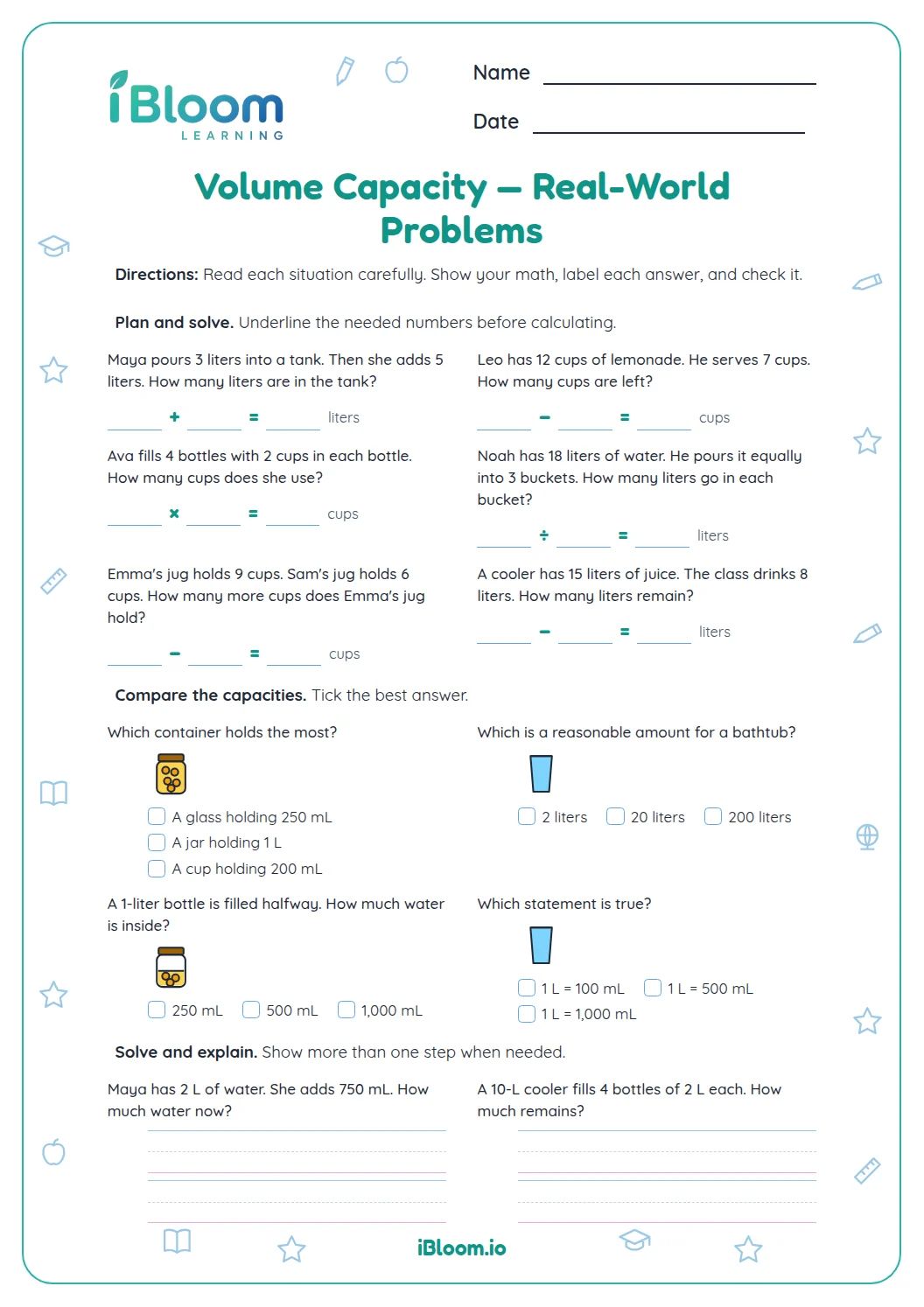
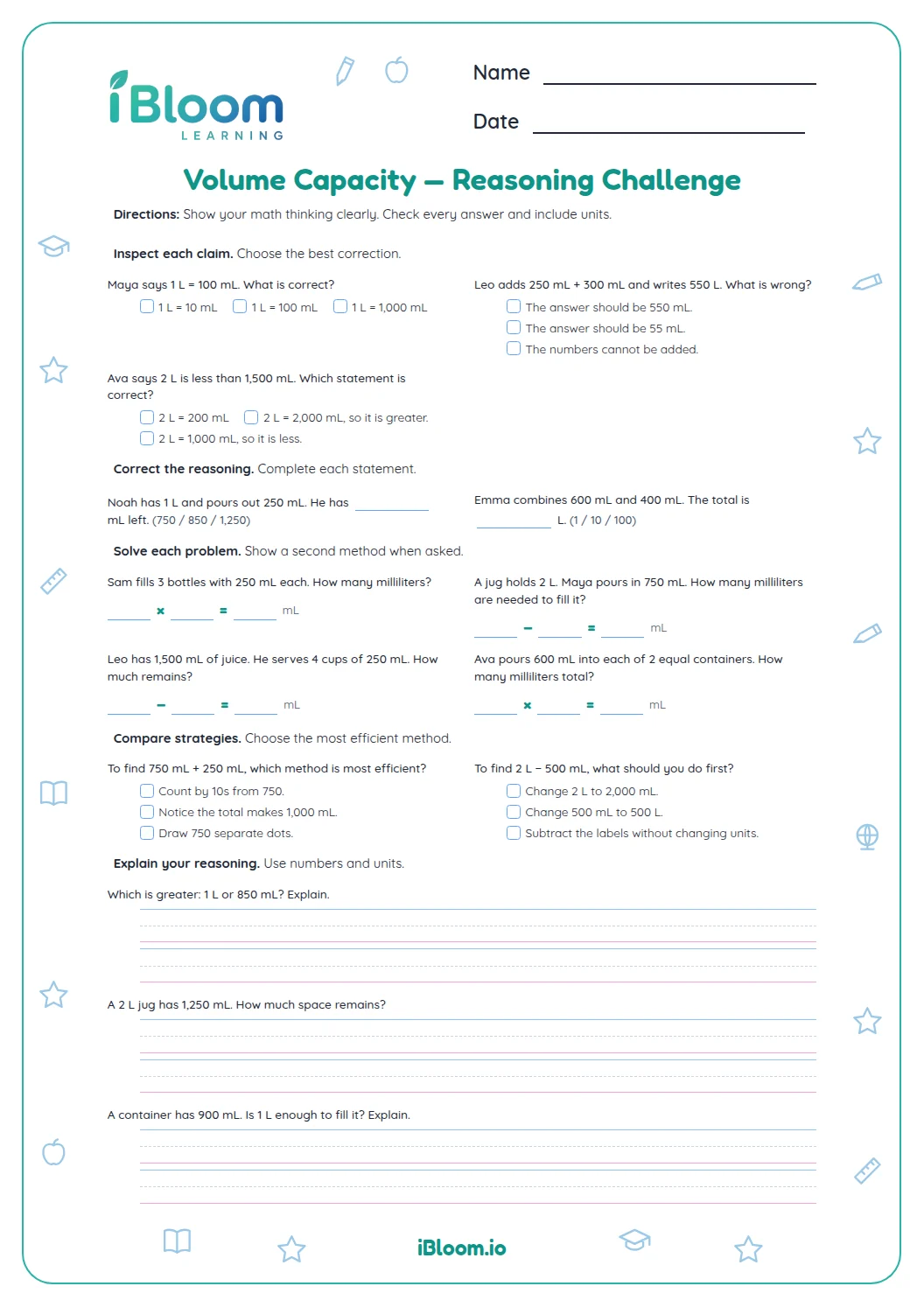
This Grade 3 math worksheet builds a foundation for volume and capacity problems aligned with CCSS 3.MD.A.2. Sixteen questions connect capacity with liters and milliliters, practice the 1 L = 1,000 mL relationship, and use addition, subtraction, multiplication, and division in volume situations. The separate answer key gives each missing number, unit, or story answer.
Aligned to 3.MD.A.2
What does capacity tell us?
Part A connects capacity with the amount a container can hold and distinguishes liters from milliliters. A large pitcher is measured in liters; a small juice box is measured in milliliters.
Question 3 uses the equivalence 1 L = 1,000 mL, which helps compare or calculate amounts in different metric units.
How do you compare two amounts?
Part B compares 700 mL and 500 mL. Both amounts use milliliters, so compare the numbers directly: 700 mL is greater than 500 mL.
How do you calculate with liters and milliliters?
Part C practices conversions and calculations with matching units. For question 5, add 300 mL and 200 mL to get 500 mL.
Convert liters to milliliters by multiplying by 1,000: 2 L = 2,000 mL. Convert 1,000 mL to 1 L.
How do you solve a capacity story?
Part D uses short liquid-volume situations. Join amounts with addition, find what remains with subtraction, multiply for equal groups, and divide when a total is shared equally.
Question 16 shares 24 L equally among 4 cans: 24 ÷ 4 = 6 L for each can.
How to use this worksheet
- 1Underline the amount and unit in the problem.
- 2Convert liters and milliliters first when the units need to match.
- 3Ask whether the amount is combined, removed, repeated in equal groups, or shared.
- 4Write the operation, calculate, and include the unit.
- 5Check whether the answer should be greater or less than the starting amount.
Mistakes to watch for
The mistake
Subtracting because the story has two numbers.
The fix
Use the action: “adds” means combine, while “pours out” means remove.
The mistake
Multiplying when a total is shared equally.
The fix
If a total is split into equal groups and you need each group, divide.
The mistake
Adding liters directly to milliliters without converting.
The fix
Rename liters in milliliters first: 1 L = 1,000 mL.
Curriculum alignment
The questions give children a chance to use this idea in short, concrete examples.
Measure liquid volume in liters and solve same-unit volume problems with the four operations.
On this sheet: Questions use liter and milliliter measures, unit conversions, and one-step volume problems with equal units.
Show the official wordingHide the official wording
Measure and estimate liquid volumes and masses of objects using standard units of grams (g), kilograms (kg), and liters (l). Add, subtract, multiply, or divide to solve one-step word problems involving masses or volumes that are given in the same units, e.g., by using drawings (such as a beaker with a measurement scale) to represent the problem.
What to practice next
Make more practice
Further reading
Questions parents and teachers ask
What does capacity mean here?
Capacity is how much liquid a container can hold. Liters suit larger amounts, while milliliters suit smaller amounts. This worksheet uses pitchers, juice boxes, jugs, bottles, and bowls, and connects the units with 1 L = 1,000 mL.
Which operations are practiced?
Students add and subtract amounts, multiply for equal groups, and divide when a total is shared equally. The sheet also practices converting liters and milliliters so amounts use the same unit before calculating. Each story keeps the unit visible in the prompt or answer.
How many questions are on the worksheet?
There are 16 questions in four parts: capacity and units, comparison, conversions and calculations, and volume stories. Students practice liters and milliliters, then use the four operations in short situations. The separate key gives each missing number or word and the relevant unit.
How do students choose multiplication or division?
Multiply when the number of equal groups and the amount in each group are known, but the total is missing. Divide when the total and number of groups are known, but each group’s amount is missing. Question 16 shares 24 liters equally among four cans, so each can gets 6 L.
Should children write the unit in every answer?
Yes. Liter amounts should keep the L unit in the completed sentence, such as 12 L. The worksheet prints L beside many blanks to make the unit visible, and the answer key repeats the unit where it belongs. Use the unit L to make the measurement clear.