

About this worksheet
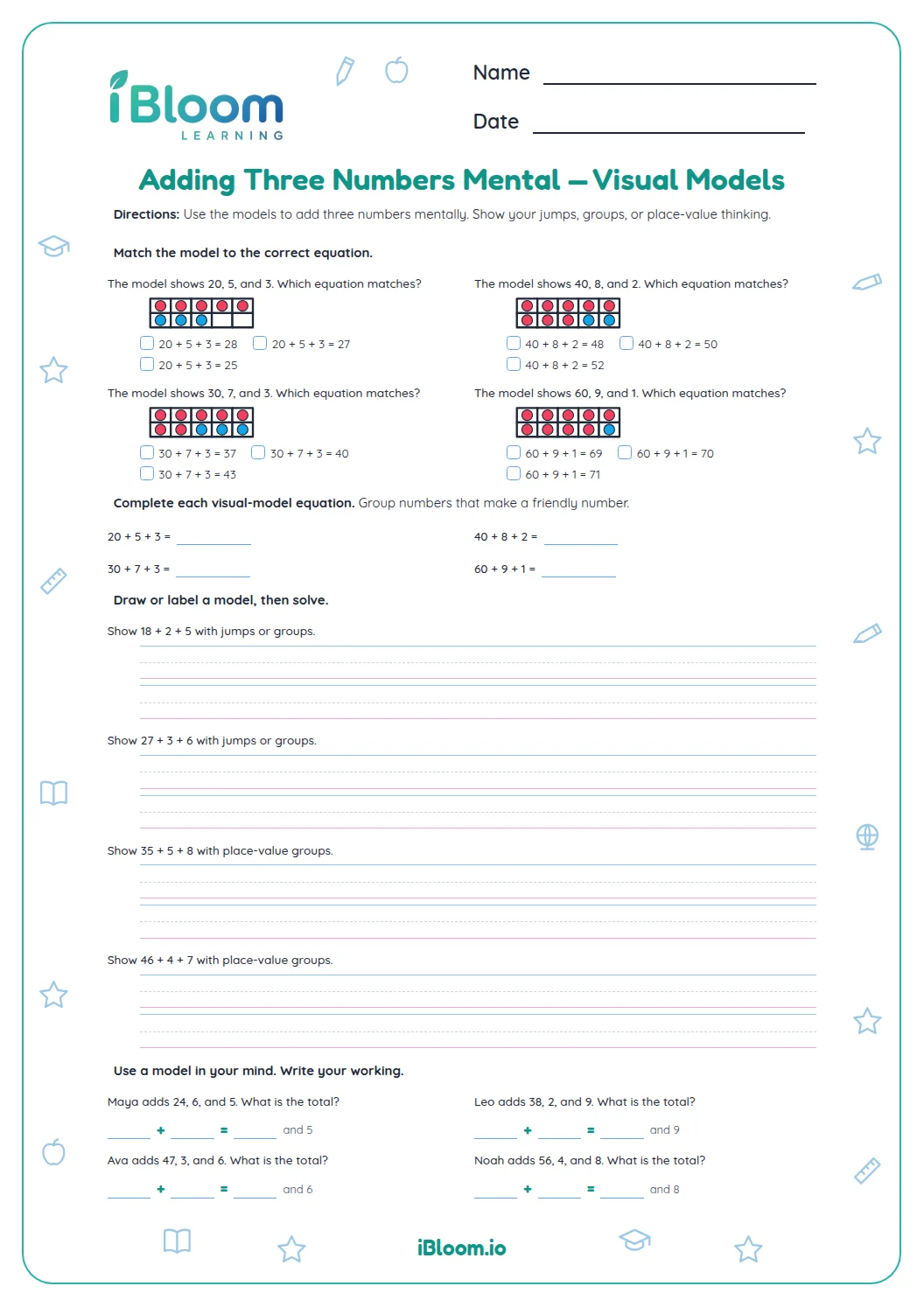
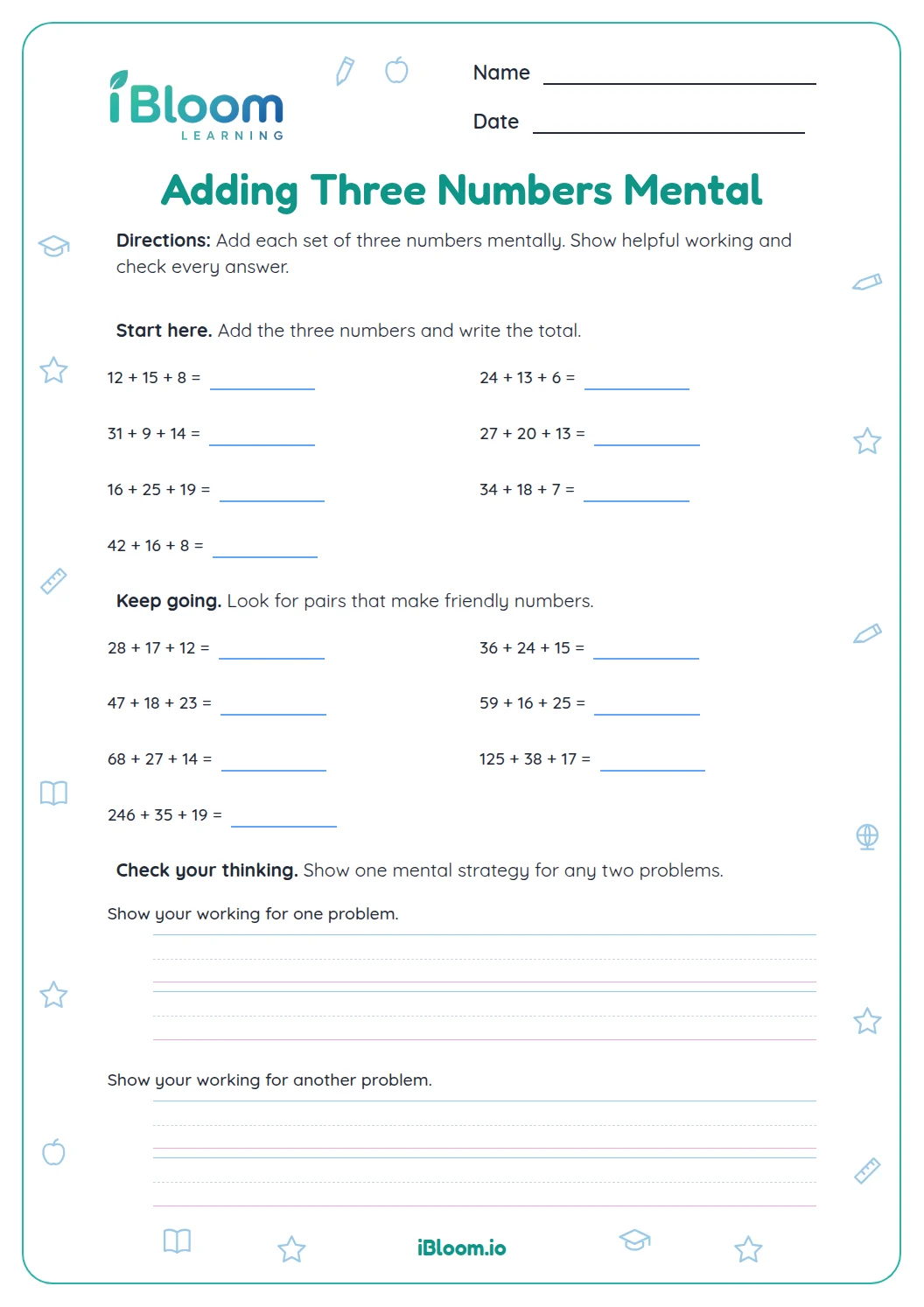
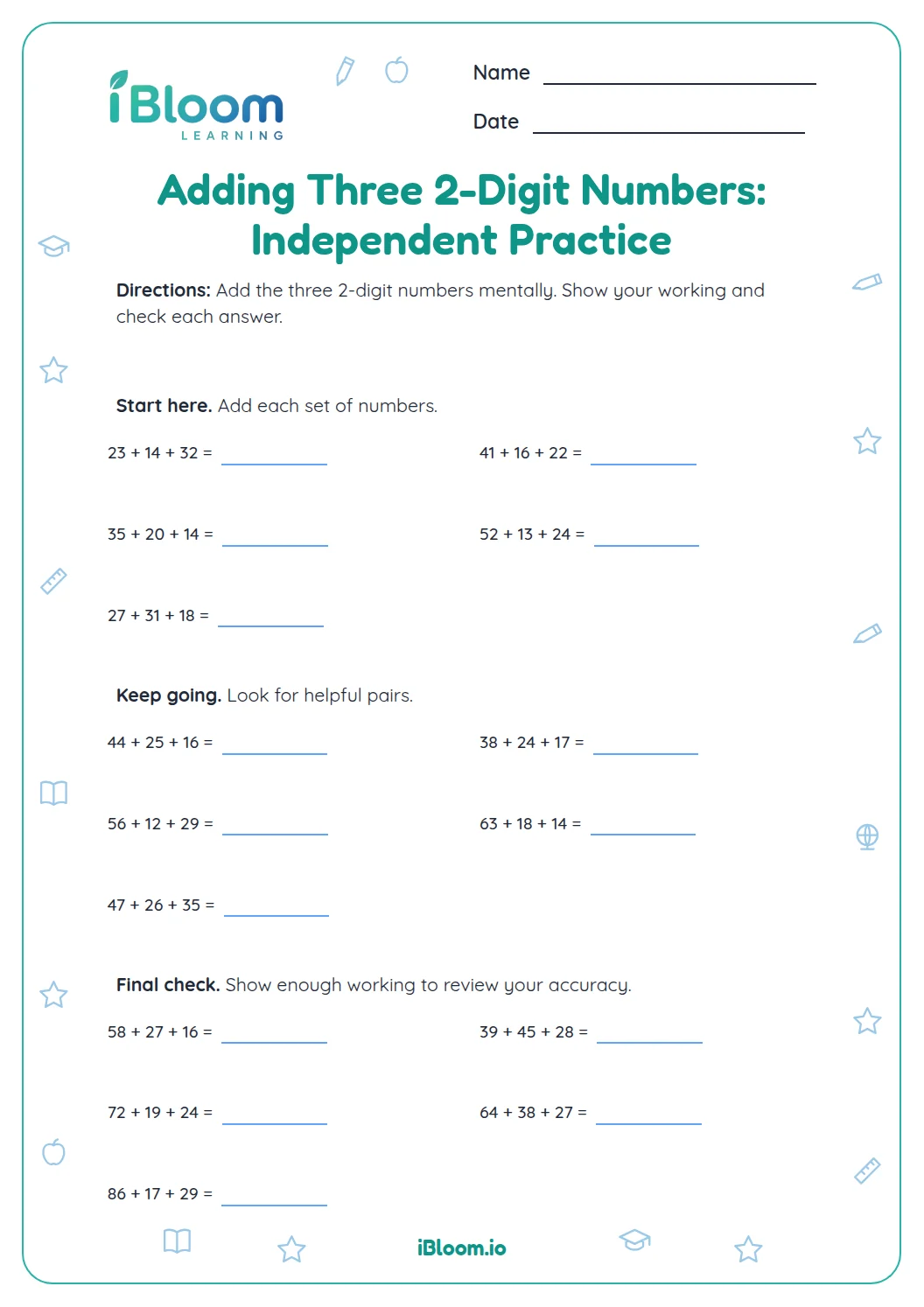
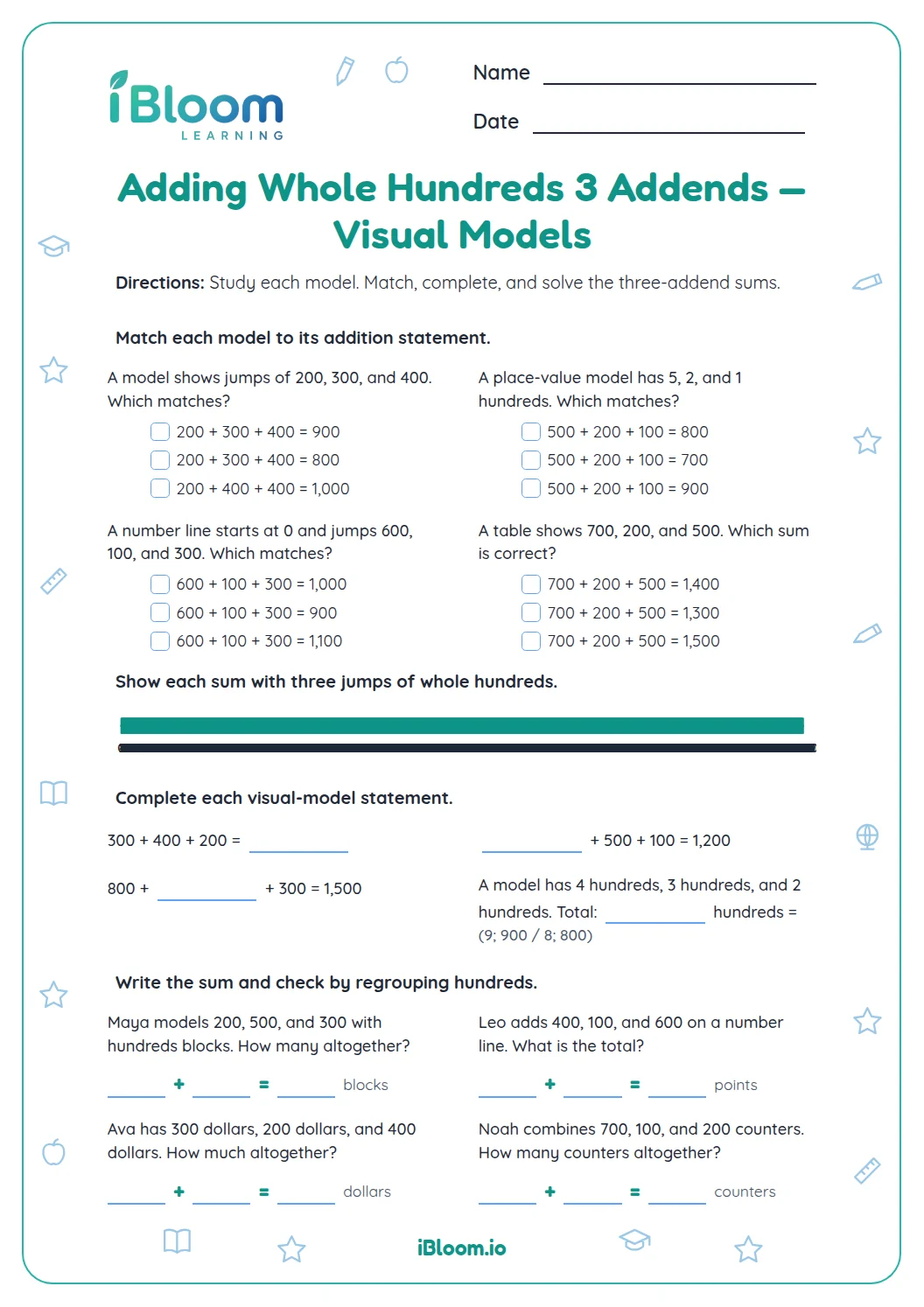
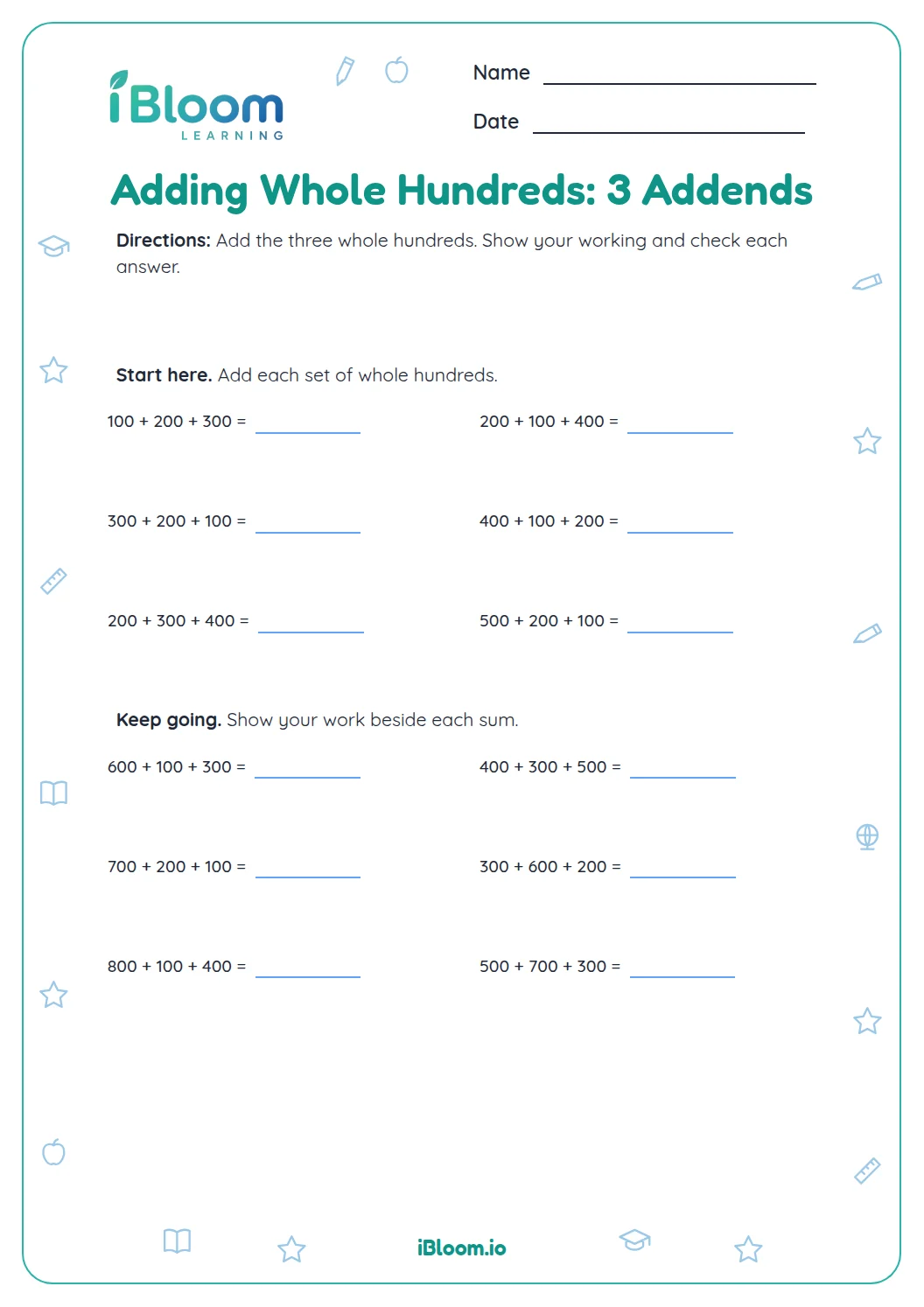
This free printable worksheet helps Grade 4 students add three numbers mentally by choosing a useful pair first. Four multiple-choice questions isolate that decision. Six sums then use a hint to pair numbers that make a whole hundred. Four independent sums and two written explanations let students choose their own order and describe it. Every total is within 1,000. The practice applies Common Core 3.NBT.A.2 through place value and properties of addition. A separate answer key gives the four helpful pairs, ten totals and two model explanations.
Aligned to 3.NBT.A.2
What makes a pair helpful for mental addition?
A useful pair makes a number that is easy to remember and add to. In Part A, students choose two numbers that make 100. For 48 + 35 + 52, the useful pair is 48 + 52, even though those addends are separated.
Finding the pair before calculating the whole sum gives students one decision at a time. They still need to carry the unused addend forward when they solve a full sum.
How do the hints guide students through a sum?
Part B tells students to pair the first and last addends. These pairs make whole hundreds, so the last mental step is short. Question 5 uses 225 and 75 to make 300, leaving 60 to add.
Part C removes the fixed pairing hint for four sums. The useful pair may be first and last, first and second, or second and third. Part D asks students to write their mental steps for two more sums, naming both the helpful pair and the final total.
- 1225 + 60 + 75 = ___
- 2Pair 225 + 75 = 300.
- 3The unused addend is 60.
- 4300 + 60 = 360.
What should a student say while solving?
Ask for a short account of the mental steps: “I paired 225 and 75 to make 300. Then I added 60.” This makes it possible to hear whether all three addends were used.
If the total is wrong, return to the chosen pair. Check that pair, then check the final addition. Recording one intermediate total on scrap paper can help a student who loses track of the numbers.
Guide a mental addition session
- 1Read the Part A direction and model looking across all three addends.
- 2Have students select the four pairs that make 100.
- 3Read the Part B example: 125 + 40 + 75 can become 200 + 40.
- 4Complete the six Part B sums, saying the pair and unused addend.
- 5Let students choose pairs for Part C and explain two sums in Part D, then check the key.
Mistakes to watch for
The mistake
Choosing 48 + 35 because those numbers appear first.
The fix
Inspect all three pairs. The 48 and 52 make 100, so they are the useful choice.
The mistake
Writing 300 as the total of 225 + 60 + 75.
The fix
300 accounts for two addends. Add the unused 60 to reach 360.
The mistake
Counting an addend twice after rearranging the sum.
The fix
Name the pair and then point to the single unused number before adding it.
Common Core alignment
Use place value and regroup addends to add mentally within 1,000.
On this sheet: Students rearrange and group three addends to form friendly totals, then add the remaining number.
Show the official wordingHide the official wording
Fluently add and subtract within 1000 using strategies and algorithms based on place value, properties of operations, and/or the relationship between addition and subtraction.
What to practice next
Make more practice
Further reading
Questions parents and teachers ask
Why does Part A ask for a pair instead of a total?
Part A focuses on choosing a useful starting point. Each of its four questions has one pair that makes 100. Students practice looking at all three numbers before adding. Parts B and C then use that same decision to calculate complete sums with three addends.
Can students add the numbers in a different order?
Yes. Any order is acceptable if every addend is used exactly once and the total is correct. The hints suggest pairs that make whole hundreds, which keep the mental steps short. Ask students to name their pair and the remaining addend so you can follow their thinking.
What is the guided example for Part B?
The direction uses 125 + 40 + 75 as a model: pair 125 and 75 to make 200, then add 40. Question 5 applies the same idea to 225 + 60 + 75. Pairing 225 and 75 makes 300, and the final total is 360.
May my child write an intermediate total?
Yes. A student can jot down the paired total on scrap paper and then add the last number. Keep the focus on selecting useful numbers and explaining the mental steps. The printed blanks hold final totals, while the four Part A items use answer bubbles.
What does the answer key include?
The answer key identifies the four pairs in Part A, gives ten totals for Parts B and C, and supplies two model explanations for Part D. Students may use different pairs if their steps are correct. Check that each explanation includes all three addends exactly once.