

About this worksheet
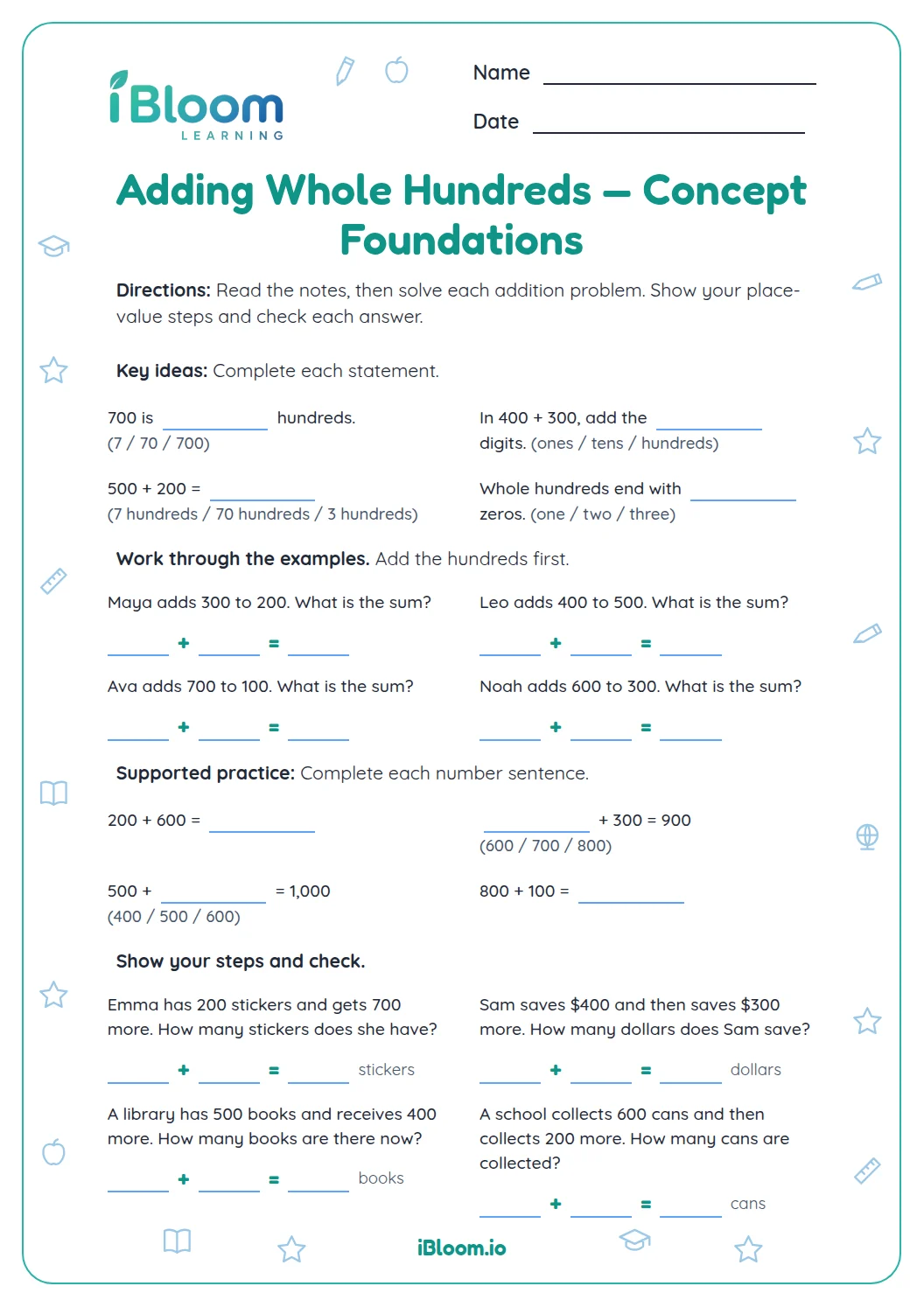
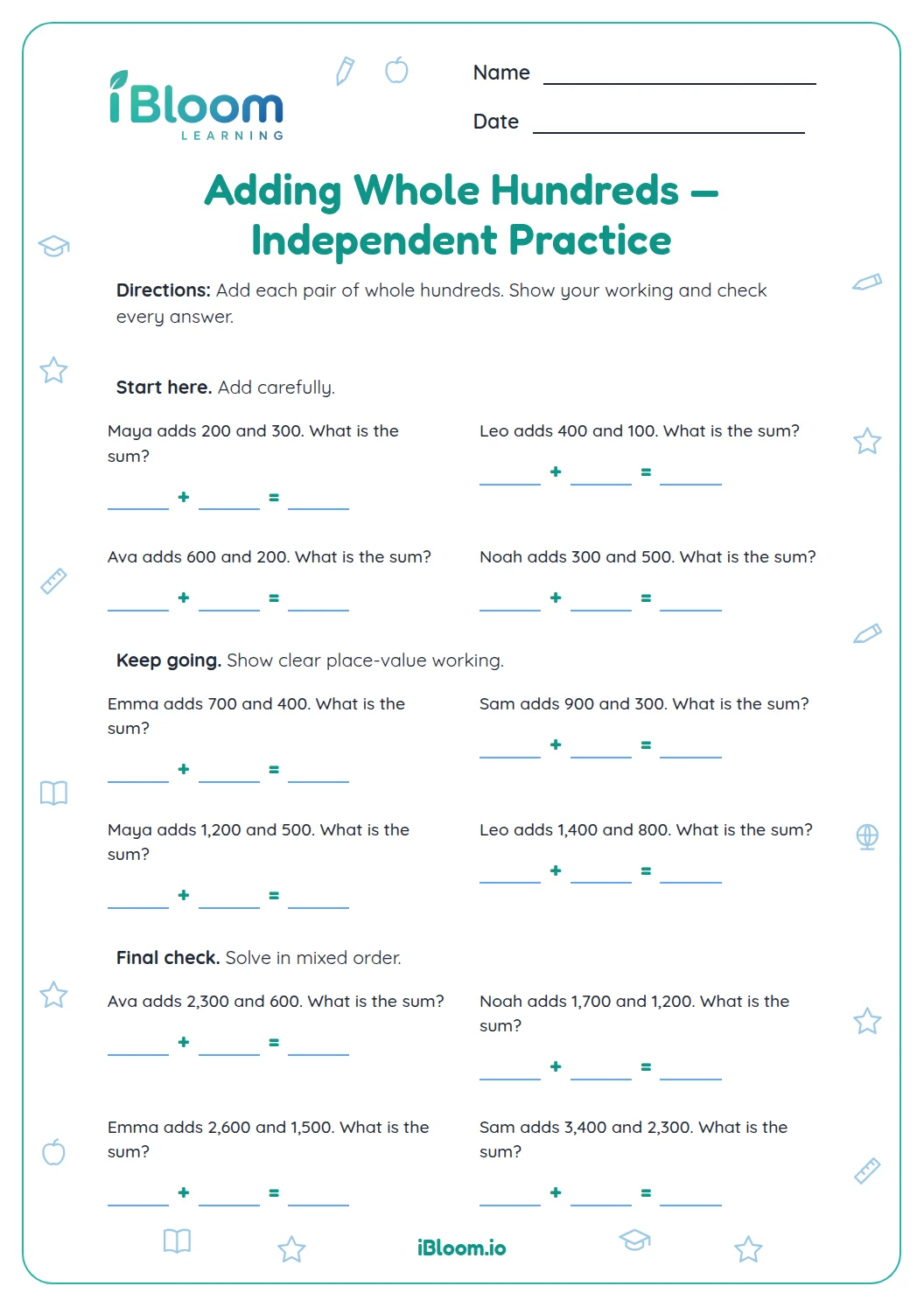
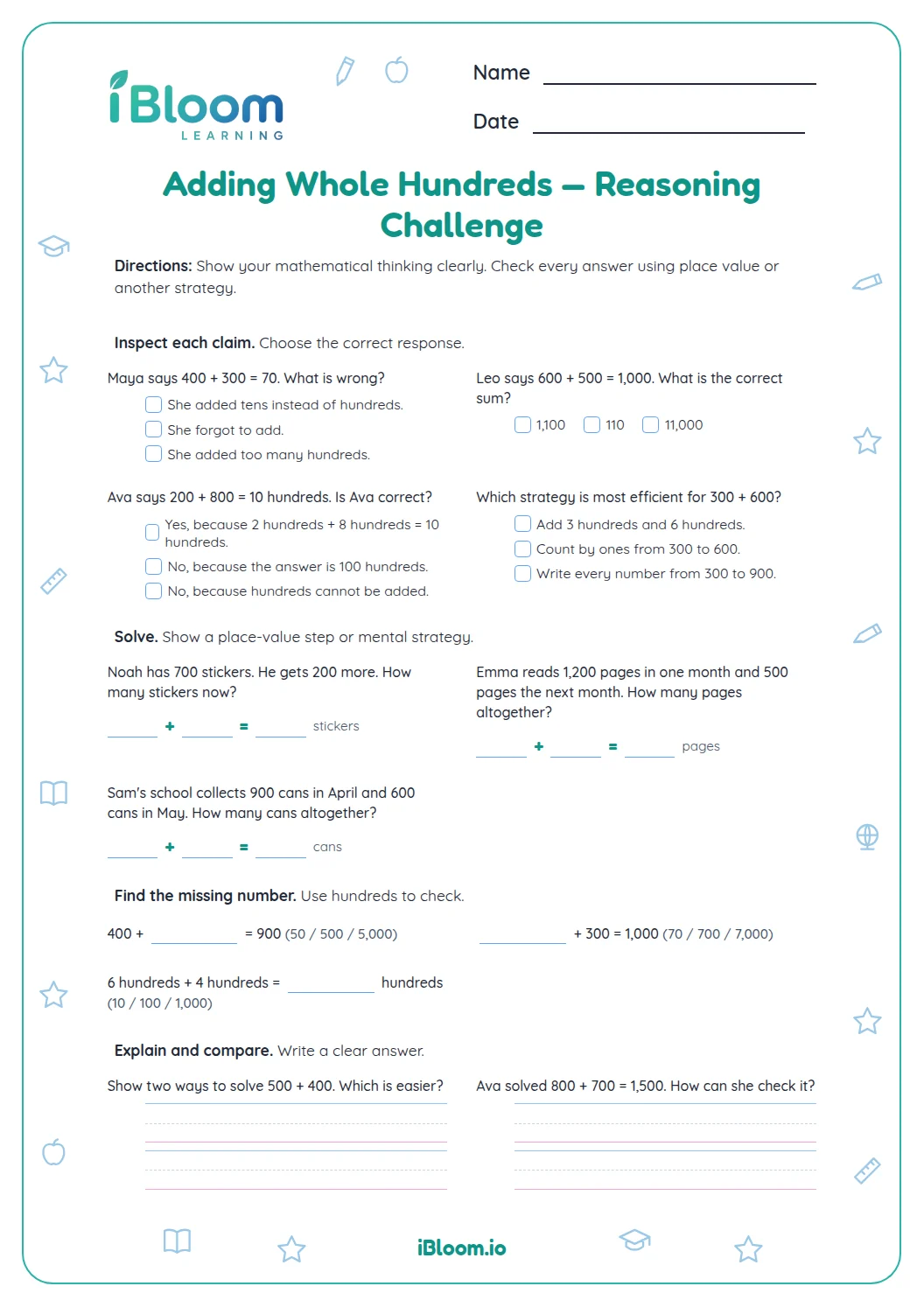
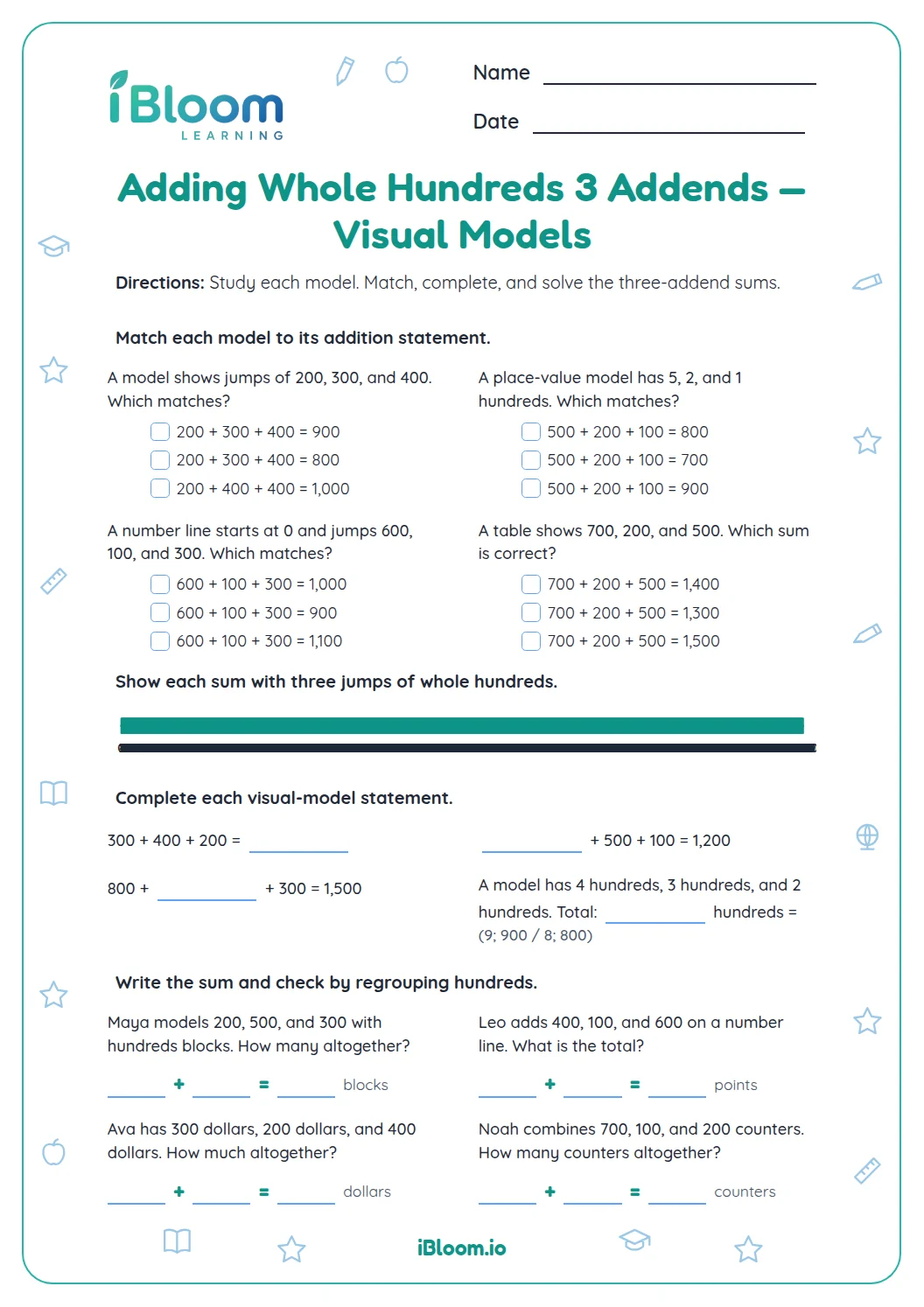
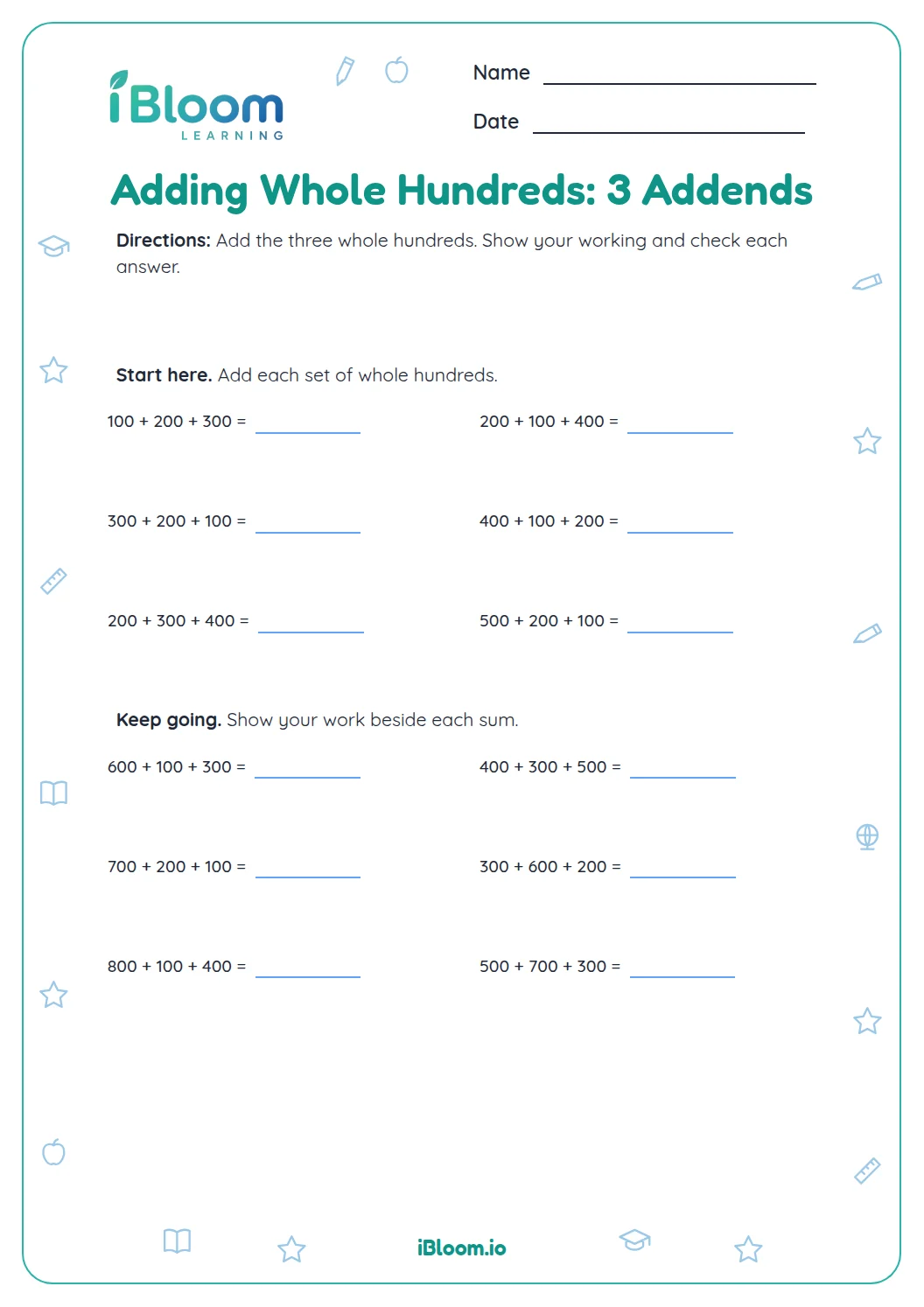
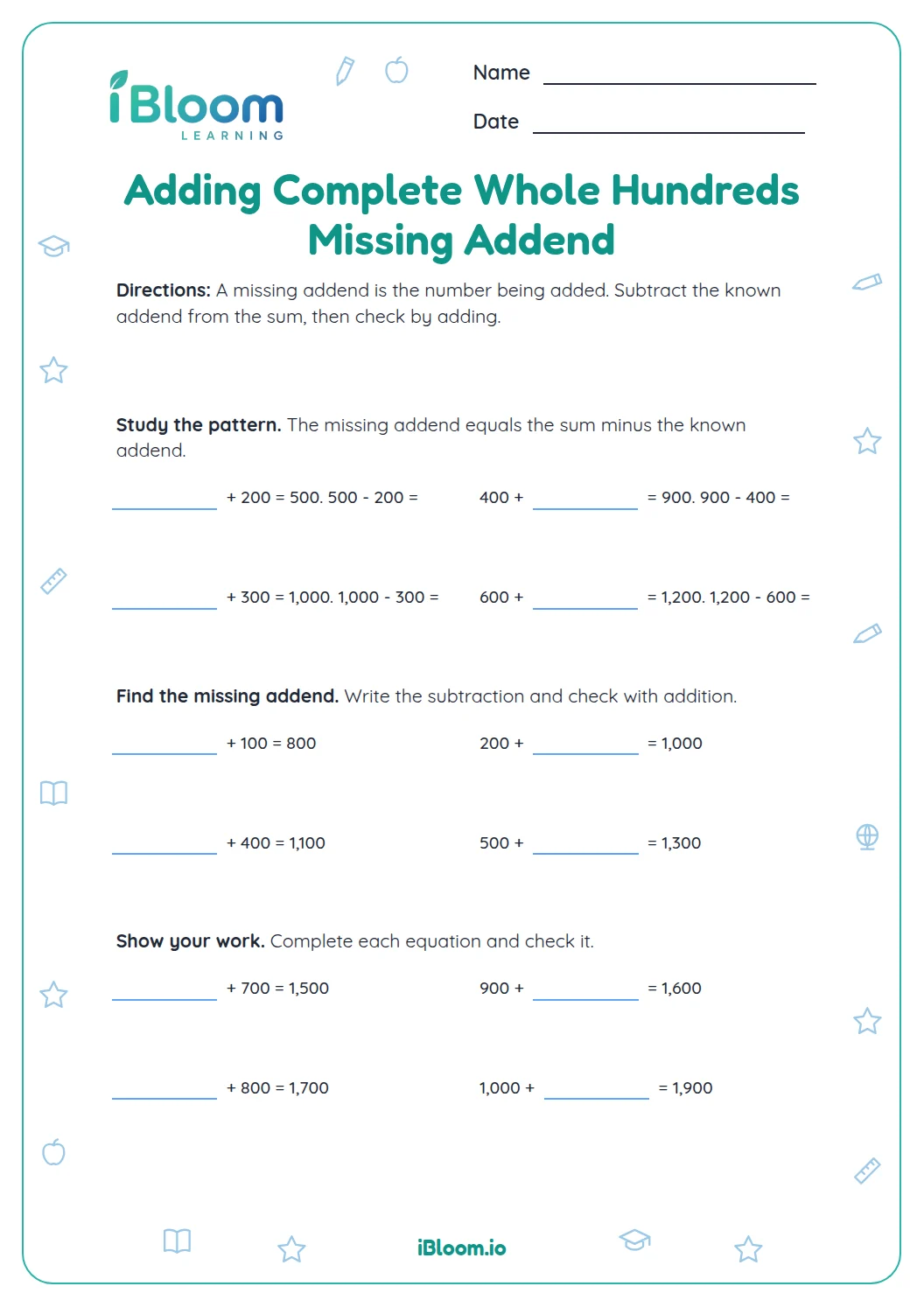
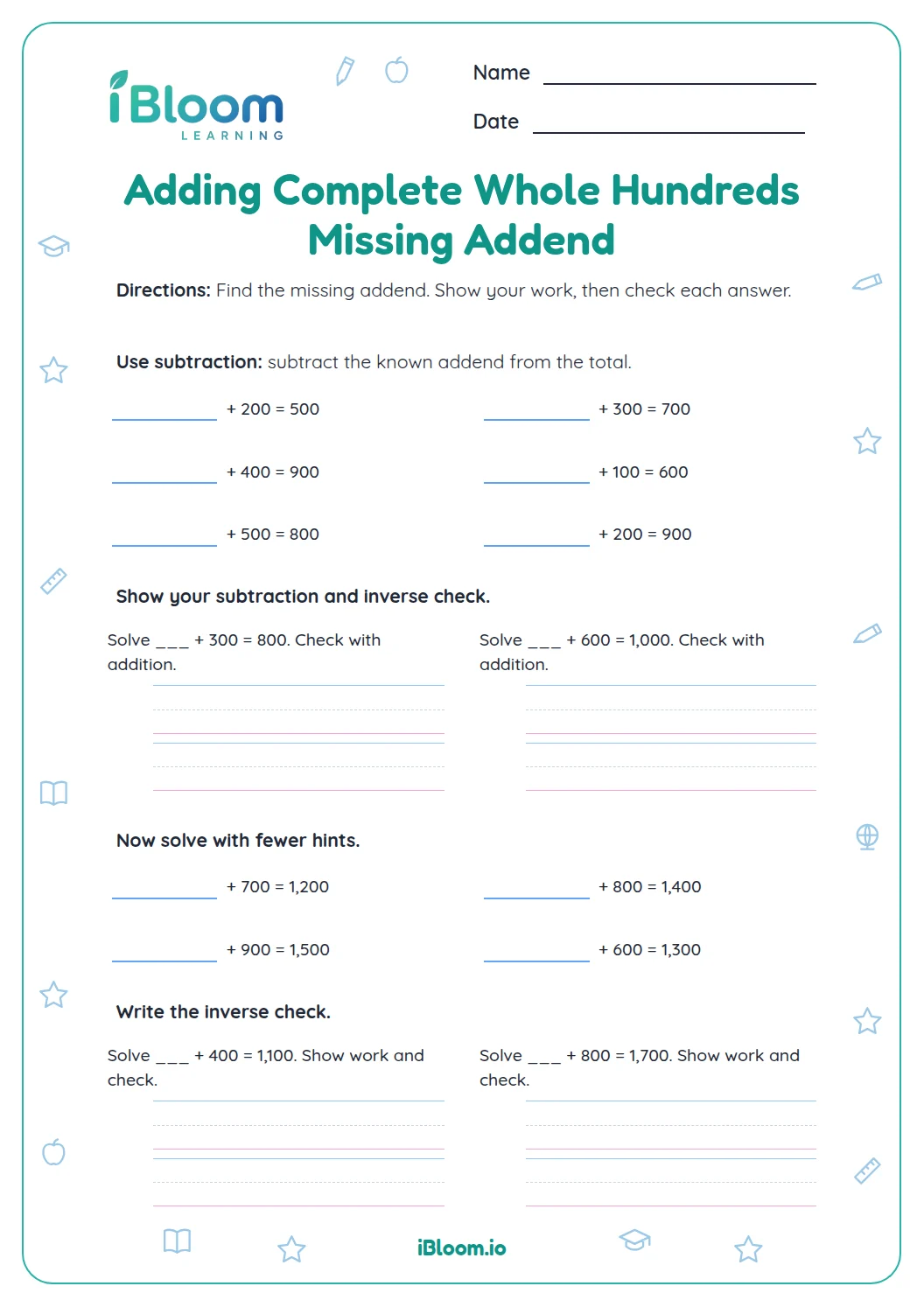
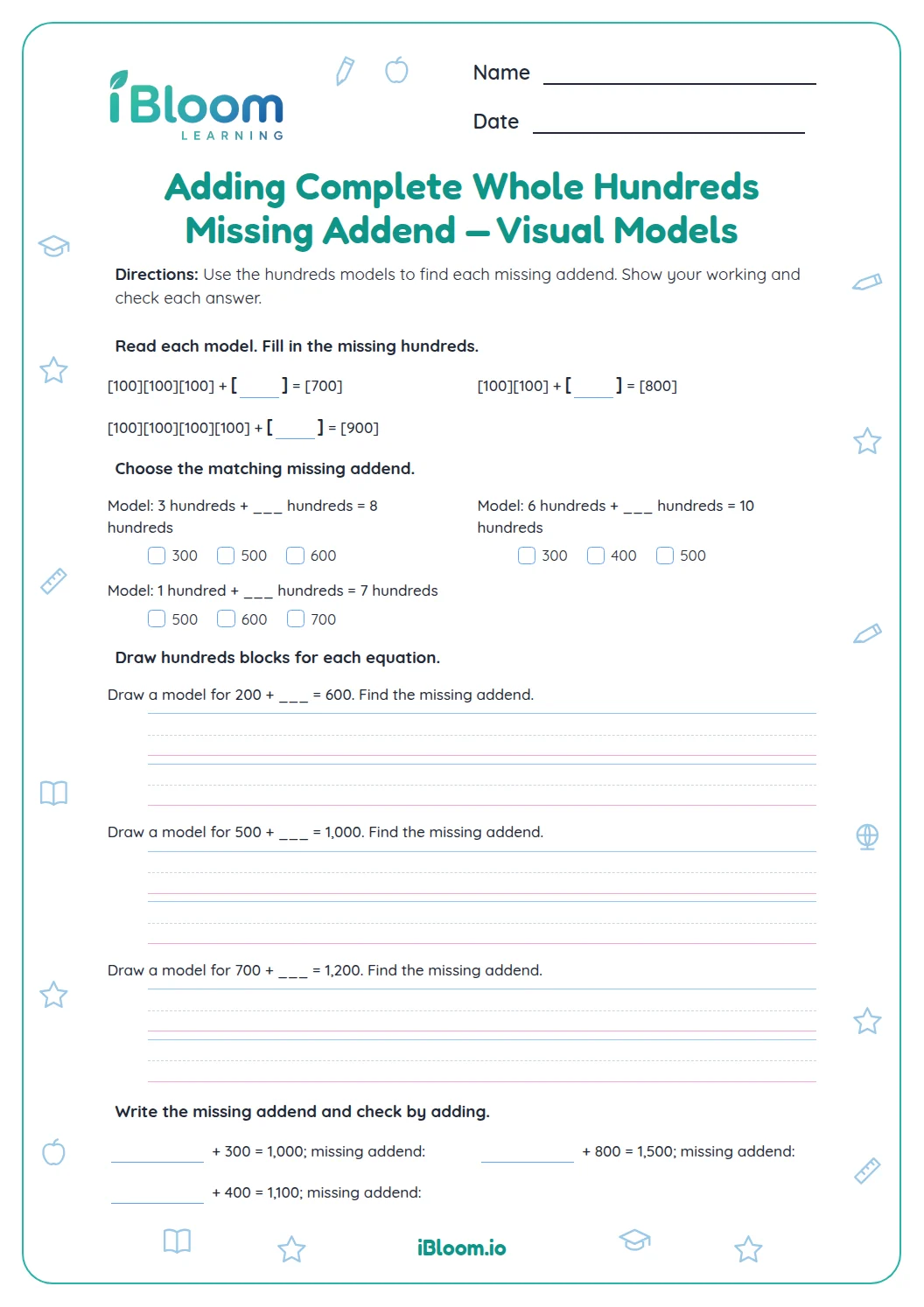
This free Grade 4 printable has 14 real-world problems using whole hundreds. Students write addition equations for amounts from settings such as a library, stadium, park and food bank, then label each total. Part A combines two amounts; Part B combines three or more amounts and includes an intermediate total. The practice supports Common Core 4.NBT.B.4 and 4.OA.A.3. A separate answer key shows the equations and totals.
Aligned to 4.NBT.B.4 and 4.OA.A.3
How do students turn a story into an addition equation?
First identify the amounts that belong in one total. Write an addition equation, keeping each place value in order, and label the answer with the story unit. Part A gives two amounts; Part B combines three or more or includes a second step.
Question 13 is a two-step example. August had 2,900 + 1,600 = 4,500 visitors. Add that to June and July: 3,800 + 2,900 + 4,500 = 11,200 visitors.
- 1Question 13: Find August first: 2,900 + 1,600 = 4,500.
- 2Then add all three months: 3,800 + 2,900 + 4,500.
- 3The total is 11,200 visitors.
What should students check when adding whole hundreds?
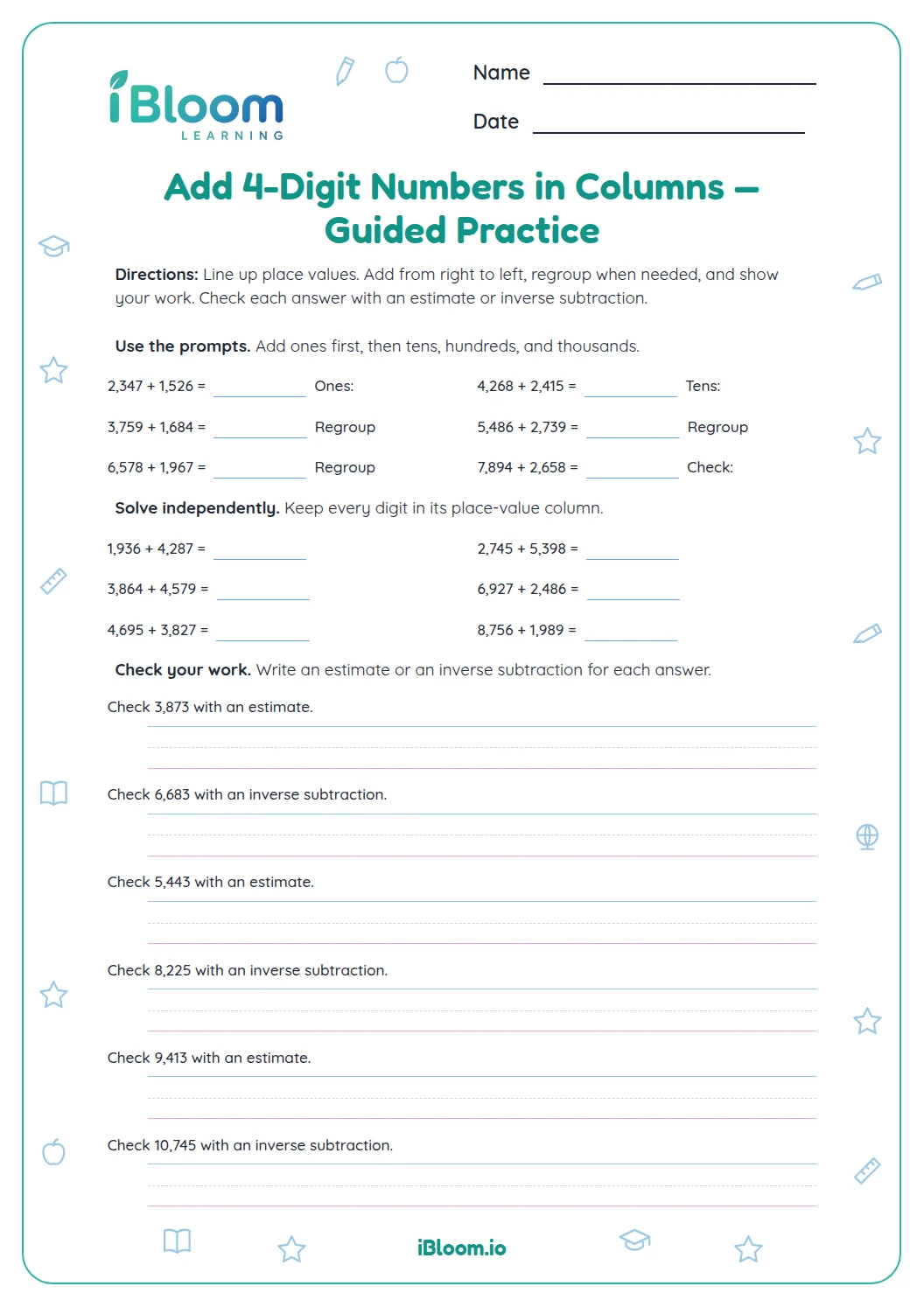
Keep each amount aligned by place value. When adding hundreds, remember that ten hundreds make one thousand; a total can have a new digit in the thousands place. Estimate first when helpful, then compare the exact sum with the choices.
Read the unit in the story before choosing, such as books, tickets or visitors. For the museum story, the sum is 11,200 visitors.
How can students keep a multi-step problem organized?
Solve a needed intermediate amount first and label it. Then use that result in the final sum. In question 13, find August’s visitors before adding June, July and August.
How to use this worksheet
- 1Read the story and identify every amount that belongs in the total.
- 2For a two-amount story, add the amounts before checking the choices.
- 3In Part B, find a needed intermediate total first.
- 4Keep hundreds and thousands in their place-value positions.
- 5Estimate, solve, and choose the answer with the correct unit.
Common mistakes and quick fixes
The mistake
Leaving out an amount in a three-part story.
The fix
Underline each amount and check that every one appears in the equation.
The mistake
Treating hundreds digits as ones.
The fix
Keep digits in their place-value columns and read the total with its full value.
The mistake
Giving a number without the story unit.
The fix
Write books, pounds, visitors or another unit with the final total.
Common Core alignment
The stories use addition with whole-number amounts and ask students to represent the situation with equations.
Add multi-digit whole-number amounts in everyday situations.
On this sheet: Every problem requires adding whole hundreds, with totals that may include thousands.
Show the official wordingHide the official wording
Fluently add and subtract multi-digit whole numbers using the standard algorithm.
Represent multi-step stories with equations and check that totals make sense.
On this sheet: Part B combines amounts from multiple steps and asks students to show an equation.
Show the official wordingHide the official wording
Solve multistep word problems posed with whole numbers and having whole-number answers using the four operations, including problems in which remainders must be interpreted. Represent these problems using equations with a letter standing for the unknown quantity. Assess the reasonableness of answers using mental computation and estimation strategies including rounding.
What to practice next
Make more practice
Further reading
Questions parents and teachers ask
How many addition problems are included?
There are 14 real-world problems. The first eight ask students to add two amounts. The remaining six combine three or more amounts or require an intermediate total before the final addition. Settings include schools, farms, libraries and museums.
What does “whole hundreds” mean here?
Each amount is a multiple of 100, such as 1,600 or 3,700. Students add these whole-number amounts in familiar settings including a school, farm, library, stadium, museum and town collection. Every problem asks students to combine those amounts in context.
Does the worksheet include multi-step addition?
Yes. Part B includes three-addend totals and stories that require finding one amount before combining all totals. Question 13 asks students to find August’s visitors, then add June, July and August. They can compare their total with the choices.
Should students show their equations?
Yes. The directions ask students to show their addition and label each answer. Question 13 is a useful example: find August’s total first, then combine June, July and August. The answer key shows the intermediate amount and final total.
What is a common place-value error?
A student may add the digits 3 and 8 in 3,800 + 2,900 but forget that they represent hundreds. Keep the numbers aligned by place value and read the answer as 6,700, not 67. An estimate can help catch a total that is too small.
What does the answer key include?
The key lists the total for all 14 stories. For the multi-step museum problem, it also shows the intermediate amount, so students can see how the story quantities were combined. It includes the measurement or item unit from each story.