



About this worksheet
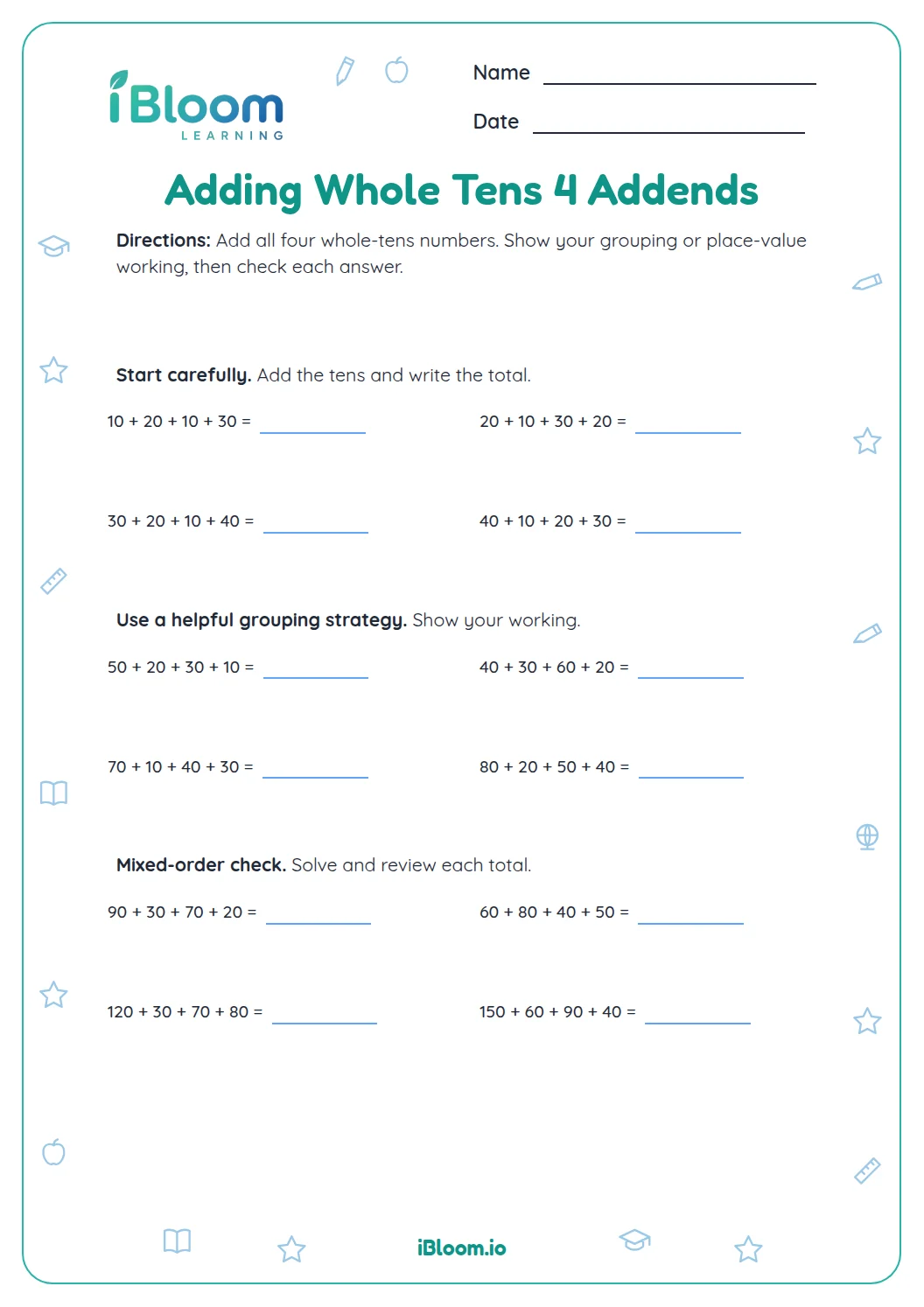
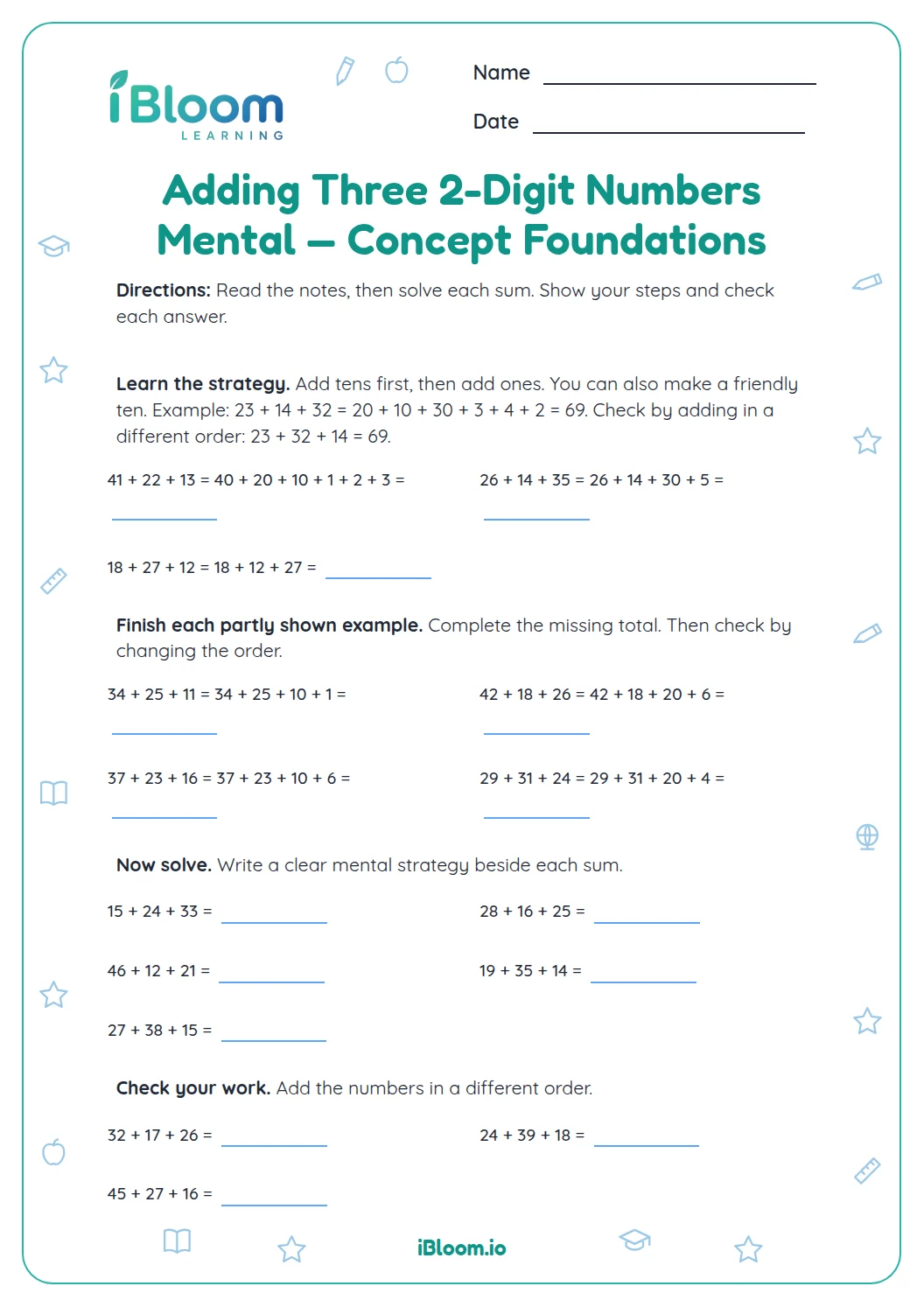
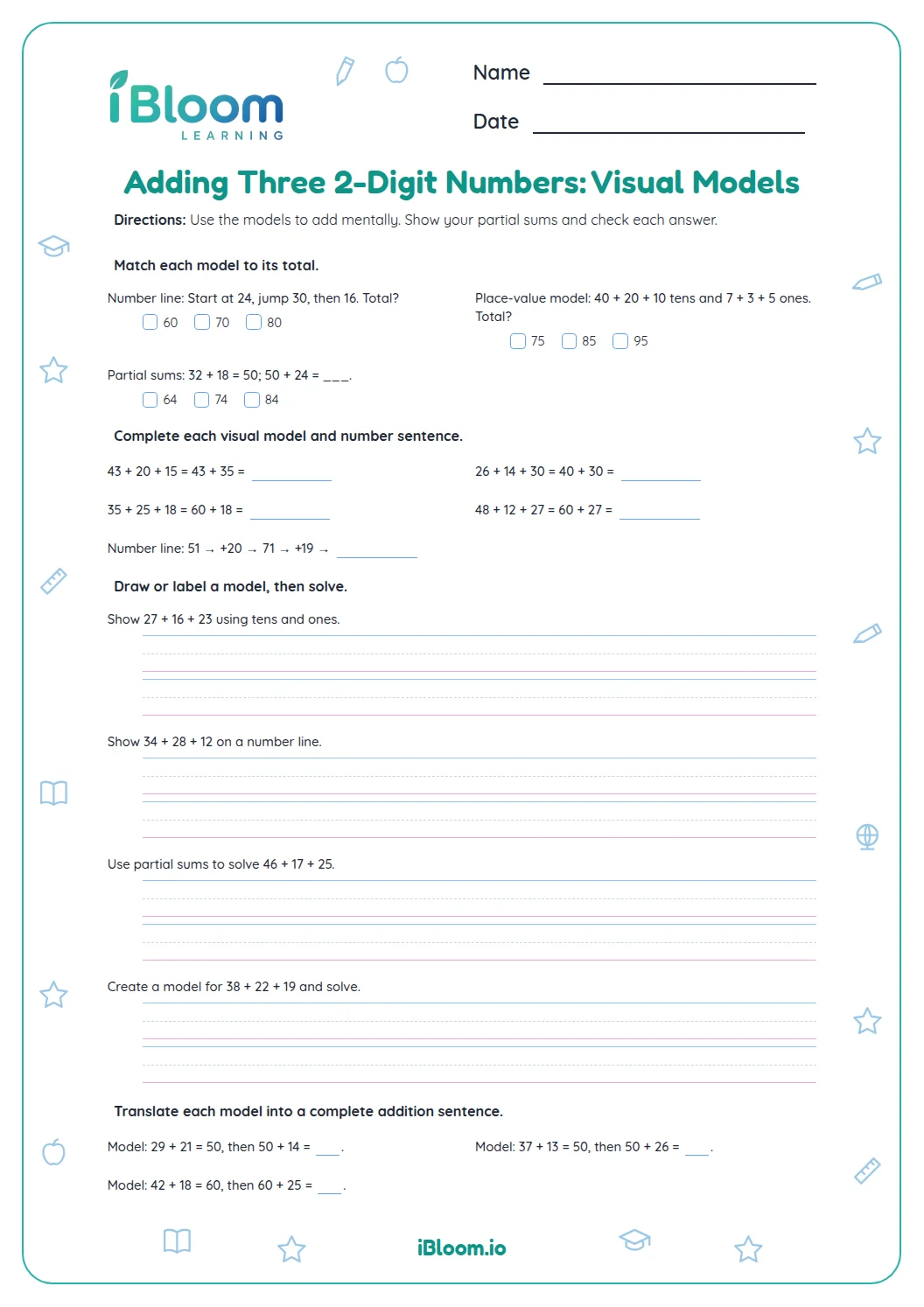
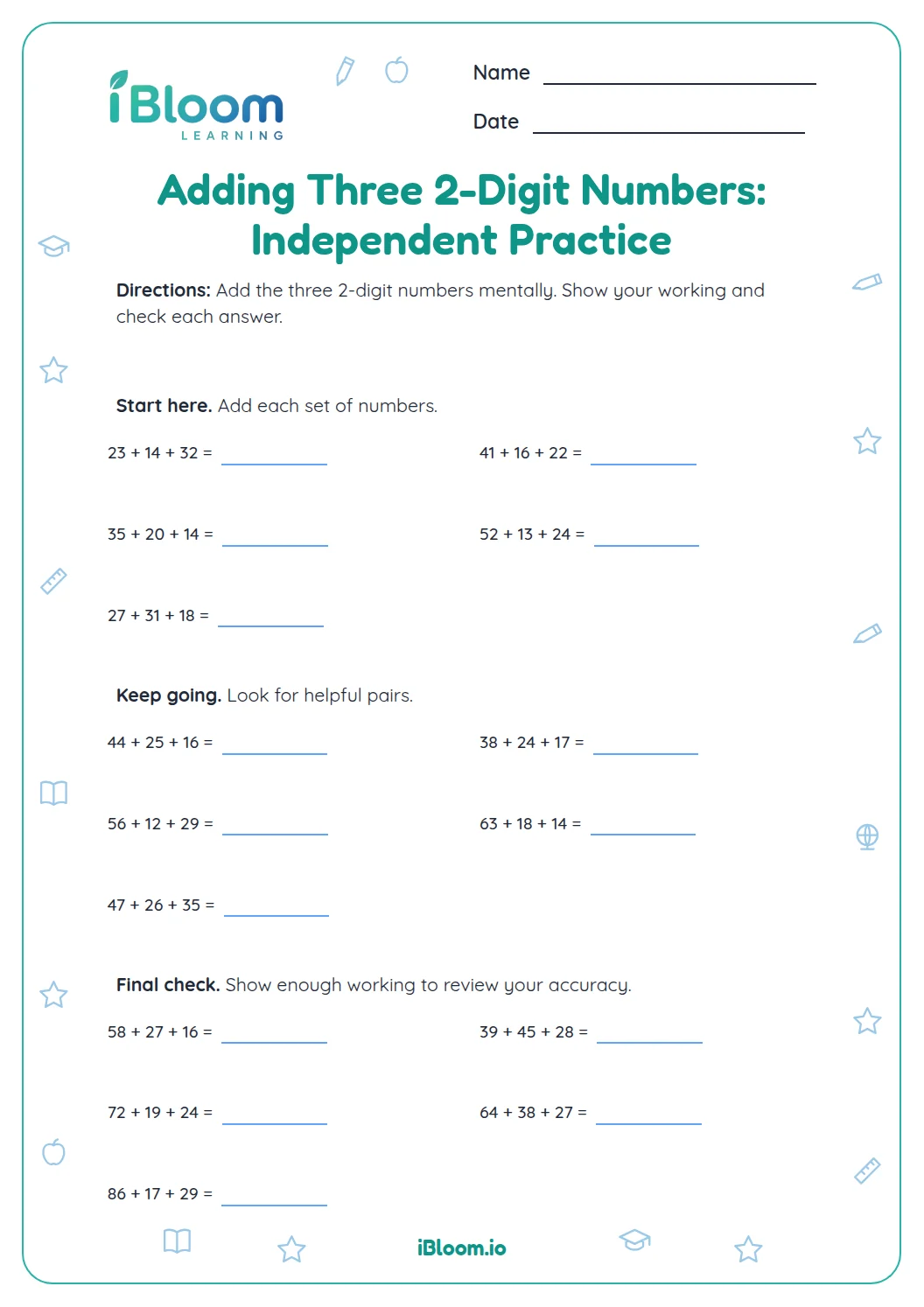
This free Grade 4 worksheet gives students twelve real-world problems that each combine four multiples of ten. Part A asks for mental totals using two-digit amounts in familiar settings such as book boxes and game scores. Part B introduces three-digit amounts, including totals above one thousand. In Part B, students arrange each set in columns, add from the ones place, and label the result. Part C returns to two-digit amounts for grouping and checking. The worksheet practices Common Core 4.NBT.B.4, using the standard algorithm to add multi-digit whole numbers. A separate answer key gives totals and sample grouping checks.
Aligned to 4.NBT.B.4
What counts as a whole-ten amount?
A whole-ten amount is a multiple of ten, such as 40, 170 or 460. Each has zero ones, so the ones column totals zero. The tens column can still need regrouping: 20 tens become 2 hundreds.
Every question gives four amounts to combine. Students should identify the unit before adding, whether it is books, dollars, seats or cans.
How does column addition work with four addends?
Question 1 gives four book boxes with 40, 70, 30 and 60 books. Write one amount under the next, keeping the zeros in the ones column. Add zero ones, then add the tens and regroup.
- 140 + 70 + 30 + 60
- 2Ones: 0 + 0 + 0 + 0 = 0
- 3Tens: 4 + 7 + 3 + 6 = 20 tens
- 420 tens = 2 hundreds, so the total is 200 books.
- 5Check: 40 + 60 = 100 and 70 + 30 = 100.
What changes in Part B?
Part B mixes two- and three-digit multiples of ten. Students still start with the ones and tens, then add the hundreds and any regrouped hundreds. A total can have more digits than any one addend.
For question 8, four sections have 340, 270, 160 and 230 seats. Adding all four gives 1,000 seats. This is a useful place to check that the tens and hundreds were regrouped rather than dropped.
Part C asks students to show two pair sums for notebooks and meals. These checks make the grouping strategy visible: all four amounts must appear once, and the pair sums must combine to the labeled total.
How to use this worksheet
- 1Read the problem and underline its four amounts.
- 2For Part A, add the tens mentally and write the total in the sentence.
- 3For Part B, stack the amounts with ones under ones and tens under tens.
- 4Add from the ones column, writing any regrouped amount in the next column.
- 5Check by adding in a different order, then compare the total with the key and check the unit against the problem.
- 6In Part C, write two pair sums and combine them to find or check the total.
Common mistakes and helpful fixes
The mistake
Adding only three amounts from a list of four.
The fix
Check off each amount once it has been copied into the column sum.
The mistake
Writing 20 instead of 200 for 40 + 70 + 30 + 60.
The fix
Say “20 tens” aloud, then rename that as 2 hundreds.
The mistake
Forgetting the regrouped hundreds in Part B.
The fix
Write the regrouped amount above the hundreds column before adding that column.
Common Core alignment
Add four multiples of ten in columns, regrouping tens and hundreds.
On this sheet: Part B asks students to arrange four amounts in columns, regroup and find the sum.
Show the official wordingHide the official wording
Fluently add and subtract multi-digit whole numbers using the standard algorithm.
What to practice next
Make more practice
Further reading
Questions parents and teachers ask
Does every problem have exactly four addends?
Yes, all twelve problems give four amounts that must be added. The first five use two-digit multiples of ten, the next five include three-digit amounts, and the last two ask for grouping and checking. Have your child count the four entries in each calculation before calculating, especially when copying numbers from a sentence.
How can my child check the first five totals?
Pair amounts that are easy to add, then combine the pairs. In question 1, 40 and 60 make 100, and 70 and 30 make another 100. The total is 200 books. Adding the same four amounts in a different order gives a useful check on the mental calculation.
How large do the totals get?
The largest total is 1,300 tickets in question 10. The four amounts are 460, 280, 370 and 190, so both the tens and hundreds need careful attention. The key uses commas in four-digit totals; a correct number written without a comma is still mathematically equivalent.
Can my child check answers by making friendly pairs?
Yes, friendly pairs are a useful check after Part B’s column work. In question 6, 120 and 80 make 200, while 150 and 50 make another 200. The total is 400 seedlings. Changing the grouping leaves the sum unchanged and provides a second calculation to compare.
What does the answer key show?
The key gives numerical totals for Parts A and B and sample grouping checks for Part C. In Part B, write units below the answer box and use your child’s column work to check the calculation. Inspect the four copied amounts first, then the tens column and any regrouping.