

About this worksheet
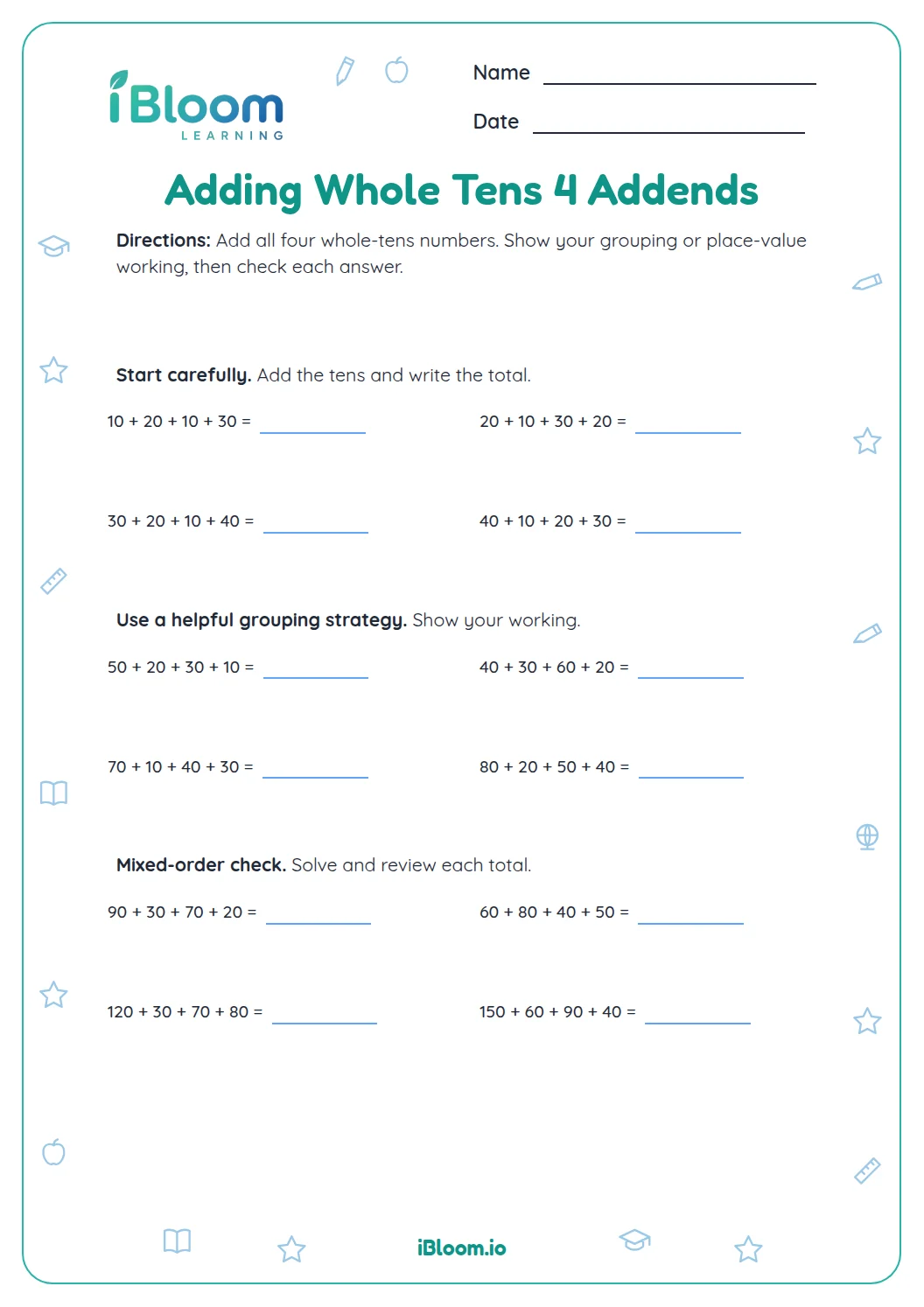
This free Grade 4 worksheet asks children to reason about adding four multiples of ten. Sixteen questions move from missing addends to useful groupings, equivalent sums and explanations of why a total stays the same or changes. Children can pair addends that make 100, track the tens, and use place value to explain a result.
Aligned to 2.NBT.B.6
Why look for pairs that make 100?
Pairs such as 30 + 70 and 40 + 60 make 100. In q1, 30 + 70 + 40 already totals 140, so the missing addend is 60 to reach 200.
- 130 + 70 + 40 + ___ = 200
- 230 + 70 = 100
- 3The other pair must also make 100.
- 440 + 60 = 100, so the missing addend is 60.
- 5Check: 30 + 70 + 40 + 60 = 200.
When does a change leave the total unchanged?
Changing the order or grouping of the same addends leaves their total unchanged. In question 6, 70 + 30 + 20 + 40 uses exactly the same four numbers as 70 + 20 + 40 + 30.
Question 8 changes the numbers themselves: 40 becomes 50 and 60 becomes 50. Adding 10 to one addend and taking 10 from another balances out, so the total stays 180.
What makes the final questions a reasoning challenge?
Part C asks children to account for place value, grouping and changes in a total. Lena’s answer of 15 confuses a count of tens with a count of ones. The correct total is 15 tens, or 150.
The last question can be solved without listing possible addends. Whole tens have zero ones, so adding four of them gives a sum ending in zero. A total of 235 is impossible under that condition.
How to use this worksheet
- 1Read the four addends and look for a pair that makes 100.
- 2For Part A, subtract the three known addends from the total or complete a helpful pair.
- 3In Part B, check that a proposed regrouping uses each original addend once.
- 4For Part C, say the reason aloud before writing it.
- 5Check numerical answers by counting tens, then convert the tens back to a whole number.
Mistakes to notice and fix
The mistake
Reporting 21 as the total of 60 + 50 + 20 + 80.
The fix
The sum is 21 tens, or 210; preserve the tens unit while calculating.
The mistake
Leaving out an addend when rearranging a sum.
The fix
Cross off each original addend once as it is used in a new grouping.
The mistake
Assuming any change in two addends preserves the total.
The fix
The increase and decrease must match. Adding 10 to both addends increases the sum by 20.
Common Core alignment
Add four multiples of ten by counting tens, pairing and regrouping addends.
On this sheet: Children find missing addends, identify equivalent groupings and explain whole-tens sums.
Show the official wordingHide the official wording
Add up to four two-digit numbers using strategies based on place value and properties of operations.
What to practice next
Make more practice
Further reading
Questions parents and teachers ask
Are all four addends whole tens?
Yes. Every four-addend expression uses two-digit multiples of ten, such as 20, 50 and 90. Missing addends are also whole tens. This keeps the arithmetic focused on tens while the questions ask children to reason about grouping, missing values, balanced changes and the possible last digit of a sum.
Why does question 5 ask for two hundreds?
The prompt asks for a particular helpful grouping, not just an equal total. All three choices rearrange the same four numbers, but only (20 + 80) + (60 + 40) makes 100 in each pair. Ask your child to calculate both parentheses to explain why that choice fits.
How can children find a missing addend?
They can add the three known numbers and subtract that total from the target. They can also complete a convenient pair. In question 1, 30 + 70 makes 100, leaving another 100 to make with 40. The missing 60 completes that pair and makes the total 200.
What counts as a good written explanation?
A good explanation names the mathematical reason, not just the answer. For Lena’s mistake, “15 tens equals 150” explains the missing place value. For the final question, “Whole tens always add to a number ending in zero” explains why 235 cannot be the total. Equivalent wording is welcome.
Can students solve these questions mentally?
Yes. Whole tens and useful pairs make mental calculation practical for this sheet. Children should still write the missing numbers, mark the choices and explain Part C in words. If keeping four addends in mind is difficult, let them write two pair totals before combining them into the final sum.