

About this worksheet
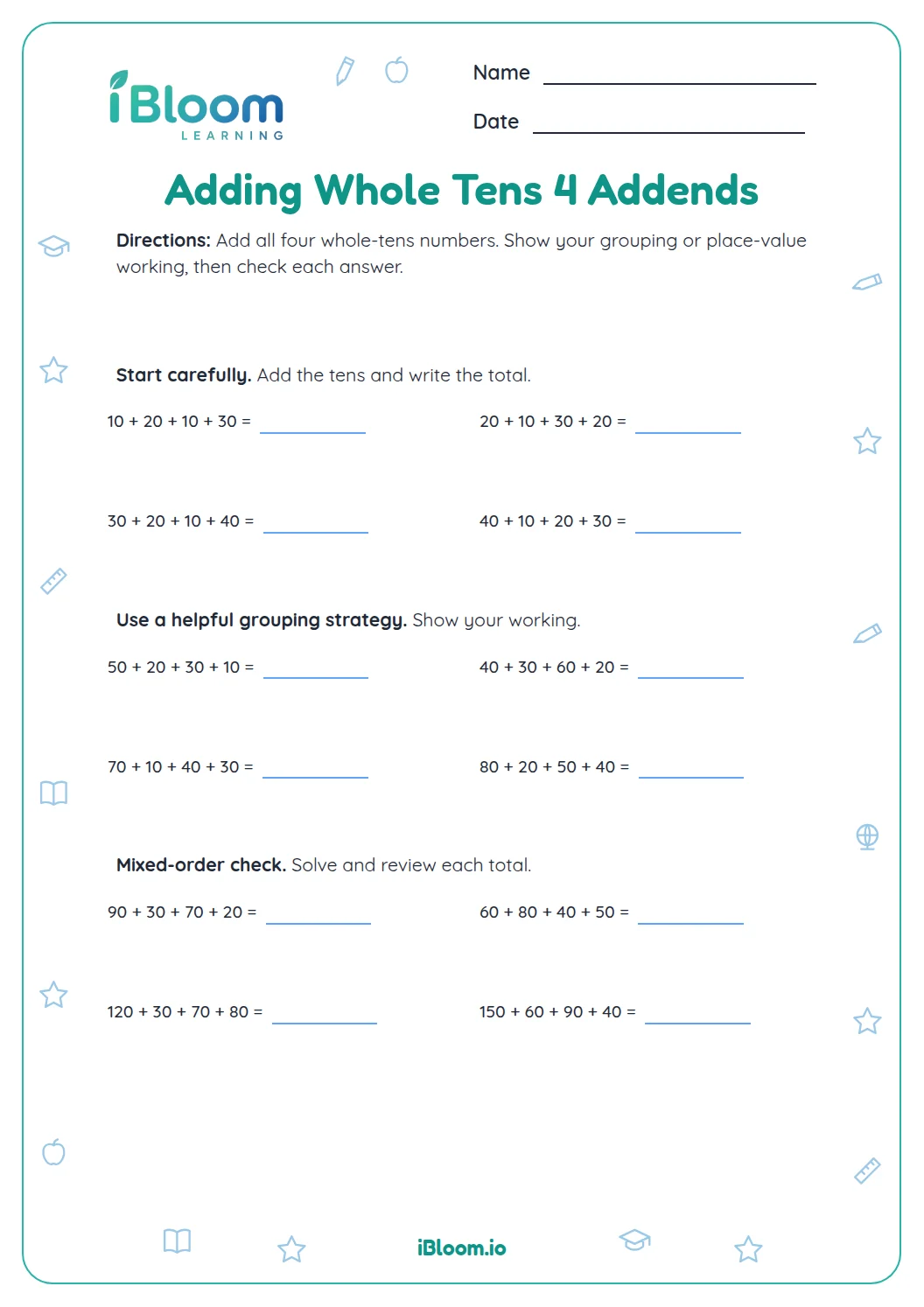
This Grade 4 printable practices adding four whole-ten addends, such as 240 + 80 + 30 + 50. Base-ten sketches highlight the tens in early problems; later sums ask children to group tens mentally, followed by short collection and total stories. It aligns with CCSS 3.NBT.A.2 and comes with a separate answer key.
Aligned to 3.NBT.A.2
How can tens make a friendly hundred?
Treat each ten as one unit. Look for pairs or groups that total 100, then combine the remaining tens. In question 3, split 50 into 20 and 30: 80 + 20 = 100, while 30 + 30 = 60. Then 240 + 100 + 60 = 400.
- 1240 + 80 + 30 + 50
- 2240 + 60 + 40 + 60
- 3240 + 100 + 60 = 400
What do the base-ten blocks represent?
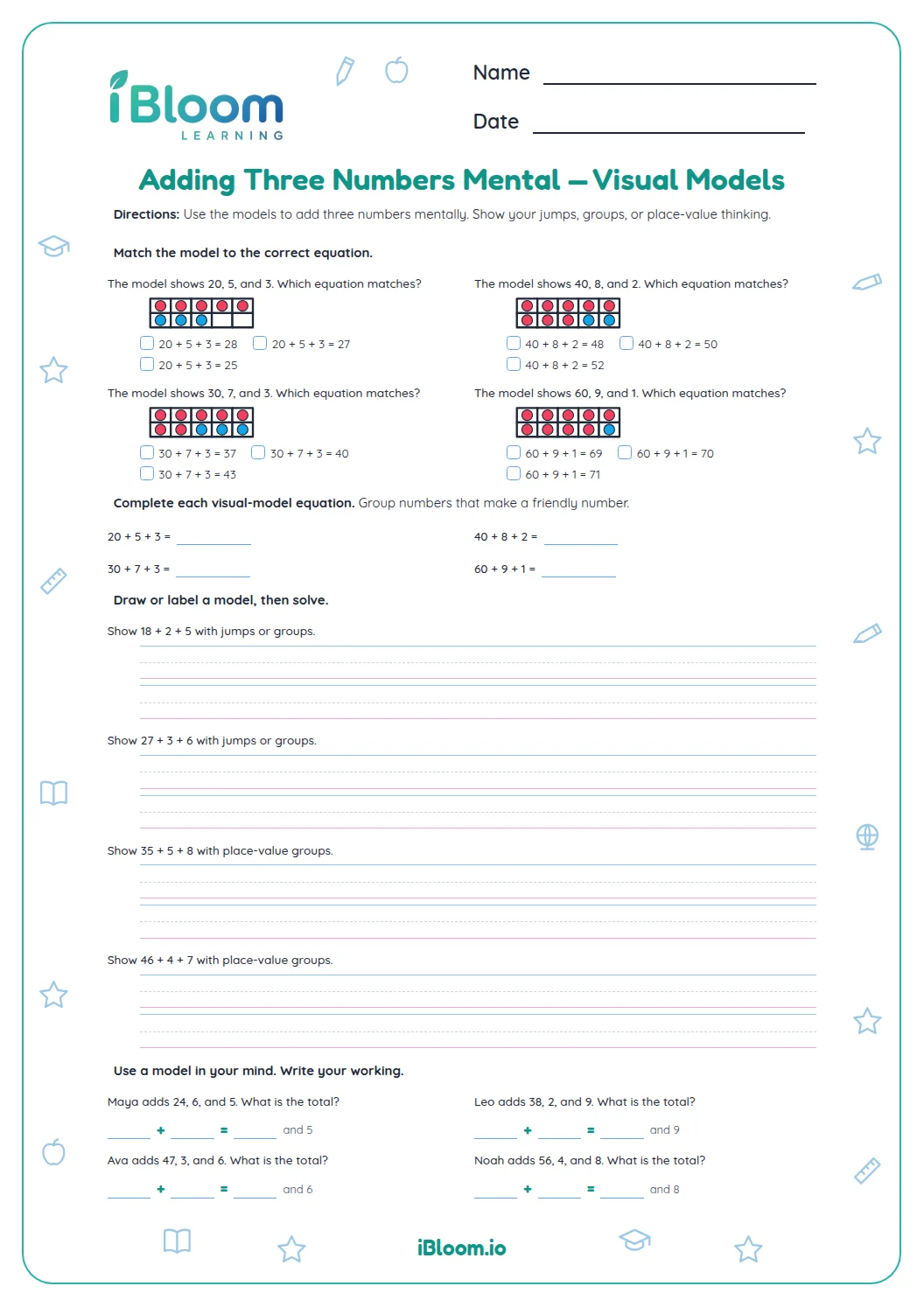
Each early model shows the sum of the first two addends in hundreds and tens. A flat is 100 and each rod is 10. Use that partial sum, then combine the two remaining addends.
What kinds of problems are on the pages?
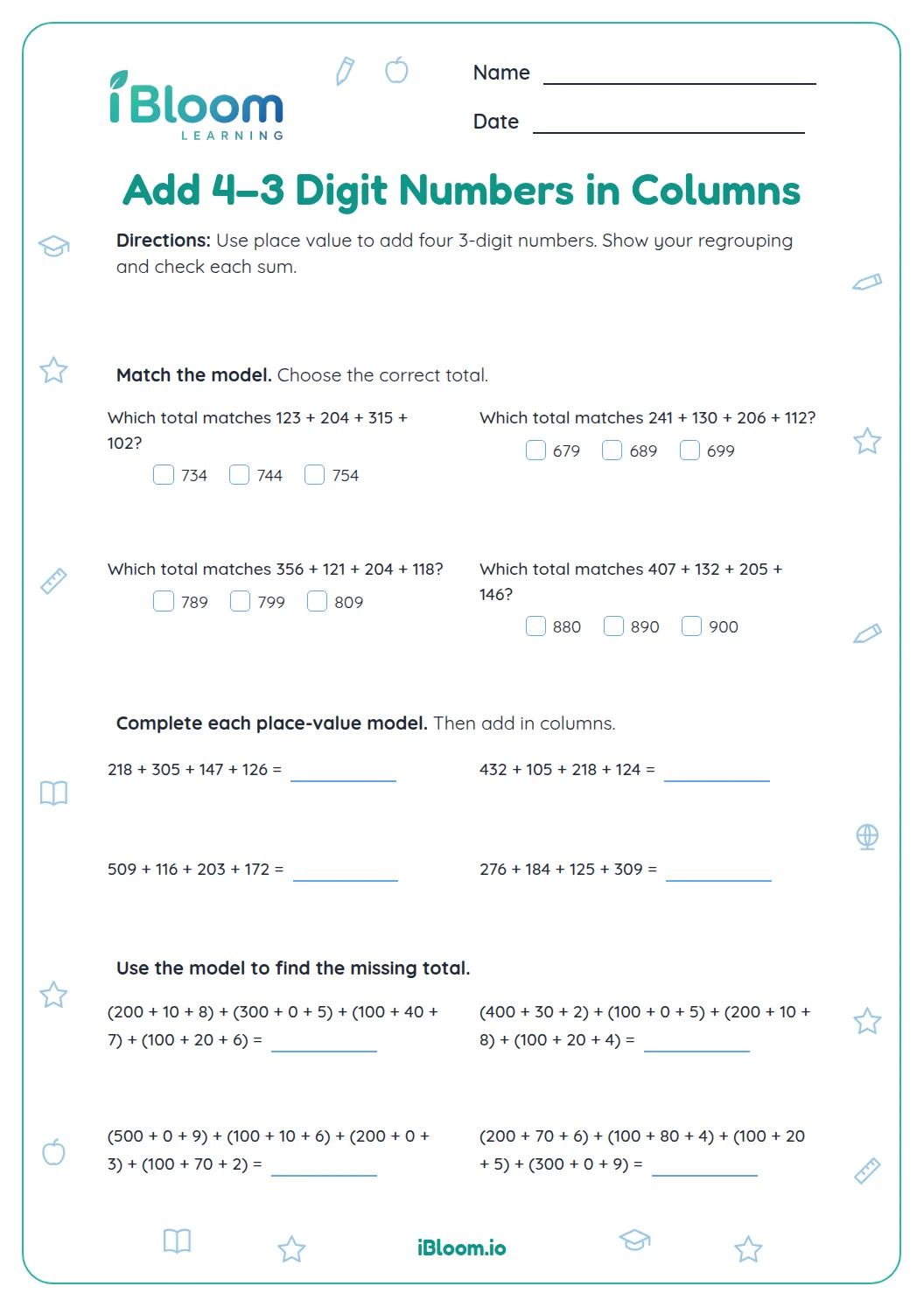
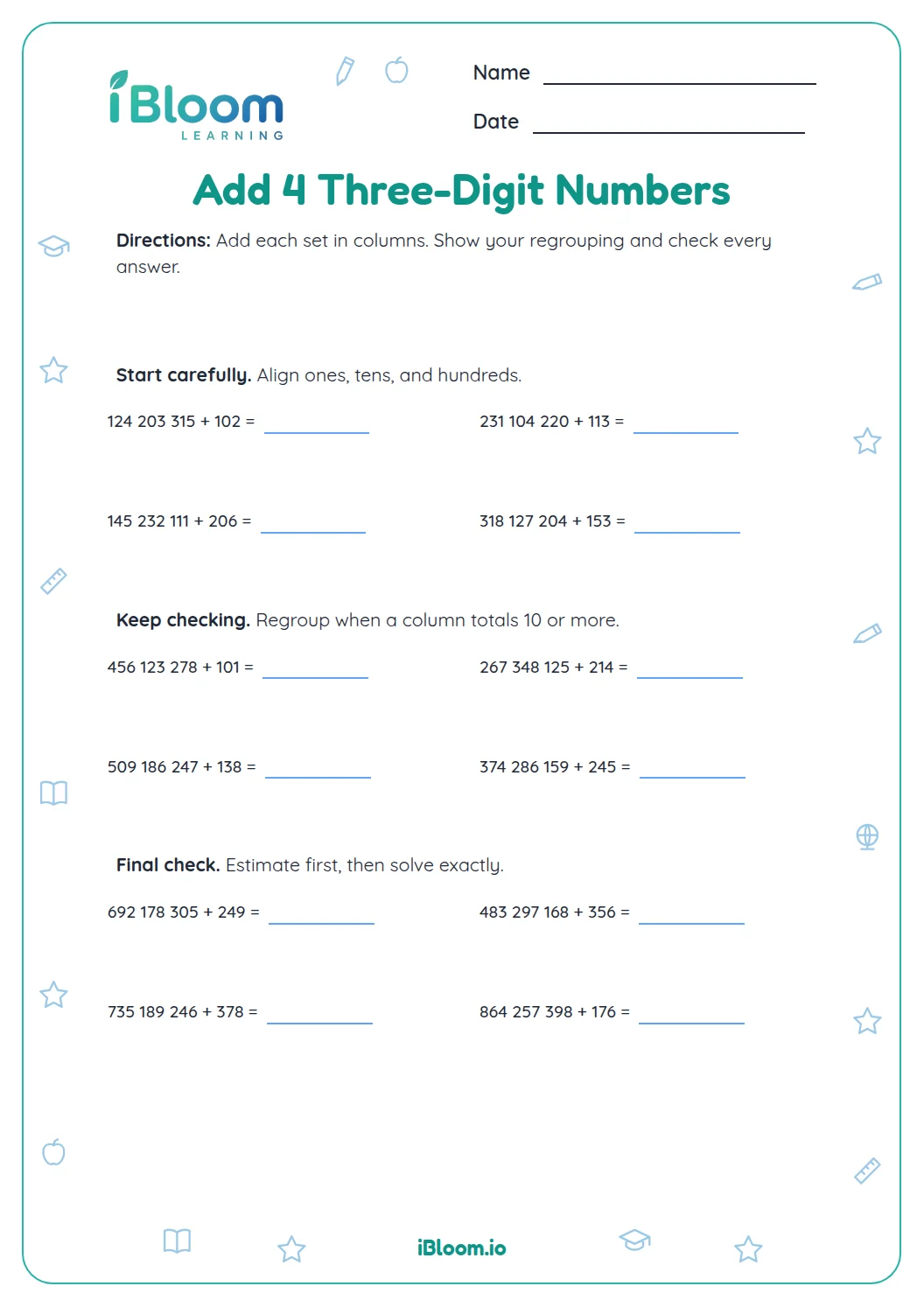
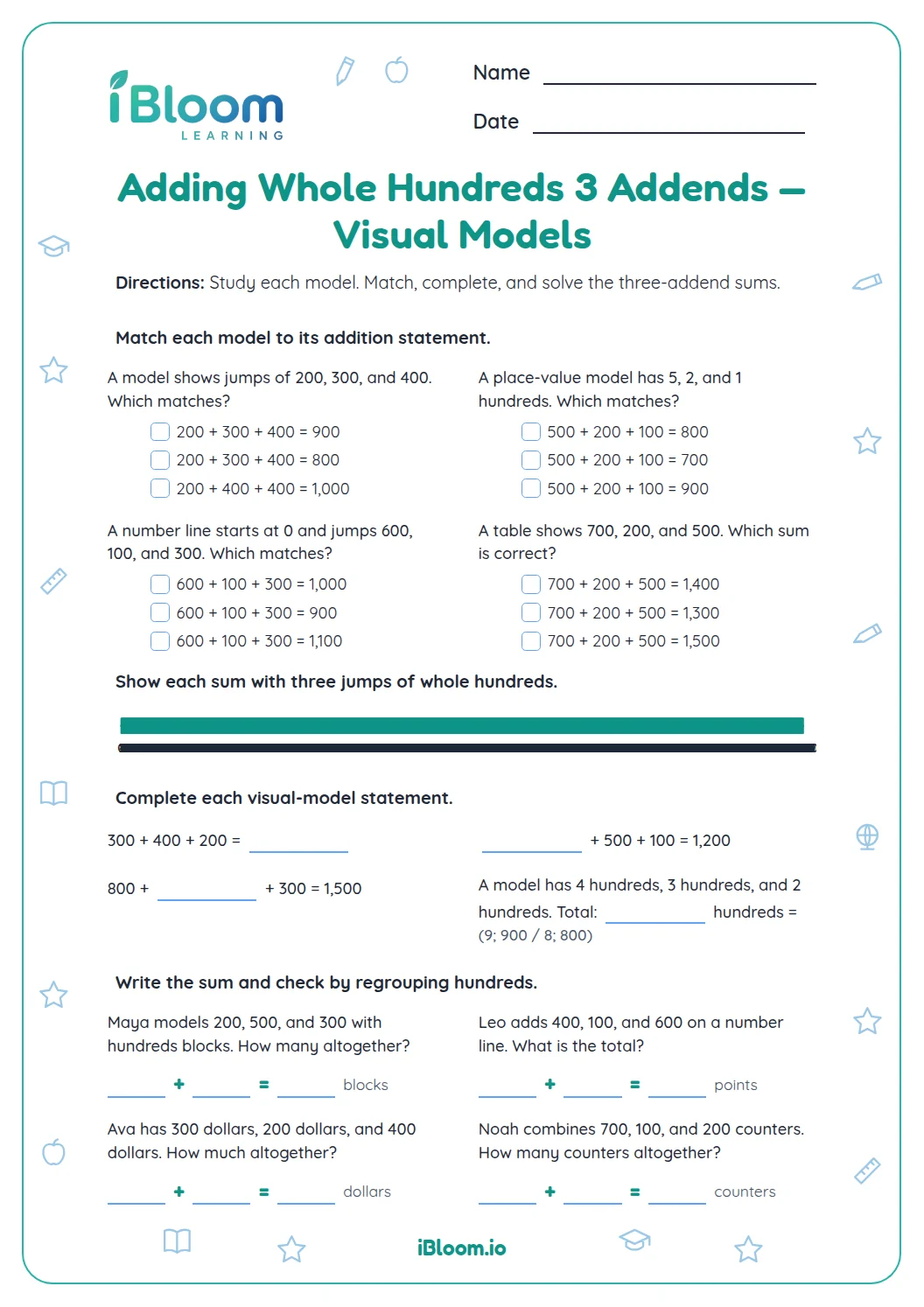
The sheet starts with six sums, four paired with a base-ten model of the first two addends combined. Two more sums ask children to group whole tens without a model. Six story problems apply the same addition to collections and totals.
Part A builds the model-to-number connection. Part B adds two four-addend sums. Part C asks for an addition sentence and a total in context.
- Part A: six sums, with tens models on the first four
- Part B: two whole-ten sums
- Part C: six short story problems
- Answer key on its own two pages
How to use this worksheet at home or in class
- 1Point to one tens rod and say its value before starting.
- 2For question 3, the model shows 240 + 80 = 320; then add 30 and 50 to reach 400.
- 3Solve the first model problems, then cover the model and explain a grouping aloud.
- 4Write each story as four addends before adding.
- 5Check a total by adding in a different order.
Common mistakes and quick fixes
The mistake
Adding only the tens digits and forgetting the hundreds already present.
The fix
Keep the hundreds from each addend in the total, then add the extra tens.
The mistake
Combining just three addends and leaving one out.
The fix
Point to each of the four addends as it joins a group.
The mistake
Combining 80 and 30, then forgetting to rename 10 tens as 100.
The fix
Trade ten tens for one hundred and add that hundred to the running total.
Common Core alignment
This worksheet practices the standard below through its printed questions.
Add within 1,000 using place-value strategies and properties of operations.
On this sheet: The sums stay within 1,000 and use tens models and place-value grouping to combine four addends.
Show the official wordingHide the official wording
Fluently add and subtract within 1000 using strategies and algorithms based on place value, properties of operations, and/or the relationship between addition and subtraction.
What to practice next
Make more practice
Further reading
Questions parents and teachers ask
How do the base-ten models help with these sums?
Each model shows the sum of the first two addends in hundreds and tens. A flat stands for 100 and each rod for 10, so children can read the partial sum before adding the remaining two amounts. For question 3, the model represents 240 + 80 = 320.
How can a child group four whole tens?
Look for addends or parts of addends that make a friendly hundred, then add what remains. In 240 + 80 + 30 + 50, split 50 into 20 and 30. Then 80 + 20 = 100, 30 + 30 = 60, and 240 + 100 + 60 = 400.
How many questions are included?
There are 14 questions: eight four-addend sums and six short story problems. Four of the first six sums have a base-ten model of the first addend. The later questions ask children to use grouping independently and apply the same addition to totals in context.
What does the answer key show?
A separate two-page answer key gives a correct total for every sum and story problem. A child may group addends in a different order and still be correct. Compare the final sum with the key, then ask the child to point out how all four amounts were included.
What skill should a child know first?
Children should be comfortable adding whole tens and understanding that ten tens make one hundred. The first four models review hundreds and tens in a starting addend. If a child is unsure, read each rod as 10 and each flat as 100 before solving the equation.