







About this worksheet
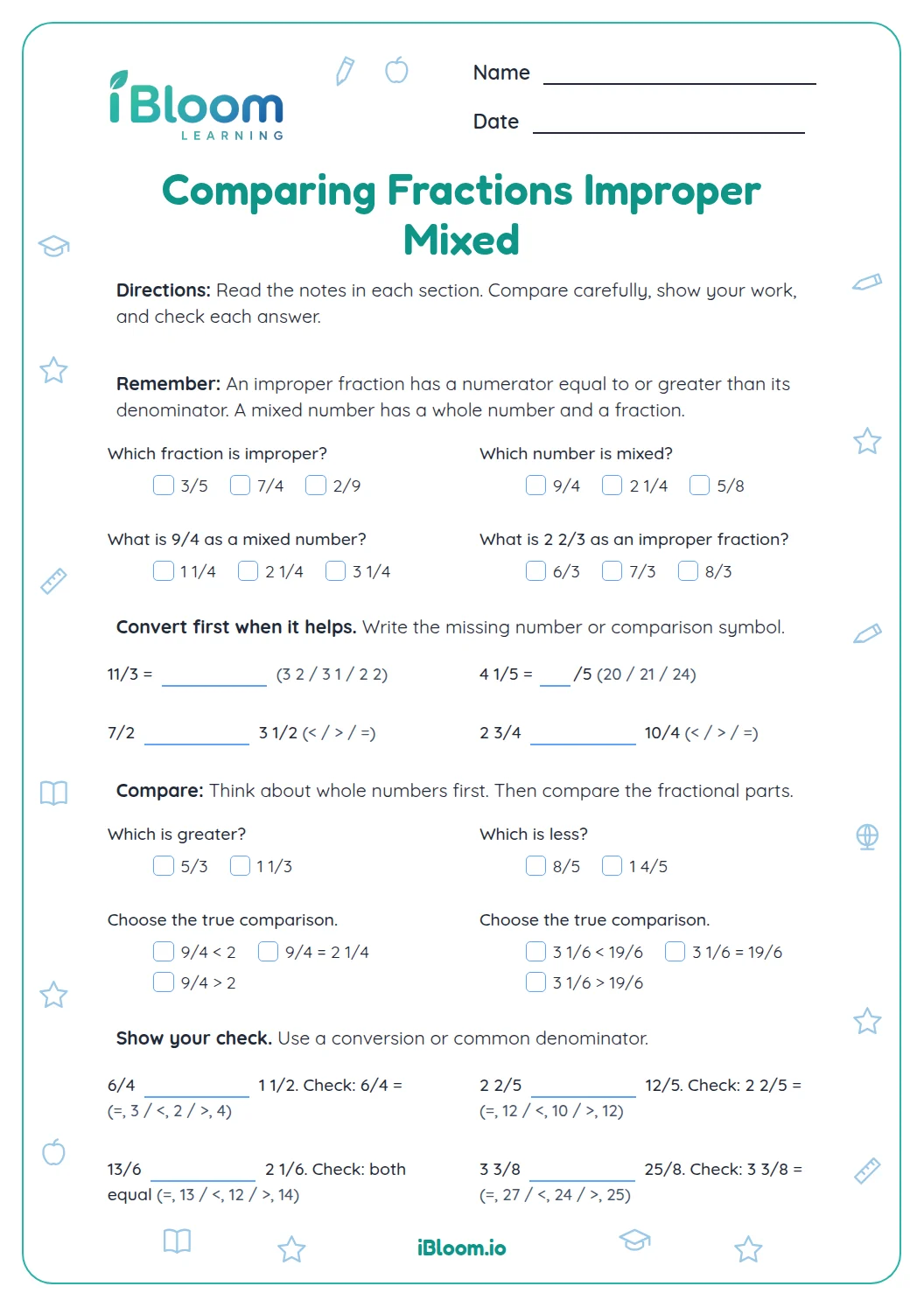
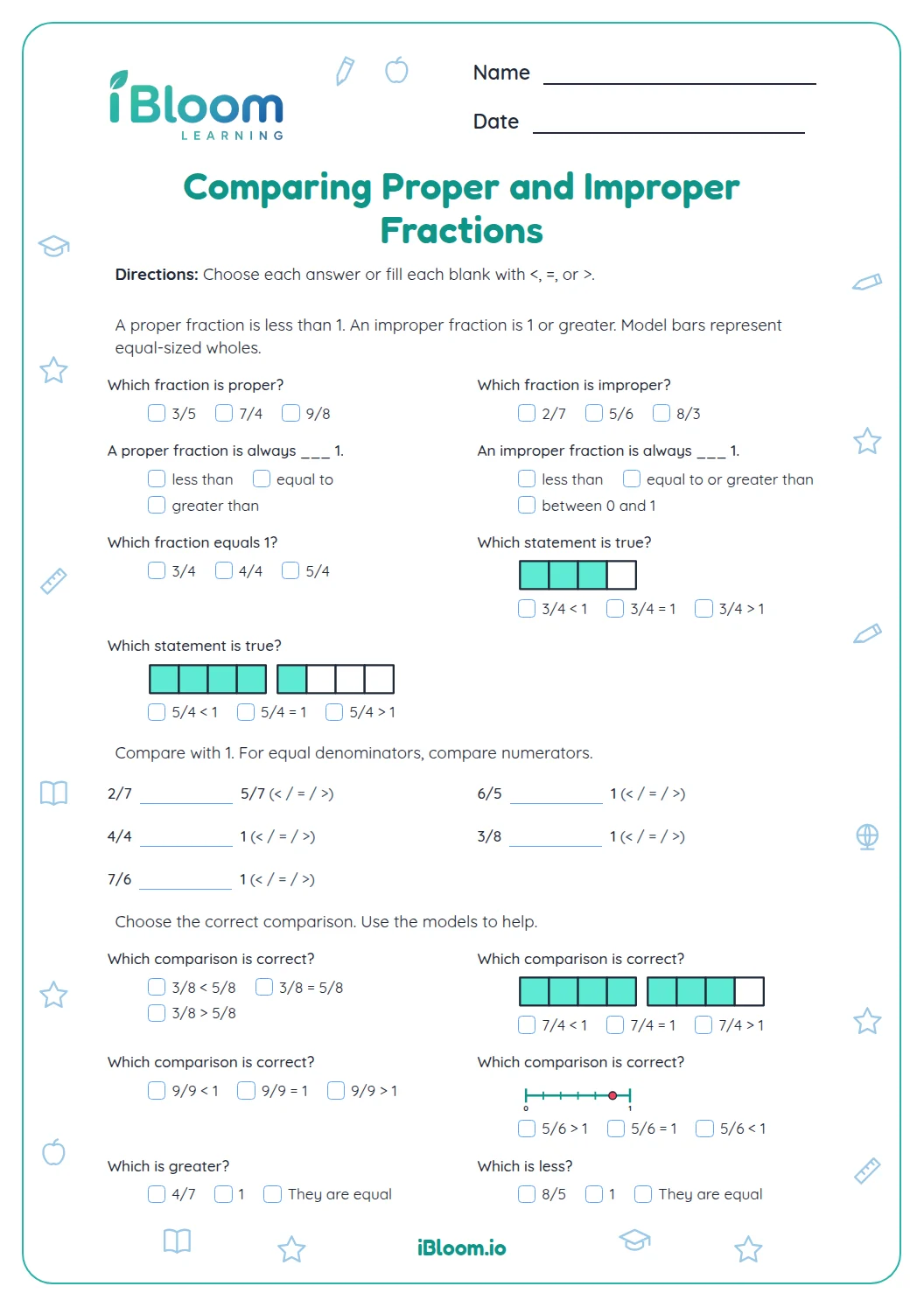
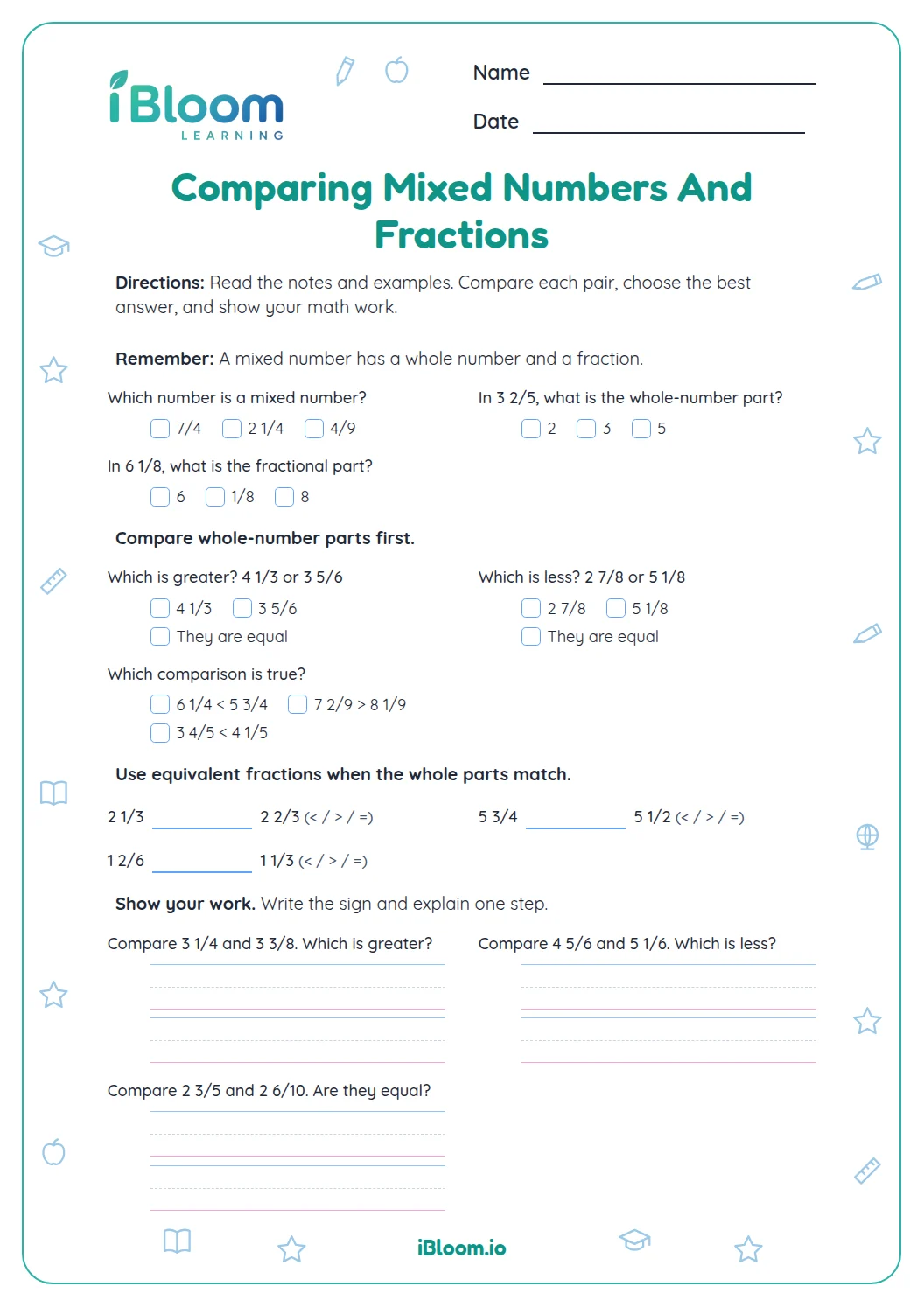
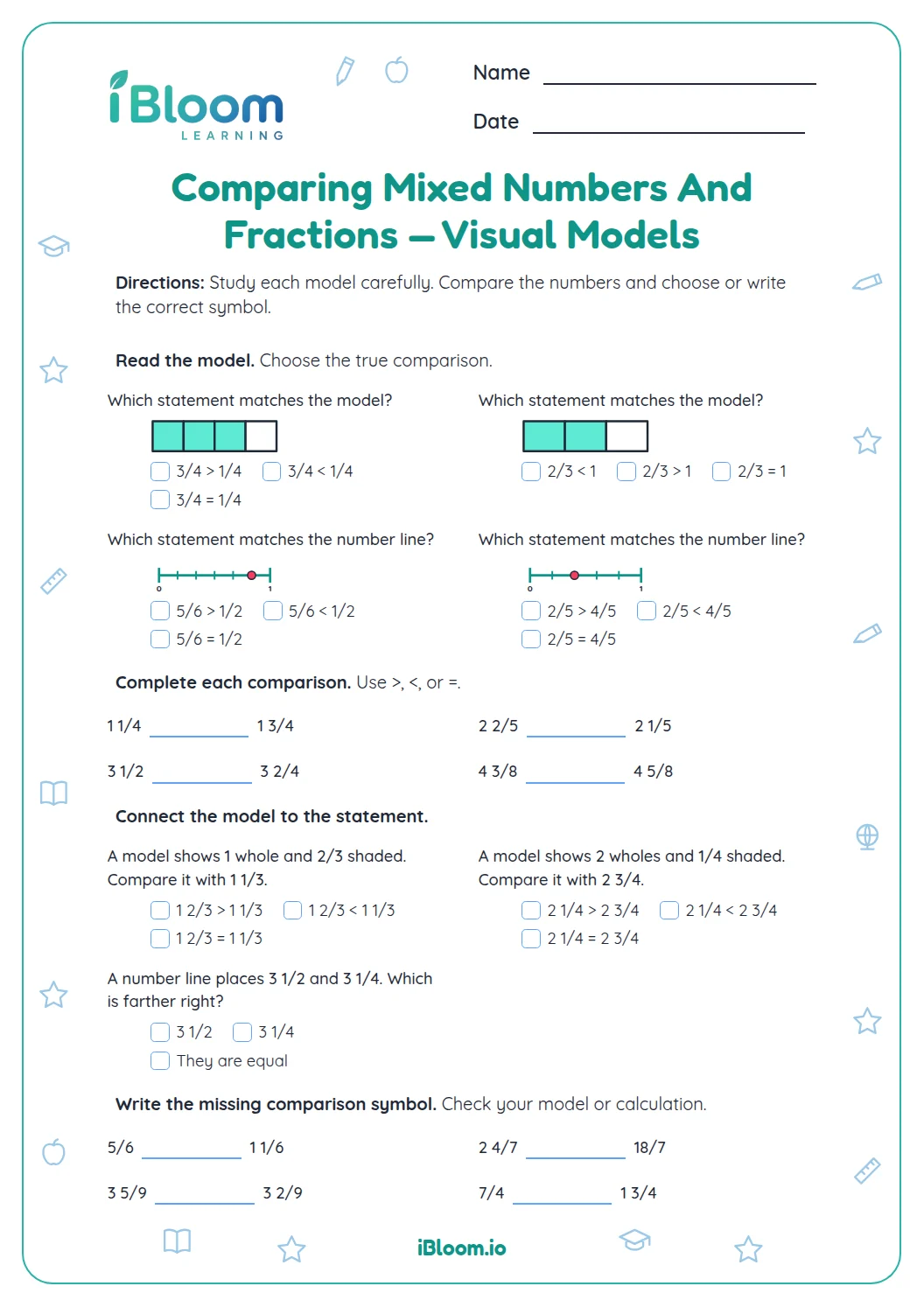
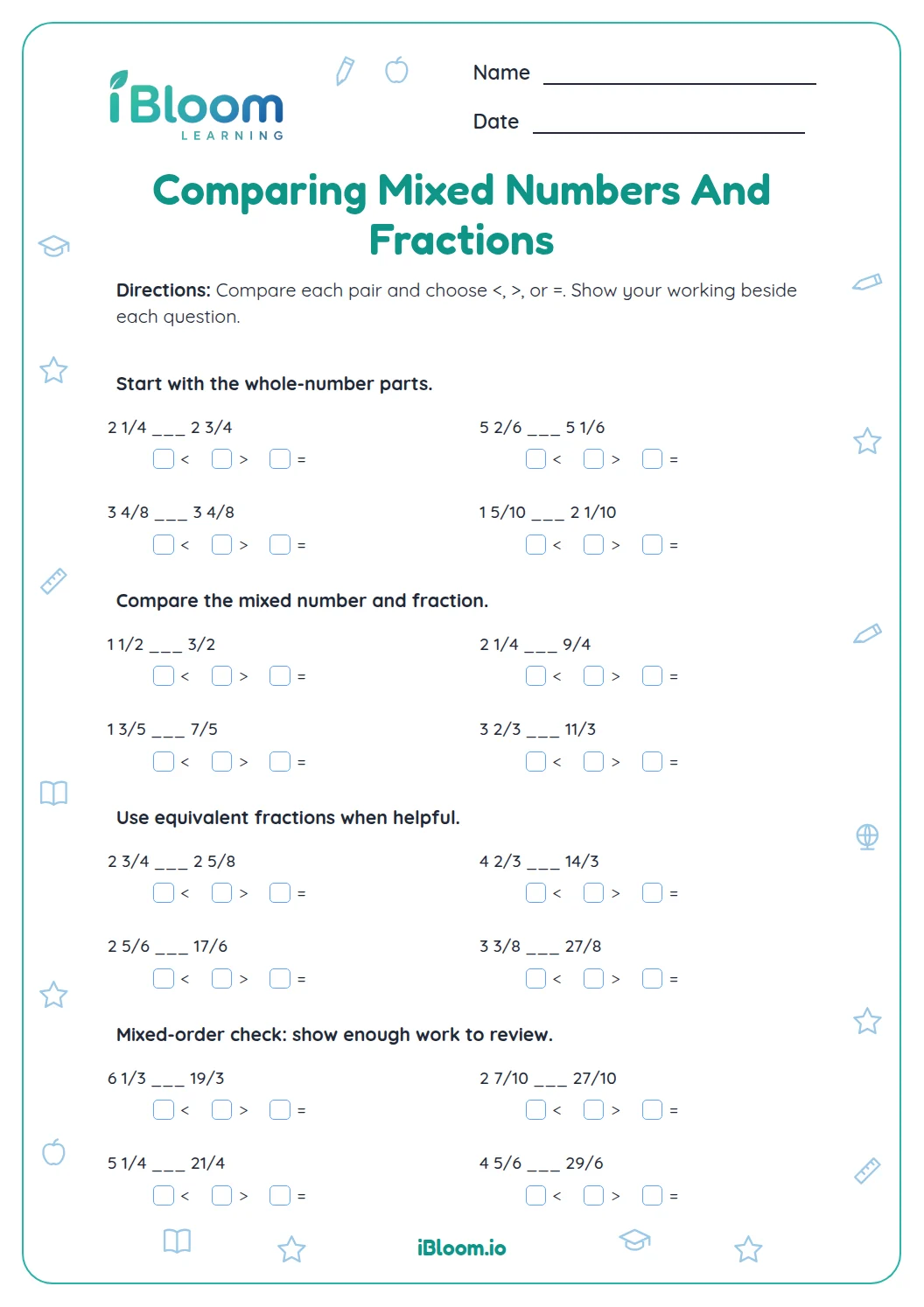
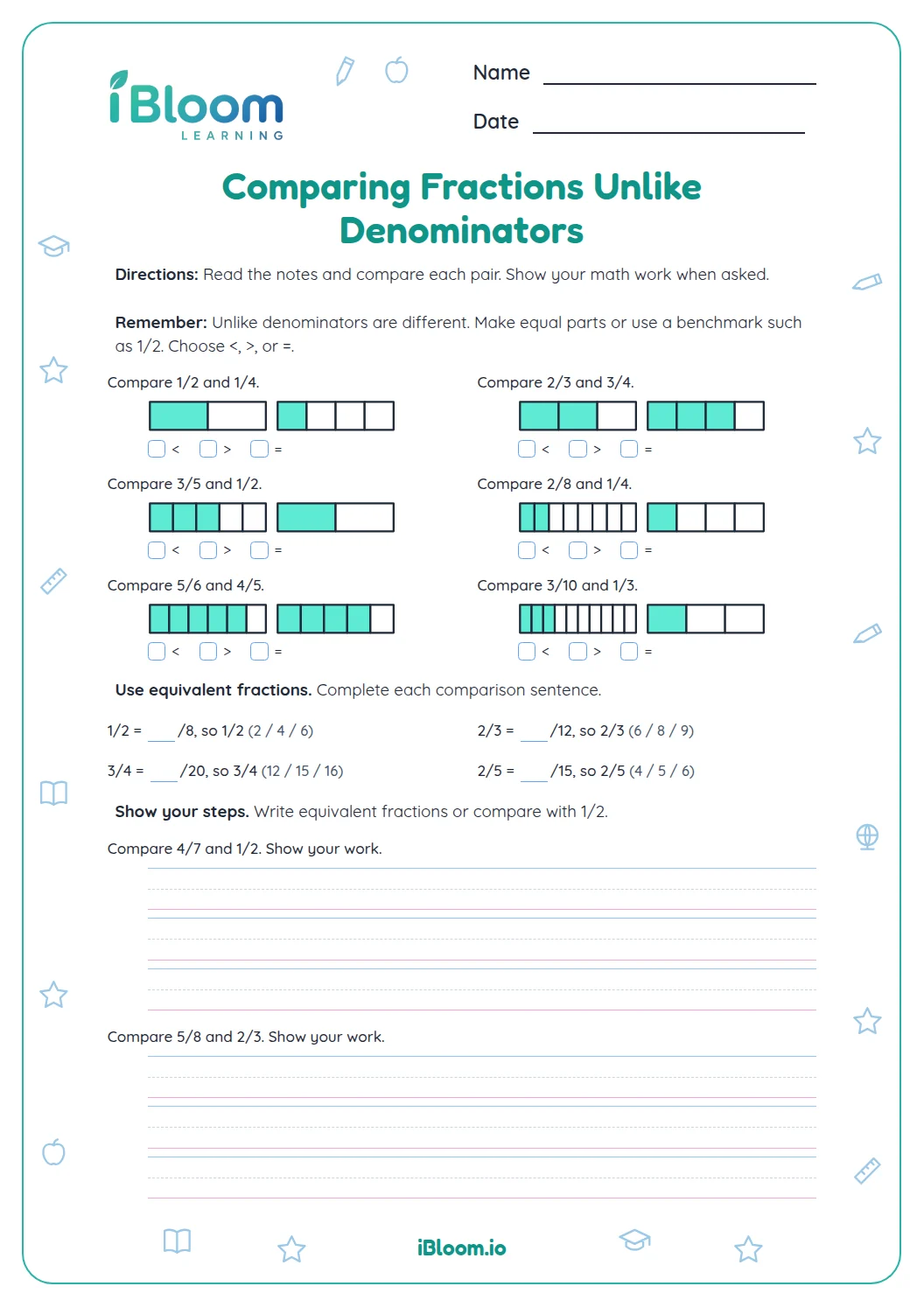
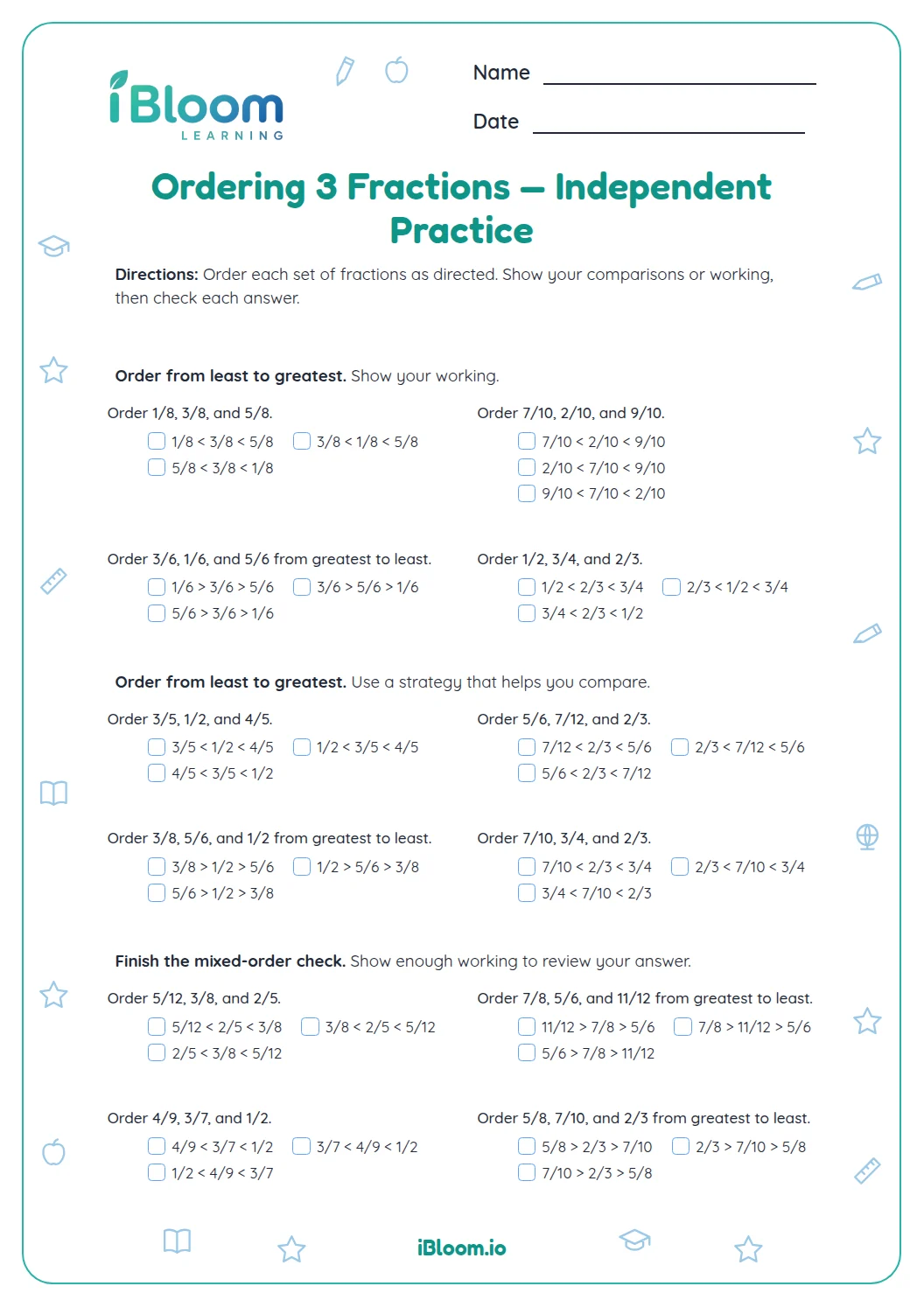
This Grade 4 fractions worksheet is a reasoning challenge about comparing improper fractions and mixed numbers that refer to the same whole. Students diagnose incorrect comparisons, write a comparison symbol, choose a useful strategy, and solve short comparison situations. Its 14 questions replace the old crowded practice with a sequence from identifying reasoning errors to explaining and applying comparisons. It aligns with CCSS 4.NF.A.2 and includes a separate answer key with the correct comparisons and sample reasoning.
Aligned to 4.NF.A.2
What went wrong in a fraction comparison?
Check the values, not just one numerator or denominator. Rewrite a mixed number or improper fraction to see the amount clearly. For example, 7/4 equals 1 3/4.
- 1Maya says 7/4 < 1 3/4 because 7 < 1.
- 2But 7/4 = 1 3/4.
- 3The values are equal; comparing only the whole-number numerals is not valid.
How can equivalent forms help?
Use equivalent forms or a benchmark such as 1 or 2. Compare the values, then choose the symbol or value that makes the statement true. In Part B, questions 9–14 apply those strategies to direct comparisons and missing values.
- 17/4 ___ 1 3/4
- 21 3/4 = 7/4
- 3The values are equal.
What does the challenge ask students to compare?
Part A contains eight diagnosis, comparison, and strategy questions. Part B contains six application questions: choose the greater or lesser value, find a numerator, compare tenths, and choose a fraction between 1 and 2. There are 14 questions across the two parts.
How to use this worksheet
- 1Read both values as amounts of the same-size whole.
- 2Rewrite a mixed number as an improper fraction or split an improper fraction into wholes and a part.
- 3Use common denominators, common numerators, or a benchmark to compare.
- 4Write <, >, or = with the smaller amount on the left when appropriate.
- 5Explain which equivalent form or benchmark supports the comparison.
- 6Check the answer key after completing each part.
Common mistakes and quick fixes
The mistake
Comparing numerators alone, such as saying 7/4 is less than 1 3/4 because 7 is less than 1.
The fix
Rewrite both amounts: 7/4 = 1 3/4, so they are equal.
The mistake
Treating a larger denominator as a larger fraction.
The fix
Compare piece sizes too: eighths are smaller than fourths, so rewrite using a common denominator.
The mistake
Using the wrong symbol after finding which amount is larger.
The fix
Read the comparison from left to right and say “left is less/greater than right.”
Curriculum alignment
This sheet practices the skill described in the standard below.
Compare fraction values and record the comparison with a symbol.
On this sheet: Students compare fractions and mixed numbers referring to the same whole and justify the comparison.
Show the official wordingHide the official wording
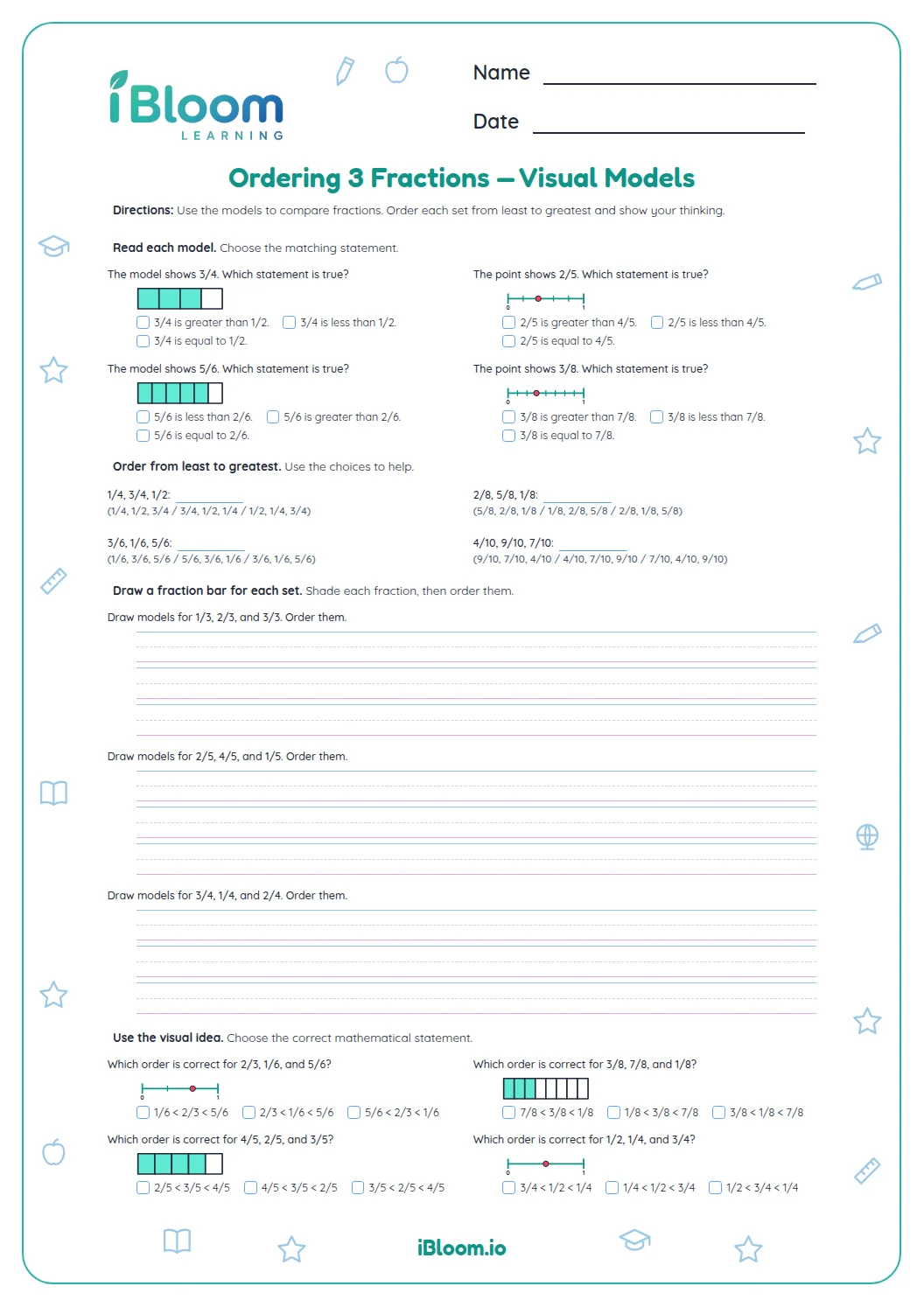
Compare two fractions with different numerators and different denominators, e.g., by creating common denominators or numerators, or by comparing to a benchmark fraction such as 1/2. Recognize that comparisons are valid only when the two fractions refer to the same whole. Record the results of comparisons with symbols >, =, or <, and justify the conclusions, e.g., by using a visual fraction model.
What to practice next
Make more practice
Further reading
Questions parents and teachers ask
What is an improper fraction?
An improper fraction has a numerator at least as large as its denominator, such as 7/4. It can be renamed as a mixed number: 7/4 is 1 3/4. Question 1 uses that equivalence to show that the two written values are equal.
How many problems are on this challenge?
There are 14 questions in two parts. Part A asks students to diagnose claims, compare values, and select a strategy. Part B asks them to choose greater or lesser values, find missing numerators, compare tenths, and identify a fraction between 1 and 2.
Why must fractions refer to the same whole?
A fraction describes parts of a whole, so the pieces need a common reference whole for their sizes to be compared. The worksheet directions now make that assumption explicit. Students can then compare the values using equivalent fractions, mixed numbers, or a benchmark.
How do you compare 7/4 and 1 3/4?
Rename the mixed number: 1 whole is 4/4, and 4/4 + 3/4 = 7/4. The values are equal, so the comparison symbol is =. Questions 1 and 3 both use this pair to check the value and the written comparison.
Can students use different strategies?
Yes. A student can rename a mixed number as an improper fraction, split an improper fraction into wholes and a fraction, or compare both values with a benchmark such as 1 or 2. The answer key shows one valid approach; equivalent reasoning that supports the comparison is sound.
Does the worksheet have an answer key?
Yes. A separate two-page key marks each comparison and strategy choice and supplies the missing values. It also gives sample reasoning for the questions that ask why a comparison is true, so adults can check both the result and the supporting idea.