

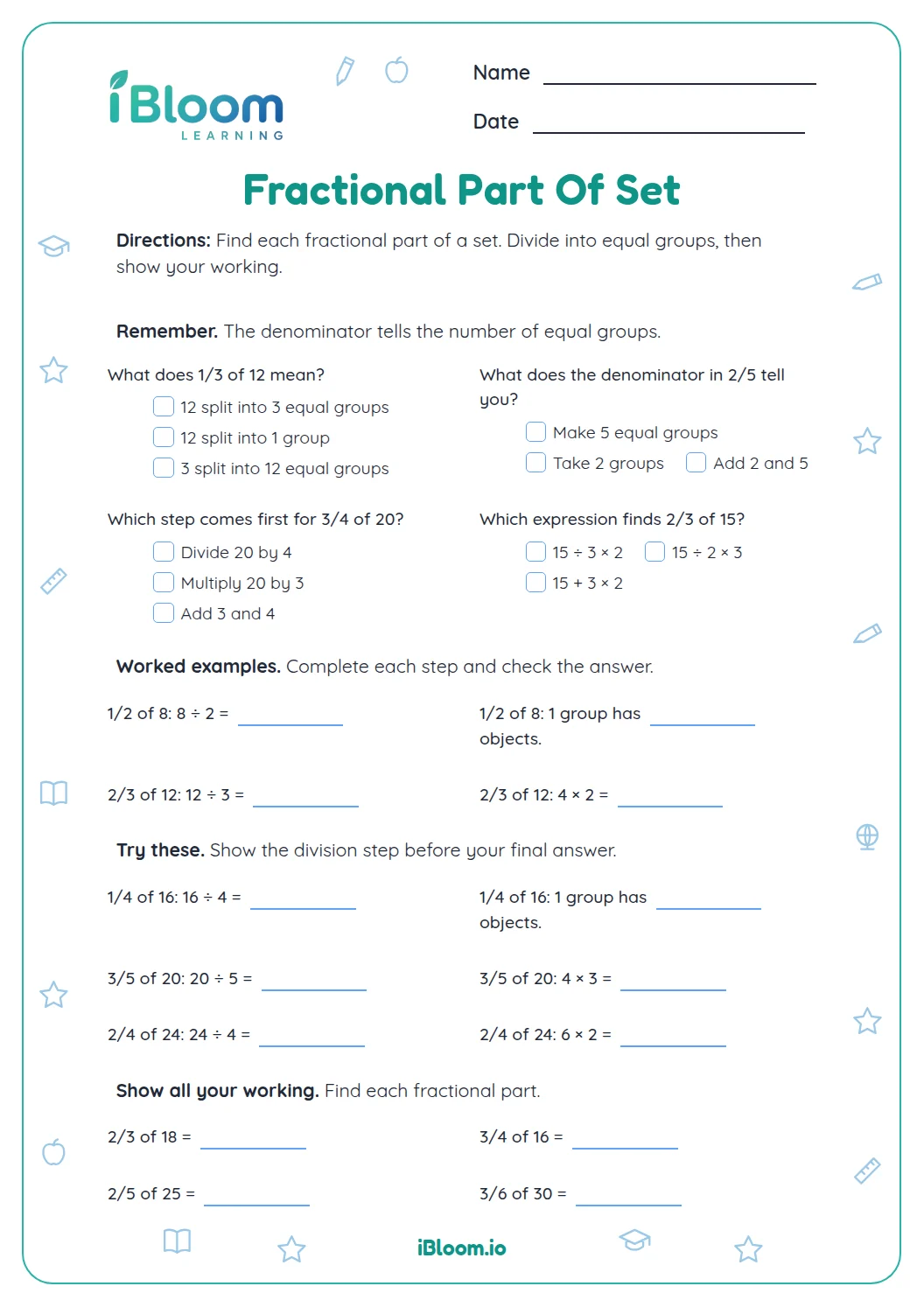
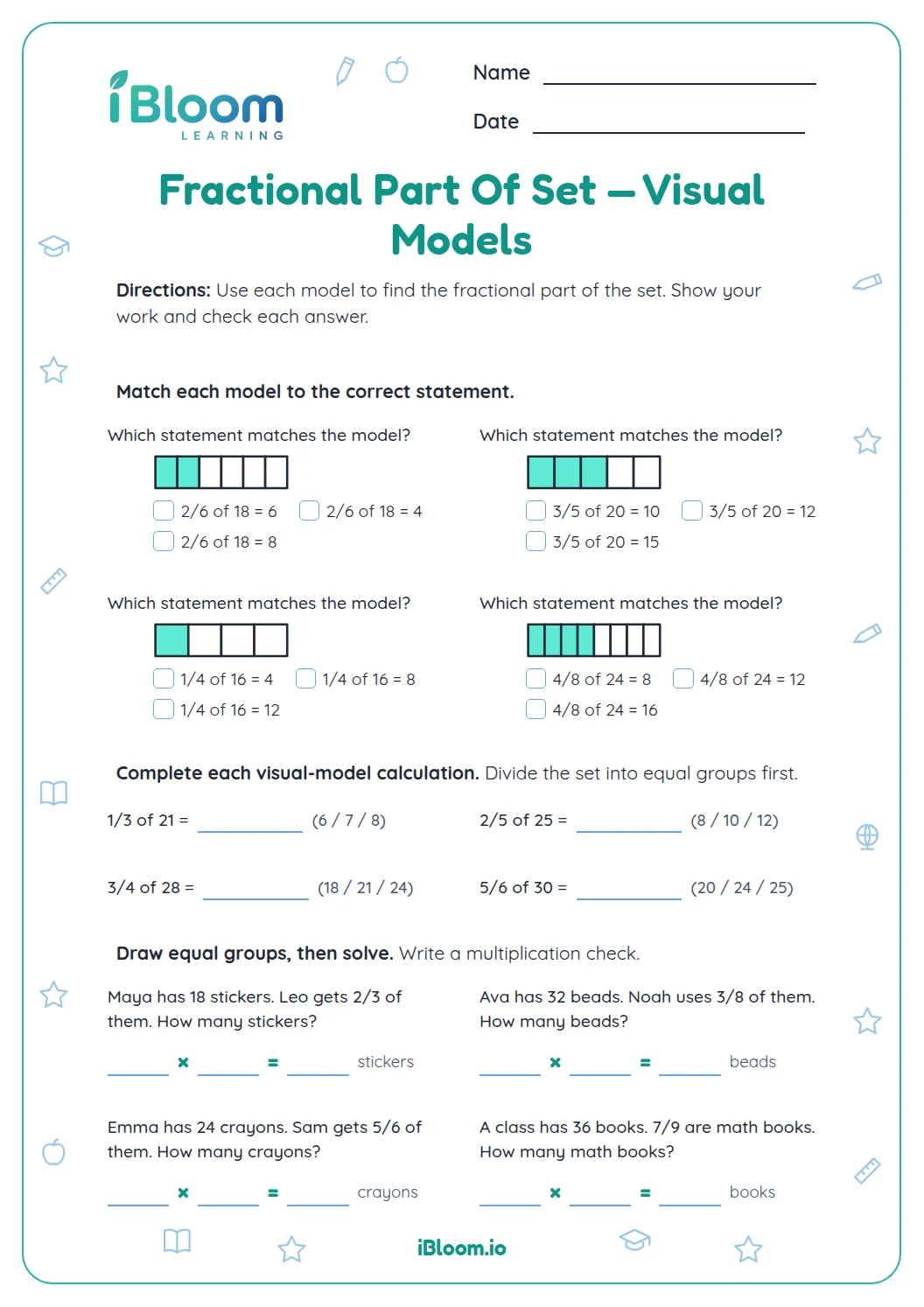
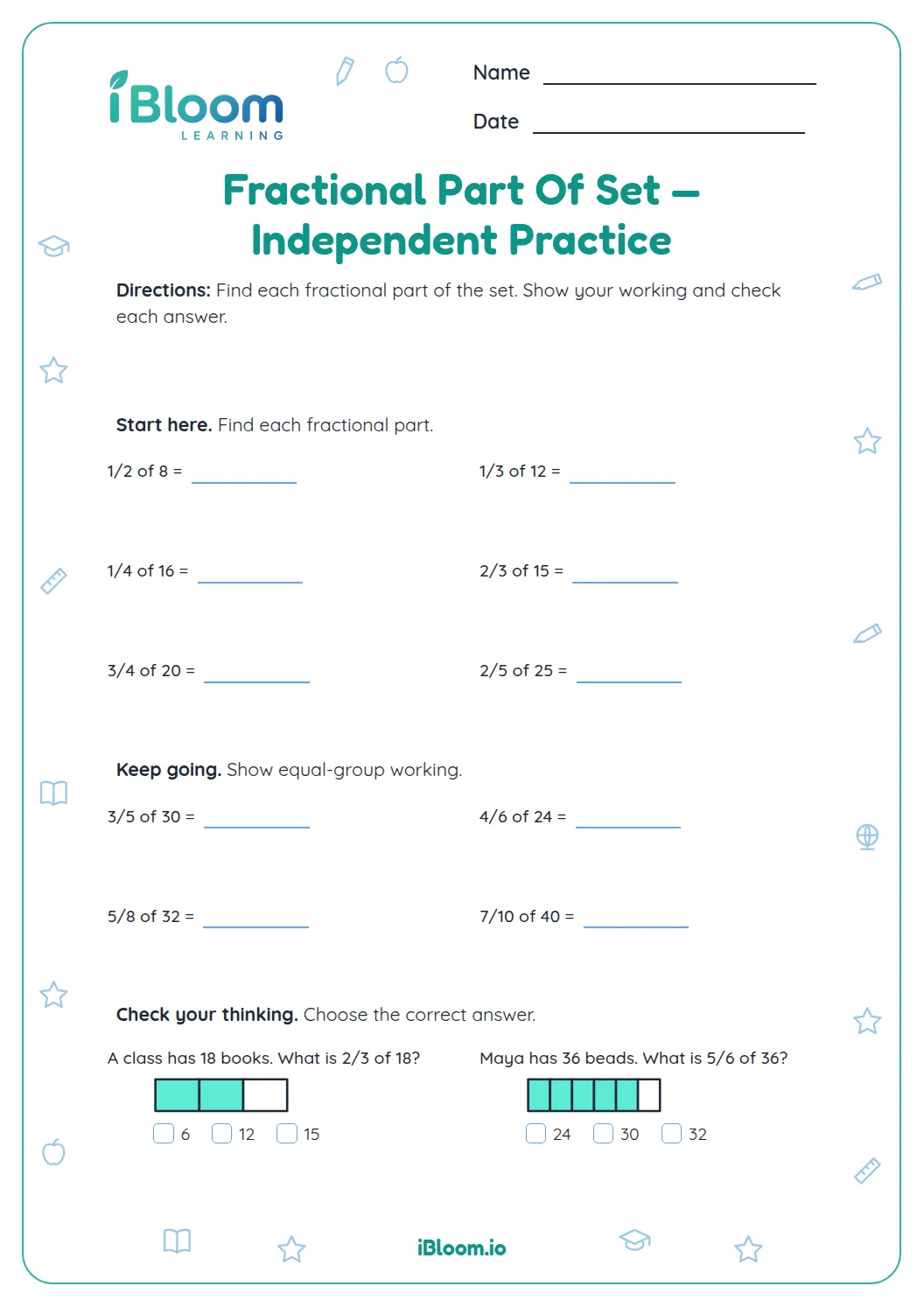
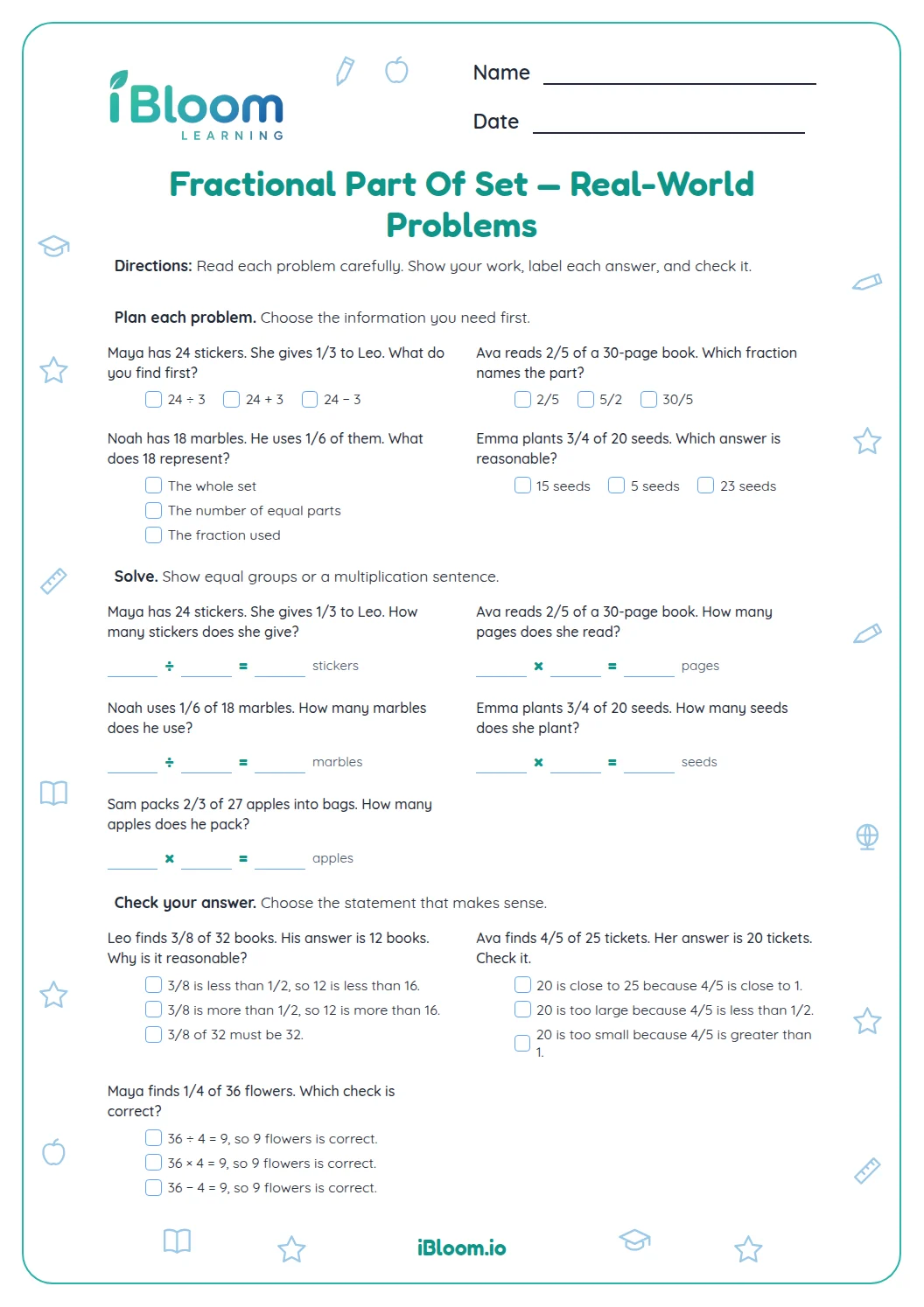




About this worksheet
The 16 questions practice finding a fraction of a set, working backward to find the whole, and applying the same reasoning to short stories. Countable apple groups support the opening models; familiar Grade 4 denominators keep every calculation within the target skill.
Aligned to 4.NF.B.4.b
How do you find a fraction of a set?
The 16 questions practice finding a fraction of a set, working backward to find the whole, and applying the same reasoning to short stories. Countable apple groups support the opening models; familiar Grade 4 denominators keep every calculation within the target skill.
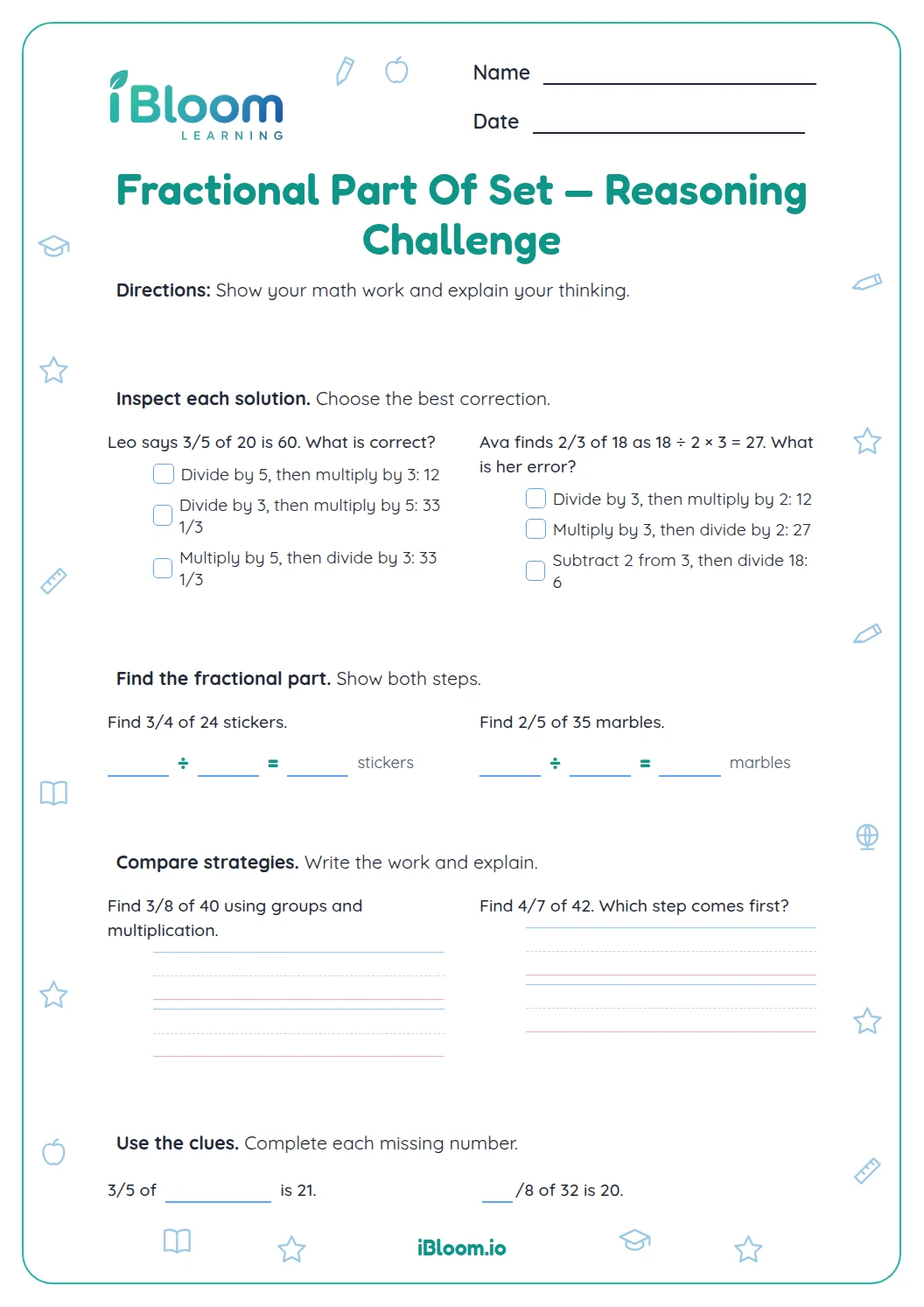
For 3/5 of 20, split 20 into five equal groups (4 each), then take three groups: 12.
- 120 ÷ 5 = 4 in each fifth
- 24 × 3 = 12
- 3So 3/5 of 20 is 12
How can you find the whole set?
If 3/4 of a set is 18, one fourth is 18 ÷ 3 = 6. Four groups of 6 make 24, so the whole is 24.
What practice is on this worksheet?
The 16 questions move from pictured groups to missing whole sets and short classroom situations. Pictures show the complete group for each model question.
- Part A: 8 pictured fraction-of-a-set questions
- Part B: 4 missing whole-set questions
- Part C: 4 short word problems with work space
- A separate answer key checks every result.
How can an adult support this practice?
- 1Read the denominator as the number of equal groups.
- 2For a pictured set, count every object before dividing.
- 3Find one fractional part by dividing the total.
- 4Multiply by the numerator to find the requested number of parts.
- 5For a missing whole, divide the known part by its numerator, then scale to the denominator.
- 6Check that equal groups would rebuild the total.
Common mistakes and quick fixes
The mistake
Dividing by the numerator first and stopping.
The fix
Divide by the denominator to find one equal part, then take the requested number of parts.
The mistake
Counting only the requested objects and forgetting the rest of the set.
The fix
Count the full group first; the denominator partitions all of it.
The mistake
Using the numerator as the number of groups.
The fix
The denominator tells how many equal groups make the whole.
Common Core alignment
This practice connects equal fractional parts to multiplication.
Use equal unit-fraction groups to find a fraction of a whole-number set.
On this sheet: Children find fractional amounts by combining equal unit-fraction groups.
Show the official wordingHide the official wording
Understand a multiple of a/b as a multiple of 1/b, and use this understanding to multiply a fraction by a whole number. For example, use a visual fraction model to express 3 × (2/5) as 6 × (1/5), recognizing that this product is 6/5. (In general, n × (a/b) = (n × a)/b.)
What to practice next
Make more practice
Further reading
Questions parents and teachers ask
What does 3/5 of 20 mean?
It means split 20 into 5 equal groups and take 3 of those groups. Each group has 4 objects, so three groups contain 12. The first part of this worksheet practices that two-step idea with pictured sets so children can connect the fraction to equal groups.
Why divide by the denominator first?
The denominator names how many equal parts make the whole. Dividing the total by 5 finds the size of one fifth; multiplying that amount by 3 finds three fifths. This keeps the groups equal and helps children explain what each number in the fraction means.
How do you find a whole when only part is known?
If 4/6 of a set is 28, divide 28 by 4 to find one sixth, which is 7. Then multiply 7 by 6 to get the whole set, 42. Part B uses this reverse reasoning in four questions.
Can the pictured sets be counted directly?
Yes. Count the complete set, then use the fraction to partition it into equal groups. The pictures on Part A show every object in the group, and the numerical questions later ask children to use the same reasoning without pictures.
What should a child do if the groups are not equal?
Recheck the division. A fraction of a set divides the whole into equal groups, so each group must have the same number of objects. If the total does not divide evenly by the denominator, check the arithmetic or the item before proceeding.
Is there an answer key?
Yes. The separate answer key gives one result for every question on the worksheet. For story problems, learners can check that the requested fraction of the full set matches their answer. An adult can ask them to explain how the denominator and numerator guided the calculation.