






About this worksheet
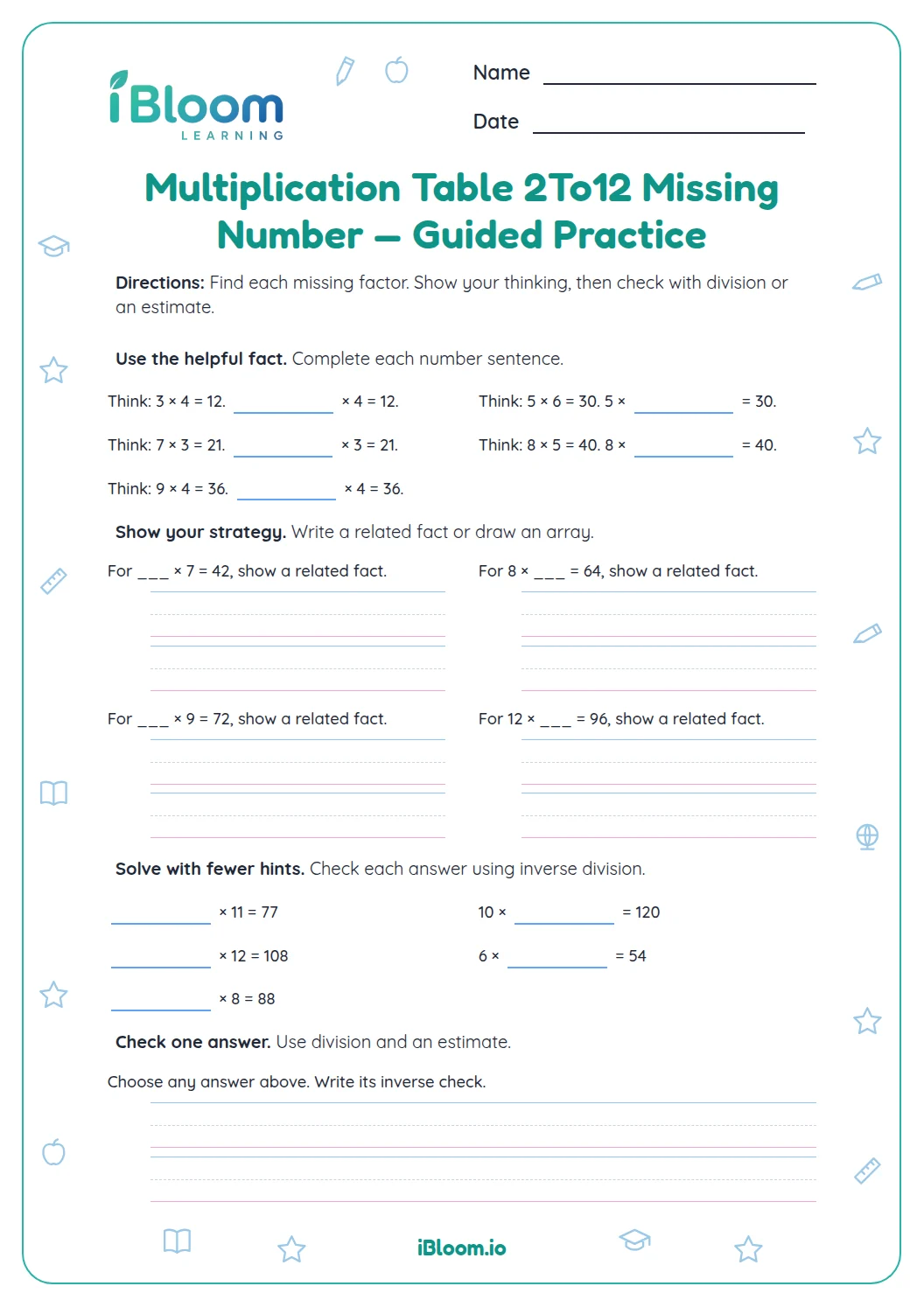
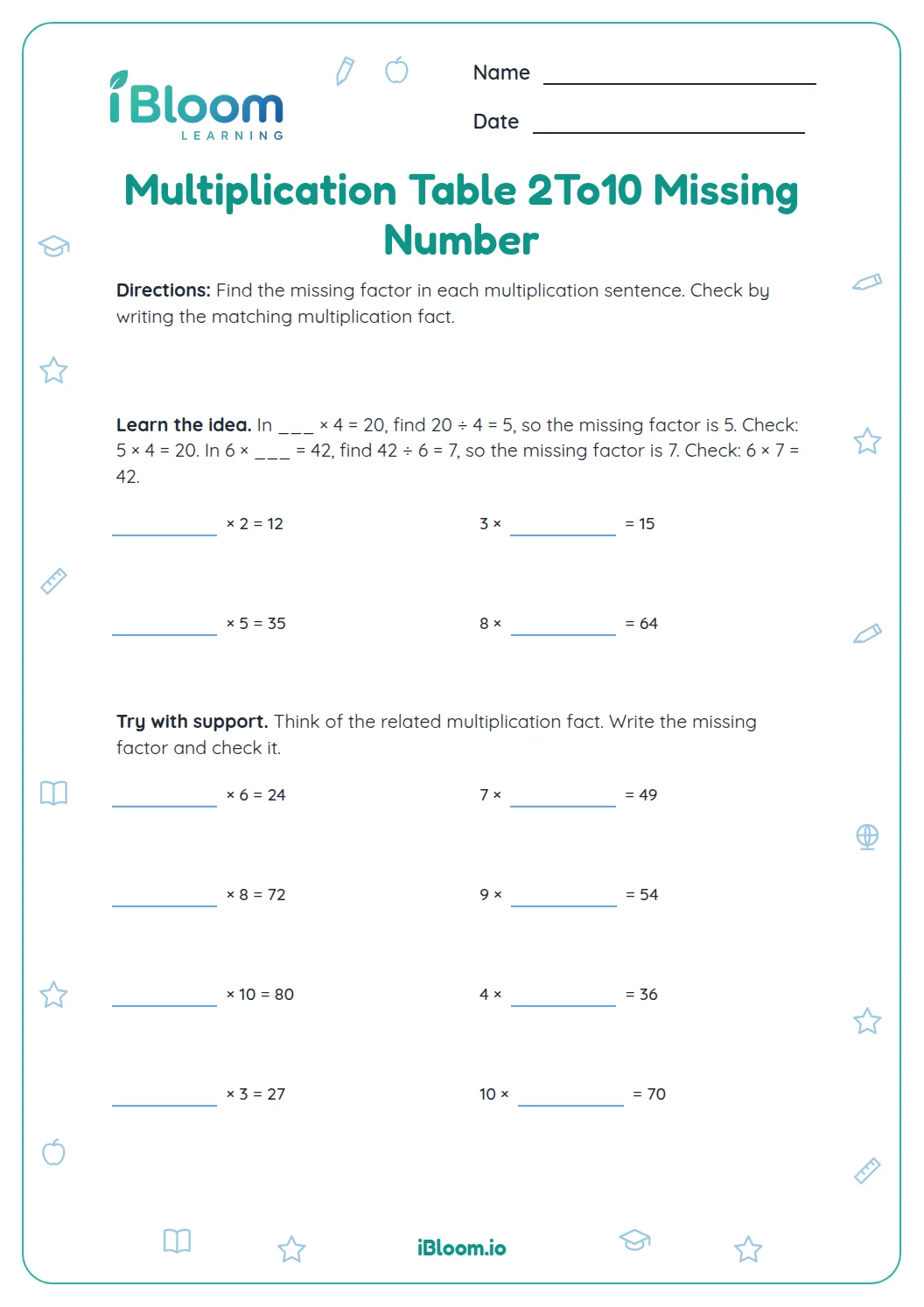
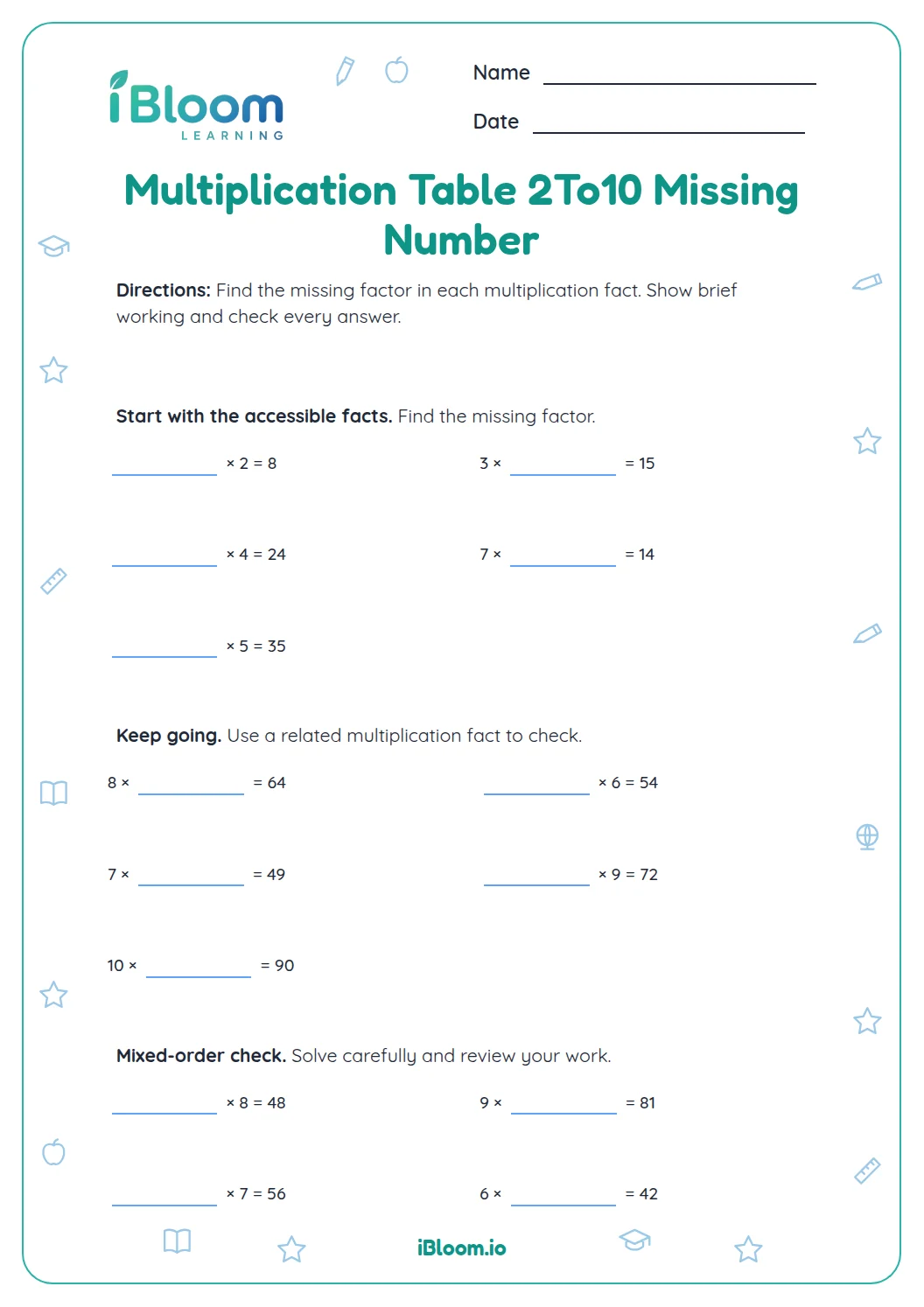
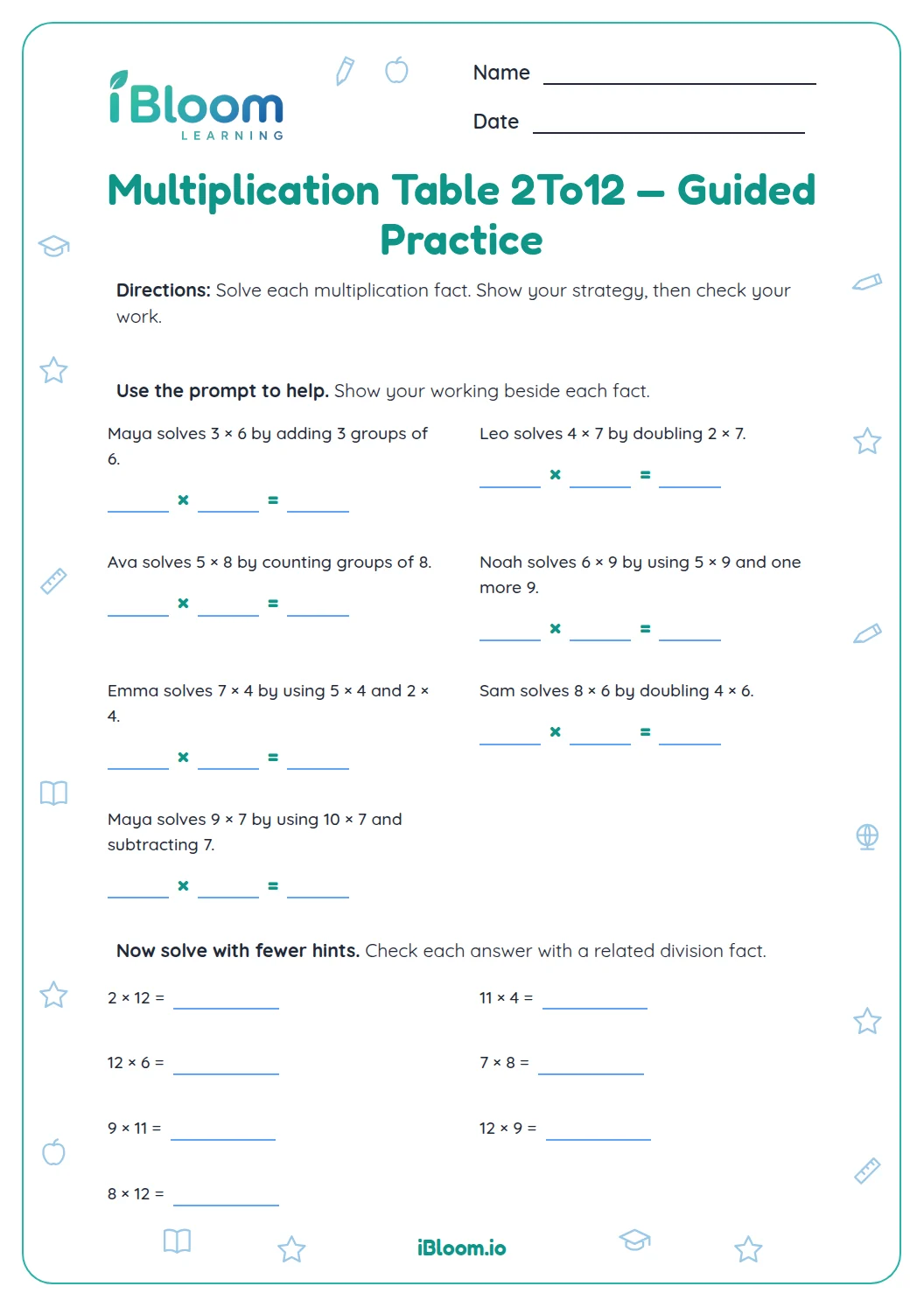
This Grade 4 printable gives 18 missing-factor questions using multiplication facts from 2 through 12. Parts A and B use number sentences; Part C turns the same factor-and-product relationship into equal-group stories. Learners find the unknown factor and can check it by multiplying or dividing. The fact practice aligns with CCSS 3.OA.C.7.
Aligned to 3.OA.C.7
How can a known fact reveal a missing factor?
A multiplication equation has two factors and a product. If one factor is blank, recall or build a fact that reaches the product. For 2 × ___ = 18, the factor is 9 because 2 × 9 = 18.
How does division help check the answer?
Divide the product by the known factor to find the missing factor. For 108 ÷ 9, the quotient is 12, so 9 × 12 = 108. Multiplying the factors back together confirms the equation.
How can children verify every equation?
For question 7, 8 × ___ = 88. Since 8 × 11 is 88, write 11 in the blank, then multiply 8 by 11 to confirm. Checking guards against stopping at a nearby fact.
- 18 × ___ = 88
- 288 ÷ 8 = 11
- 3Check: 8 × 11 = 88
- 4Answer: 11
How to solve the missing-factor facts
- 1Read the factor you know and the product at the end.
- 2Ask which multiplication fact with the known factor makes that product.
- 3If useful, divide the product by the known factor to find the blank.
- 4Write the missing factor in the equation.
- 5Multiply the factors to check that they return the given product.
Missing-factor mistakes
The mistake
Dividing the known factor by the product.
The fix
Use product ÷ known factor to find the missing factor.
The mistake
Choosing a nearby fact, such as 8 × 10 for a product of 88.
The fix
Multiply the candidate by the known factor and check the exact product.
The mistake
Switching the factor and product positions.
The fix
Keep the equation structure in view: factor × factor = product.
Common Core alignment
Use multiplication and division fact relationships to find missing factors.
On this sheet: All 18 equations practice multiplication facts within 100 with a missing one-digit or two-digit factor up to 12.
Show the official wordingHide the official wording
Fluently multiply and divide within 100, using strategies such as the relationship between multiplication and division (e.g., knowing that 8 × 5 = 40, one knows 40 ÷ 5 = 8) or properties of operations. By the end of Grade 3, know from memory all products of two one-digit numbers.
What to practice next
Make more practice
Further reading
Questions parents and teachers ask
What does “missing factor” mean?
A factor is one of the numbers multiplied. In 8 × ___ = 88, one factor is known and the other is missing; 11 fills the blank because 8 × 11 = 88. The product is the answer after multiplying, which here is 88.
Which multiplication tables are included?
The 18 questions use factors from the multiplication tables 2 through 12. The first 12 are missing-factor equations; the last six describe equal groups and ask for the unknown group size. The answer key gives the factor that makes each product true.
How can division help solve these questions?
When a product and one factor are known, divide the product by the known factor. For 88 ÷ 8, the quotient is 11, so the missing factor in 8 × ___ = 88 is 11. Multiplying 8 × 11 checks the result.
How many questions are on the worksheet?
There are 18 questions across three parts: twelve fill-in multiplication equations and six equal-group stories. Part A starts with familiar facts, Part B uses the wider table range, and Part C asks students to find an unknown factor from a product and group description. The worksheet uses two pages, followed by its answer key.
What should a student do after filling a blank?
Multiply the known factor by the proposed missing factor. The result should equal the product already shown. If it does not, check the related fact or divide the product by the known factor and try again. The answer key also lists all 18 missing factors.
How long does this practice take?
Plan for about 15 minutes for all 18 equations. A student who pauses to use division facts or write a check may need a little longer. Completing one part, checking those answers, and then moving on can keep the practice manageable.