





About this worksheet
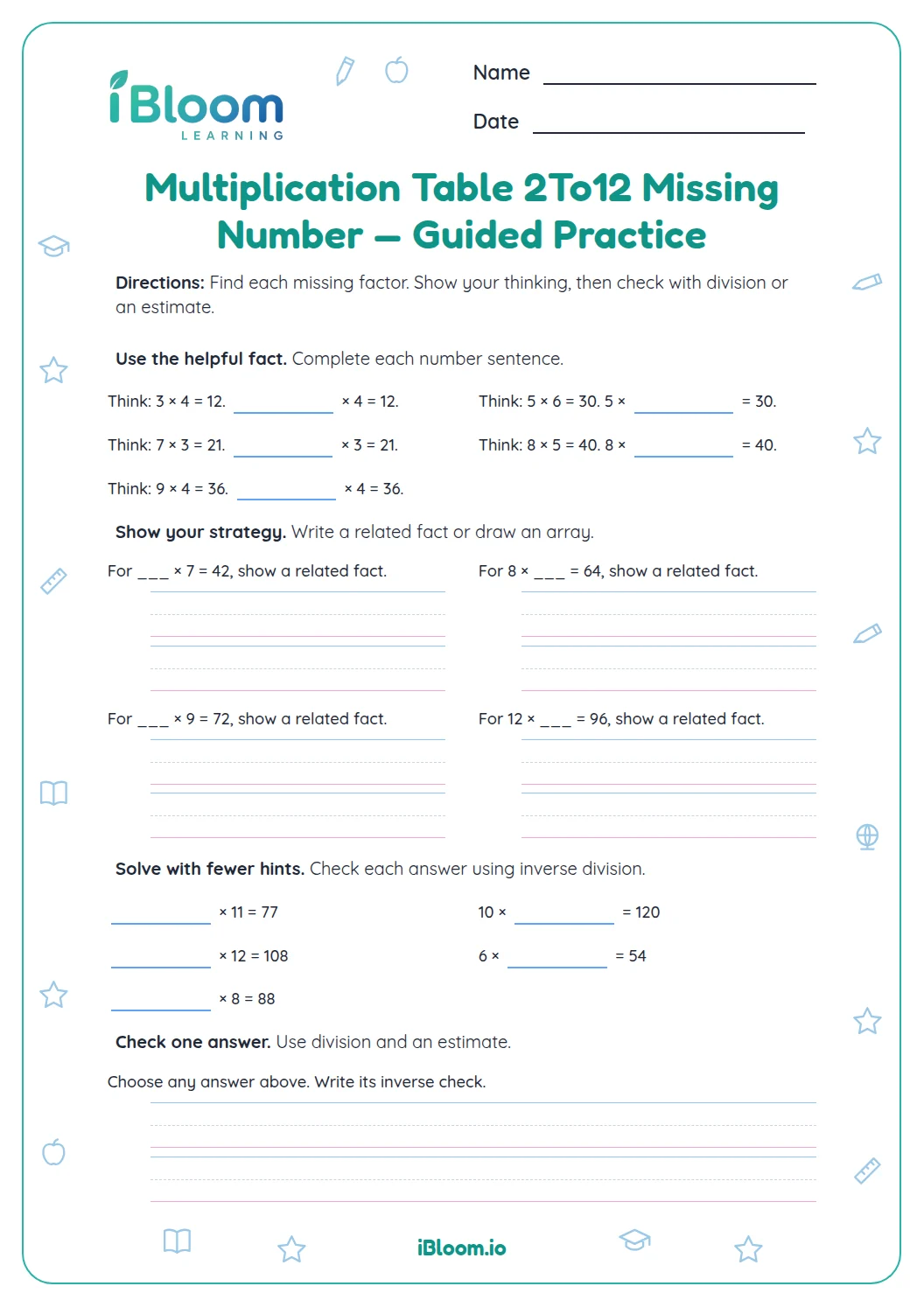
This free printable Grade 4 worksheet gives students 24 missing-factor problems using multiplication facts from 2 through 12. Twenty equations build from a worked factor idea to independent practice, followed by four short contexts about equal groups. Students can divide the product by the known factor or recall a related fact, then multiply to check. The sheet practices CCSS 3.OA.A.4, finding the unknown whole number in a multiplication or division equation.
Aligned to 3.OA.A.4
How can division reveal a missing factor?
In a multiplication equation, the factors make the product. If 4 × ___ = 32, divide 32 by 4 to find 8. Students can also recall that 4 groups of 8 make 32.
The sheet moves from direct equations to short equal-group situations. Each answer can be checked by multiplying both factors.
- 16 × ___ = 48
- 248 ÷ 6 = 8
- 3Check: 6 × 8 = 48
Which multiplication facts appear?
The equations use known factors and missing factors across the 2 through 12 tables. The product and one factor are shown; students supply the other factor. The four final questions express the same idea with rows, teams, plants, or groups of objects.
How should students check a factor?
Multiply the known factor by the proposed missing factor. The product must match the number in the equation or story. For example, 8 groups of 9 muffins make 72 muffins.
How to use this worksheet
- 1Read the directions and scan the whole part.
- 2Underline or name the information that matters.
- 3Choose a strategy and show the calculation.
- 4Write a complete answer with its unit when needed.
- 5Check the answer key and correct any missed step.
Common mistakes and quick fixes
The mistake
Starting to calculate before identifying what the prompt asks.
The fix
Say the unknown aloud, then choose the operation that finds it.
The mistake
Leaving off a unit or context label.
The fix
Reread the question and include the requested unit in the answer.
The mistake
Accepting an answer without checking it.
The fix
Use the inverse operation or estimate to see whether the result makes sense.
Common Core alignment
This worksheet practices the following Common Core skill.
Find the unknown whole number in a multiplication or division equation.
On this sheet:
Show the official wordingHide the official wording
Determine the unknown whole number in a multiplication or division equation relating three whole numbers.
What to practice next
Make more practice
Further reading
Questions parents and teachers ask
How many missing-factor questions are included?
There are 24 questions: 20 multiplication equations and four short equal-group contexts. The answer key lists the missing factor for each one. Students can solve by recalling facts or dividing the product by the known factor. The practice includes both positions for the missing factor.
How do you solve 6 × ___ = 48?
Divide the product, 48, by the known factor, 6. Since 48 ÷ 6 = 8, the missing factor is 8. Check by multiplying 6 × 8 and confirming the product is 48. This inverse relationship is the central strategy on the sheet.
Does the worksheet cover the 2 through 12 facts?
Yes. The equations use factors from the multiplication tables 2 through 12. The given factors and the missing factors vary, so students practice identifying the unknown position rather than completing one repeated table. The factors range across the stated tables.
How do the word problems connect to missing factors?
Each context describes equal groups and gives the total, so students find the number in one group or the number of groups. For example, 72 muffins in 8 rows means 72 ÷ 8 = 9 muffins per row. The story gives the total and one group quantity.
Which standard is practiced?
The worksheet aligns with CCSS 3.OA.A.4, determining the unknown whole number in a multiplication or division equation. Each equation or equal-group story supplies two quantities and asks students to find the third. The same unknown-factor idea appears in each item.