






About this worksheet
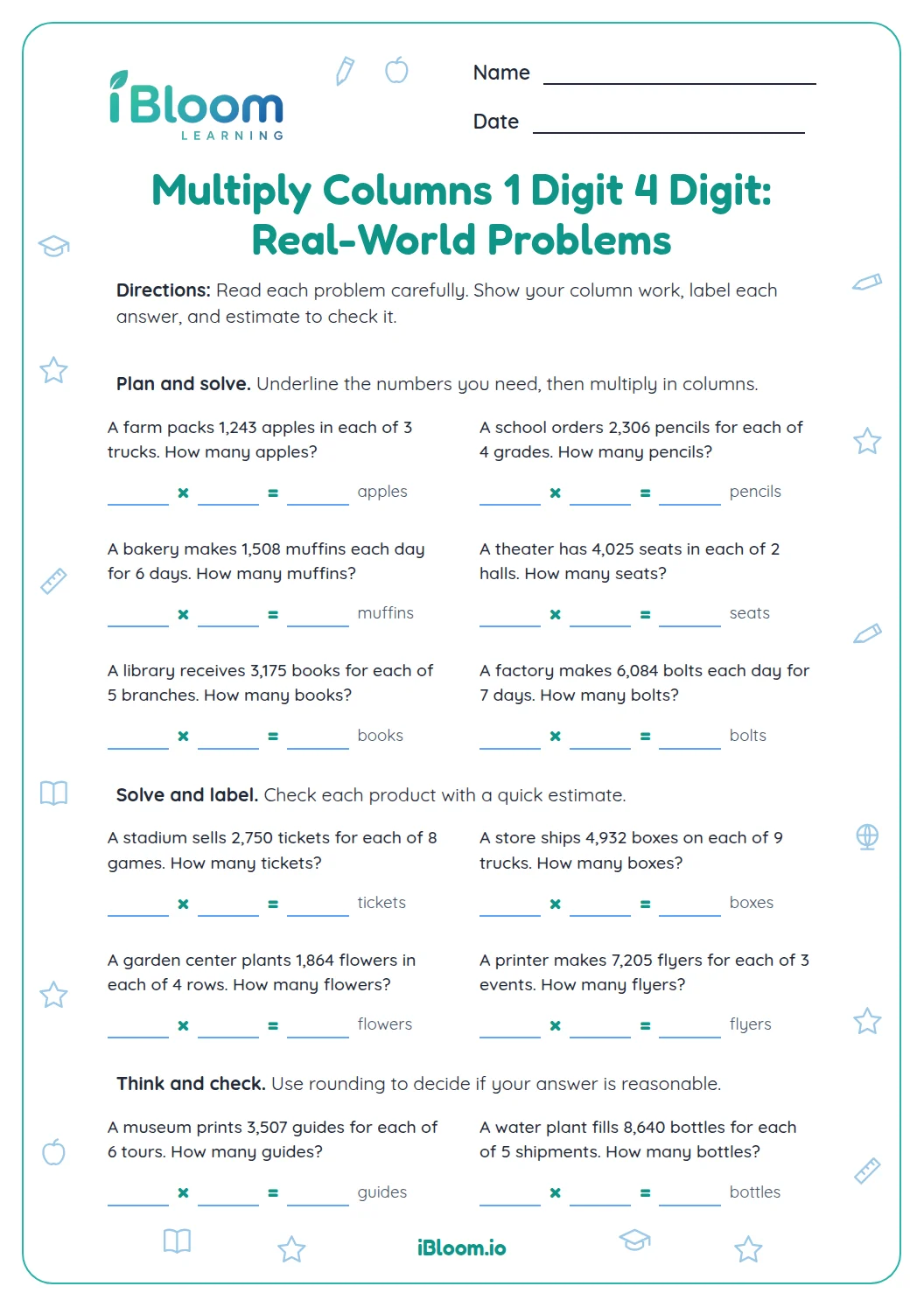
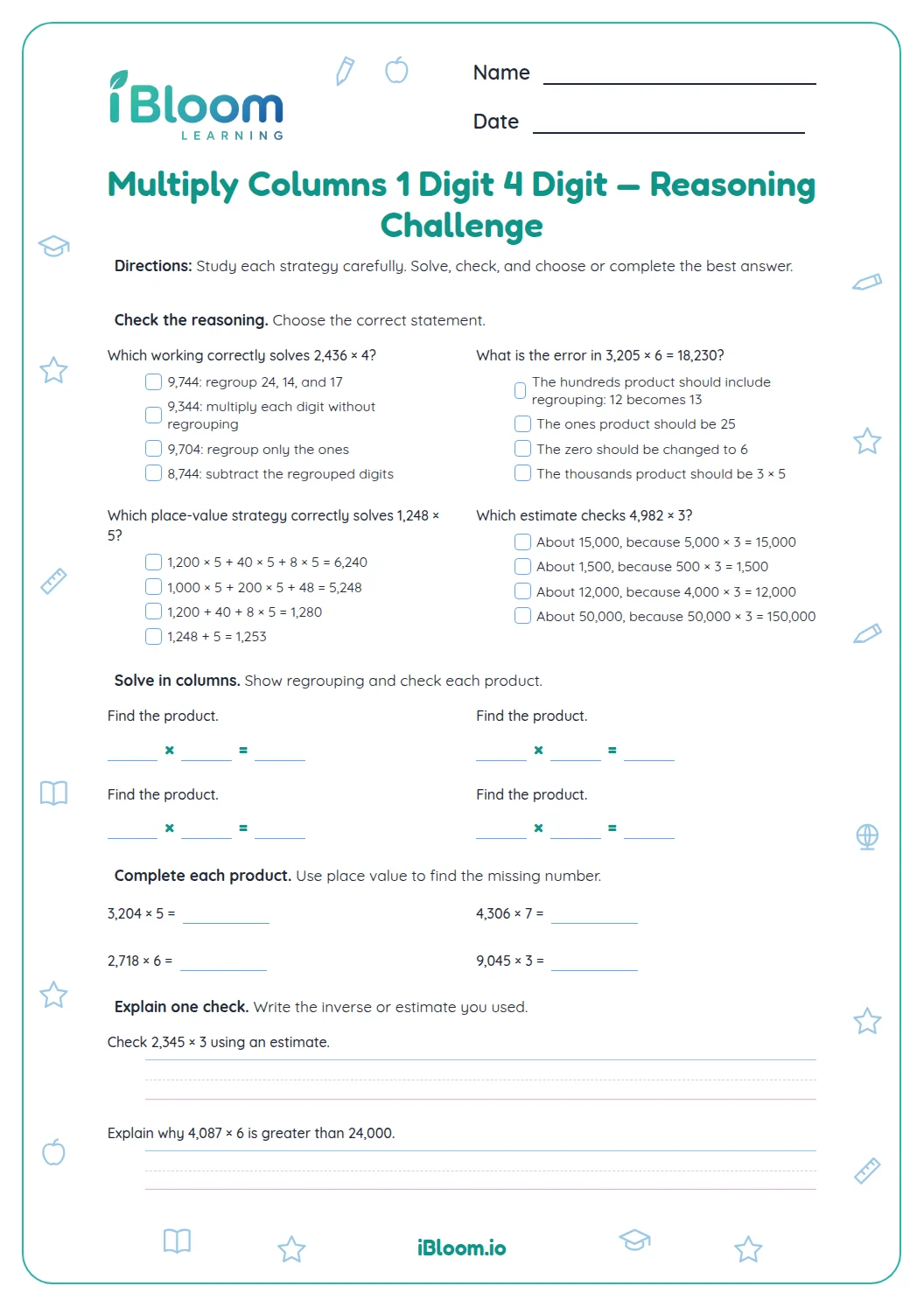
This Grade 4 multiplication worksheet builds from reading the place values in four-digit numbers to finding partial products and full products. Learners solve 15 items, including four-digit multiplication in column-work space and two short contexts. Each product uses a four-digit number and a one-digit factor, practicing CCSS.MATH.CONTENT.4.NBT.B.5.
Aligned to CCSS.MATH.CONTENT.4.NBT.B.5
How does place value organize a product?
A digit’s position tells its value. In 2,346, the 3 is in the hundreds place, so it represents 300. Read each four-digit number by place before moving on to its partial products.
How do partial products make multiplication clear?
Multiply each place-value part by the one-digit factor, then combine the results. In 2 × 1,526, the hundreds partial product is 2 × 500 = 1,000. The final items provide column-work space and apply multiplication to equal groups.
How to use this worksheet
- 1Read each four-digit number by place value.
- 2For a partial product, multiply only the named place-value part.
- 3For full products, set up the four-digit number and one-digit factor in columns.
- 4Regroup when a place has ten or more.
- 5Estimate or multiply the factors to check the product.
Multiplication mistakes to watch for
The mistake
Treating the 3 in 2,346 as 3 instead of 300.
The fix
Name the place first, then state the digit’s value.
The mistake
Writing a hundreds partial product in the ones place.
The fix
Keep each partial product aligned with its place value.
The mistake
Forgetting to regroup when a column product is ten or more.
The fix
Write the ones digit and carry the tens to the next place.
Curriculum alignment
This worksheet practices the named skill through short, grade-level items.
Multiply up to four-digit whole numbers by one-digit whole numbers.
On this sheet: Learners decompose four-digit numbers, find partial products, and solve one-digit by four-digit products.
Show the official wordingHide the official wording
Multiply a whole number of up to four digits by a one-digit whole number, and multiply two two-digit numbers, using strategies based on place value and the properties of operations. Illustrate and explain the calculation by using equations, rectangular arrays, and/or area models.
What to practice next
Make more practice
Further reading
Questions parents and teachers ask
What numbers does this worksheet use?
Every multiplication item uses a four-digit whole number and a one-digit factor. Early questions review place value and partial products, then learners find full products and solve equal-group situations using the same factor sizes. The separate key supports checking the work.
Why does the practice start with place value?
Place value explains why multiplying a hundreds part produces hundreds. For example, in 2 × 1,526, the 2 multiplied by 500 makes 1,000. Recognizing each partial product helps learners keep digits in the correct columns during multiplication. Rereading together makes the clue easier to notice.
Is there room to show column work?
Yes. The full-product and context items use working space so learners can set up the factors, record regrouping, and write the product. The directions ask learners to show work, then check each result by multiplying or estimating. Rereading together makes the clue easier to notice.
How can learners check a product?
Estimate by rounding the four-digit number to a nearby thousand, then compare the estimate with the exact product. Learners can also add the partial products and confirm that their sum matches the column multiplication. The key gives exact products for checking.
How many questions and pages are included?
The worksheet has 15 questions across three total pages, including the answer key. The questions include place-value reading, partial products, full multiplication, and two short equal-group contexts with four-digit quantities. Rereading together makes the clue easier to notice.