




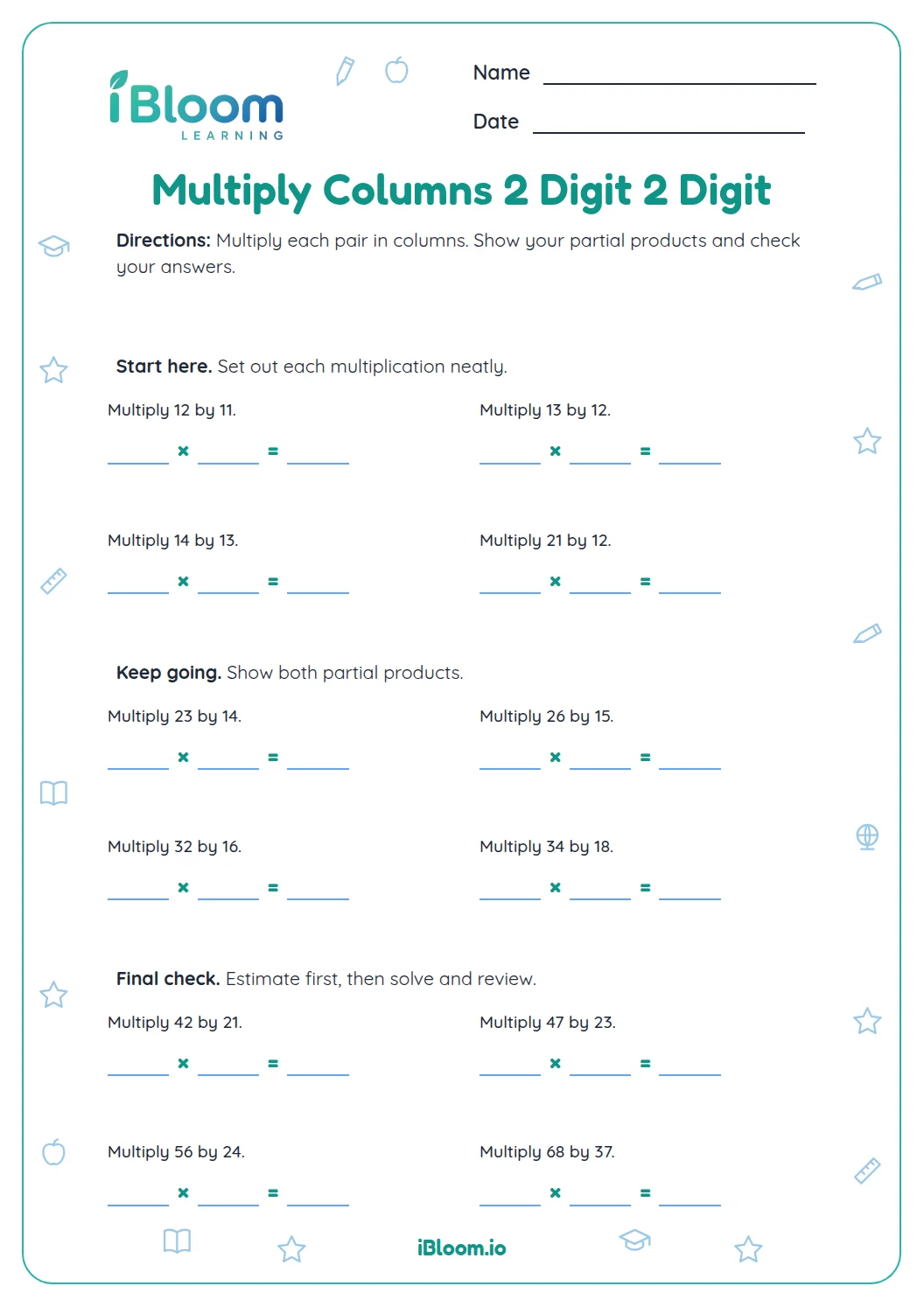
About this worksheet
This free printable Grade 4 multiplication worksheet helps students multiply a three-digit number by a one-digit factor in columns. Six direct problems build the routine, five short stories apply it, and five final items focus on regrouping, place-value products, and checking. A separate answer key is included. The skill aligns with CCSS 4.NBT.B.5.
Aligned to 4.NBT.B.5
How do you multiply in columns?
Write the one-digit factor beneath the ones place. Multiply from right to left, regrouping a ten into the next place when needed. Keep the hundreds, tens, and ones aligned.
Question 1 is 3 × 214. Compute 3 × 4 ones, 3 × 1 ten, and 3 × 2 hundreds to get 642.
- 1 214
- 2× 3
- 3 642
Why does place value matter in each product?
A digit represents ones, tens, or hundreds. For 3 × 214, the parts are 3 × 200, 3 × 10, and 3 × 4. Their products combine to make 642.
How can multiplication solve a repeated-groups story?
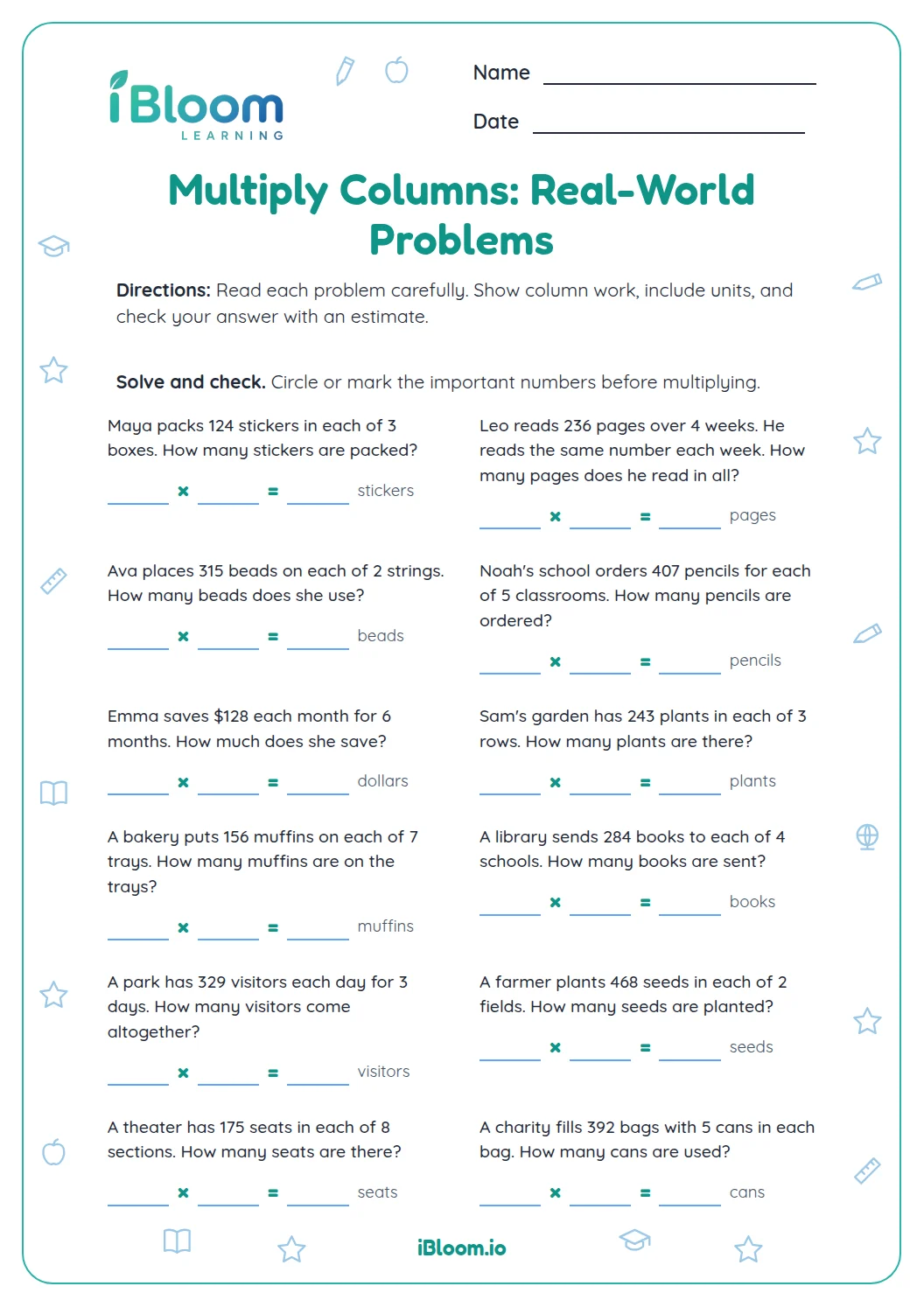
When each group has the same amount, multiply the amount in one group by the number of groups. Three theater sections with 236 seats each means 236 × 3.
How to use this worksheet
- 1Align the one-digit factor under the ones digit.
- 2Multiply the ones, tens, and hundreds in order.
- 3Regroup a ten when a partial product is 10 or more.
- 4Combine the partial products to form the whole product.
- 5Check with an estimate or the related division fact.
Common mistakes and quick fixes
The mistake
Misaligning the one-digit factor.
The fix
Place it directly under the ones digit.
The mistake
Forgetting a regrouped ten.
The fix
Record the carried value above the next place and include it in that product.
The mistake
Treating tens as ones.
The fix
Keep each digit’s place value in mind when multiplying and combining partial products.
Common Core alignment
Multiply a three-digit number by a one-digit factor using place value.
On this sheet: Multiply a three-digit number by a one-digit factor using place value
Show the official wordingHide the official wording
Multiply a whole number of up to four digits by a one-digit whole number, and multiply two two-digit numbers, using strategies based on place value and the properties of operations.
What to practice next
Make more practice
Further reading
Questions parents and teachers ask
What does this multiplication worksheet cover?
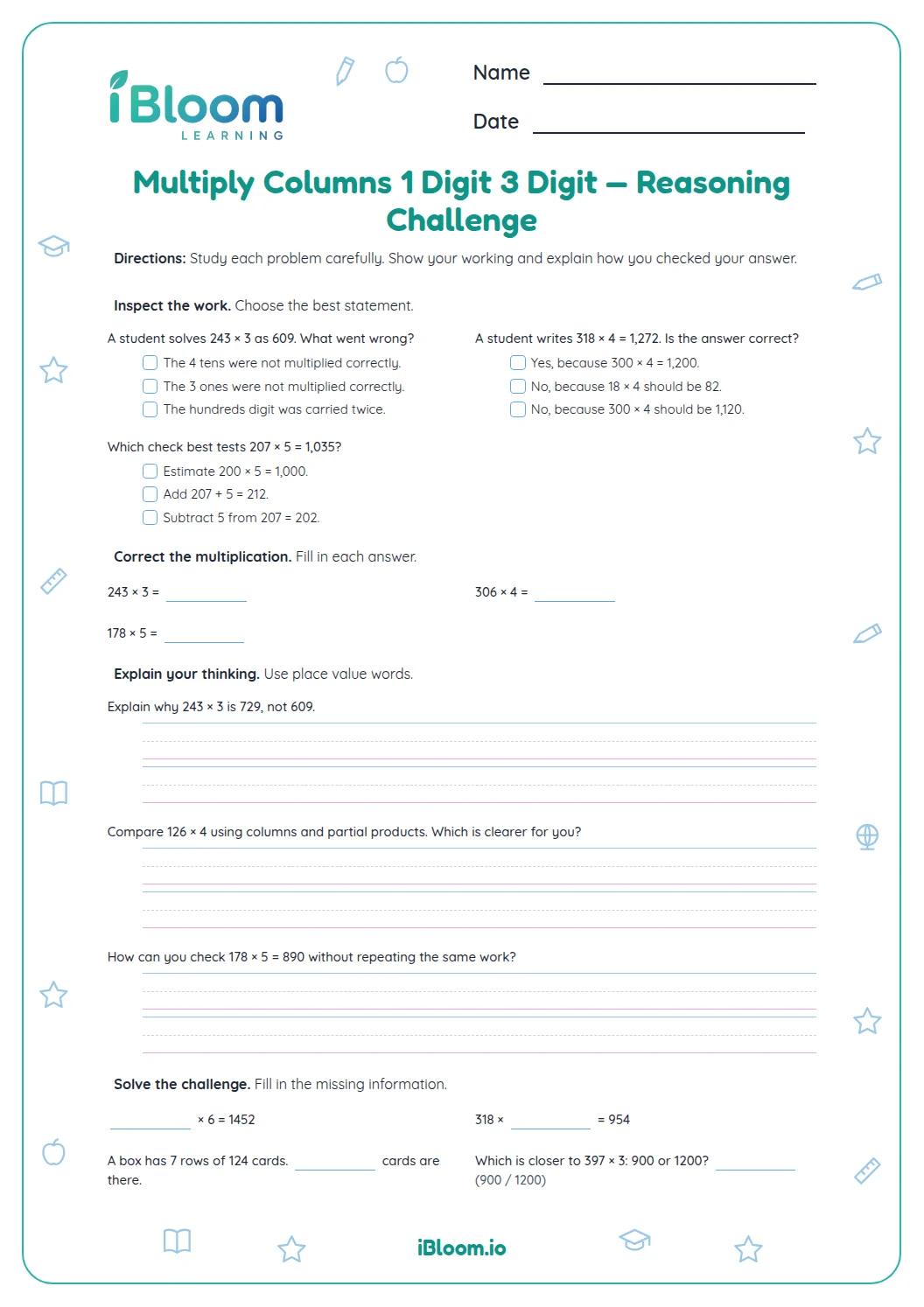
The 16 questions focus on multiplying a three-digit whole number by a one-digit whole number. Six give room to set up and solve products in columns; other questions apply products to stories or check multiplication and place-value reasoning.
How should the digits line up in column multiplication?
Write the three-digit number on top and place the one-digit factor directly under its ones digit. Multiply from ones to tens to hundreds, recording each regrouped amount in the next place before finishing the product. Use the separate key to review the reasoning and result.
Does the sheet include word problems?
Yes. Five questions describe equal groups, such as the same number of seats in each section or flyers made each hour. Students choose the correct product from three options, applying three-digit by one-digit multiplication to each situation. Use the separate key to check the reasoning and result.
How can students check a product?
Estimate whether the product is a reasonable size, then use the related division fact when it is easy to do. For example, 4 × 219 = 876 can be checked with 876 ÷ 4 = 219. Use the separate key to review the reasoning and result.
Why is regrouping needed?
A partial product can be ten or more in a place. Regrouping exchanges ten ones for one ten, or ten tens for one hundred, so the written product keeps the correct place values. The worksheet includes products that require regrouping.