




About this worksheet
This free Grade 4 worksheet builds fluency with multiplying a three-digit number by a one-digit number. Students connect place value to products, solve in columns with regrouping, apply multiplication to equal groups, and check with partial products. It practices CCSS 4.NBT.B.5. A separate answer key lists products and word-problem answers.
Aligned to 4.NBT.B.5
What skills are included?
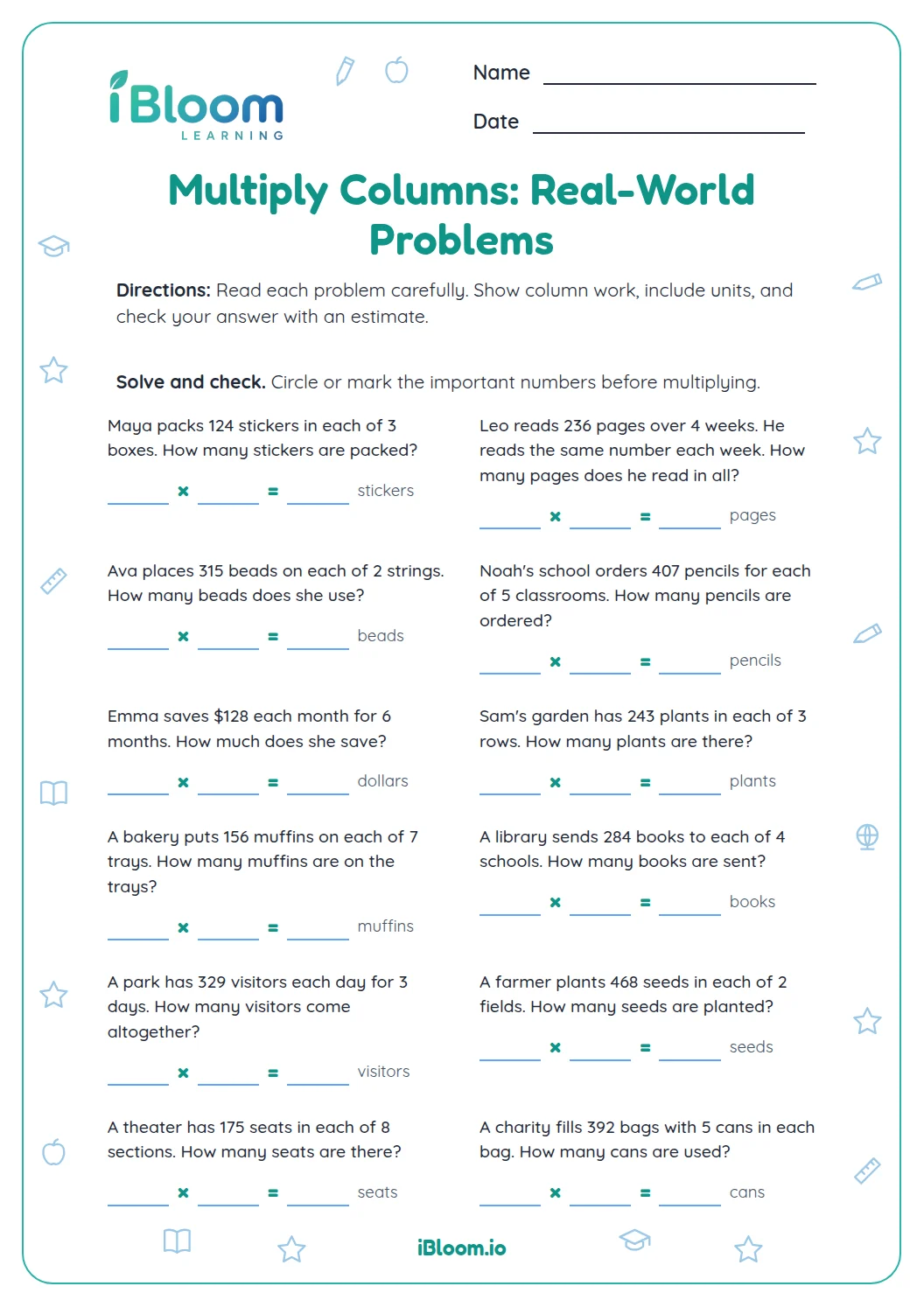
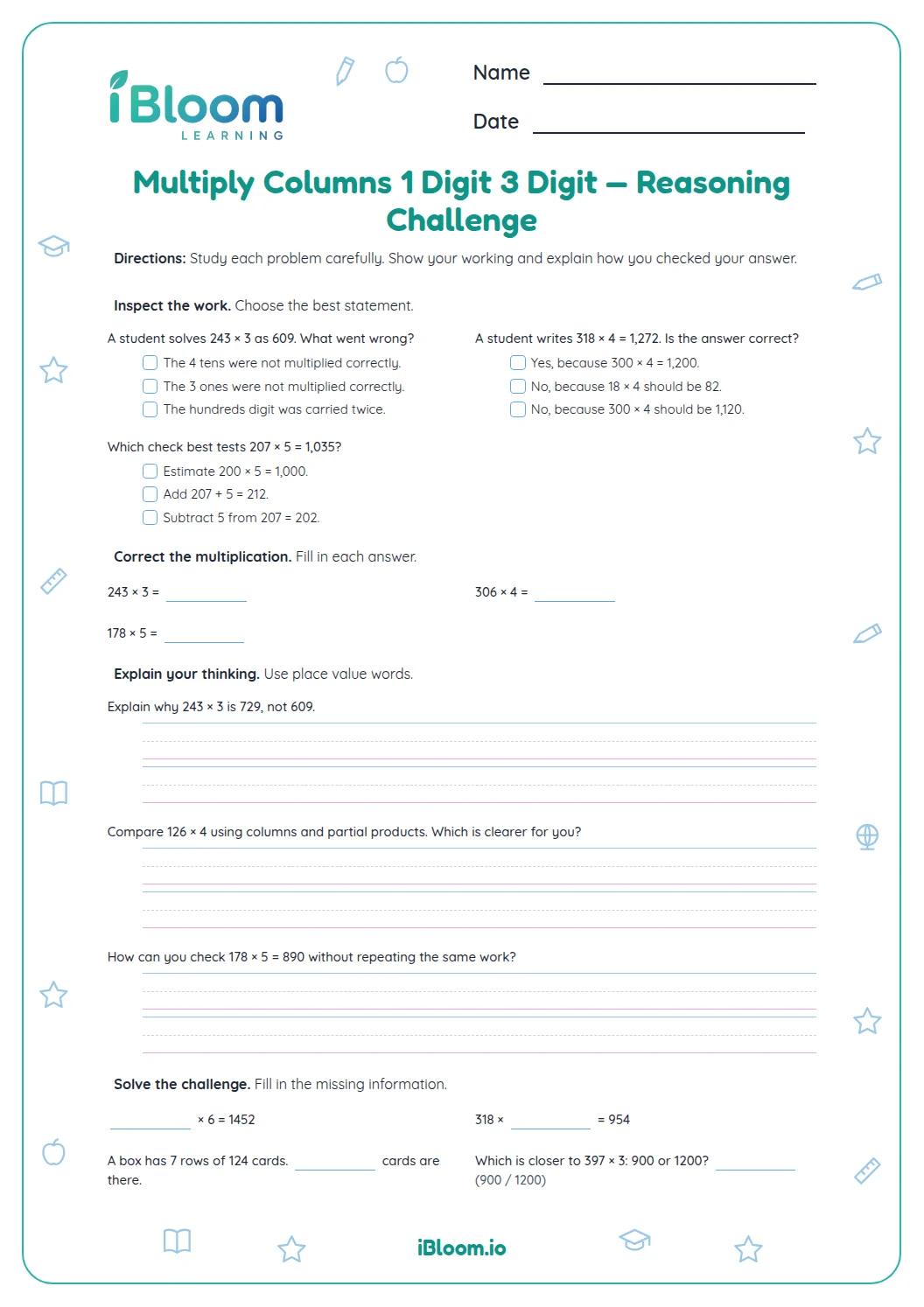
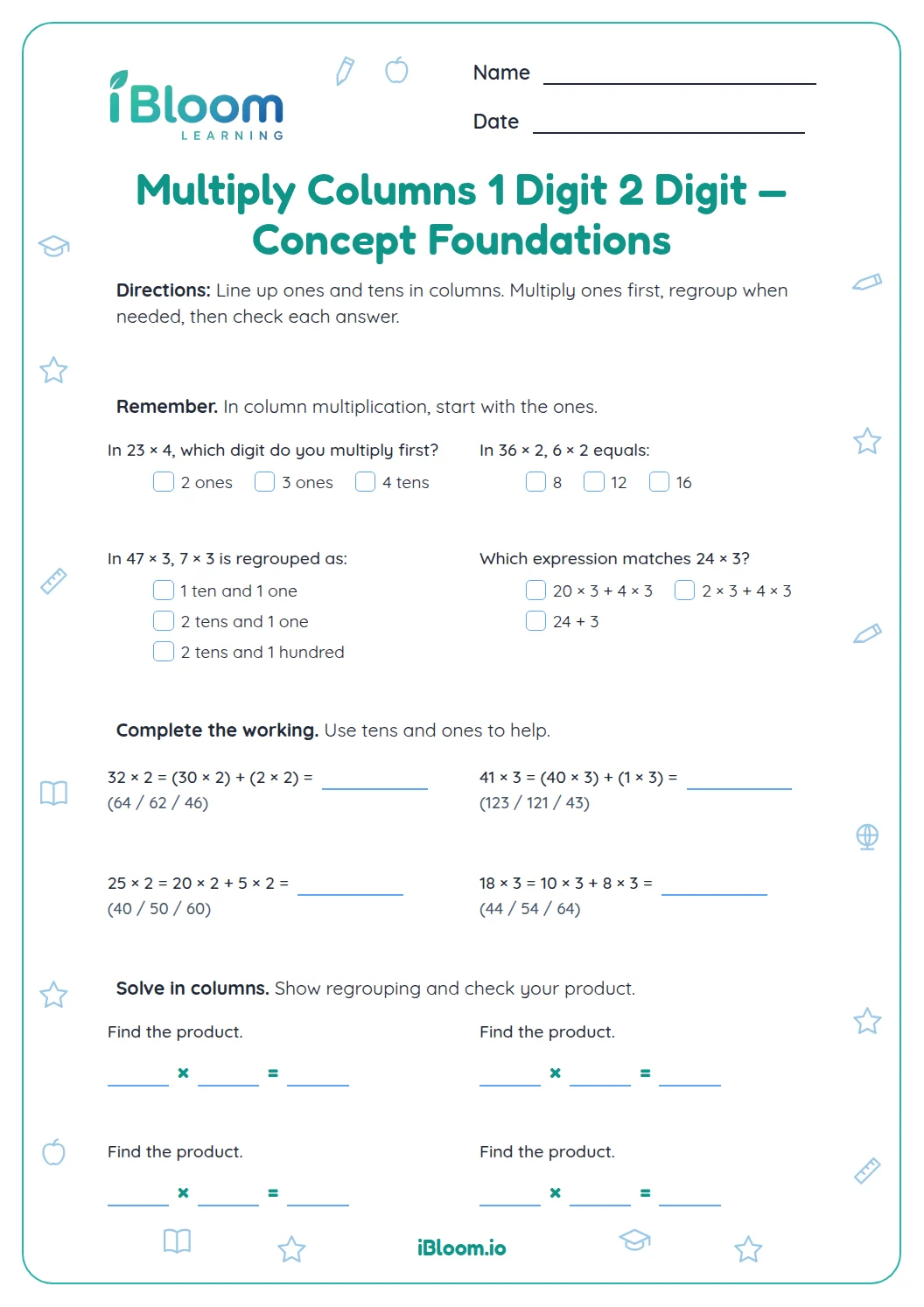
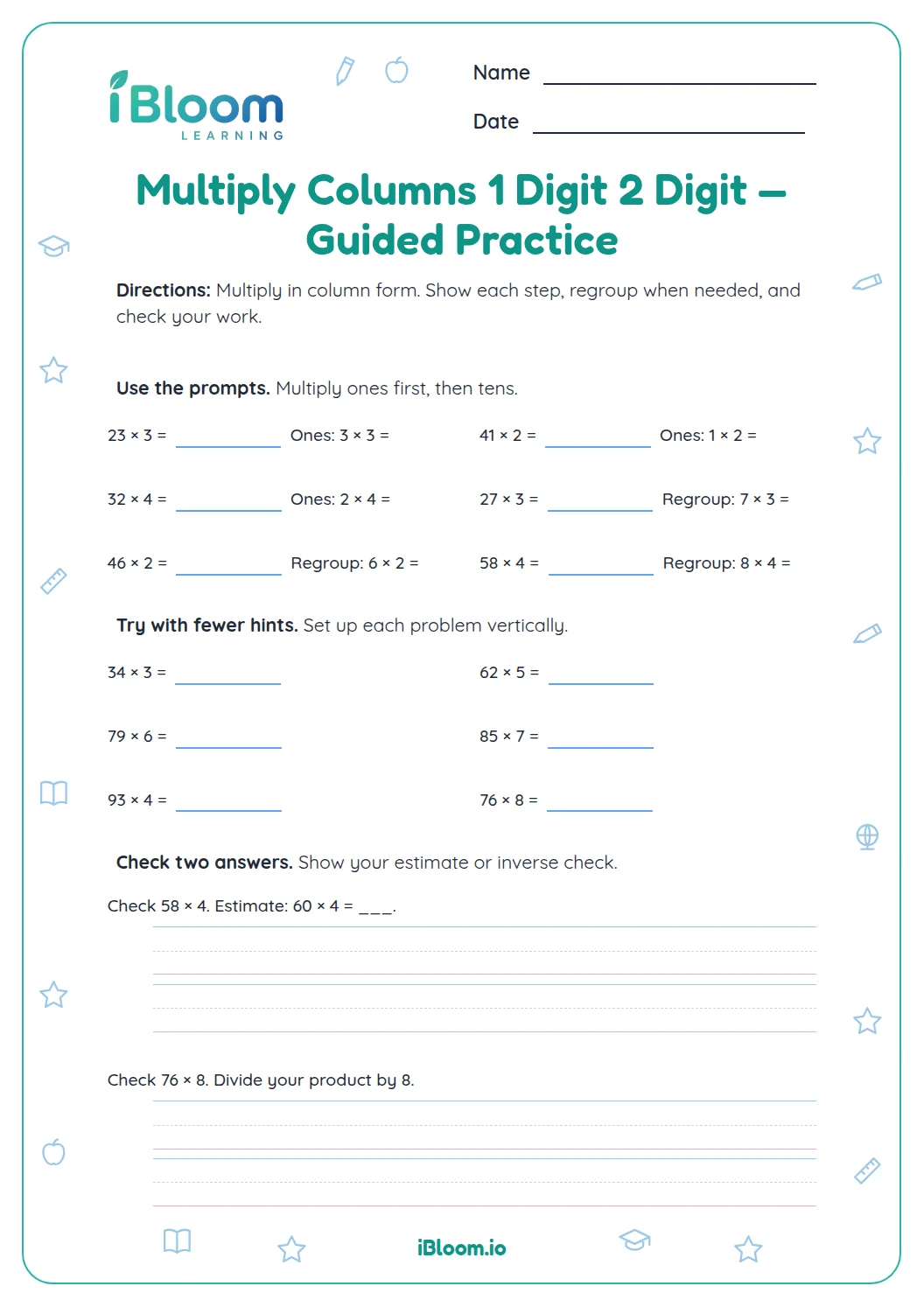
Part A connects place value to multiplication. Part B gives column practice with regrouping. Part C puts equal groups into short contexts, and Part D asks students to use partial products as a check.
How can place value make multiplication clearer?
Split the three-digit factor into hundreds, tens, and ones. Multiply each part by the one-digit factor, then add those results to get the full product.
- 1243 × 3 = (200 × 3) + (40 × 3) + (3 × 3)
- 2600 + 120 + 9 = 729
- 3So 243 × 3 = 729.
When should students regroup?
Regroup when a place-value product is ten or more of that place. In 326 × 3, 6 × 3 is 18 ones, so write 8 ones and regroup 1 ten before multiplying the tens.
How to use this worksheet
- 1Start by naming the hundreds, tens, and ones in the number.
- 2Multiply each digit by the one-digit factor, beginning with the ones place.
- 3Regroup a ten or hundred when a partial product reaches the next place.
- 4Use an equation for each equal-groups story in Part C.
- 5Check selected products by adding the partial products.
Multiplication slips to check
The mistake
Dropping a regrouped ten.
The fix
Write the carried value above the next place and include it in that product.
The mistake
Treating 40 as 4 in a partial product.
The fix
Keep the place value: 4 tens times 3 is 12 tens, or 120.
The mistake
Multiplying only the first two digits.
The fix
Check the hundreds, tens, and ones products before adding them.
Common Core alignment
The questions connect multiplication to place value, regrouping, and partial products.
Multiply up to four-digit numbers by one-digit numbers using place value.
On this sheet: Multiply up to four-digit numbers by one-digit numbers using place value.
Show the official wordingHide the official wording
Multiply a whole number of up to four digits by a one-digit whole number, and multiply two two-digit numbers, using strategies based on place value and the properties of operations. Illustrate and explain the calculation by using equations, rectangular arrays, and/or area models.
What to practice next
Make more practice
Further reading
Questions parents and teachers ask
What multiplication does this worksheet practice?
It practices three-digit numbers multiplied by one-digit numbers. Students use place-value ideas, solve products in columns, apply multiplication to equal groups, and check with partial products. Students can pause after each part and use the key to review both the answer and the reasoning.
How many questions are included?
The worksheet has 16 questions across four parts. There are place-value model items, column computations, equal-groups word problems, and partial-product checks. Students can pause after each part and use the key to review both the answer and the reasoning.
Why use partial products?
Partial products show how hundreds, tens, and ones each contribute to the total. For example, 243 × 3 can be calculated as 600 + 120 + 9. Students can pause after each part and use the key to review both the answer and the reasoning.
What does regrouping mean in multiplication?
Regrouping exchanges ten ones for one ten, or ten tens for one hundred. It lets students record a product using the correct place values. Students can pause after each part and use the key to review both the answer and the reasoning.
How can a student check a product?
Break the three-digit factor into hundreds, tens, and ones, multiply each part, and add the results. The total should match the product from the column method. Students can pause after each part and use the key to review both the answer and the reasoning.