






About this worksheet
This Grade 4 worksheet builds two-digit by one-digit multiplication from arrays and place-value models to partial products and independent problems. Students read equal groups, split a factor into tens and ones, and solve short grouping situations. It practices CCSS 4.NBT.B.5 through place-value strategies, rectangular arrays, and equations. The separate answer key includes each product.
Aligned to 4.NBT.B.5
How do the models show multiplication?
An array displays equal rows and columns. Five rows of 12 squares show 5 groups of 12, or 60 squares. A base-ten drawing can show the total after multiplying groups.
- 1Question 4 shows 5 rows of 12 squares: 5 × 12 = 60.
How can tens and ones make a product easier?
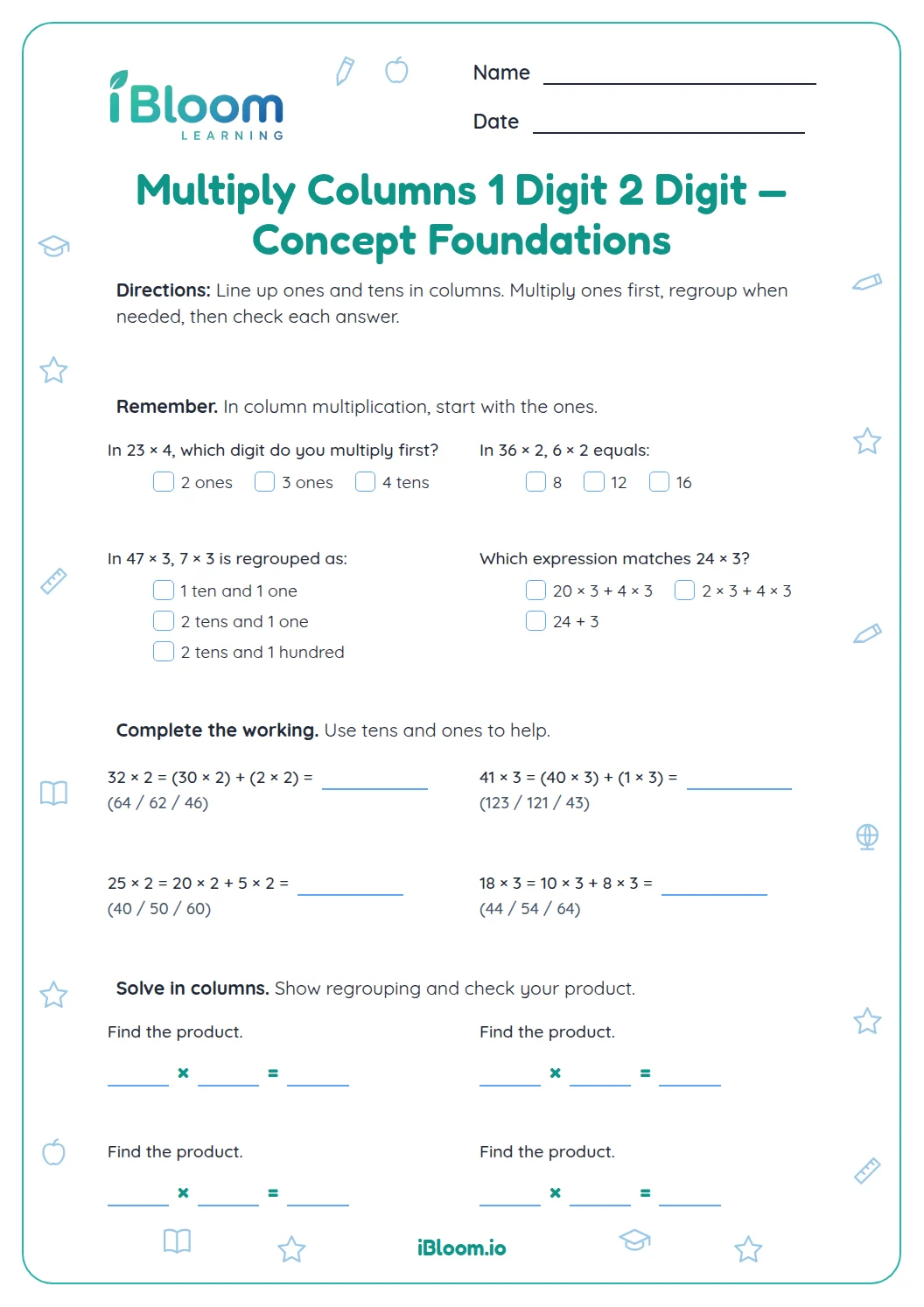
Break a two-digit factor into tens and ones, multiply each part, then add. This keeps the place value visible and helps catch a missed digit.
- 123 × 3 = (20 × 3) + (3 × 3) = 60 + 9 = 69.
How do I write a multiplication story as an equation?
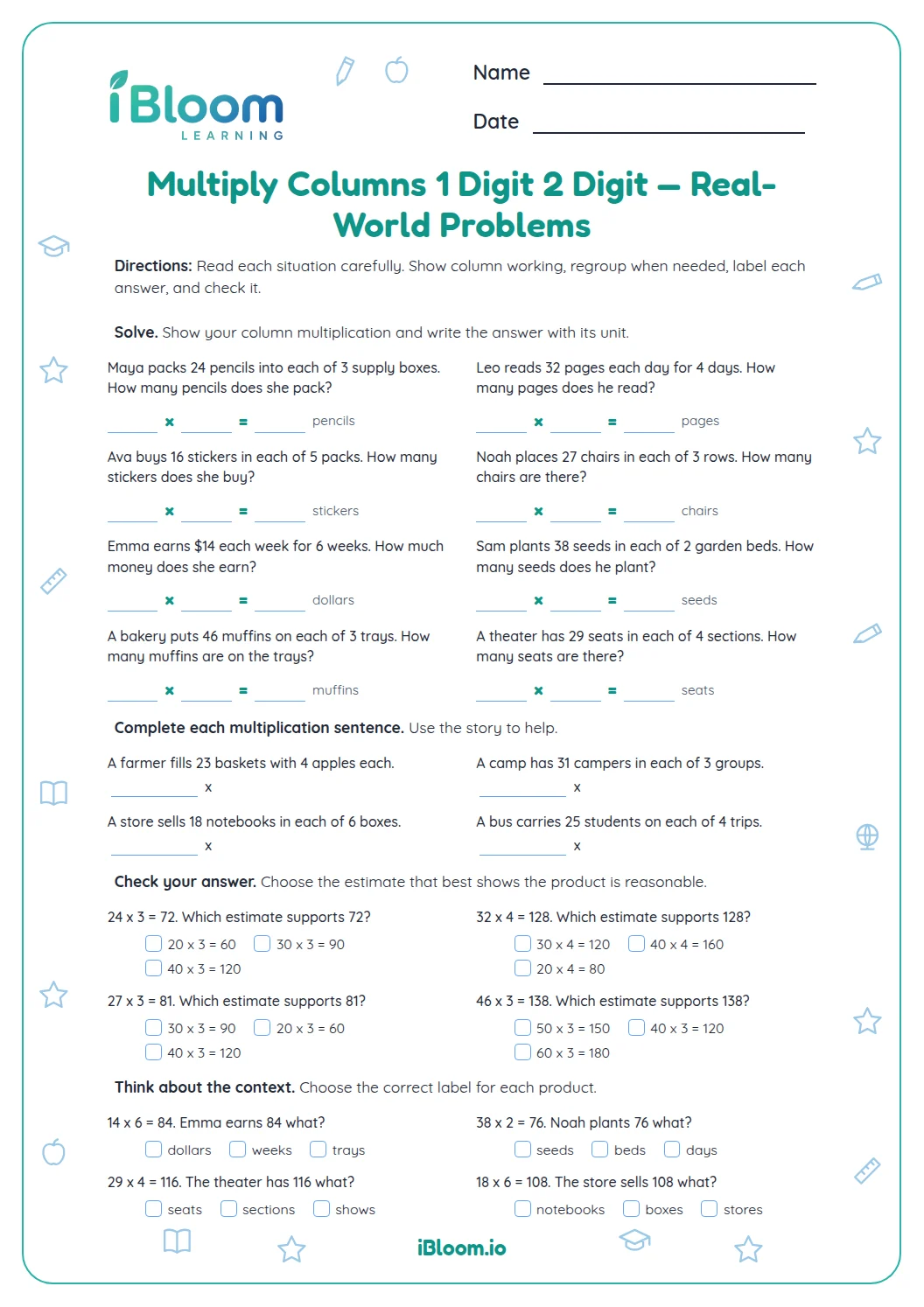
Find the size of one group and the number of groups. Multiply those values, then include the unit named in the question.
How to use this multiplication worksheet
- 1Name the number in one group and the number of groups.
- 2Match the array or blocks to a multiplication equation.
- 3Split a two-digit factor into tens and ones.
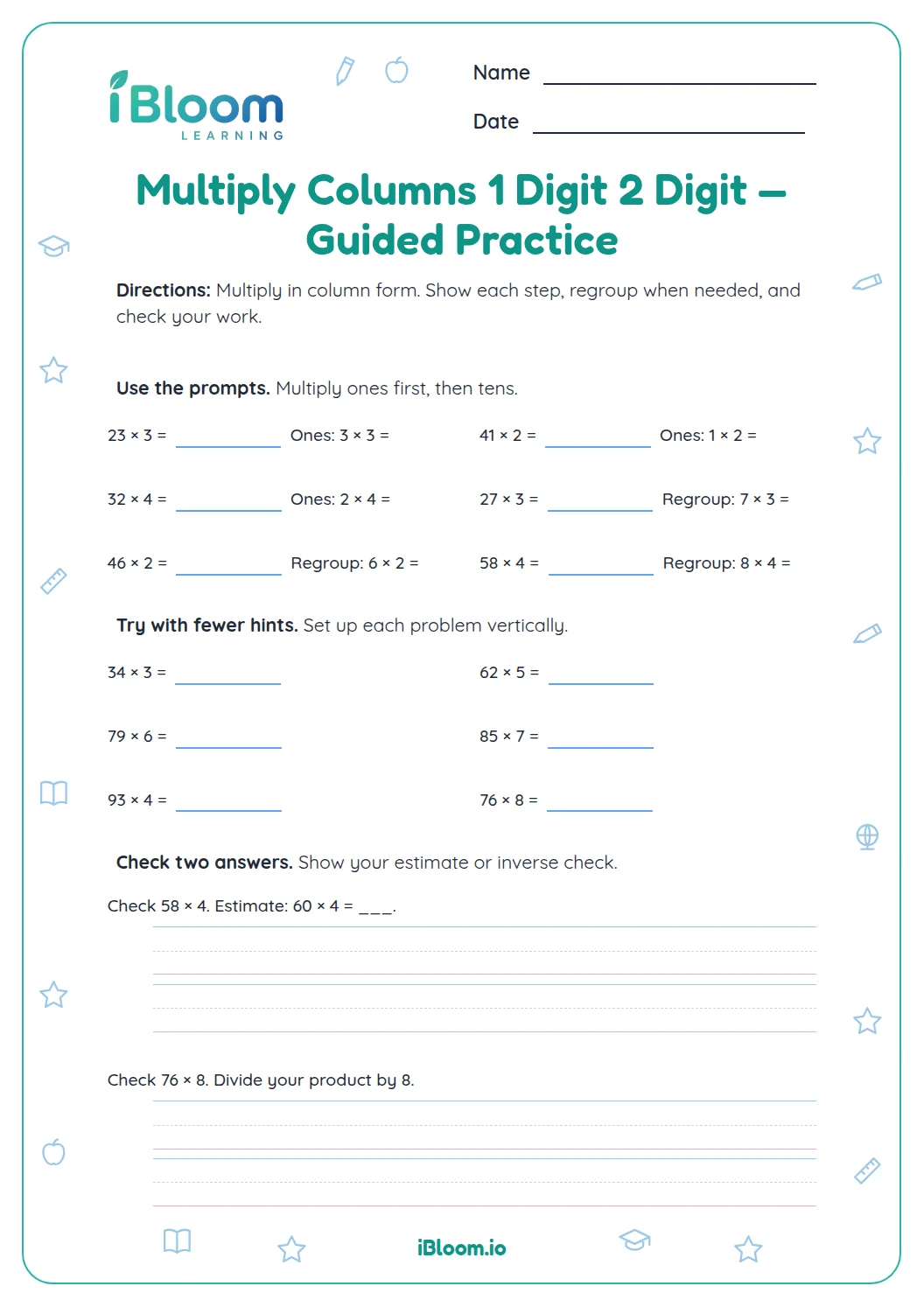
- 4Multiply each part and add the partial products.
- 5For each story, write the equation and include the unit.
Common mistakes and quick fixes
The mistake
Multiplying only the ones digit
The fix
Multiply both tens and ones by the group count.
The mistake
Forgetting to add partial products
The fix
Write the two partial products on separate lines, then combine.
The mistake
Reversing group size and number of groups
The fix
Use the story wording to label each factor before multiplying.
This worksheet gives students a concrete way to practice the skill.
Use place-value reasoning and the standard algorithm to multiply two-digit numbers by one digit.
On this sheet:
Show the official wordingHide the official wording
Multiply a whole number of up to four digits by a one-digit whole number, and multiply two two-digit numbers, using strategies based on place value and the properties of operations. Illustrate and explain the calculation by using equations, rectangular arrays, and/or area models.
What to practice next
Make more practice
Further reading
Questions parents and teachers ask
Why split a two-digit number into tens and ones?
Split a two-digit factor into tens and ones, multiply both parts, then add the partial products. For 23 × 3, compute 20 × 3 = 60 and 3 × 3 = 9; 60 + 9 = 69. The split keeps the place value visible.
Do the two factors have to stay in the same order?
No. Multiplication is commutative, so 13 × 5 and 5 × 13 have the same product. On a story problem, write the factors in an order that helps you see the group size and how many groups there are. Ask the student to point to the matching model or words in the question so the reasoning is visible.
How can an array help with multiplication?
An array displays equal rows and columns. Five rows of 13 squares show five groups of 13, so the total is 13 × 5 = 65. Counting by rows or breaking each row into 10 and 3 can both help verify the product.
What does a partial product mean?
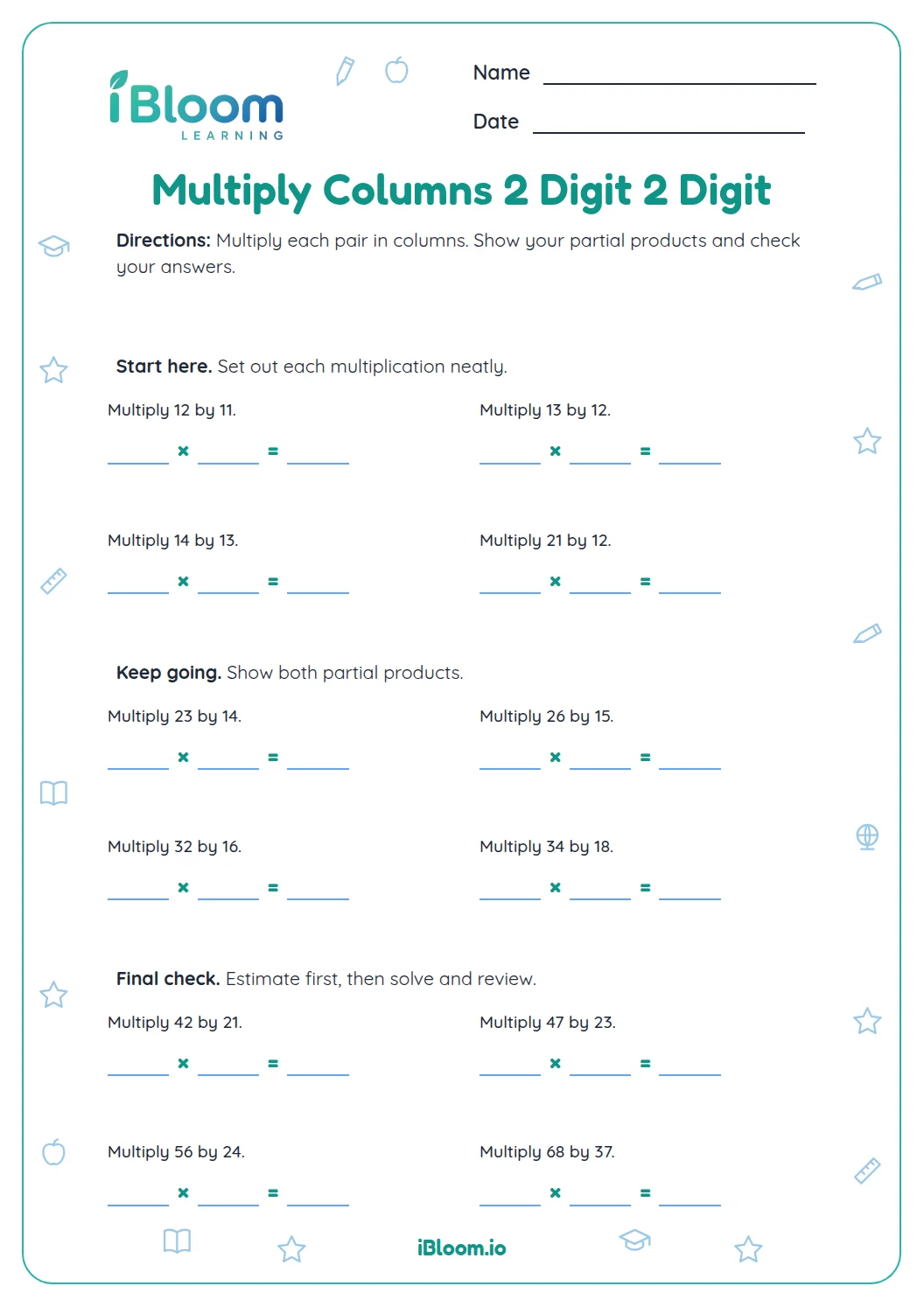
A partial product is the product of one place-value part of a factor. For 23 × 3, the partial products are 20 × 3 = 60 and 3 × 3 = 9. Add them to get the full product, 69.
How should I check a word problem answer?
Check that the equation matches the group size and number of groups, then estimate. Five groups of 17 is close to five groups of 20, or 100, so 85 is a reasonable exact total. The answer key lists the products for all 16 questions.