




About this worksheet
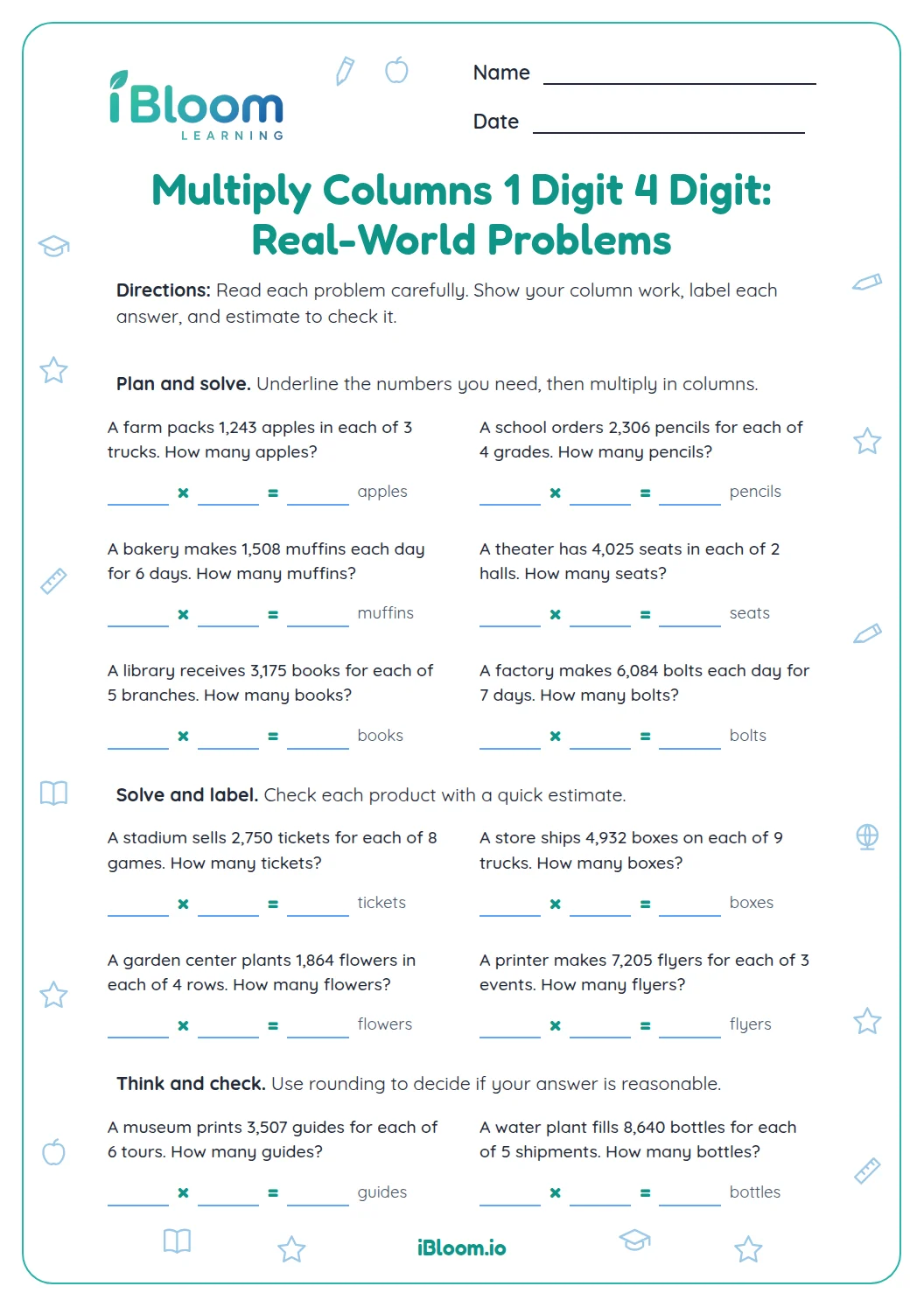
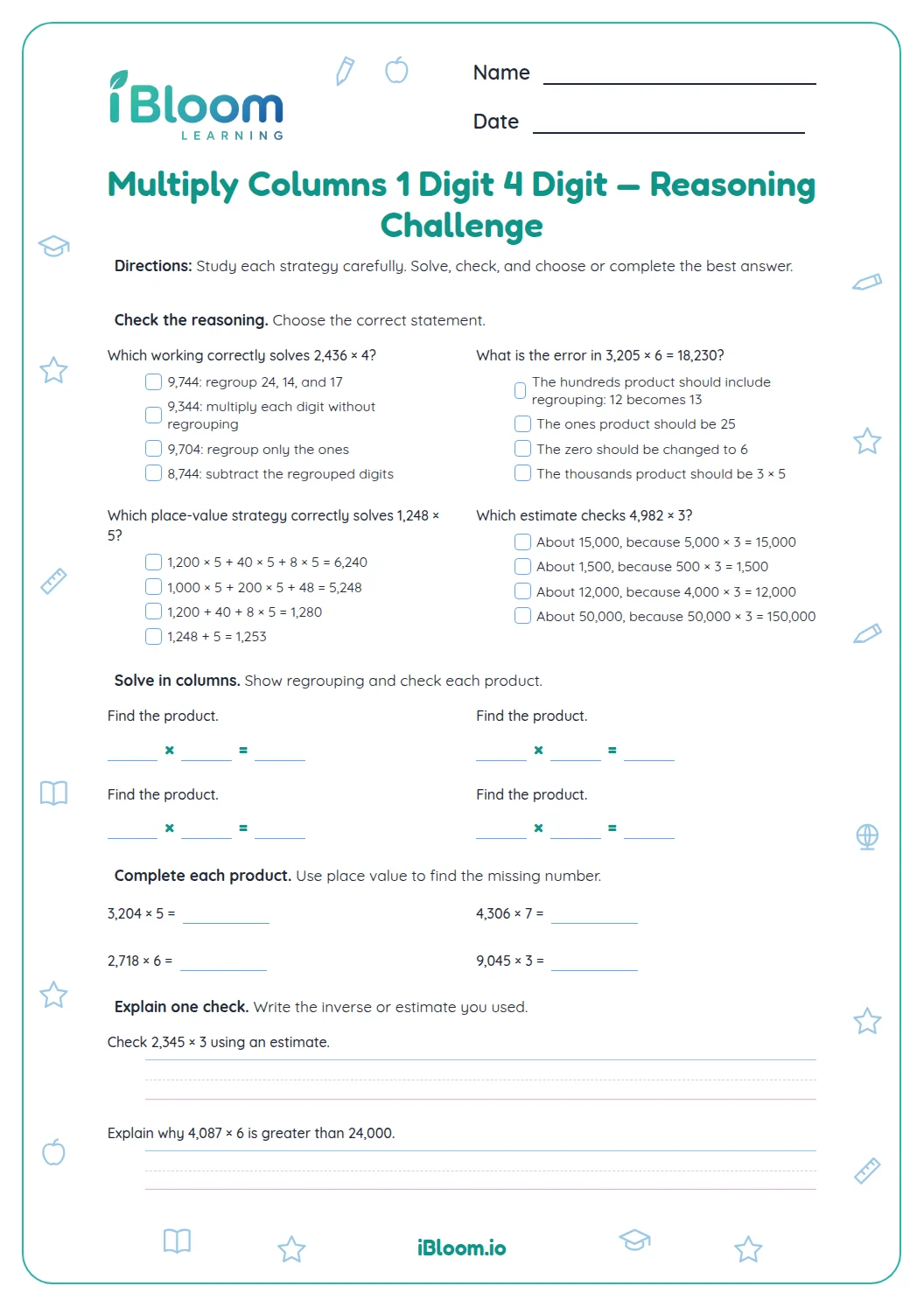
This Grade 4 worksheet follows the old page’s equal-group models, place-value thinking, and multiplication contexts. Eight picture models show robots standing for equal groups of a stated four-digit number; six more items ask for four-digit by one-digit products. The separate answer key lists all 14 products. Students can break each factor into place-value parts to check a product. This practices CCSS 4.NBT.B.5.
Aligned to 4.NBT.B.5
How do the robot pictures show equal groups?
Each robot stands for the number of blocks named in its prompt. The picture shows how many equal groups to count. For question 1, each robot represents 1,204 blocks and the picture shows 3 robots, so find 1,204 × 3.
- 11,204 × 3
- 21,204 + 1,204 + 1,204
- 3Answer: 3,612 blocks.
How can place value help with a four-digit product?
A four-digit number can be split into thousands, hundreds, tens, and ones. For 1,204 × 3, multiply 1,000, 200, 0, and 4 by 3, then add 3,000 + 600 + 0 + 12 to get 3,612. The final six questions ask students to find each product.
How can you check a product?
Estimate by rounding the four-digit number to a nearby hundred or thousand, then multiply by the one-digit factor. The exact answer should be close to that estimate. Check that regrouped digits land in the correct place.
How to use this worksheet
- 1Read the value represented by one robot.
- 2Count how many equal groups the picture shows.
- 3Multiply the group value by the number of groups.
- 4For the number sentences, calculate the four-digit by one-digit product.
- 5Estimate the product to check that its size makes sense.
Common mistakes and quick fixes
The mistake
Counting the robots as the number of blocks.
The fix
Remember that each robot stands for the larger value printed in the prompt.
The mistake
Multiplying by the wrong number of groups.
The fix
Count every robot in the picture before calculating.
The mistake
Dropping a place value when calculating a four-digit product.
The fix
Break the factor into thousands, hundreds, tens, and ones to check the total.
Common Core alignment
This worksheet practices the following standard.
Multiply whole numbers up to four digits by a one-digit whole number using place-value strategies.
On this sheet: Students use equal-group pictures, place-value reasoning, and multiplication equations to find products.
Show the official wordingHide the official wording
Multiply a whole number of up to four digits by a one-digit whole number, and multiply two two-digit numbers, using strategies based on place value and the properties of operations. Illustrate and explain the calculation by using equations, rectangular arrays, and/or area models.
What to practice next
Make more practice
Further reading
Questions parents and teachers ask
What does each equal-group picture show?
Each robot stands for the four-digit number named in its prompt, and the number of robots shows how many equal groups there are. Students find the total number of blocks. The second part has six more four-digit by one-digit multiplication facts, and the answer key lists all 14 products.
Does every multiplication use a four-digit number?
Yes. All 14 problems multiply a four-digit whole number by a one-digit whole number. The first eight pair the multiplication with a picture model of equal groups; the last six give a number sentence and ask for the product. These six products use different factors from the picture models.
How can place value help find the product?
Break the four-digit factor into thousands, hundreds, tens, and ones. Multiply each part by the one-digit group count, then add the partial products. For example, 1,204 × 3 can be worked as 3,000 + 600 + 0 + 12, which equals 3,612.
How can students check a product?
Estimate by rounding the four-digit number to a nearby hundred or thousand, then multiply by the one-digit factor. The exact result should be close to the estimate. Students can also multiply each place-value part separately and add the partial products to check the total.
What is in the answer key?
The separate key lists a product for every question. For the picture models, students can compare their total with the key after multiplying the group value by the number of robots. For the final six facts, the key lets them check each four-digit by one-digit product.