





About this worksheet
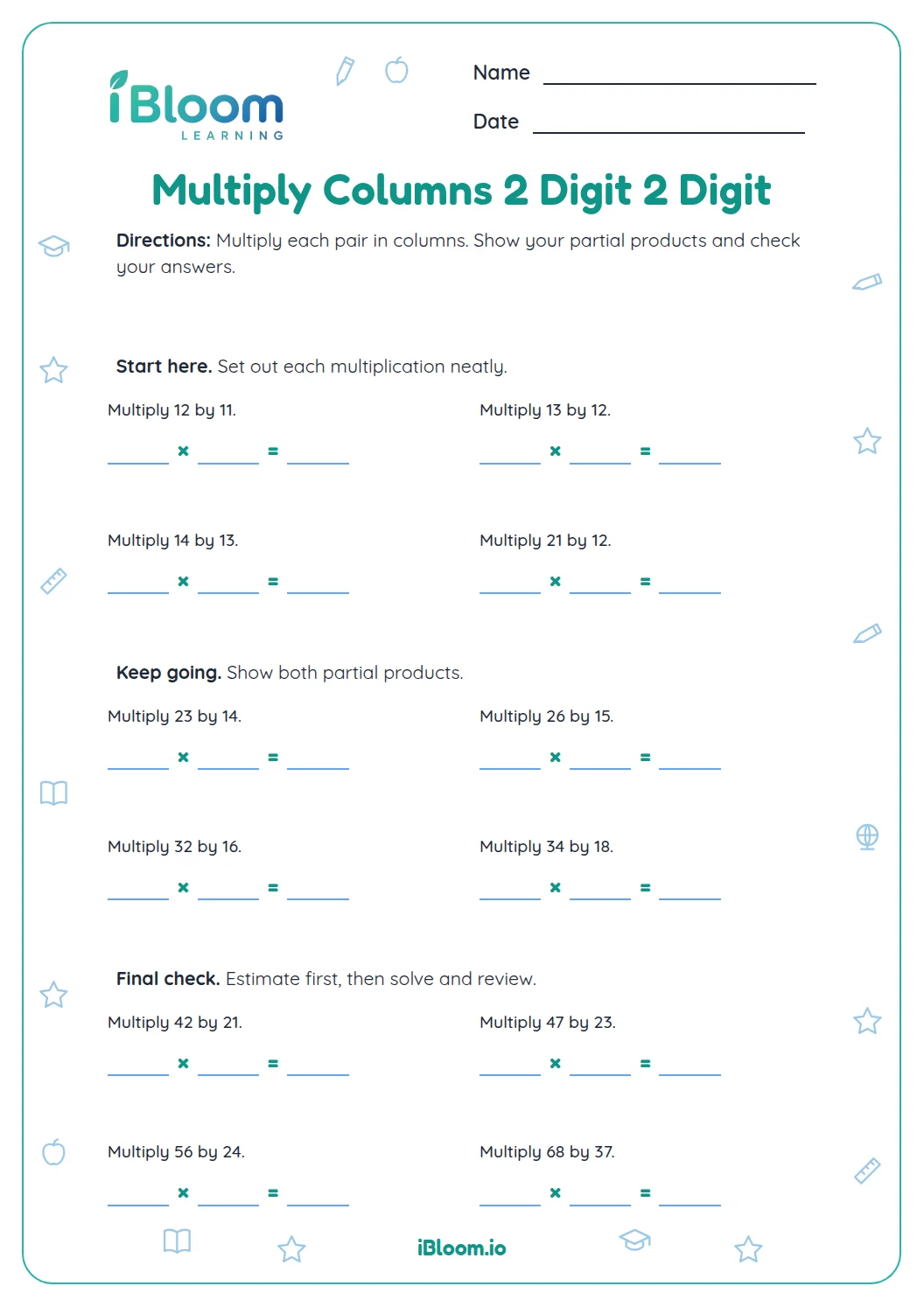
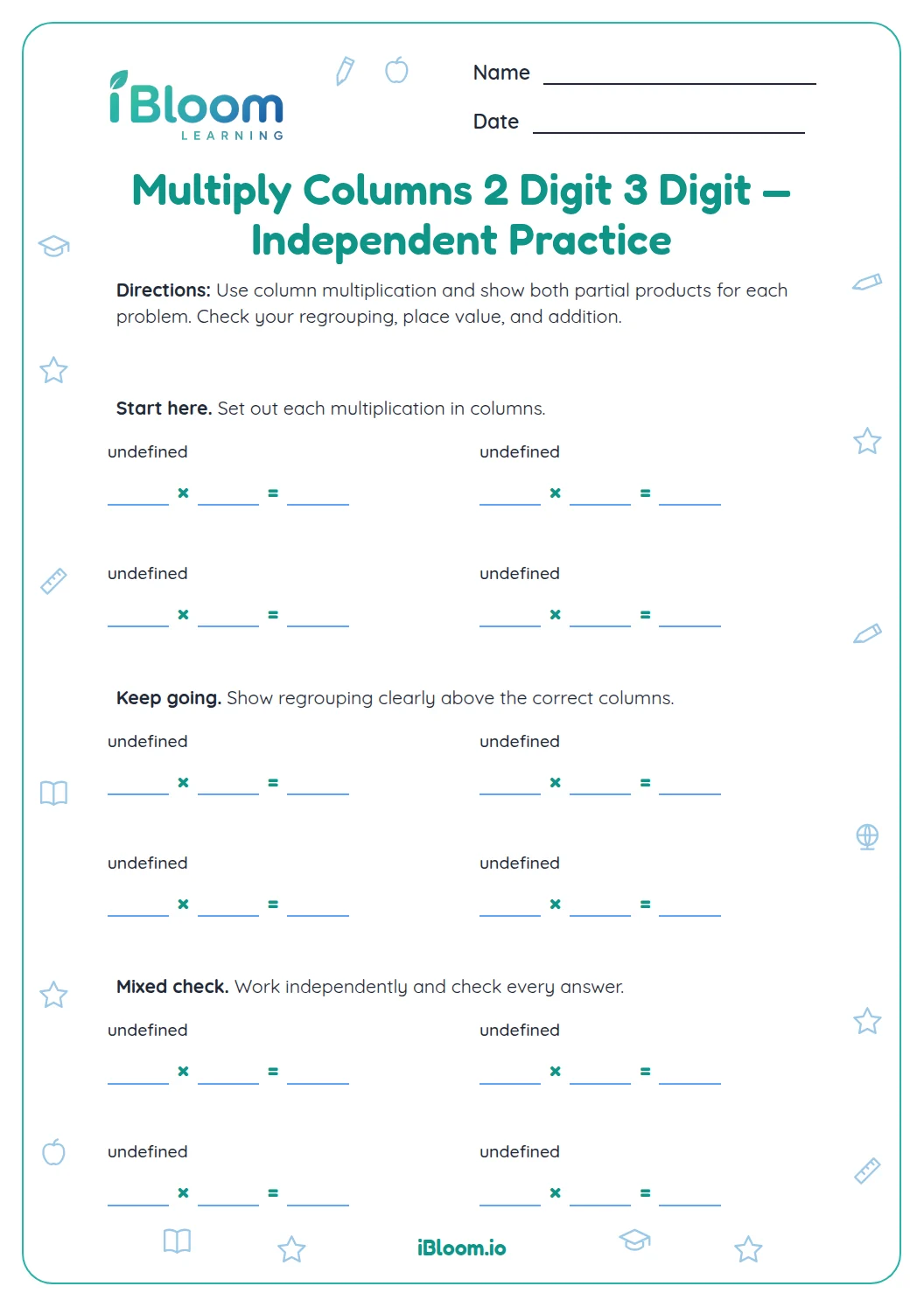
Students use place value to multiply two two-digit numbers. The first set invites a tens-and-ones split, the middle set builds fluency with column multiplication, and the last items ask what a partial product means. Products are checked and the answer key lists each result.
Aligned to 4.NBT.B.5
What is on this worksheet?
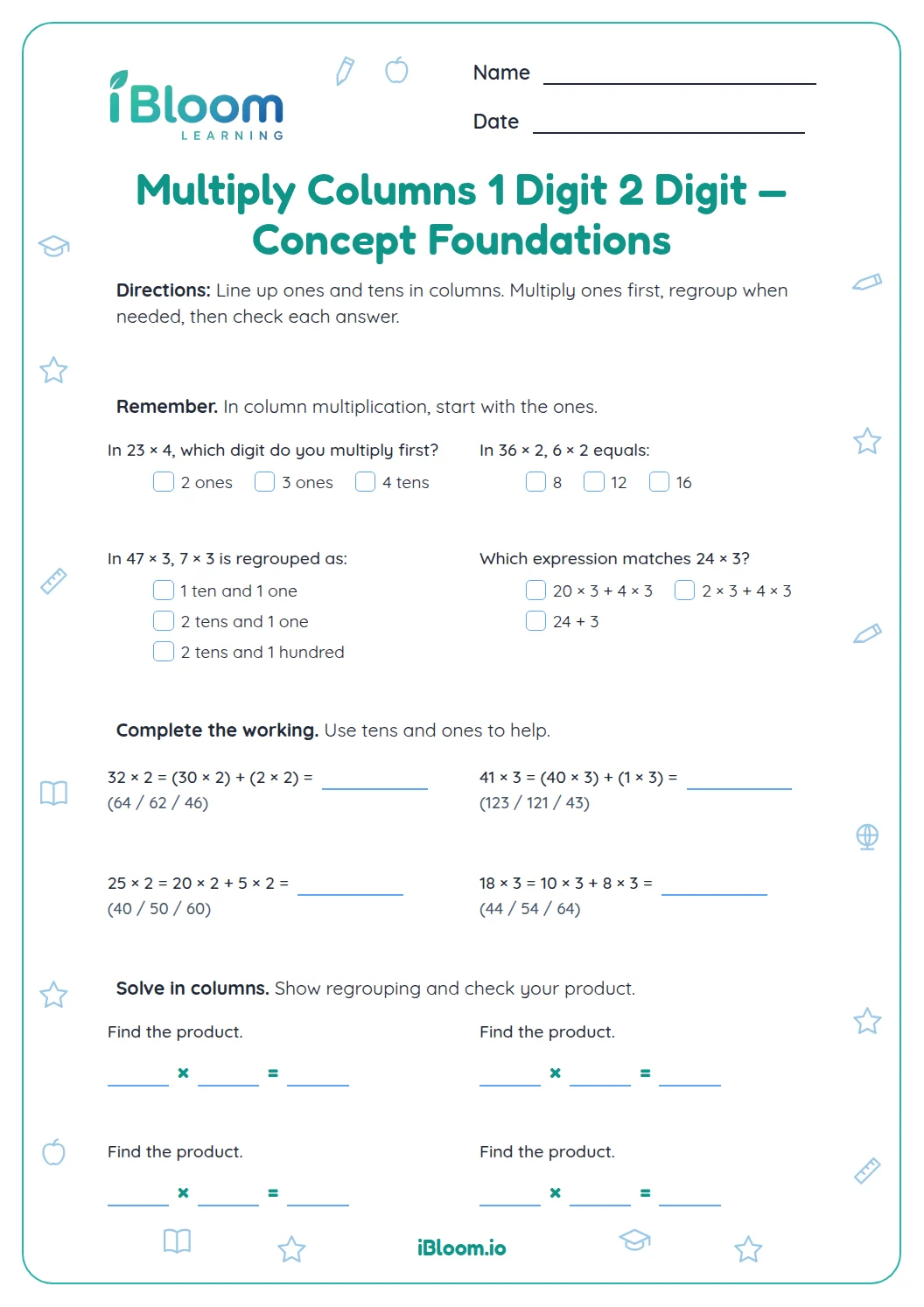
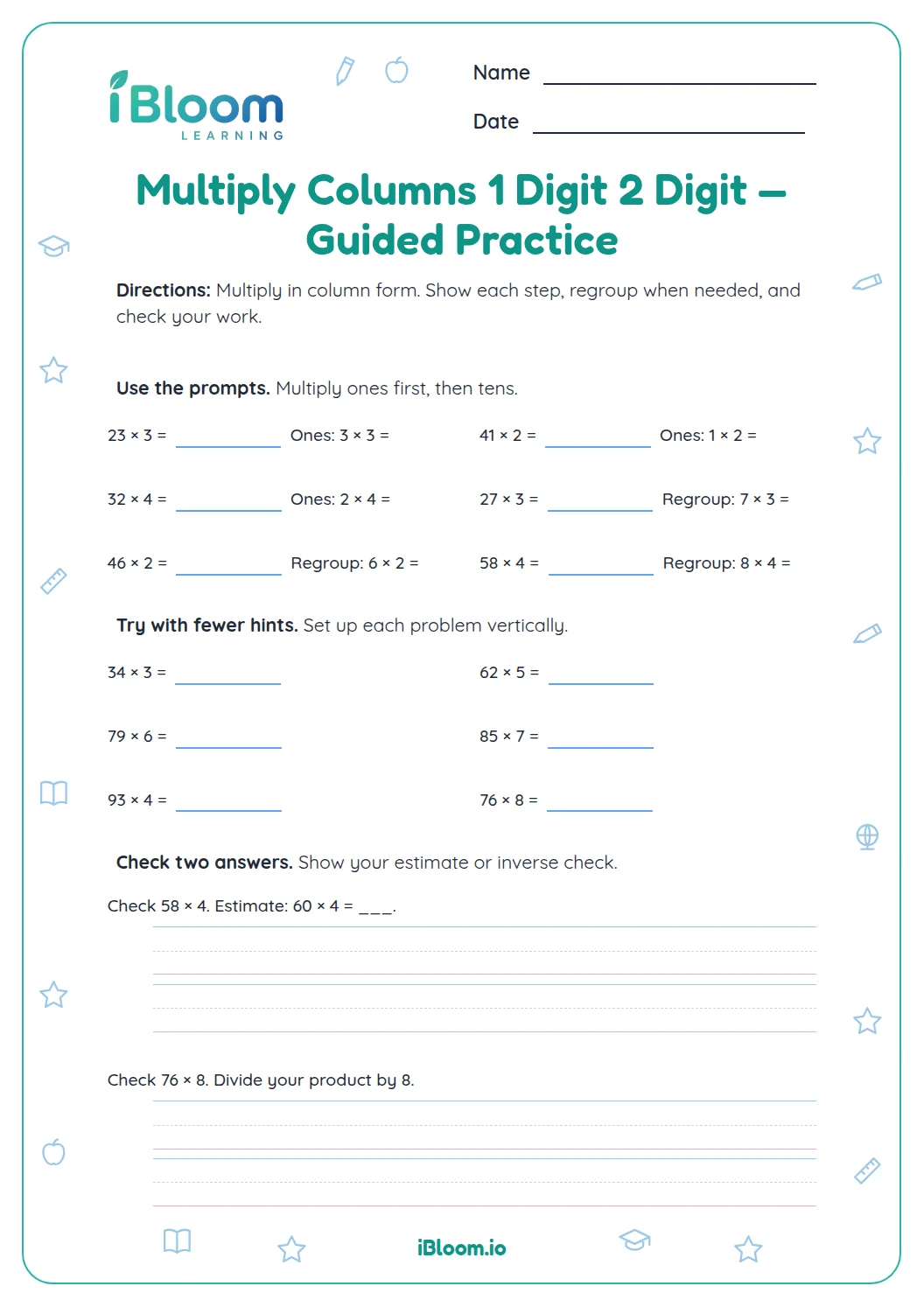
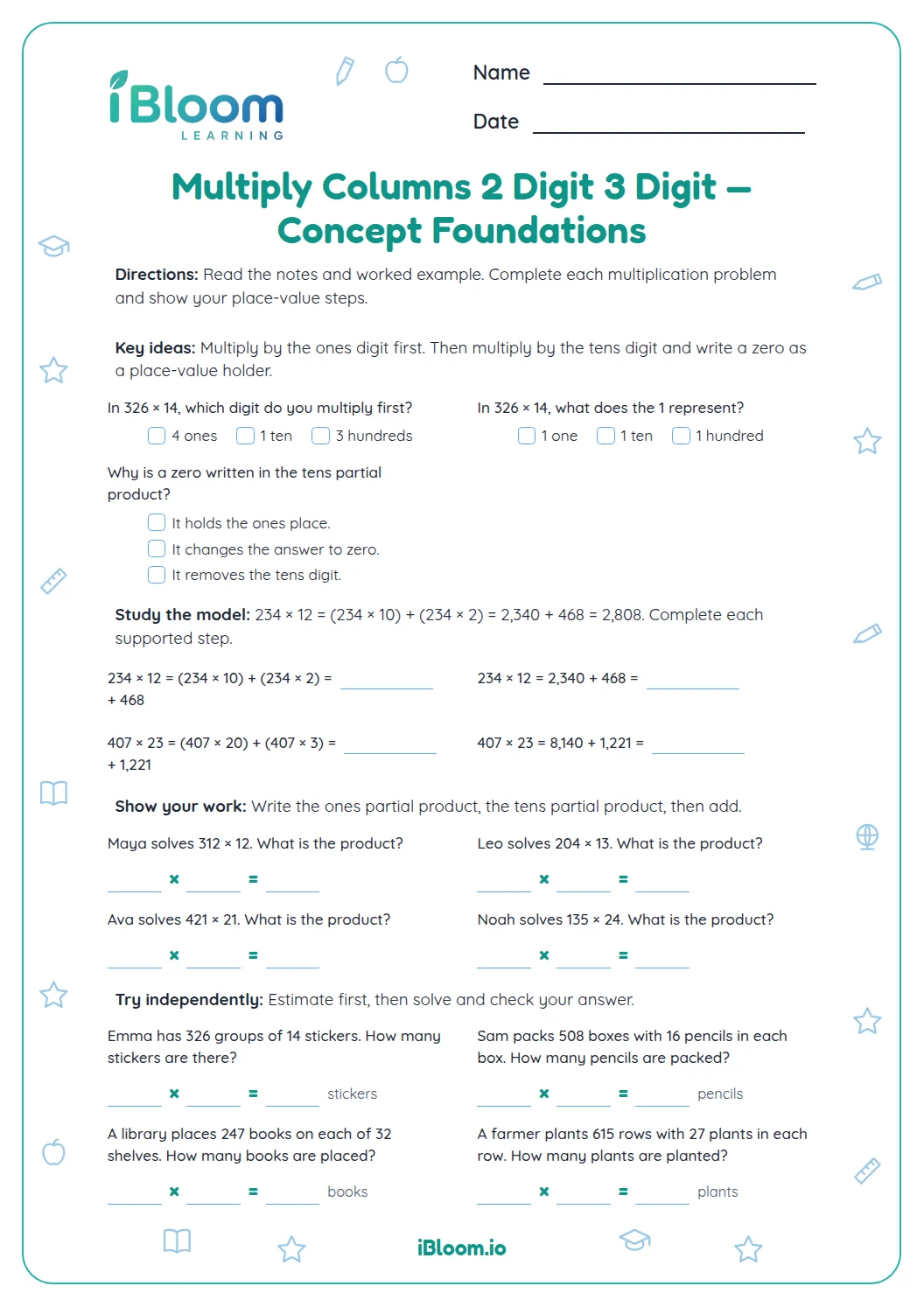
The 14 problems begin with four products that give space to build partial products. Students then solve concise products independently and finish with two extended column problems.
Working space accompanies the products so students can align the ones and tens rows, show partial products, and add them.
- Part A: build products by splitting a factor into tens and ones.
- Parts B–C: solve two-digit products and check with place value.
- Part D: show partial products for two extended products.
Why use partial products?
A two-digit factor is made of tens and ones. For 23 × 14, students can calculate 23 × 10 and 23 × 4, then add those results. This keeps the place value visible.
The tens partial product includes a zero in the ones place. Aligning the rows carefully prevents a common place-value error.
How can students check a product?
Estimate first: 23 × 14 is close to 20 × 15, or 300. Then check the exact partial products. An answer far from the estimate may signal a multiplication or addition slip.
The final two questions ask students to show both partial products and calculate the product. Each problem checks the place-value strategy with different factors.
How to use this worksheet
- 1Write the factors so the ones digits line up.
- 2Split one factor into tens and ones.
- 3Find each partial product, keeping the tens value in the correct place.
- 4Add the partial products and compare the product with a quick estimate.
- 5Check each result with the answer key.
Common mistakes and quick fixes
The mistake
Writing the tens partial product as if the tens digit were ones.
The fix
For 23 × 14, calculate 23 × 10 = 230, not 23.
The mistake
Adding partial products before finding both correctly.
The fix
Label the tens and ones parts, calculate each product, then add.
The mistake
Misaligning digits when adding partial products.
The fix
Line up ones under ones and tens under tens before adding.
Common Core alignment
The problems use whole-number factors and place-value reasoning.
Multiply whole numbers using place value and properties of operations.
On this sheet: Every numerical product multiplies two two-digit whole numbers; the strategy prompts focus on place-value decomposition and partial products.
Show the official wordingHide the official wording
Multiply a whole number of up to four digits by a one-digit whole number, and multiply two two-digit numbers, using strategies based on place value and the properties of operations. Illustrate and explain the calculation by using equations, rectangular arrays, and/or area models.
What to practice next
Make more practice
Questions parents and teachers ask
What is a partial product?
It is the product of one part of a decomposed factor. For 26 × 12, split 12 into 10 and 2; the partial products are 260 and 52, which add to 312. Each part contributes to the final product. Use the stated objects and counts to explain why the answer fits this particular question.
Why does the tens row shift in column multiplication?
Multiplying by the tens digit means multiplying by a multiple of ten. For 23 × 14, the tens partial product is 23 × 10 = 230, so its digits must be aligned by place value rather than written as 23.
Should students show their work?
Yes. The directions ask students to show place-value work in the answer area. Writing both partial products makes it easier to locate a multiplication or addition slip and check the final product. A clear record also helps a student explain how the tens and ones contributed to the total.
How can I check a product?
Multiply with partial products, then compare the total with an estimate. For example, 23 × 14 is close to 20 × 15, or 300. An estimate near 300 is reasonable; a result far away suggests a place-value or computation error.
What is the answer to 23 × 14?
Split 14 into 10 and 4. Then 23 × 10 = 230 and 23 × 4 = 92; adding 230 + 92 gives 322. This is the first product on the sheet and models the partial-products strategy used throughout. Use the stated objects and counts to explain why the answer fits this particular question.