





About this worksheet
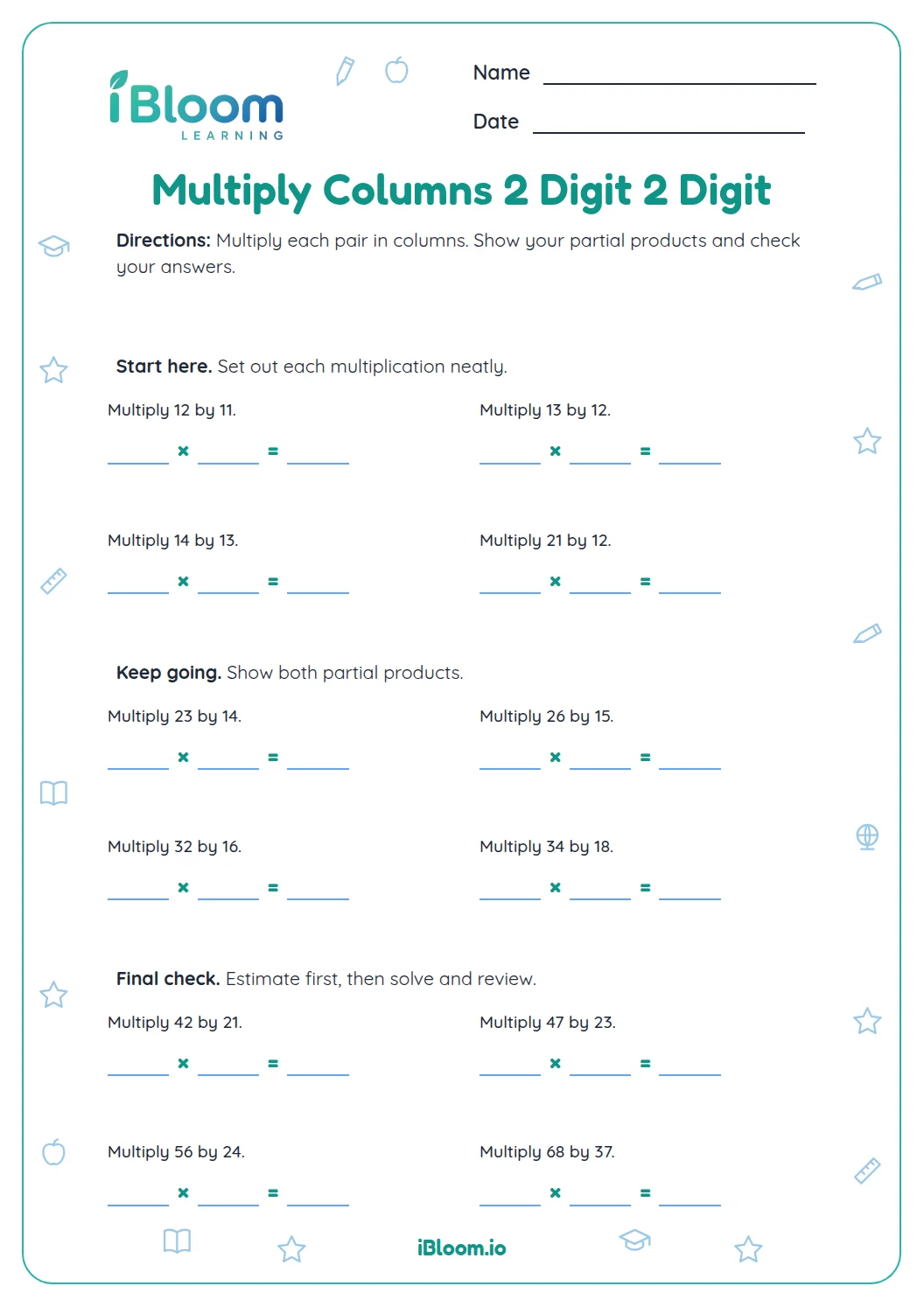
This Grade 4 worksheet practices two-digit multiplication using place value. In Part A, students set up four products in columns and record each result in a large work area. Part B connects multiplication to partial products, rounding, missing factors, and division checks. The answer key gives all 14 results.
Aligned to 4.NBT.B.5
What does “multiply in columns” mean?
Part A has four two-digit multiplication problems to set up in columns in the open work area. Part B checks the same place-value ideas through partial products, an estimate, missing factors, and division.
- 1Set up 24 × 13 in columns, then record the product: 312
Why are both partial products needed?
In 24 × 13, the 1 represents one ten, so the partial products are 24 × 10 = 240 and 24 × 3 = 72. Adding them gives 312. Part B uses this place-value reasoning in several short forms.
How many problems are on the page?
There are 14 questions in two parts: four column products followed by ten related problems. Students apply place value and inverse operations, then check results with the separate answer key.
How to use this worksheet
- 1Read the directions and look at one example.
- 2Complete each part in order, showing work where there is room.
- 3Read answers aloud or check each written result.
- 4Use the key to review and correct any missed items.
Common mistakes and quick fixes
The mistake
Skipping a key detail in the prompt.
The fix
Read the full question before responding.
The mistake
Writing an answer without checking it.
The fix
Use the worked example and key to review.
The mistake
Moving on after an error.
The fix
Correct the response and explain what changed.
This worksheet practices the listed Common Core skill.
Multiply two two-digit numbers using place value and operation properties.
On this sheet: Multiply two two-digit numbers using place value and operation properties.
Show the official wordingHide the official wording
Multiply a whole number of up to four digits by a one-digit whole number, and multiply two two-digit numbers, using strategies based on place value and the properties of operations.
What to practice next
Make more practice
Further reading
Questions parents and teachers ask
What does “multiply in columns” mean?
Write the factors one above the other, align the ones digits, and multiply by each place value. For 24 × 13, the partial products are 24 × 10 = 240 and 24 × 3 = 72; 240 + 72 = 312. Part A gives four products to solve in this way.
Why are both partial products needed?
The tens digit represents a number of tens, so its product belongs in the tens place. For example, multiplying 24 by 13 means finding 24 × 3 and 24 × 10, then adding those results. The tens partial product must stay in the tens place.
How many problems are on the page?
There are 14 problems in two parts. Part A has four two-digit products to solve in column form. Part B has ten short items using partial products, rounding, missing factors, and division to apply the same place-value ideas. The answer key supports checking each result.
How can students check a result?
Estimate each factor or use the distributive property to check the size of the answer. For an exact check, multiply the partial products and add them again, taking care to align place values. The estimate should be close to the exact answer.
What does the answer key include?
The separate answer key gives the product for every problem, including the four column multiplications. Students can compare each result after doing the work and revisit a partial product when a total does not match. It also lists the estimates, missing factors, and division results.