



About this worksheet
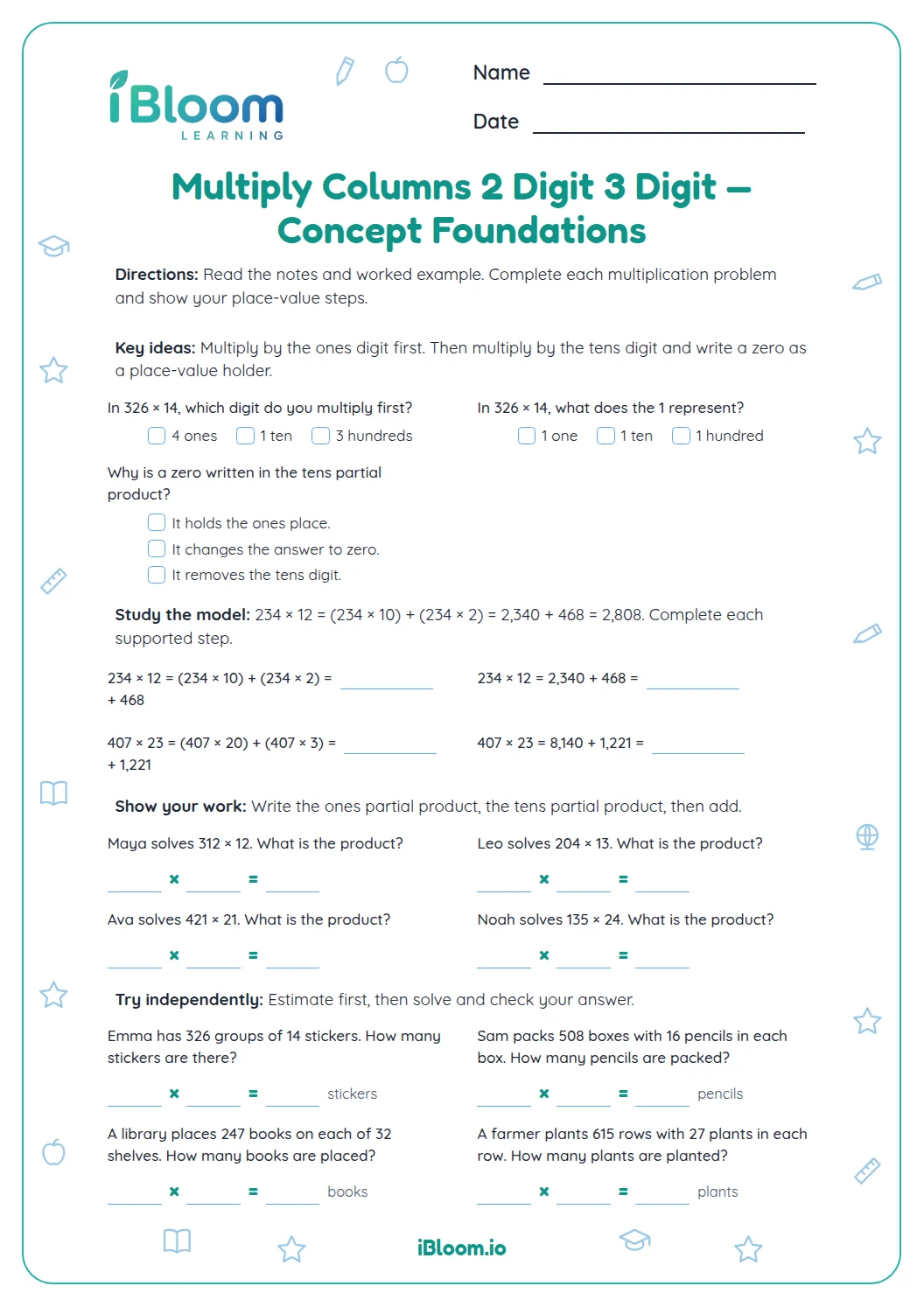
This Grade 4 multiplication worksheet offers 16 problems multiplying a two-digit number by a three-digit number. Question 1 asks students to show both partial products in column work; the remaining short equations give room for efficient independent practice. The answer key lists each product. The page practices multi-digit multiplication strategies aligned with CCSS 4.NBT.B.5.
Aligned to 4.NBT.B.5
How do partial products build a product?
Break the two-digit factor into tens and ones. For question 1, multiply 136 by 20 and by 4, then add the partial products.
- 124 × 136
- 2136 × 20 = 2,720
- 3136 × 4 = 544
- 42,720 + 544 = 3,264
How do you keep column work organized?
Line up digits by place value, and make sure each partial product keeps its place. A zero in a factor contributes zero for that place.
How can you check a product?
Estimate with nearby friendly numbers, then compare that estimate with the exact product. The answer key gives each exact result.
How to work through the sheet
- 1Read the direction at the start of each part.
- 2Work from the first example in the part and keep units or place value visible.
- 3Pause after each answer to check whether it fits the question.
- 4Use the answer key after finishing a part, then correct any missed step.
Keep each place value clear
The mistake
Multiplying by 2 instead of 20 when splitting 24.
The fix
Label the tens part as 20 before finding its product.
The mistake
Leaving out a partial product for the hundreds part.
The fix
Break the three-digit factor into hundreds, tens, and ones and account for all three.
The mistake
Adding partial products with a place-value shift.
The fix
Write each product by place value and check the sum against an estimate.
Curriculum alignment
The problems use place-value reasoning to multiply multi-digit whole numbers.
Use place value and properties of operations to multiply multi-digit whole numbers.
On this sheet: The problems move from direct practice to applying the same skill in context.
Show the official wordingHide the official wording
Multiply a whole number of up to four digits by a one-digit whole number, and multiply two two-digit numbers, using strategies based on place value and the properties of operations. Illustrate and explain the calculation by using equations, rectangular arrays, and/or area models.
What to practice next
Make more practice
Further reading
Questions parents and teachers ask
What does multiplying in columns mean?
Write factors with digits aligned by place value, then multiply and combine the partial products. The first question guides this breakdown for 24 × 136, showing the tens product and ones product before adding. Students can write the factors by place value and compare their result against an estimate before checking the key.
What is a partial product?
A partial product is one result from multiplying by a place-value part. For 24 × 136, the parts are 20 and 4: 136 × 20 = 2,720 and 136 × 4 = 544. Their sum is 3,264. Students can write the factors by place value and compare their result against an estimate before checking the key.
How should a zero digit be handled?
Keep the zero in its place-value position. In 305, the tens part contributes zero, so multiplying by 305 still combines the hundreds and ones contributions in their correct places. Students can write the factors by place value and compare their result against an estimate before checking the key.
How many problems are included?
There are 16 products, each with a two-digit factor and a three-digit factor. The first provides room to show a partial-product method, and the other 15 use compact equations for practice. Students can write the factors by place value and compare their result against an estimate before checking the key.
How can students check a product?
Estimate with rounded factors before comparing with the exact result. For 24 × 136, 25 × 140 is about 3,500, so 3,264 is a reasonable product. Then use the key to check the exact answer. Students can write the factors by place value and compare their result against an estimate before checking the key.