



About this worksheet
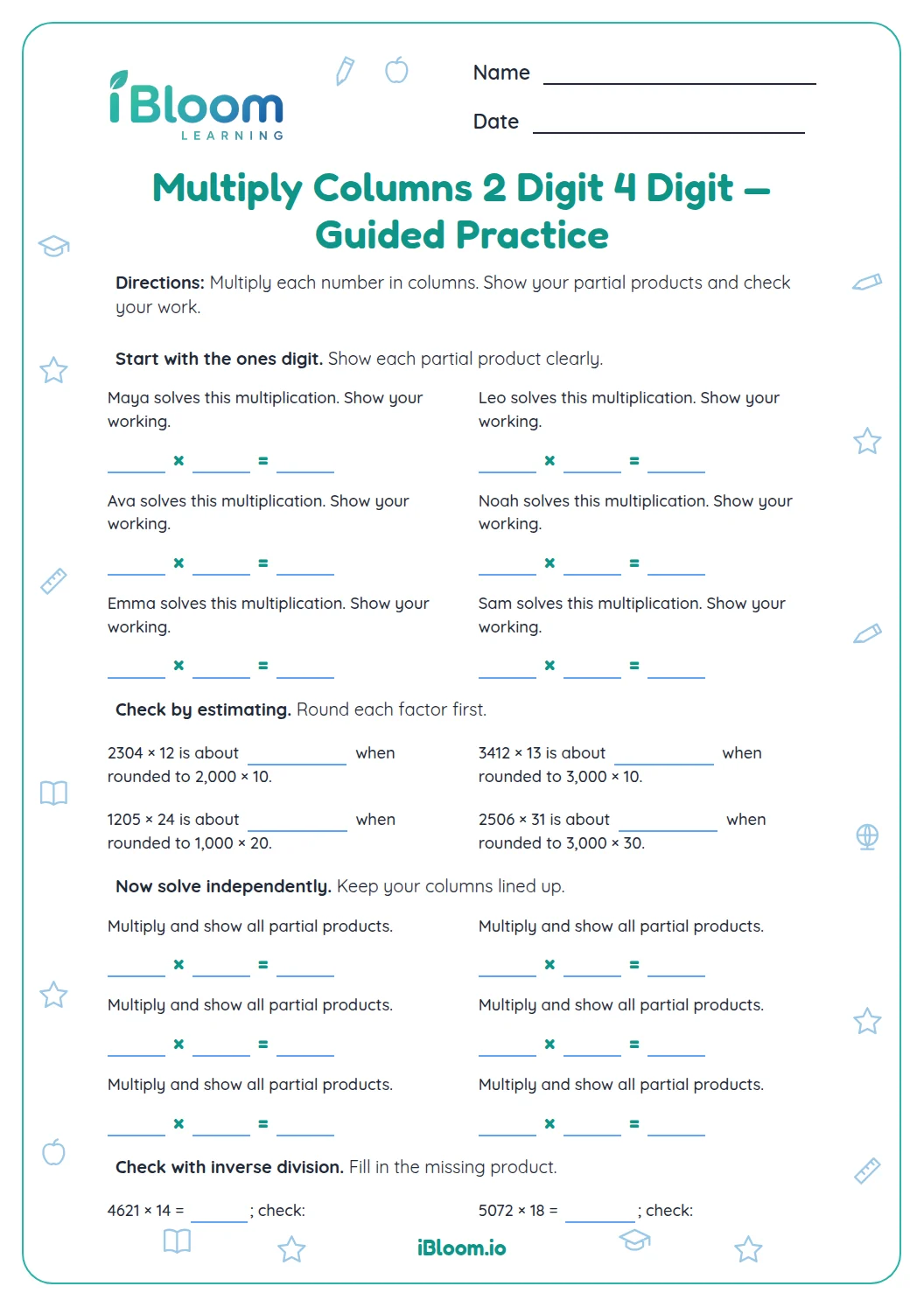
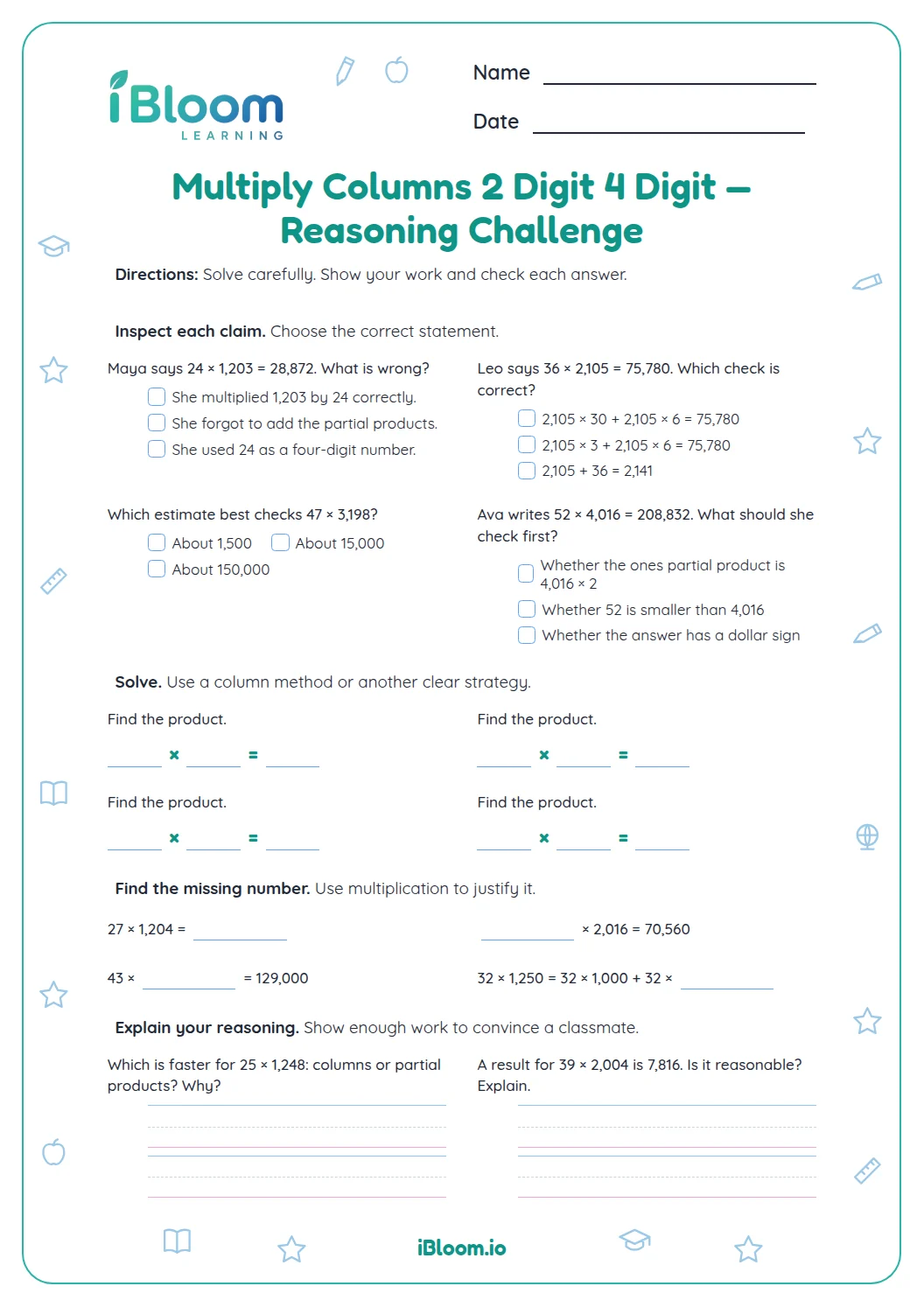
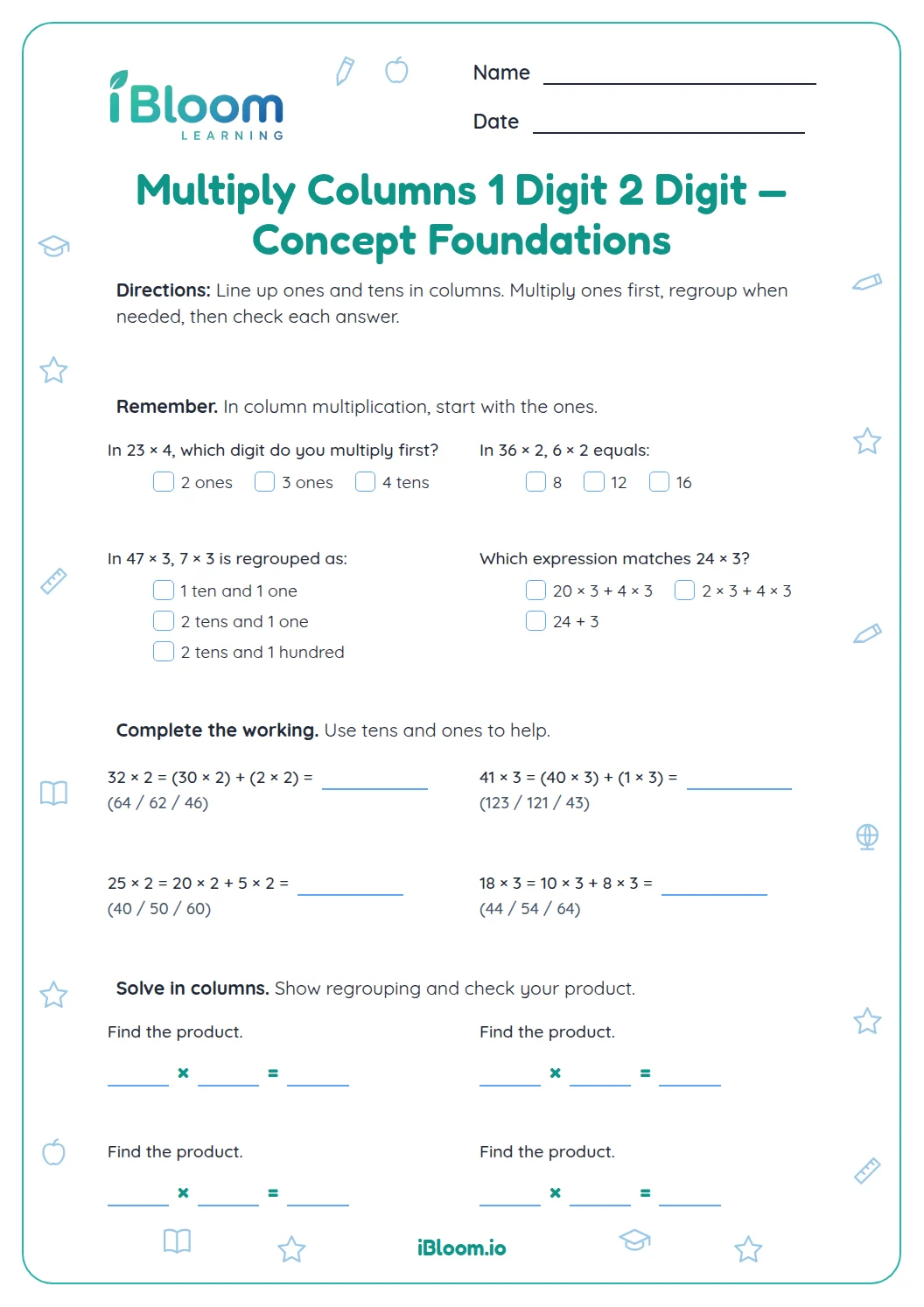
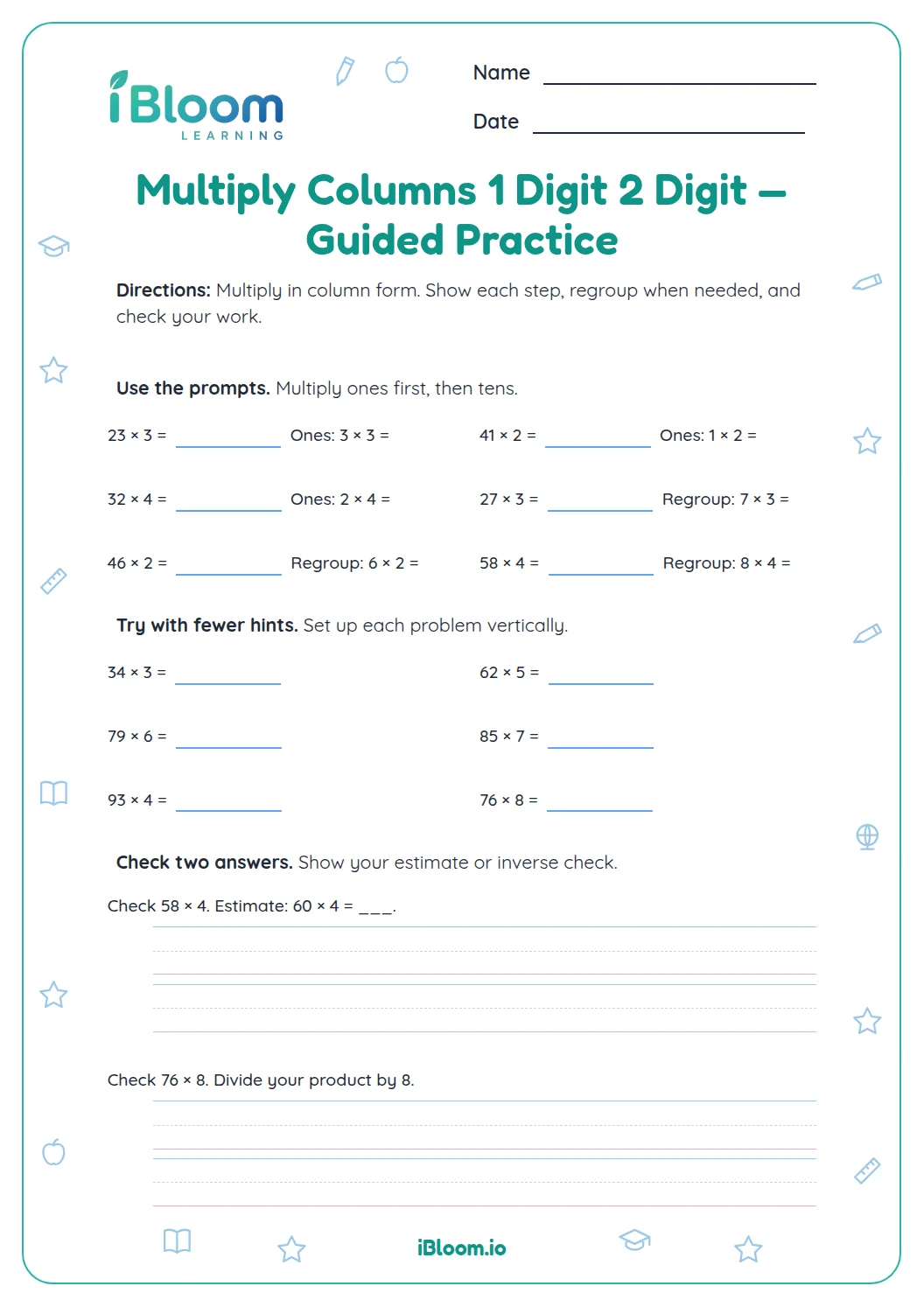
This Grade 4 printable builds multiplication through partial products, column multiplication, and short applications. Learners begin with the parts of 23 × 14, then solve two-digit products and four-digit-by-one-digit products before applying the method to boxes of markers and rows of seats. The 14 questions span five parts across two worksheet pages, with a separate two-page answer key. It practices Common Core 4.NBT.B.5 by using place-value strategies and equations to multiply.
Aligned to 4.NBT.B.5
How can learners work through two-digit multiplication and multi-digit-by-one-digit multiplication?
This Grade 4 printable builds multiplication through partial products, column multiplication, and short applications. Learners begin with the parts of 23 × 14, then solve two-digit products and four-digit-by-one-digit products before applying the method to boxes of markers and rows of seats. The 14 questions span five parts across two worksheet pages, with a separate two-page answer key. It practices Common Core 4.NBT.B.5 by using place-value strategies and equations to multiply.
For example, Use the partial products 200, 80, 30, and 12 to find 23 × 14. The result is 200 + 80 + 30 + 12 = 322.
- 1Use the partial products 200, 80, 30, and 12 to find 23 × 14.
- 2200 + 80 + 30 + 12 = 322
What is included in this two-digit multiplication and multi-digit-by-one-digit multiplication sheet?
The worksheet has 14 questions arranged in short parts. The separate answer key provides an answer for each item.
- Use partial products
- Write the product
- Multiply in columns
- Apply the method
- Check the reasoning
How can an adult support practice?
It practices two-digit by two-digit products and four-digit by one-digit products. Learners use partial products, column multiplication, and two equal-group applications. The separate answer key covers all 14 questions, so an adult can check each section after the learner finishes it. The key gives the expected product or response for each worksheet item. For the final check, it identifies whether the partial-product equation is correct. Ask learners to compare their steps as well as their final number.
How to use this worksheet
- 1For questions 1–5, multiply each partial product and add the results.
- 2For questions 6–7, solve the two-digit products using place value.
- 3For questions 8–11, multiply each digit and keep its place value.
- 4For questions 12–13, write a multiplication equation for the groups.
- 5For question 14, recompute 27 × 14 from its partial products.
Common mistakes and quick fixes
The mistake
Adding partial products without preserving place value.
The fix
Label each product by the tens or ones it represents before adding.
The mistake
Forgetting a zero in a tens partial product.
The fix
Write 27 × 10 as 270, then combine it with 27 × 4.
The mistake
Accepting a product without checking its parts.
The fix
Add the partial products again and compare with the stated product.
Common Core alignment
This worksheet practices 4.NBT.B.5 through multiply two-digit numbers and up to four-digit numbers by a one-digit number using place value and partial products.
Use place value and partial products to multiply multi-digit numbers.
On this sheet: Questions ask learners to multiply two-digit numbers and up to four-digit numbers by a one-digit number using place value and partial products.
Show the official wordingHide the official wording
Multiply a whole number of up to four digits by a one-digit whole number, and multiply two two-digit numbers, using strategies based on place value and the properties of operations. Illustrate and explain the calculation by using equations, rectangular arrays, and/or area models.
What to practice next
Make more practice
Questions parents and teachers ask
What multiplication does this worksheet practice?
It practices two-digit by two-digit products and four-digit by one-digit products. Learners use partial products, column multiplication, and two equal-group applications. The separate answer key covers all 14 questions, so an adult can check each section after the learner finishes it. Point to the tens and ones in each factor before multiplying.
How does question 1 work?
Question 1 breaks 23 × 14 into four products: 200, 80, 30, and 12. Add those values to get 322. This shows how tens and ones in both factors contribute to the full product. This first example is answered on the page and modeled with its partial products.
What is in the answer key?
The key gives the expected product or response for each worksheet item. For the final check, it identifies whether the partial-product equation is correct. Ask learners to compare their steps as well as their final number. For a word problem, name the product with the requested unit.
How long does the worksheet take?
Plan for about 25 minutes, adjusting for how much written work the learner shows. The first two parts focus on partial products and two-digit multiplication; later parts use column work and short applications. A learner can complete one part, then check before moving on.
How can I check a multiplication answer?
Break one factor into tens and ones, multiply each part, and add the partial products. For 23 × 14, calculate 23 × 10 and 23 × 4, then add 230 and 92 to get 322. The tens product is 230 and the ones product is 92.