



About this worksheet
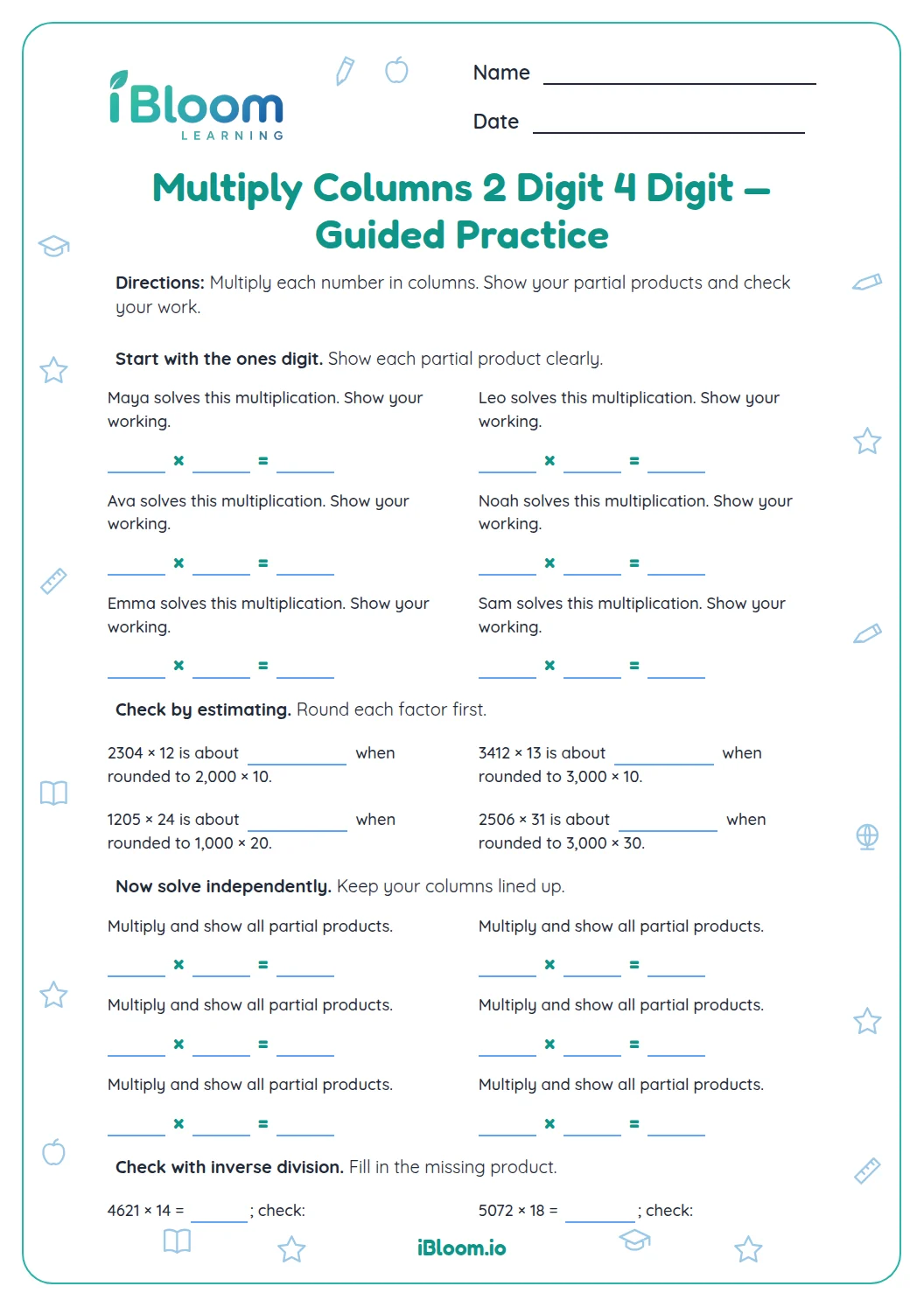
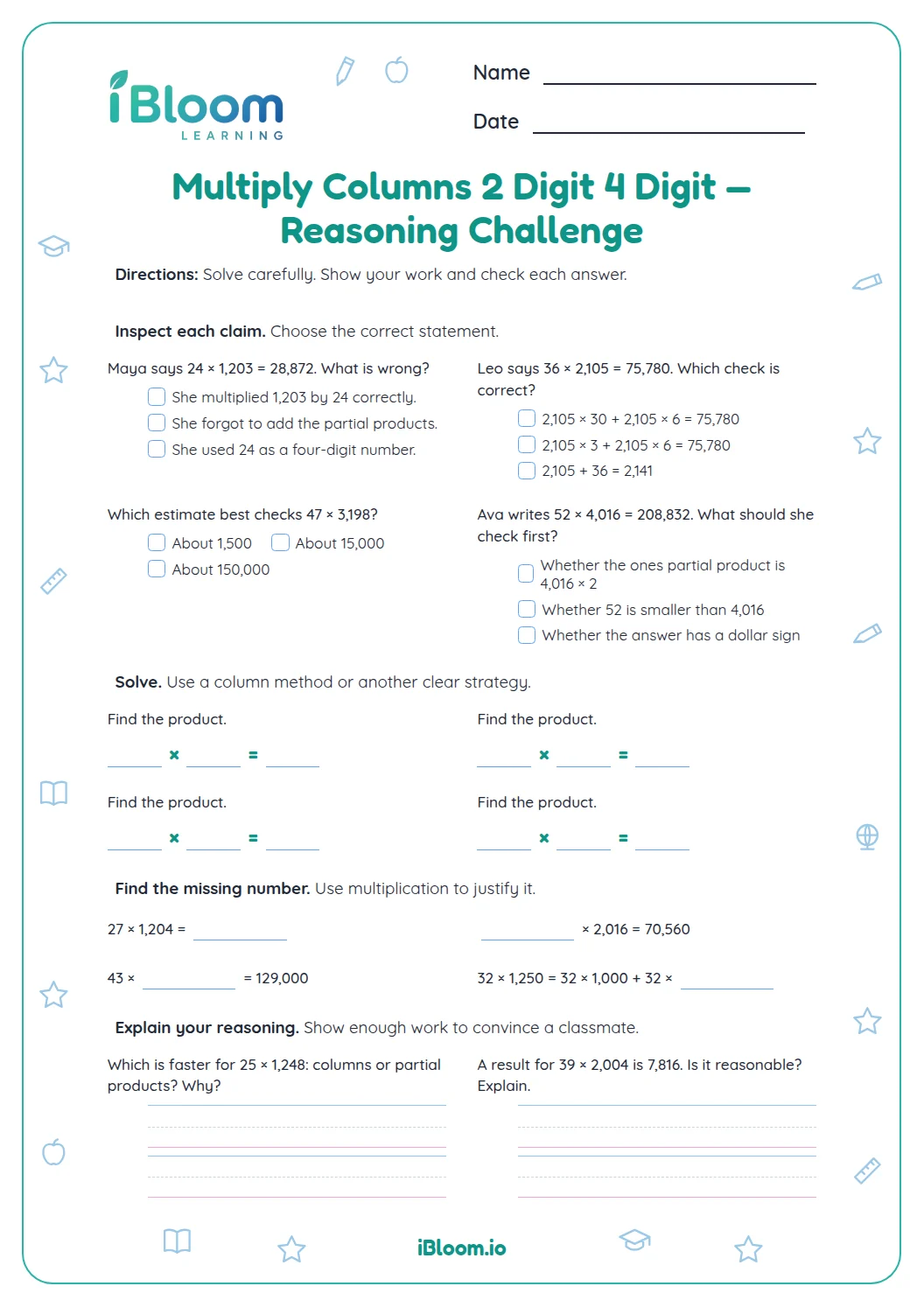
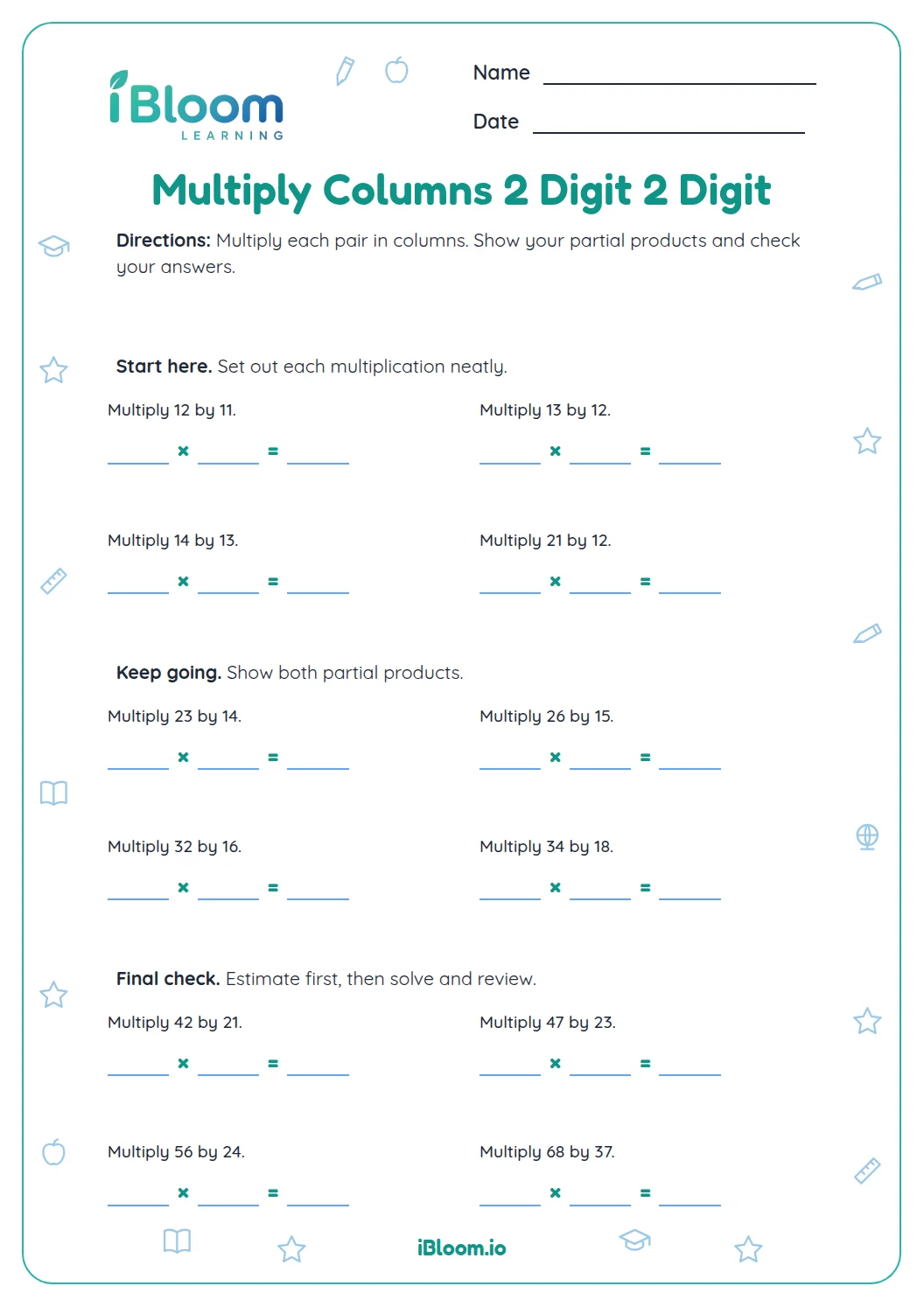
This printable gives Grade 4 students practice multiplying a four-digit number by a two-digit number. Eight short situations ask for the total number of items in equal groups; six more questions give the factors directly for column work. Students can align place values, record partial products, and check each product with the separate answer key. The skill aligns with CCSS 5.NBT.B.5.
Aligned to 5.NBT.B.5
How do students turn a situation into multiplication?
Identify the number of groups and the number in each group. In question 1, 24 schools receive 1,236 notebooks apiece, so the total is 24 × 1,236.
- 11,236 × 20 = 24,720
- 21,236 × 4 = 4,944
- 324,720 + 4,944 = 29,664 notebooks
How can column work keep place values clear?
Multiply by each digit, keeping tens and ones in their places. Add partial products, then estimate to check whether the answer makes sense.
What will students practice?
Part A applies four-digit quantities to everyday situations. Part B gives six standalone four-digit by two-digit products.
How to use this worksheet
- 1Underline the group count and amount in each story.
- 2Write the multiplication equation before calculating.
- 3Multiply ones and tens, keeping each partial product aligned.
- 4Add partial products and label the total when the story has units.
- 5Estimate each product and compare it with your answer.
Common mistakes and quick fixes
The mistake
Adding factors instead of multiplying equal groups.
The fix
Sketch a few equal groups and connect repeated addition to multiplication.
The mistake
Writing a tens partial product as ones.
The fix
Keep the tens product one place to the left.
The mistake
Forgetting to add partial products.
The fix
Add the rows after calculating both partial products.
Common Core alignment
This worksheet practices the Common Core skill named below.
Use the standard algorithm to multiply multi-digit whole numbers.
On this sheet: Students multiply four-digit quantities by two-digit group counts in stories and column problems.
Show the official wordingHide the official wording
Fluently multiply multi-digit whole numbers using the standard algorithm.
What to practice next
Make more practice
Further reading
Questions parents and teachers ask
How can a student check a product?
Round each factor to a nearby friendly number and compare the estimate with the exact product. For 24 × 1,236, 20 × 1,200 is about 24,000, so 29,664 is plausible. Recheck the partial products if the result is far from the estimate.
What does question 1 ask students to multiply?
Question 1 describes 24 schools receiving 1,236 notebooks each. Multiply 24 × 1,236 to find the total number of notebooks, 29,664. The context gives two factors and asks for their product; it does not ask students to add the two quantities.
Does the answer key include units?
The key lists each numerical product. In Part A, students can add the context unit to the total, such as notebooks for question 1 or books for question 4. Part B gives the product for each number sentence without a real-world unit.
Which questions use column multiplication?
All six questions in Part B present a multiplication sentence without a story. Students can write the factors in columns, multiply by each digit of the two-digit factor, and add the partial products. The eight Part A problems apply the same multiplication to equal groups.
What grade is this multiplication practice for?
The page is labeled Grade 4 and focuses on four-digit by two-digit multiplication. Its cited Common Core alignment is 5.NBT.B.5, whose stated skill is fluently multiplying multi-digit whole numbers with the standard algorithm. Use the page when this level of multiplication matches the learner’s current work.