




About this worksheet
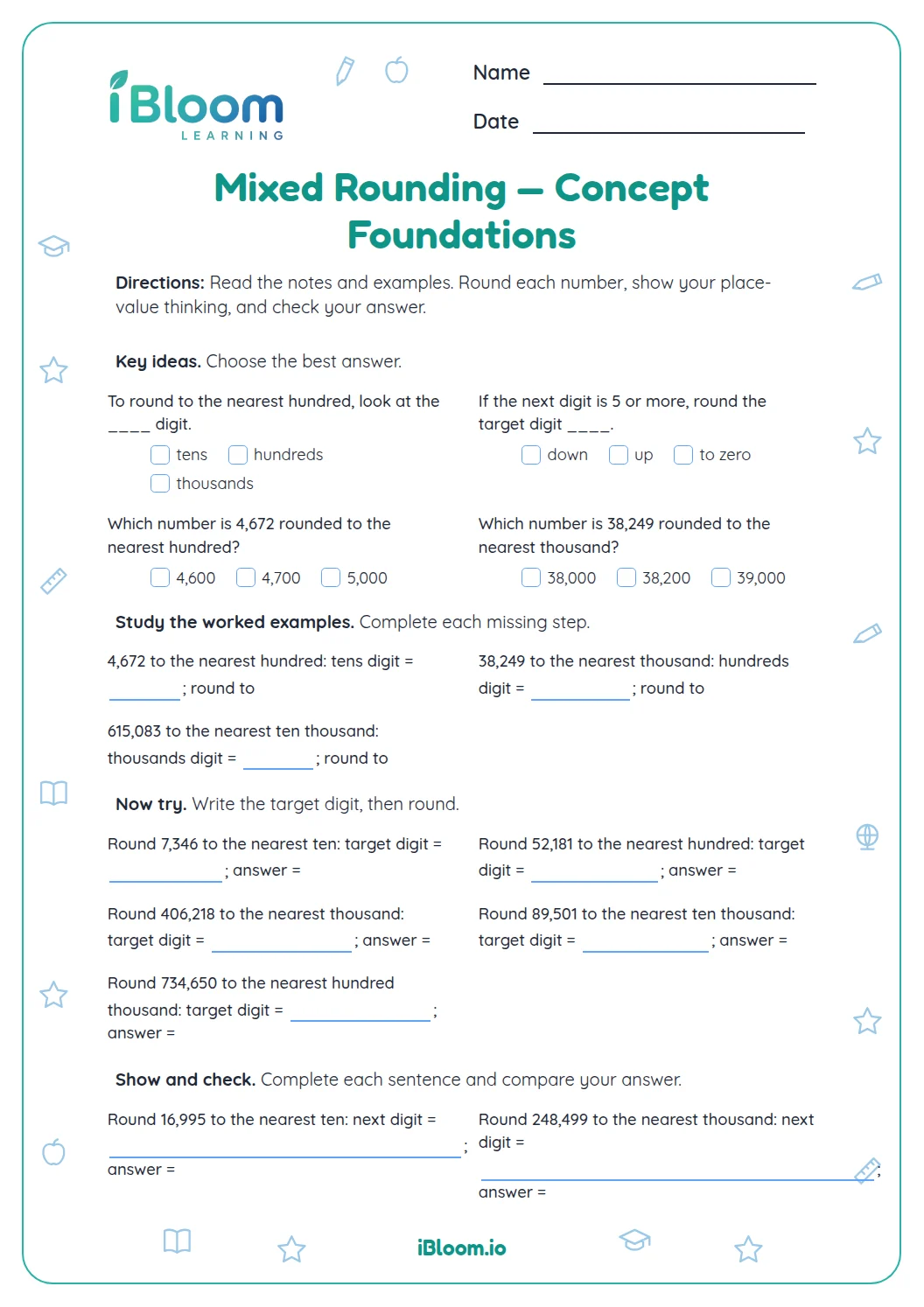
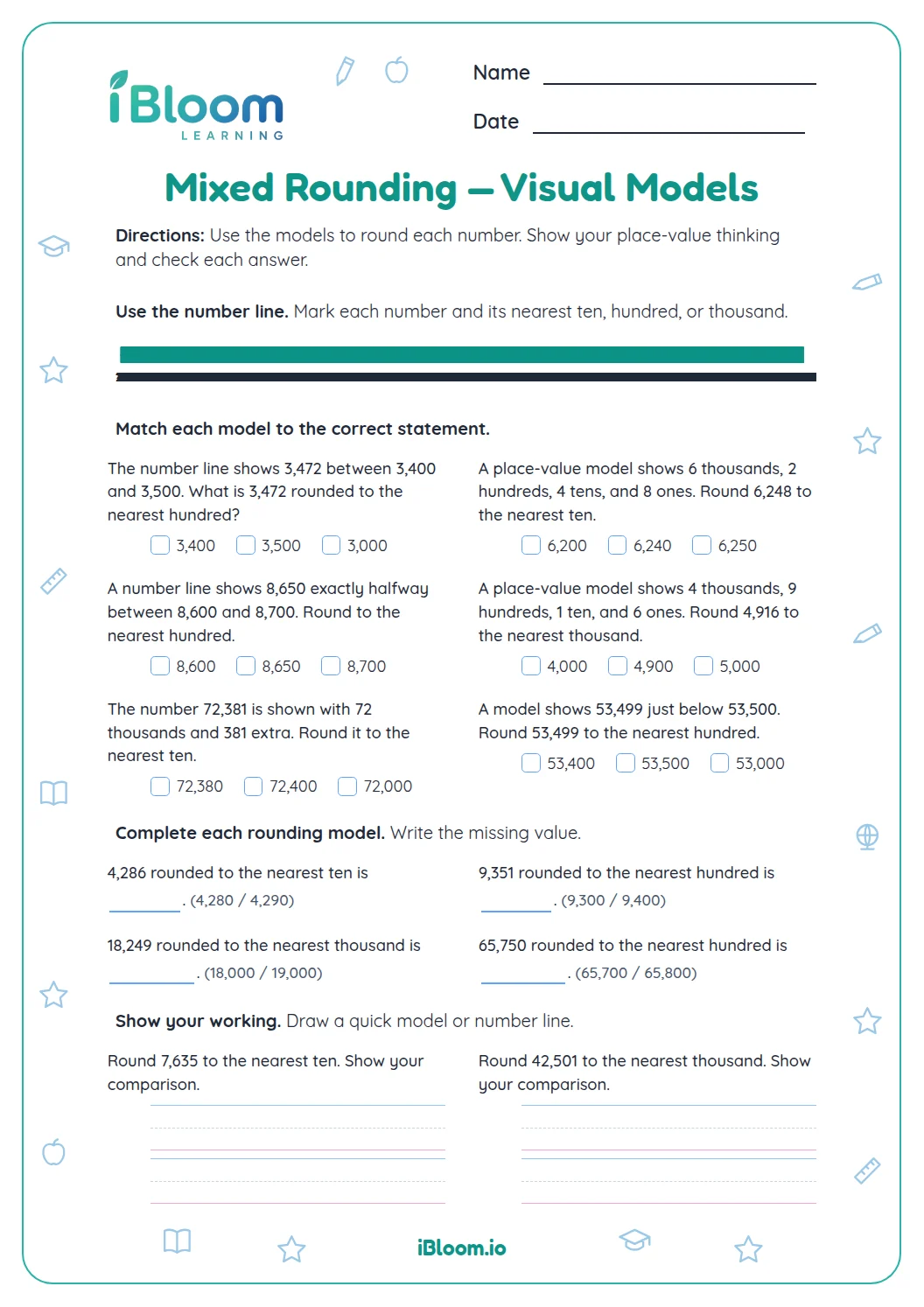
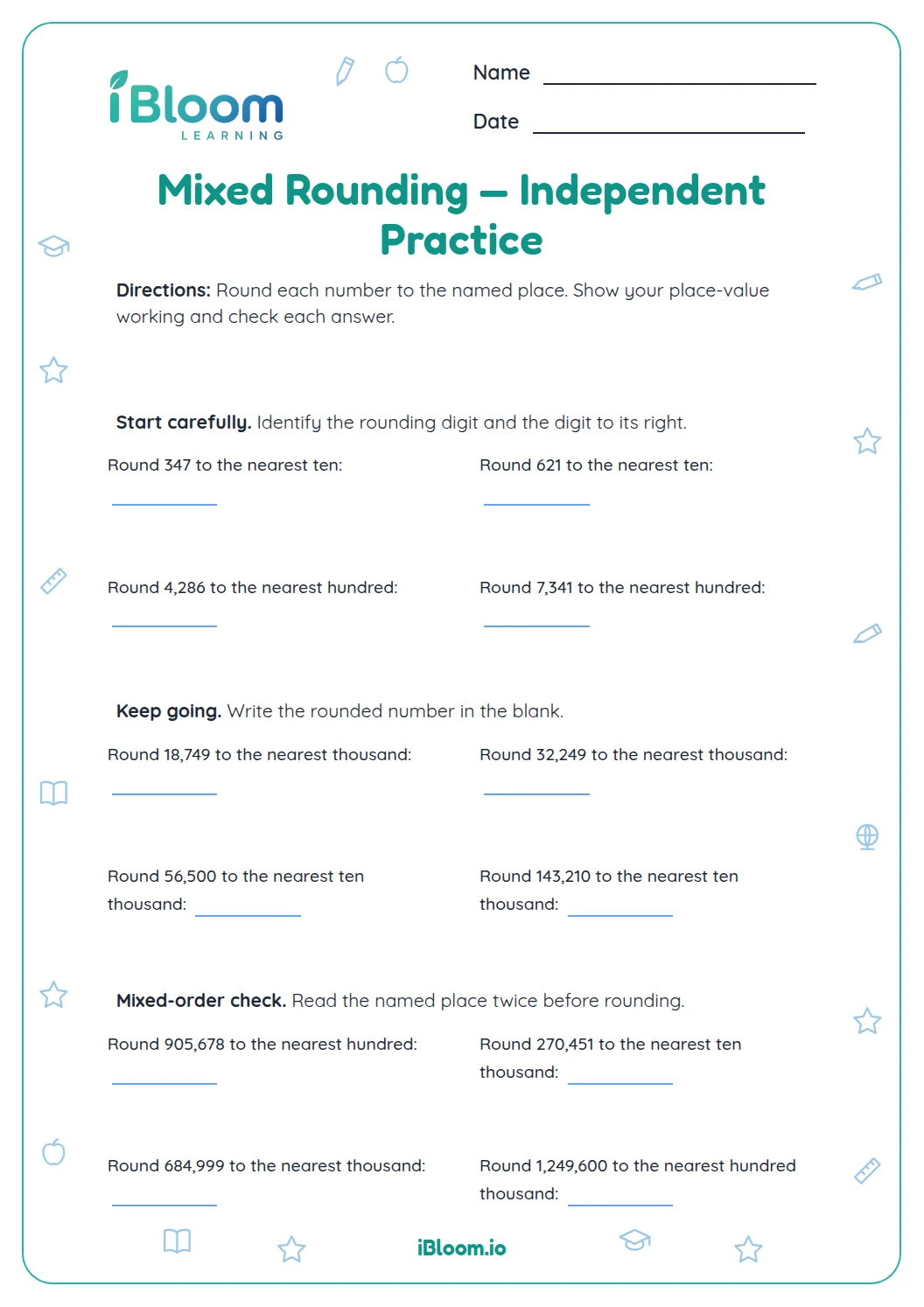
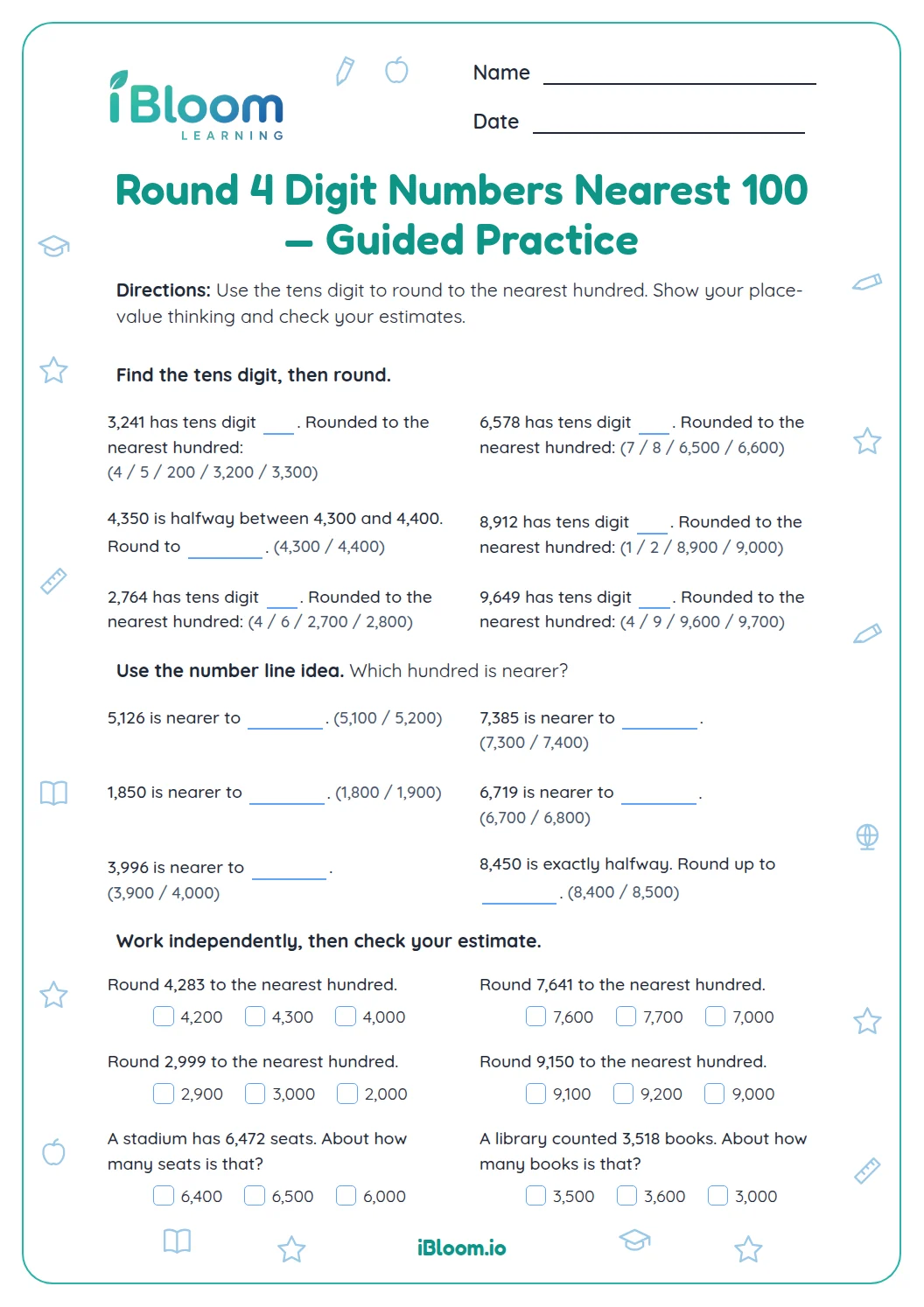
This free Grade 4 printable gives students 14 real-world rounding problems using attendance, books, distance, and other familiar quantities. It practices CCSS 4.NBT.A.3: rounding multi-digit whole numbers to any place using place value. Students round to tens, hundreds, thousands, and ten-thousands, then use rounded numbers in estimates. A separate answer key is included.
Aligned to 4.NBT.A.3
How do you round a number in a story problem?
Find the place named in the question. Look one digit to its right: 5 through 9 means increase the named digit by one; 0 through 4 means keep it. Replace digits to the right with zeros.
For question 2, 7,649 rounds to 8,000 to the nearest thousand. The hundreds digit is 6, so the thousands digit 7 increases to 8.
- 17,649
- 2Thousands digit: 7
- 3Hundreds digit: 6, so round up
- 47,649 ≈ 8,000
How do I choose the right place value?
Use the exact direction in each situation. “Nearest hundred” means inspect the tens digit; “nearest thousand” means inspect the hundreds digit. Keep the requested place visible and change the smaller places to zeros.
How can rounding help estimate a total?
Round each amount first, then combine the rounded values. In question 11, 18,640 becomes 19,000 and 21,380 becomes 21,000, so the estimated total is 40,000. Estimates help check whether an exact total is reasonable.
How can I use this worksheet?
- 1Underline the place value named in the prompt.
- 2Circle the digit immediately to its right.
- 3Use 5–9 to round up and 0–4 to keep the digit.
- 4Replace every digit to the right with zero.
- 5For estimates, round each amount before combining.
Common mistakes and quick fixes
The mistake
Looking at the wrong digit when rounding to the nearest thousand.
The fix
Point to the hundreds digit, directly right of the thousands place, before deciding.
The mistake
Keeping digits after the rounded place.
The fix
Write zeros in every place to the right.
The mistake
Adding exact values when the problem asks for an estimate.
The fix
Round each amount first, then combine the rounded numbers.
Curriculum alignment
This worksheet practices the skills described in these Common Core standards.
Round multi-digit whole numbers to any place using place value.
On this sheet: The situations require rounding to named tens, hundreds, thousands, or ten-thousands.
Show the official wordingHide the official wording
Use place value understanding to round multi-digit whole numbers to any place.
What to practice next
Make more practice
Further reading
Questions parents and teachers ask
Which digit do I check when rounding to the nearest hundred?
Check the tens digit, immediately to the right of the hundreds place. A 5, 6, 7, 8, or 9 means round the hundreds digit up; a 0 through 4 means keep it. Then replace the tens and ones digits with zeros.
How do students estimate a total on this sheet?
Round each amount to the place named before adding. In question 9, 18,640 rounds to 19,000 and 21,380 rounds to 21,000, so the estimated total is 40,000. The estimate uses rounded numbers rather than the exact total. Students can also compare the estimate with the exact sum afterward.
Does the rounding worksheet include an answer key?
Yes. The separate key gives the rounded number or estimate for all 14 questions. For the total questions, it also lists the rounded amounts so an adult can see how the estimate was formed and a student can check each step.
Which place values do the questions use?
The prompts ask students to round to the nearest ten, hundred, thousand, or ten thousand. They include single numbers and real-world totals, such as visitors, books, fruit, and attendance, so students practice identifying a place before rounding. This mixed practice matches the rounding places named in the prompts.
Should students round the total or each amount first?
For questions that ask students to estimate a total, round each amount first and then add those rounded values. Question 10 uses 3,649 and 2,251: these round to 3,600 and 2,300, for an estimate of 5,900 fruit. The key shows those rounded amounts and the estimated sum.