



About this worksheet
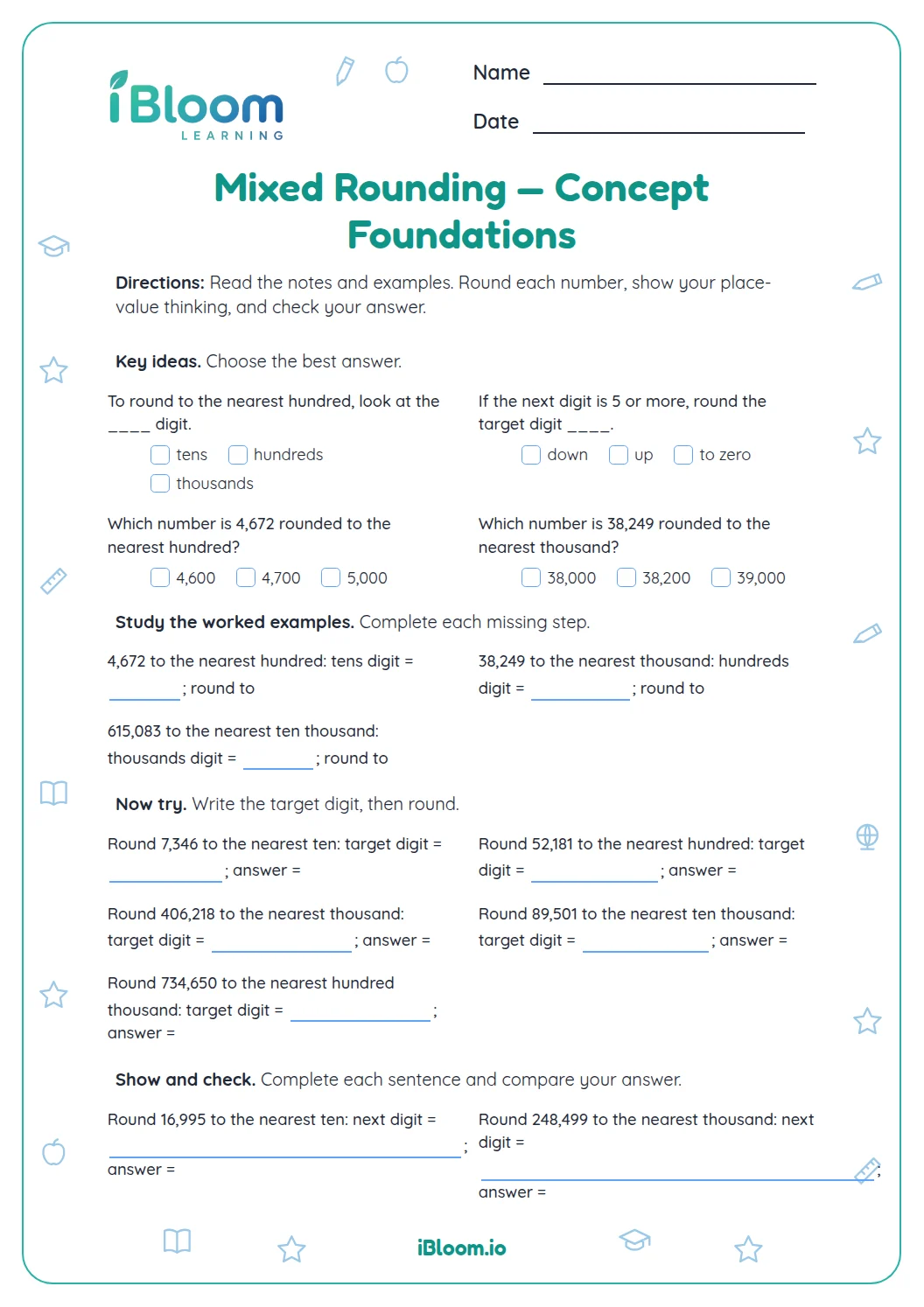
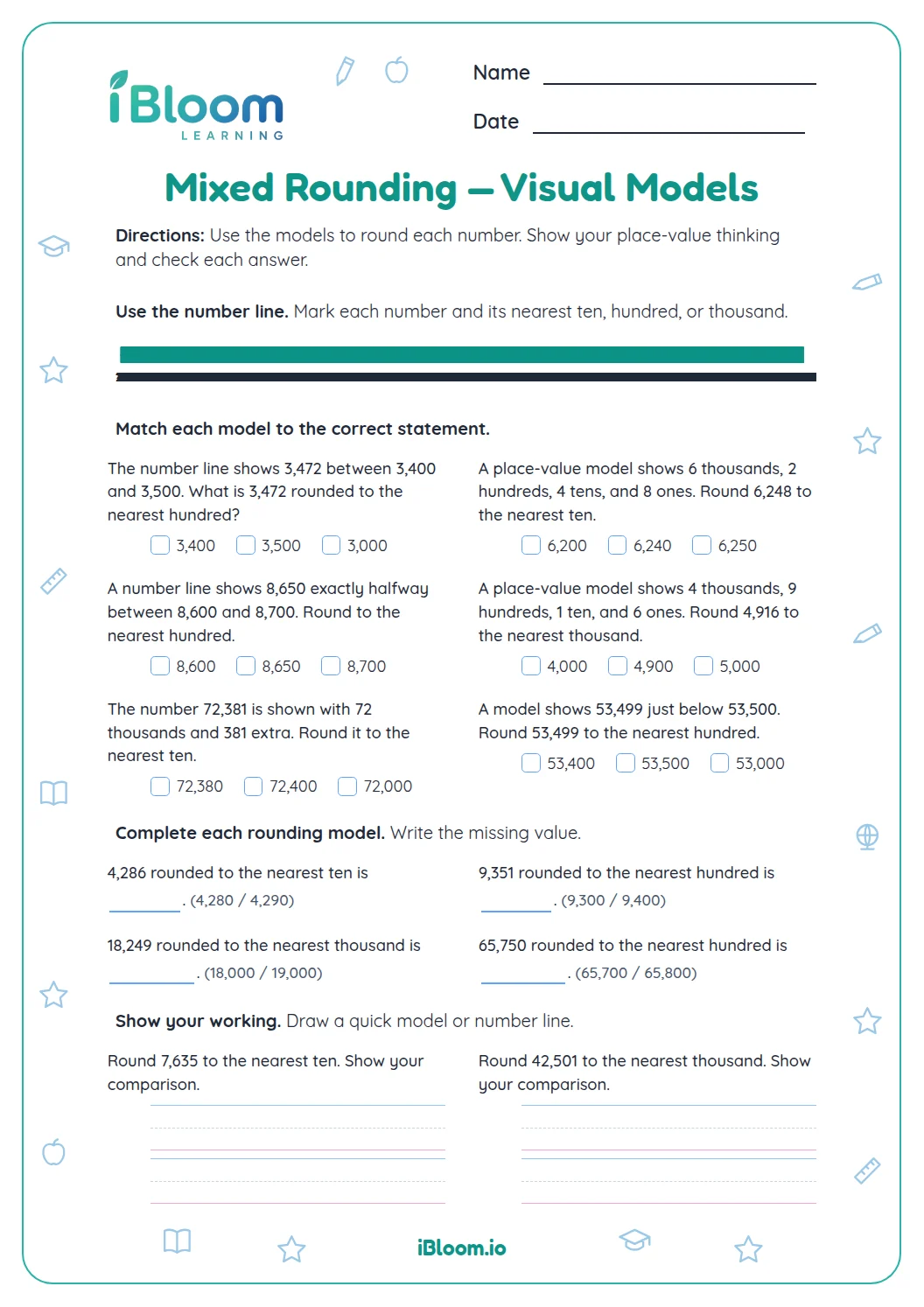
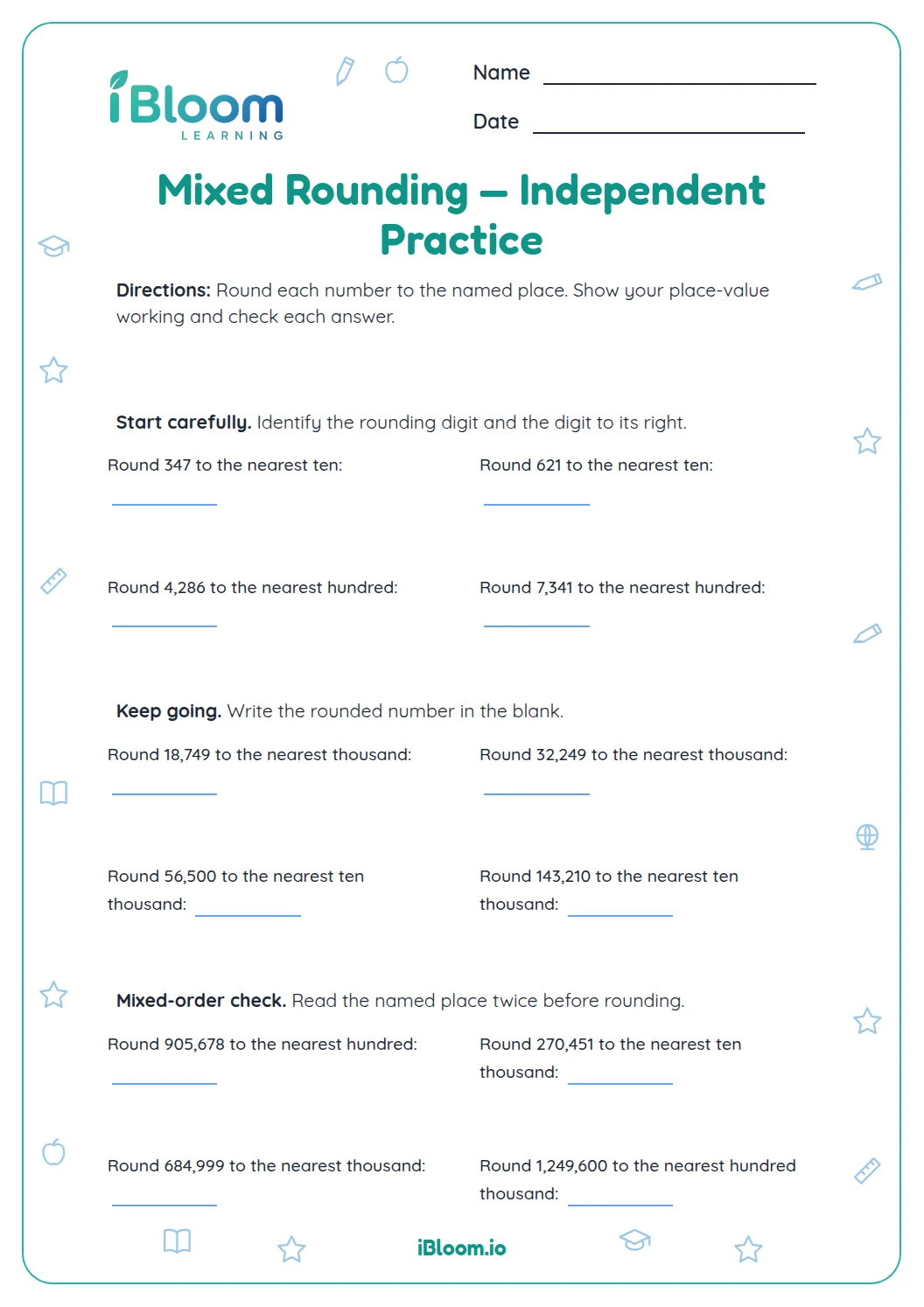
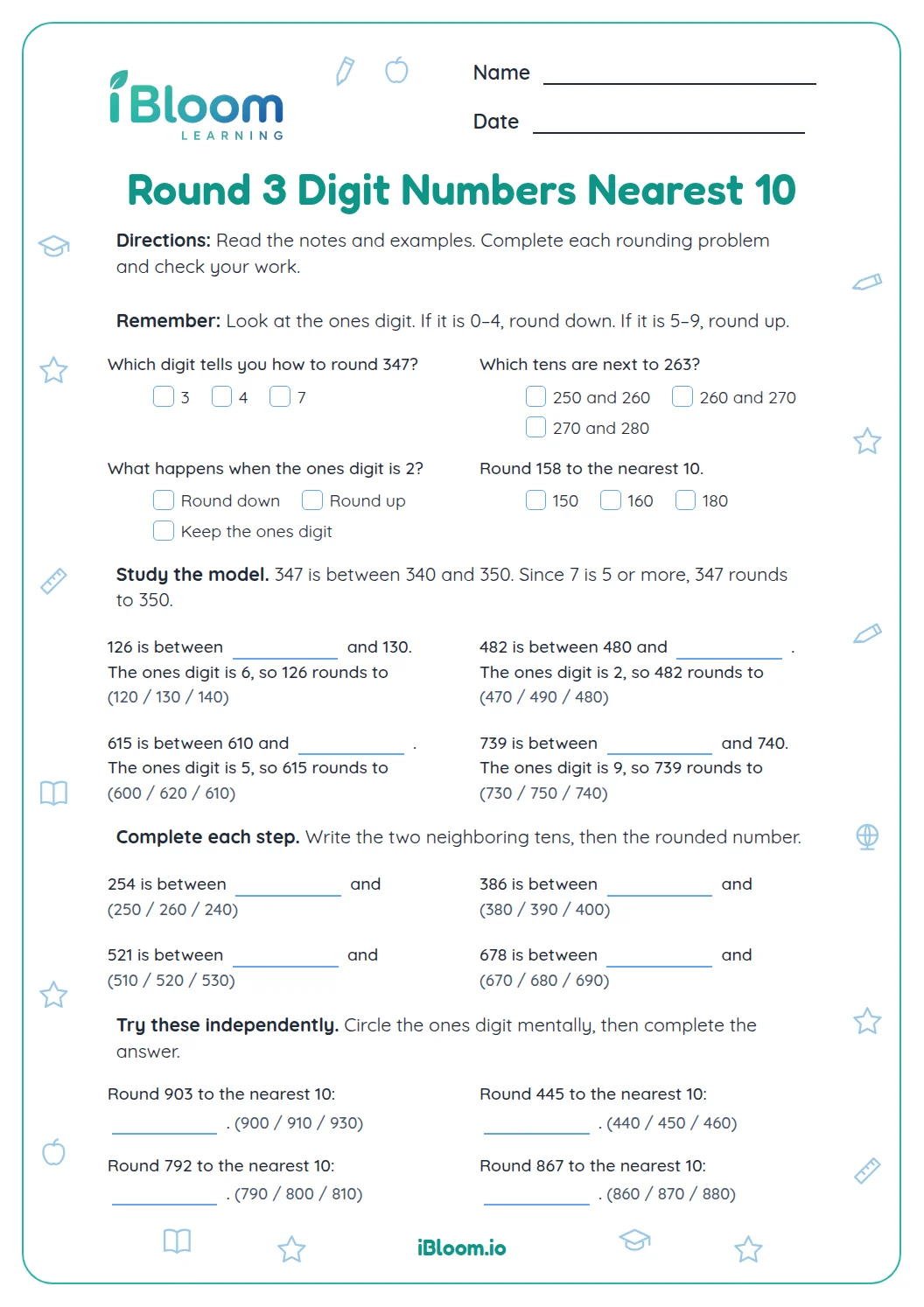
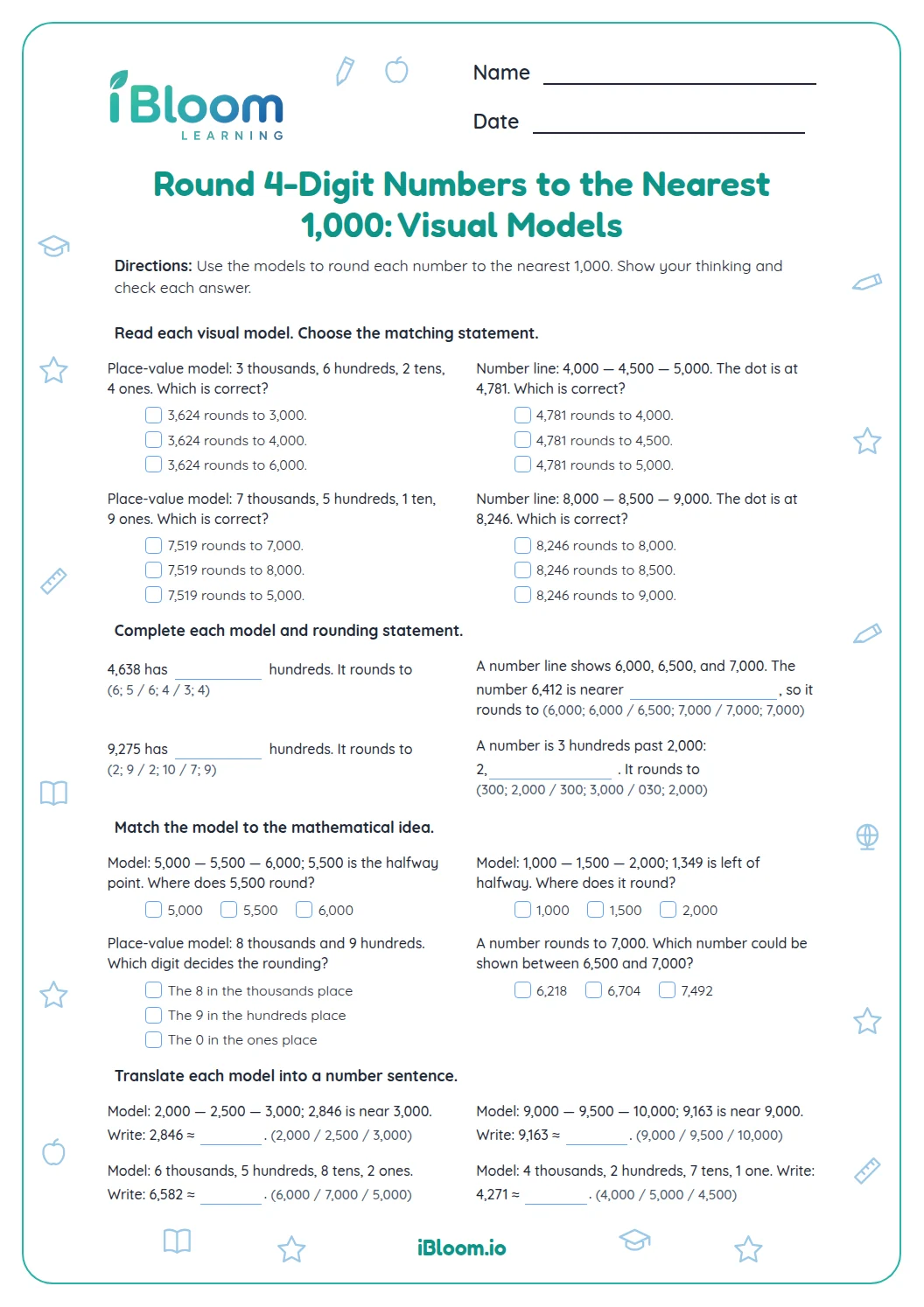
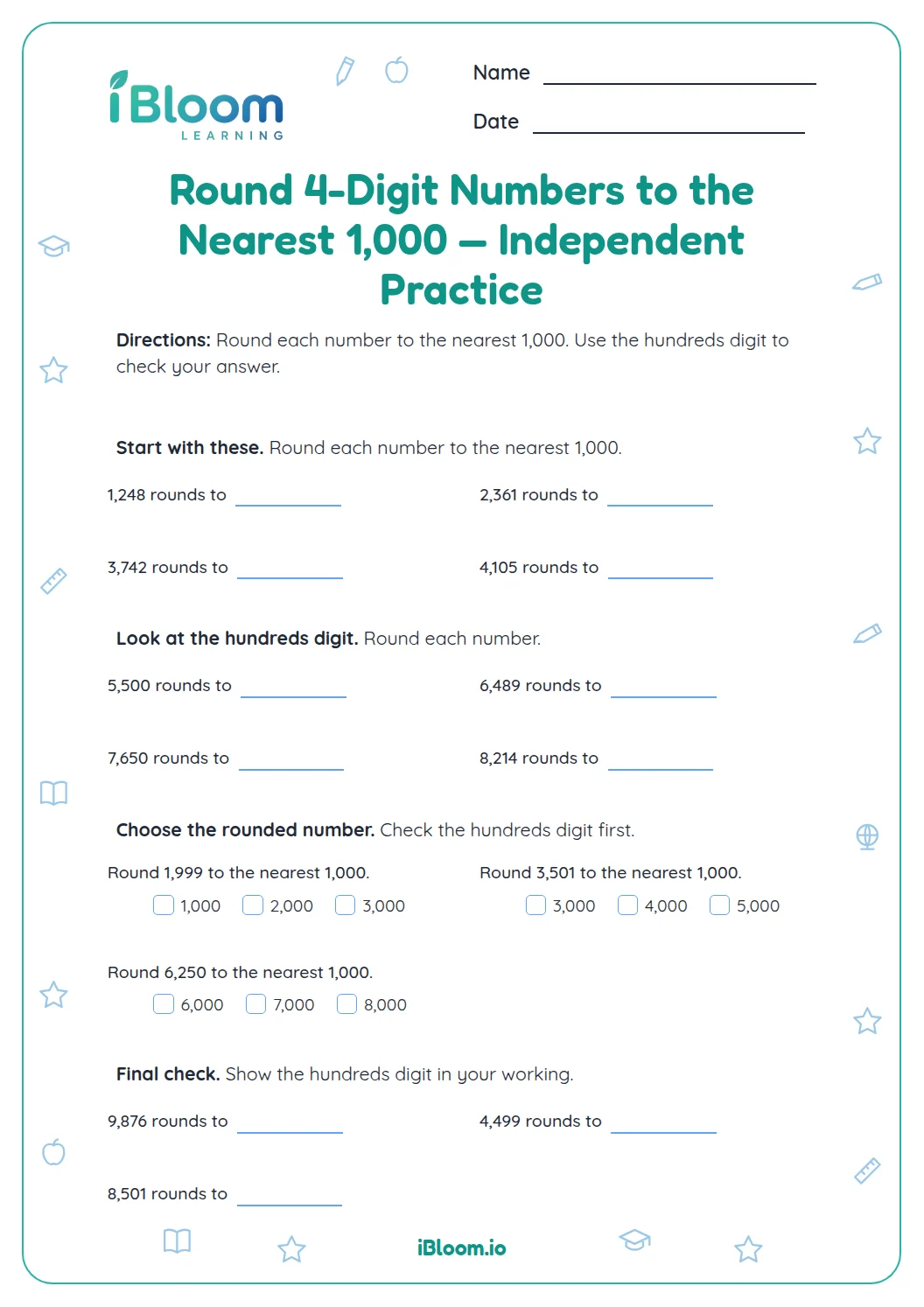
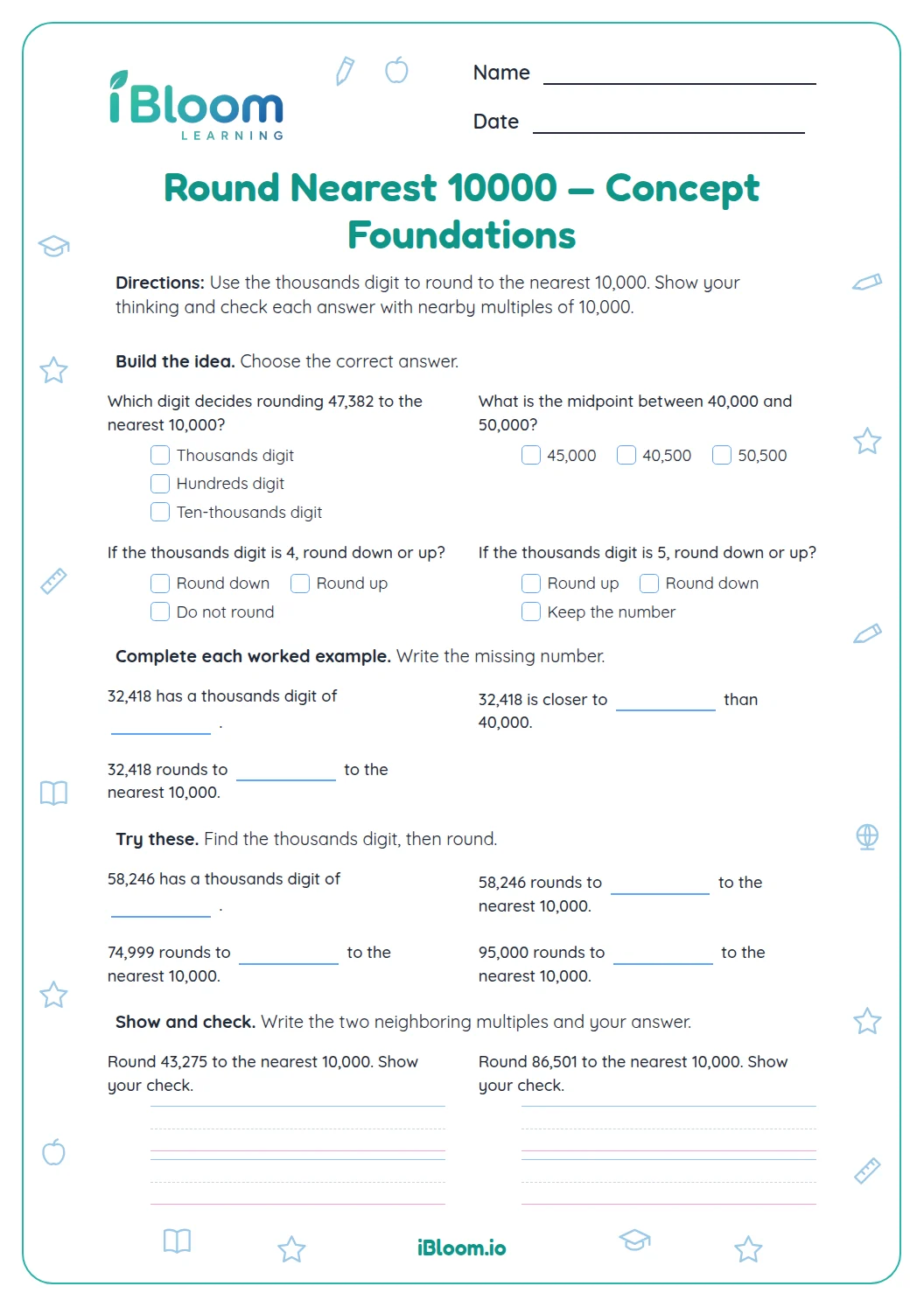
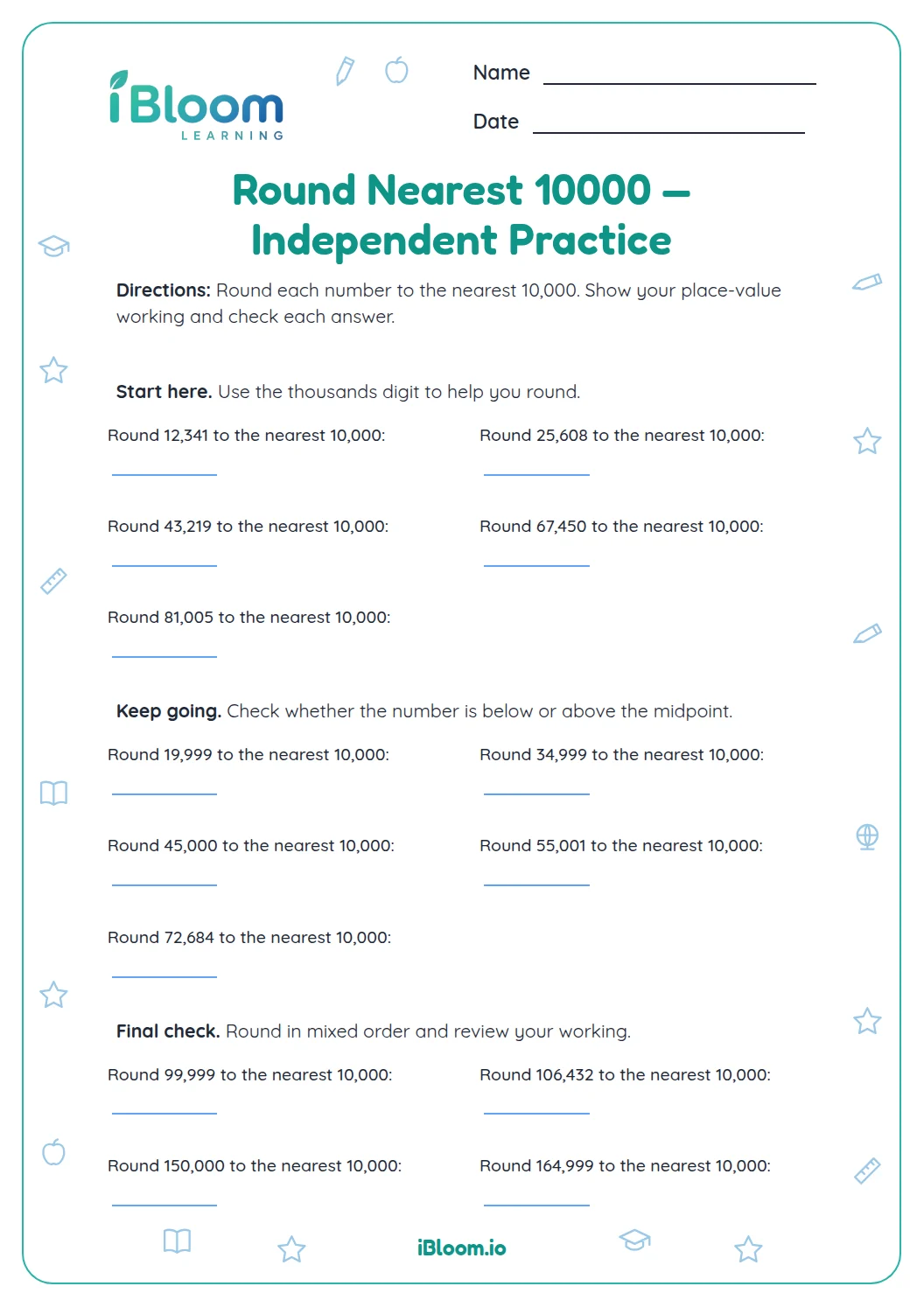
This free Grade 4 mixed rounding worksheet asks children to look closely at the requested place before choosing an answer. Part A has six rounding questions, including the same number rounded three ways. Part B offers four challenges about possible original numbers and rounding boundaries. Part C asks for two explanations, including why rounding in stages can change an answer. The 12 questions practice Common Core 4.NBT.A.3, using place value to round multi-digit whole numbers. The separate answer key gives every rounded value and sample reasoning.
Aligned to 4.NBT.A.3
Why can one number have several rounded values?
A rounded number names a nearby multiple of the place requested. Questions 1, 2, and 3 all begin with 6,482, but their targets are tens, hundreds, and thousands. The three answers differ because the intervals differ.
Ask children to underline “ten,” “hundred,” or “thousand” before doing any calculation. This small step keeps the task tied to place value.
How do halfway points help?
To round 6,482 to the nearest thousand, compare 6,000 and 7,000. The halfway point is 6,500. Since 6,482 is below it, 6,000 is nearer.
For whole numbers exactly halfway between the two multiples, this sheet uses the convention of rounding to the greater multiple. Question 4 gives children that case.
- 16,482 is below 6,500, so it rounds to 6,000.
- 26,500 is halfway between 6,000 and 7,000.
- 3At halfway, round up: 6,500 rounds to 7,000.
What makes these questions a reasoning challenge?
Part B works backward: children must identify an original number or the endpoint of a range that produces a given rounded value. Testing each choice against the halfway point makes these answers checkable.
Question 12 compares direct rounding with rounding in two stages. The number 1,449 rounds directly to 1,400 to the nearest hundred. Rounding to a ten first changes it to 1,450, which would then round to 1,500. Always return to the original number for the requested place.
How to use this worksheet
- 1Underline the rounding place in each question.
- 2Identify the multiples immediately below and above the original number.
- 3Compare the original number with their halfway point.
- 4Test each Part B choice by rounding it to the requested place.
- 5Use the original number to explain the two decisions in Part C.
Mistakes to notice and fix
The mistake
Giving 6,500 for every rounding question about 6,482.
The fix
Read the requested place again. Tens, hundreds, and thousands use different neighboring multiples.
The mistake
Rounding 6,500 down to 6,000 because it is equally close.
The fix
Use the sheet’s halfway rule: a number exactly halfway rounds to the greater multiple.
The mistake
Rounding to tens before rounding to hundreds.
The fix
Start again with the original number. Intermediate rounding can move a number onto a new halfway point.
Common Core alignment
Use place value to round whole numbers to tens, hundreds, thousands, and ten thousands.
On this sheet: Students round to different places, find possible original numbers, and explain rounding decisions.
Show the official wordingHide the official wording
Use place value understanding to round multi-digit whole numbers to any place.
What to practice next
Make more practice
Further reading
Questions parents and teachers ask
Which rounding places are included?
The sheet includes tens, hundreds, thousands, and ten thousands. The first three questions round 6,482 to three different places, making it easy to compare the results. Later questions use larger numbers and ask children to reason backward from rounded values, including their boundary numbers.
What happens when a number is exactly halfway?
Round to the greater multiple when the whole number is exactly halfway. In question 4, 6,500 is equally far from 6,000 and 7,000, so the answer is 7,000. Naming both neighboring multiples helps children explain the rule instead of only reciting a digit shortcut.
Why is 9,499 the greatest answer for question 8?
The whole numbers from 8,500 through 9,499 round to 9,000 to the nearest thousand. The next whole number, 9,500, is halfway to 10,000 and rounds up. Testing 9,499 and 9,500 side by side shows exactly where the rounding result changes for this question.
Why should children avoid rounding in stages?
Rounding in stages can move a number across a boundary for the final place. Question 12 uses 1,449: directly rounding to the nearest hundred gives 1,400. Rounding to the nearest ten first gives 1,450, which then rounds to 1,500. Use the original number each time.
How should I check the written explanations?
Look for a correct rounded value and a place-value reason. A child might name the deciding digit or compare distances to neighboring multiples. For question 11, the thousands digit in 34,950 is 4, so rounding to the nearest ten thousand gives 30,000. The key offers sample explanations.