

About this worksheet
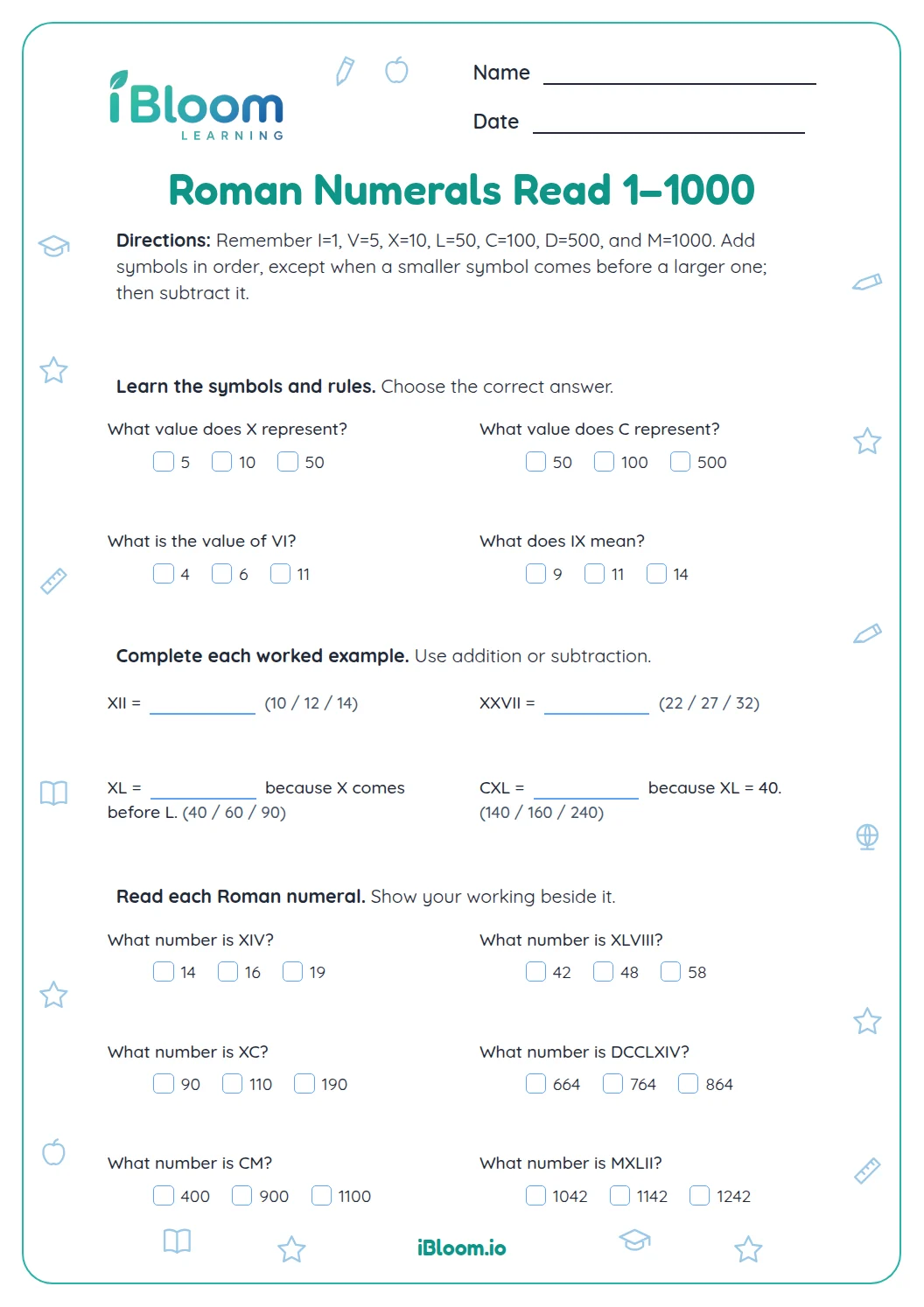
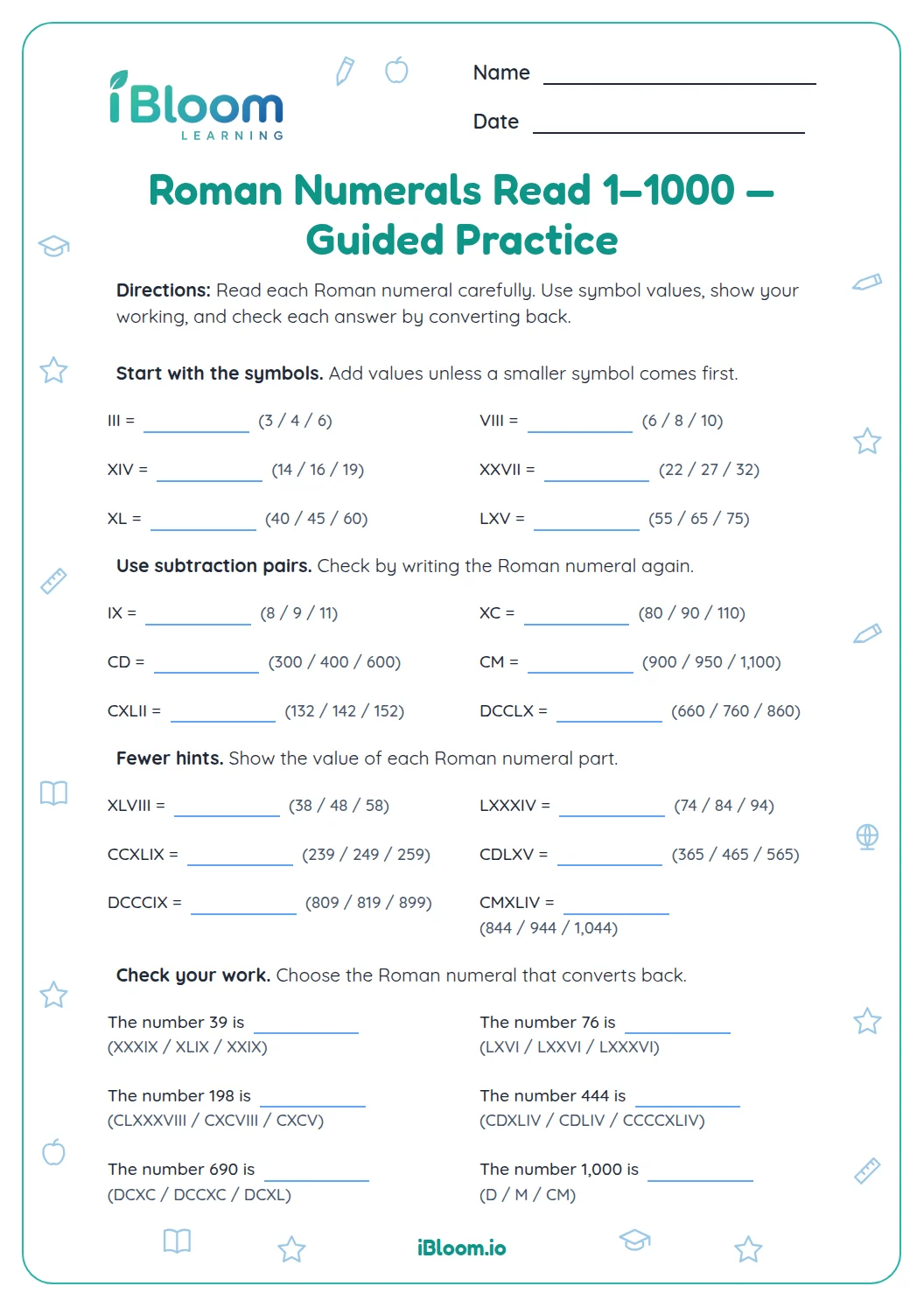
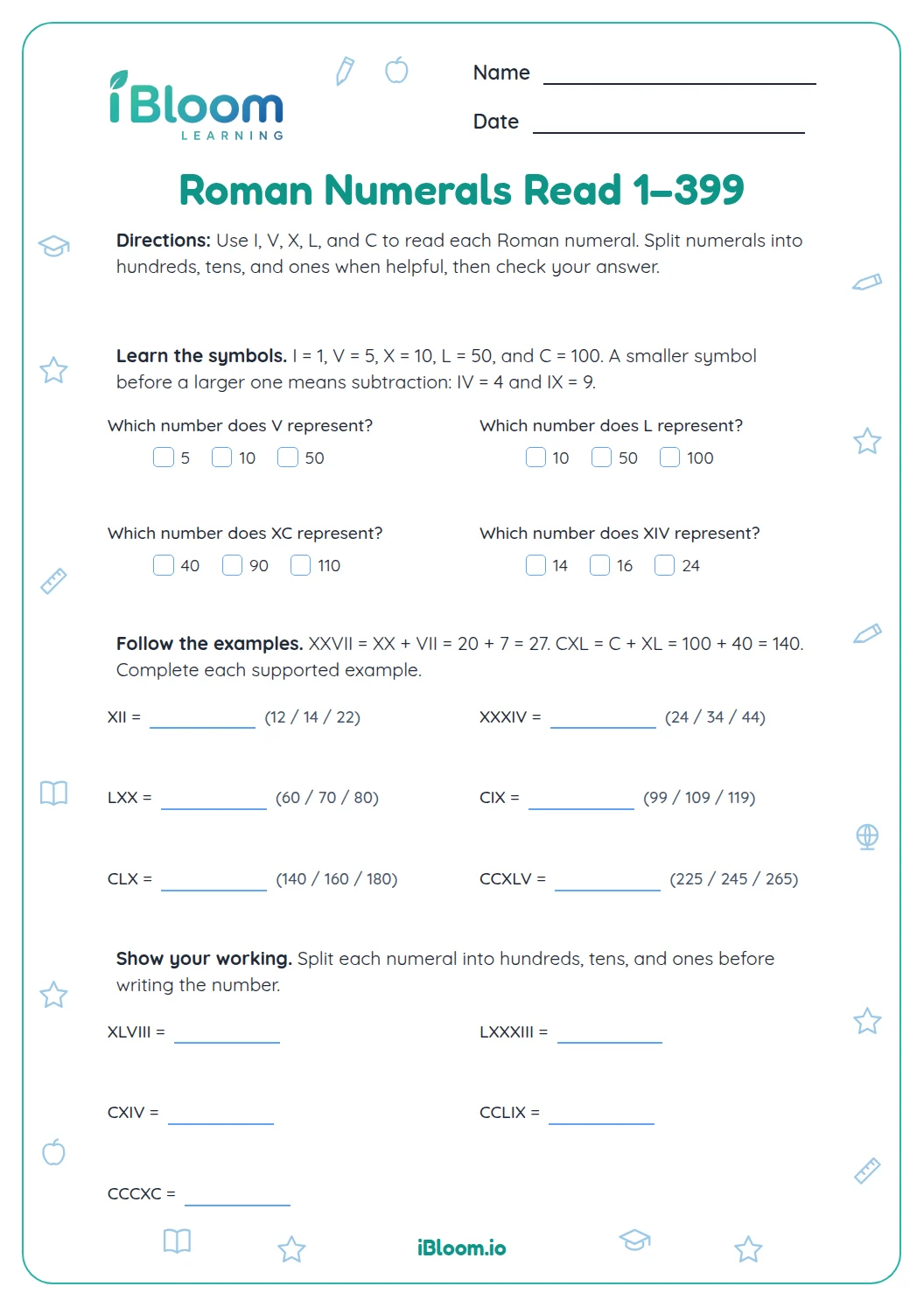
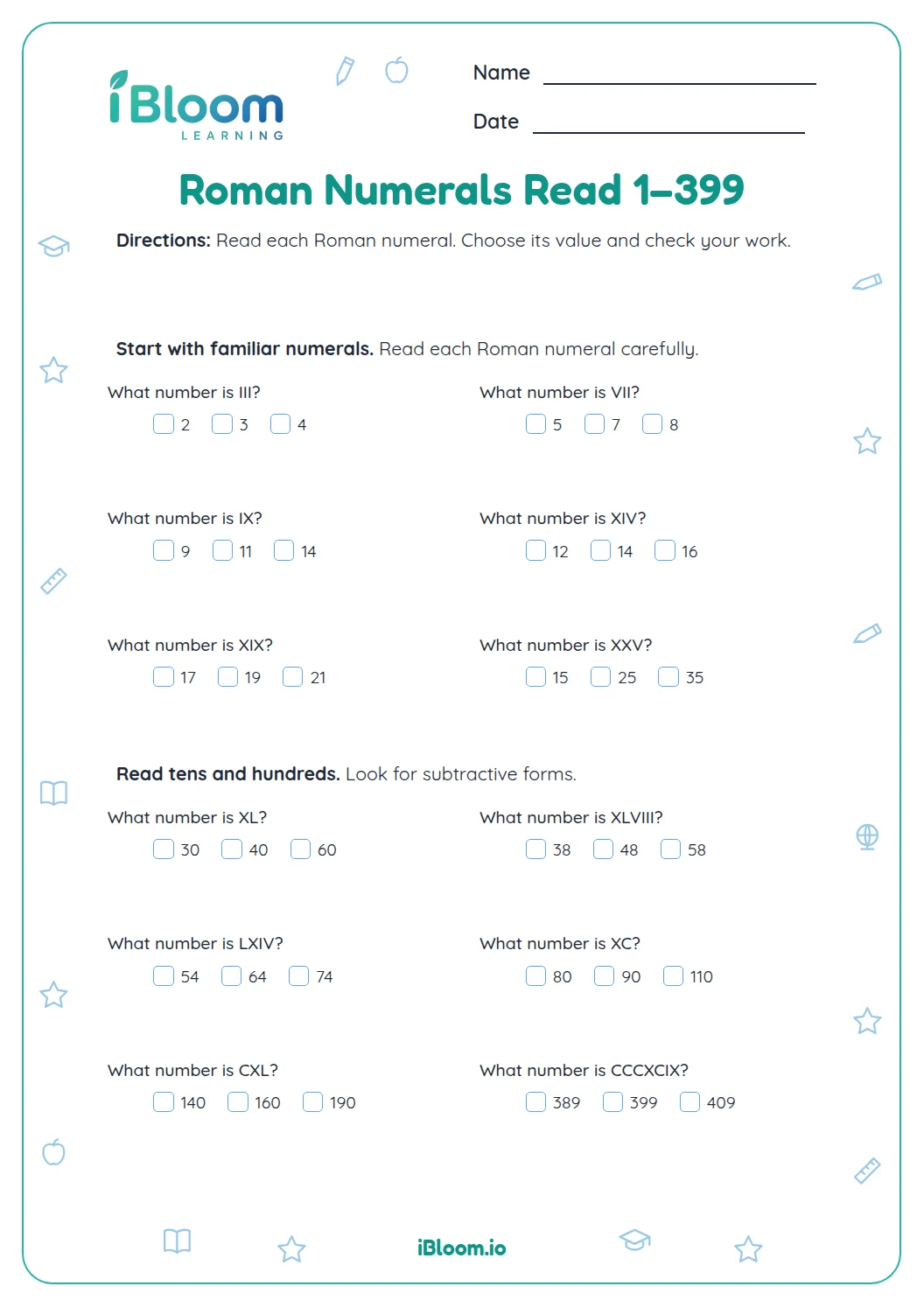
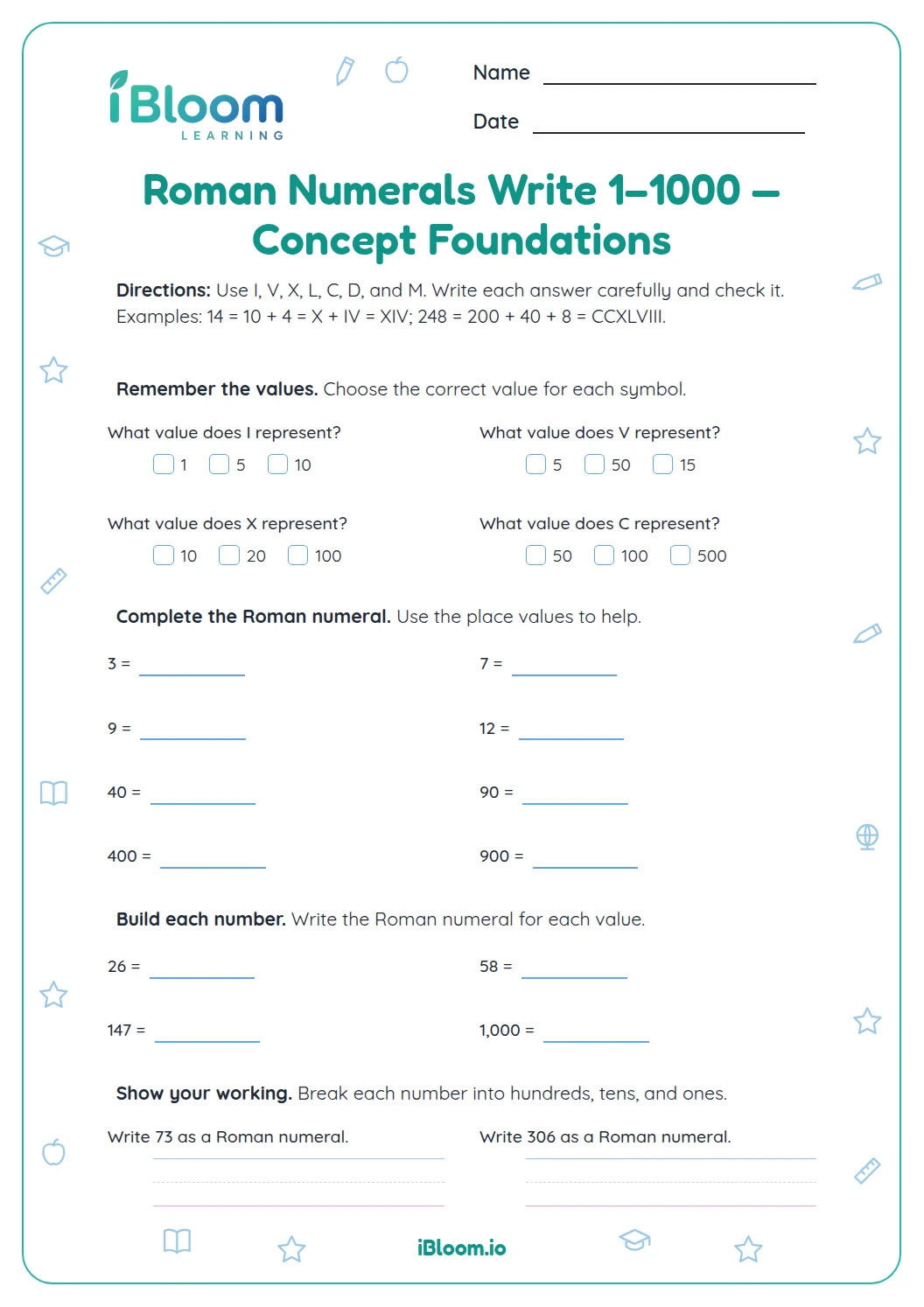
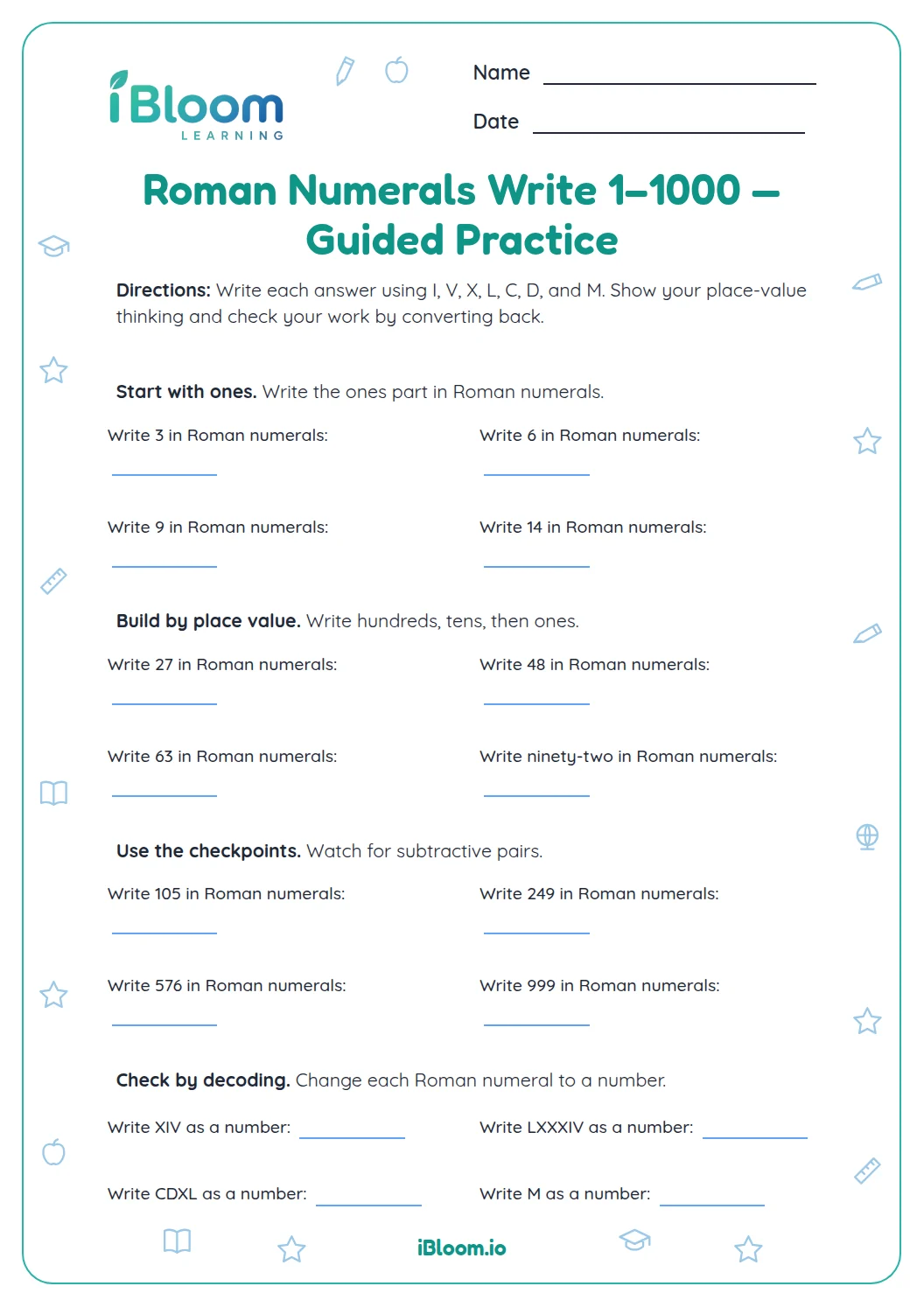
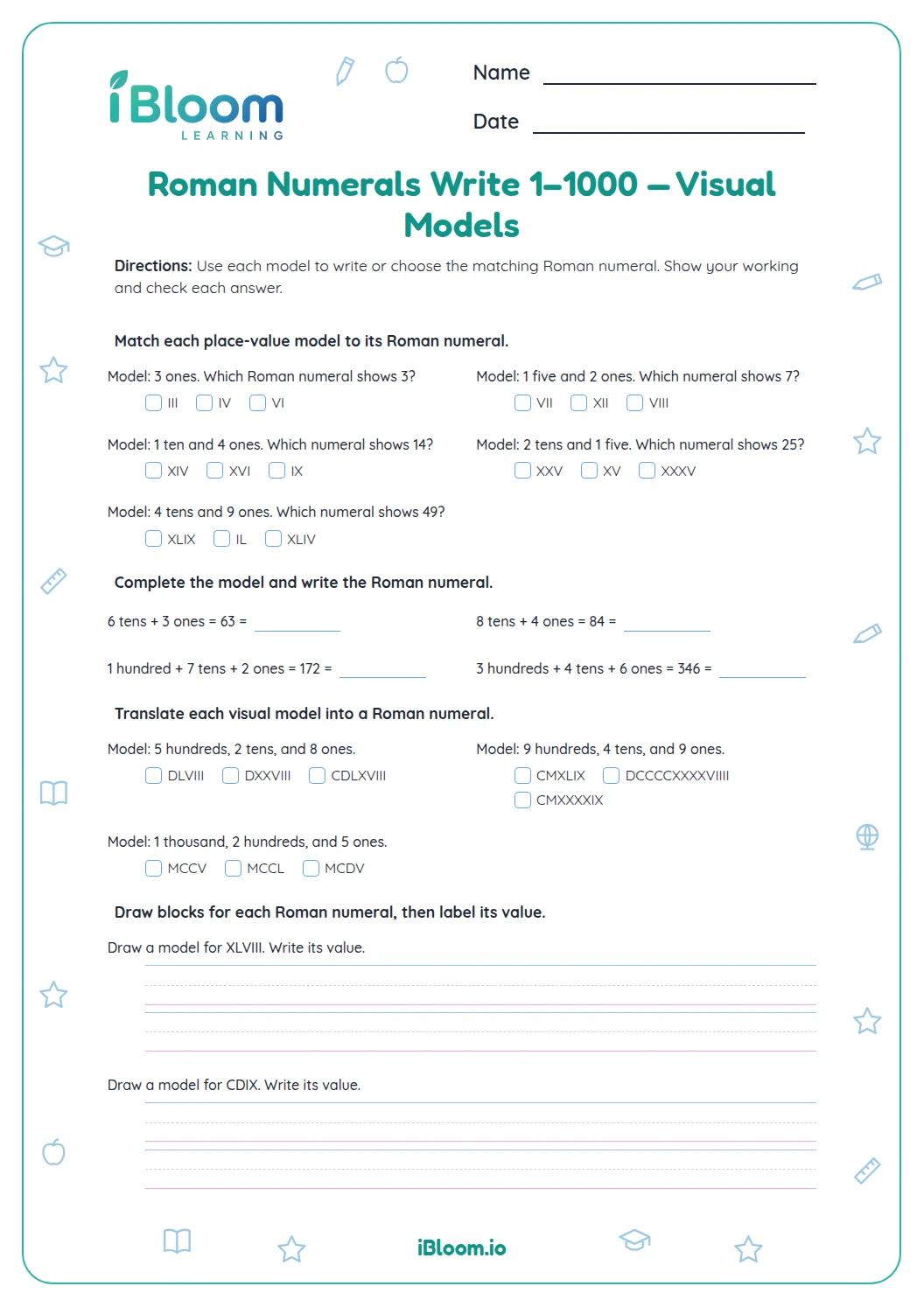
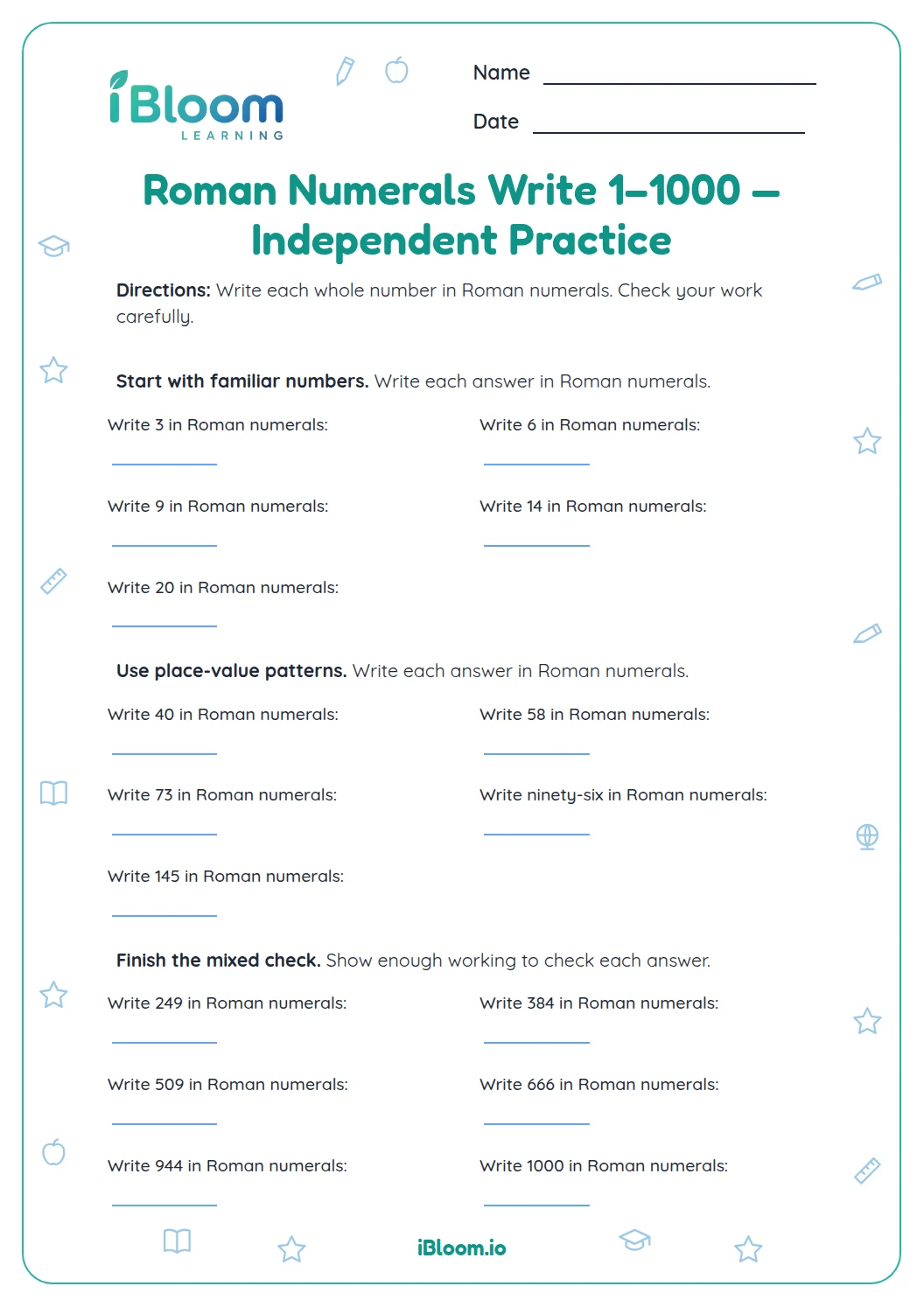
This Grade 4 worksheet builds fluency reading Roman numerals across the full range from I to M (1–1,000). Students interpret subtractive forms such as XL and CM, combine symbols in larger numerals, and compare two numeral values. Every prompt gives the Roman numeral and asks for its value, so children practice translating the notation rather than copying a conversion chart. A separate key is included.
How do subtractive Roman numeral pairs work?
When a smaller symbol comes before a larger one, subtract it: IV is 4 and XC is 90. Otherwise, add the symbol values. Question 6 uses CDIX: CD is 400 and IX is 9, so the whole numeral is 409.
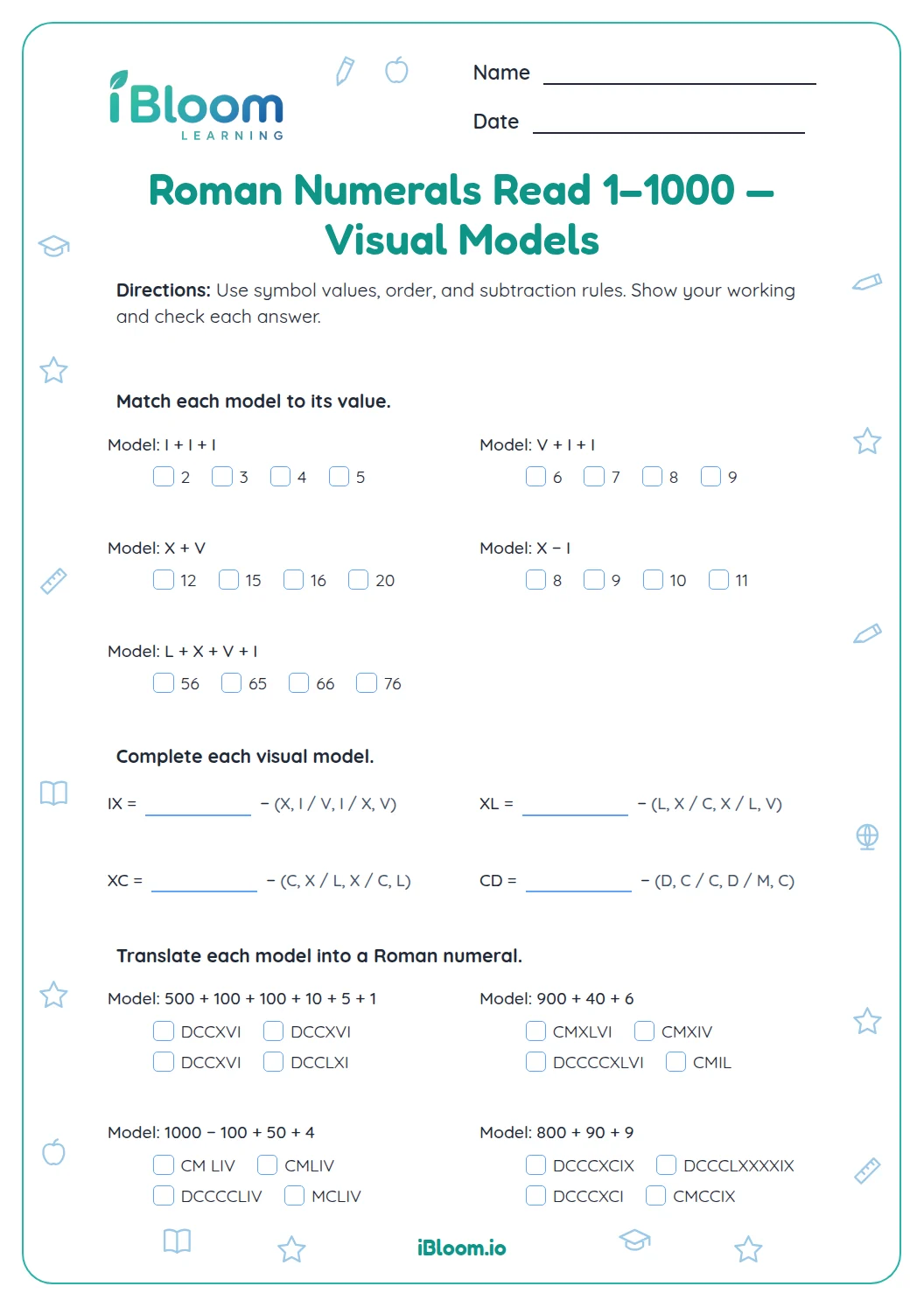
- 1CMXLII = CM + XL + II
- 2900 + 40 + 2
- 3CMXLII = 942
How can you read hundreds and thousands?
Break a long numeral into familiar groups, such as CM, XL, and II. CM is 900, XL is 40, and II is 2, so CMXLII is 942. The worksheet includes values across the full range from I to M.
How can you check a Roman numeral value?
Read the groups from left to right and check each subtractive pair before adding. For the comparison, XLIX is 49 and LII is 52, so LII is greater. Question 14 asks for IX, which is 9 on a clock face.
How to use this worksheet
- 1Read the numeral from left to right and look for a smaller symbol before a larger one.
- 2Group subtractive pairs such as IV, IX, XL, XC, CD, or CM.
- 3Add the values of the groups to find the whole number.
- 4For the comparison, convert both numerals before deciding which is greater.
- 5Use the key to check the value and revisit any group that was added or subtracted incorrectly.
Common mistakes and quick fixes
The mistake
Adding every symbol, including a smaller symbol before a larger one.
The fix
Check each adjacent pair first: XL is 50 minus 10, or 40.
The mistake
Subtracting when the smaller symbol comes after the larger one.
The fix
In VI, V comes first and I follows, so add: 5 + 1 = 6.
The mistake
Stopping after reading only the first group.
The fix
Translate every group and combine them. For CMXLII, include CM, XL, and II to reach 942.
What to practice next
Make more practice
Questions parents and teachers ask
How do you read a numeral such as XLVIII?
Read XL as 40 because X comes before L and is subtracted. Then add VIII, or 8. The total is 48. This same grouping method works for larger numerals in the worksheet, including hundreds and values near 1,000.
Why does CDIX equal 409?
CD is 400 because C comes before D, and IX is 9 because I comes before X. Add the two groups: 400 + 9 = 409. Checking the subtractive pairs first prevents adding every symbol as though the order did not matter.
What number does M represent?
M represents 1,000, the largest value on this worksheet. Other questions combine I, V, X, L, C, and D to make values below 1,000. The key lists each value in Arabic numerals, so students can check how each symbol group contributes.
How can a student compare XLIX and LII?
Convert each numeral first. XLIX is 40 + 9, or 49, while LII is 50 + 2, or 52. Since 52 is greater than 49, LII is greater. Comparing the Arabic values is clearer than comparing the number of Roman symbols.
What do the letters I, V, X, L, C, D, and M mean?
They stand for 1, 5, 10, 50, 100, 500, and 1,000. Read the symbols from left to right, adding values except when a smaller value comes before a larger one. In that case, subtract the smaller value, as in IV for 4 or XC for 90.